
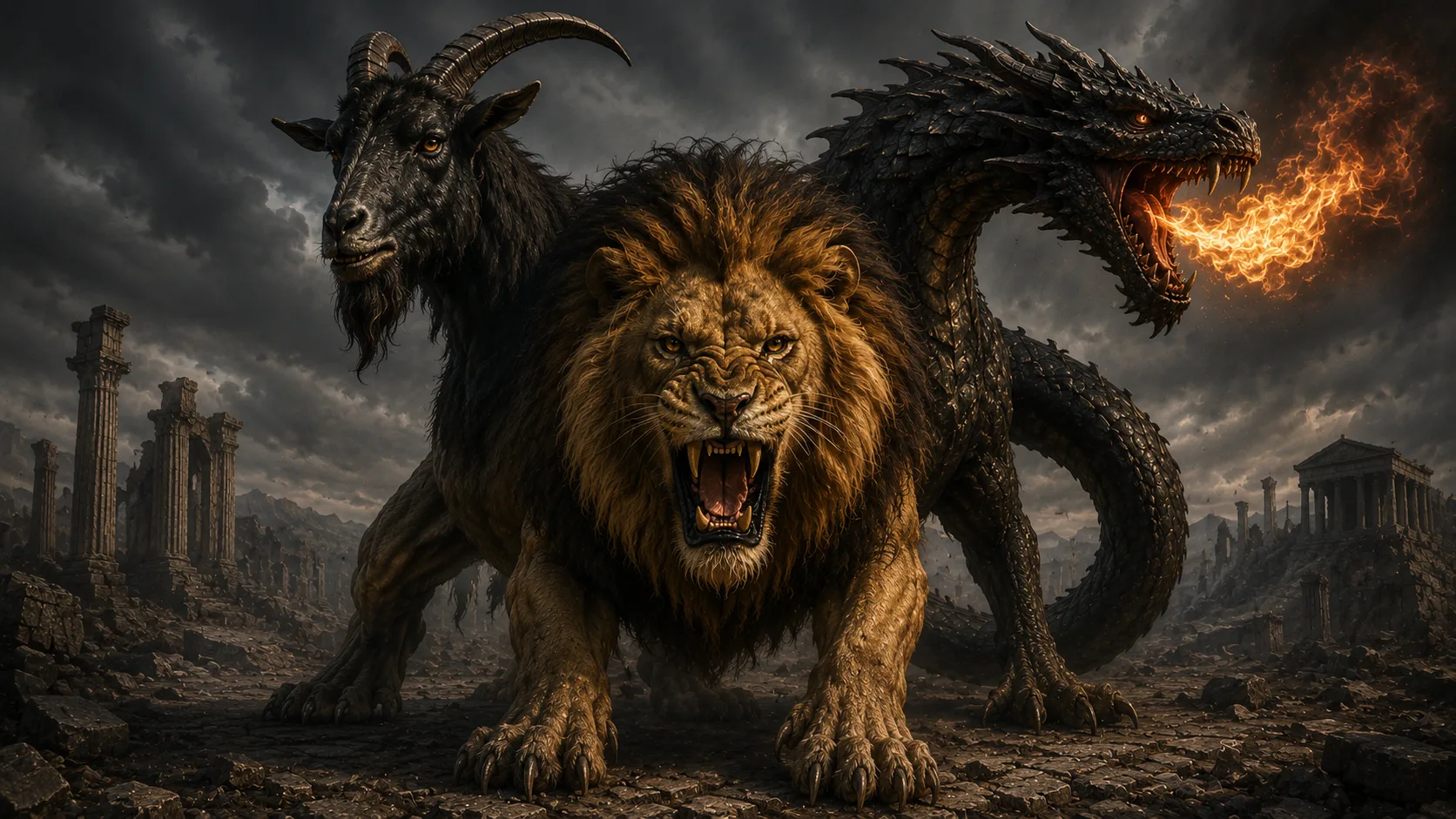
- Chimera is one of the most characteristic and recognizable monsters of Greek mythology. As a hybrid creature combining different animals in a terrifying form, it personifies the fear of abnormal and uncontrolled. Her presence in the myths is associated with destruction, fire and divine punishment.
And she gave birth to the Chimera, breathing unquenchable fire,
fearsome, huge, swift-footed, and fierce;
and she had three heads: one like a joyful lion,
one of a chimera, and one of a serpent, like a fierce dragon;
a lion in front, a dragon behind, and a chimera in the middle,
breathing forth a dreadful, blazing fury of fire.Hesiod
Chimera: The Hybrid Monster that Spreaded Terror in Greek Mythology
In the large gallery of monsters that multiply Greek mythology, Chimera holds a special position — Not only because of its heinous appearance, but also because of what it represents: the violation of natural boundaries, the confusion of incompatible nature, the living proof that the world can turn against its own order.
This creature — Part lion, part goat, part snake, capable of firing flames — It's not just a «Monster» in the common sense of the term. It is the archetype of the hybrid creature, the prototype on which a whole tradition of imaginary beings depends that reaches modern video games and fantasy novels. Every monster that combines characteristics of different animals — From medieval dragons to science fiction creatures — He owes Chimera something.
Her influence extends far beyond the world of mythology. In literature, art, philosophy and even modern biology, her name has ended up stating more than a mythological being: it symbolizes the impossible, the unterritorial, that fantasy that seems real but can never be conceived.
The Origin of Chimera
To understand Chimera, we need to meet her parents. — And they alone are enough to cause chills.
Her father was Typhon, the most terrible monster ever born by Greek mythology — a being so scary that they fled themselves Olympian gods. Typhon was the personification of primitive chaos, a giant form that touched the stars with its head, with a hundred heads of snake, voices that imitated all animals at once, and flames emanating from its eyes.
Her mother was the Echidna, the «Mother of monsters» — half a woman and half a snake, immortal and relentless, residing in a cave deep beneath the earth. From this union were born the most terrible creatures of Greek mythology.
Chimera had brothers equally famous: Cerberus, the three-headed keeper of the Underworld· The Lernaean Hydra, the multi-headed snake that reborn his heads· The Sphinx The Thebes· The Nemea Leo· and RectumThe two-headed dog. This family is the «terror dynasty» — a series of monsters symbolizing different aspects of primal fear, and that the heroes of mythology are called upon to face as evidence of human ability to defeat the impossible.
The Chimera Appearance
One creature of three animals
Chimera doesn't have a unique, stable image — different ancient writers and visual artists described it with small variations. However, the base torso remains almost unchanged: front and head was a lion. — the symbol of royal power and destructive momentum. The waist body, or emerging from the back, there was a head goat — the animal associated with the earth, sexual energy, but also with something uncontrollable and disorderly. The tail ended in snake or dragon — a symbol of the lower ethic force, the hidden danger and the deadly surprise attack.
And above all: Chimera He was firing fire.. Oral use — or, in certain versions, from its three mouths — They were burning flames that burned everything they found on their way. This ability was the element that made it practically insurmountable: how can you approach a creature that incinerates you before you well-well see it?
Symbolization of its form
Each of the three animals that make up Chimera carries its own symbolic weight. The lion represents the violent, spontaneous force — is the «basil» evil, what attacks head-on and crushes. The goat is more controversial: it refers to folk, territory, but also to chaotic — facts that do not obey the logical order. The snake is the fear that hides, that lurks, that doesn't seem until it hits.
The combination of these three is not a sum of forces — It's something qualitatively different. Chimera is the embodiment of the disruption of the natural order: these animals do not belong together, and precisely this «Together» It makes them scary. mythology often treats species involvement as something unholy — a violation of the rules governing the world.
Chimera in Lycia
According to legend, Chimera lived in Lycia, an area on the southwest coast of Asia Minor. Lycia was a country with mountains, forests and coasts extending to its limits «known» Greek world — ideal setting for a creature that had to be far enough away to look plausible, but close enough to be threatening.
There, Chimera scattered terror. She destroyed her cattle, cremating them with her breath. She ransacked settlements, leaving behind ash and despair. He was killing people who dared to get close. No weapon seemed to penetrate it, no trap could capture it. The fire he was launching left no room for heroic duel — Whoever came near was burning.
Her fame was that of an undefeated monster, a being who seemed to have been sent by the gods to punish an area without explanation and without mercy.
The Bellerophon and the Extermination Mission
King Jobat's command
- Bellerophon He was a young hero with a turbulent history. He was falsely accused by the queen Strength — husband of King Preetus of Argos — that she attempted to rape her, while in fact she had refused her proposals. Proetus, without wanting to be himself a murderer, sent the Bellerophon to his father-in-law, the king. Iobate of Lycia, bringing with him a sealed letter with the request that the carrier be killed.
Jobatis, loyal to hospitality but bound by the letter, thought of a clever solution: he would not kill his own guest, but send him on a mission from which no one could return alive. The mission was to eliminate the Chimera.
This is one of the finest political figures in mythology: the hero is not killed directly but sent to die in a way «decent» — Or, if he returns triumphantly, prove that the gods are on his side. The mission is both punishment and testing.
Pegasus and divine help
Before leaving, the Bellerophon sought the help of the inspired seer Multispecies, who advised him to sleep for a night in her temple Athena. There, his goddess appeared in his sleep and gave him a gold bridle — the key to tame him Pegasus, the legendary winged horse born of her blood Medusa.
Pegasus was the perfect strategic advantage: a flying horse allowed Bellerophon to attack Chimera from above, outside the range of her flames. Divine help did not come in the form of impossible power but in the form of intelligent solution: it did not have to defeat the monster body to body — He needed to get over it.
The Battle with Chimera
The Vellerophon and Chimera conflict is one of the most impressive battles in mythology. Riding him Pegasus, the hero rose above the plain of Lycia where terror dominated. From there, he bombarded Chimera with arrows, avoiding flames thanks to height.
In some versions of the myth, the hero used a clever trick: he solidified a piece lead at the tip of his spear. When he stuck it in Chimera's throat, the fire that the monster emitted melted lead, which flowed down into her interior and finished it from the inside. The very force Chimera used as a weapon turned on her — a poetic justice characteristic of mythological narrative.
In other versions, Bellerophon He defeated her with a shower of arrows or spears from above, exhausting her power. In any case, the key to victory was the combination of divine aid, intelligence and avoiding direct confrontation.
Chimera in Ancient Sources
Homer
The oldest written reference to Chimera is in Iliad (Z, 179–182). THE Homer describes it as «of divine origin, not human», with lion head, goat body and snake tail, «breathe a relentless fire»The description is concise but impressively clear — Homer doesn't need many words to yield terror.
Hesiod
The Theogony (f. 319–325), Hesiod provides the genealogical record: Chimera was born to Typhon and Echidna, has three heads, emits fire and is a descendant of the darkest forces. Hesiod sees it mainly through the prism of cosmology — is a link in the chain of creatures symbolizing primitive disorder.
Healthy, Apollodorus and later writers
- Apollodorus (Library, II.3.1) gives a more detailed account of the myth of Bellerophon, including mission and battle. THE Hygiene (Fabulae) expands mythology, adding details about her parents and siblings. In Roman times, Chimera is already not just a monster — is a symbol, an image of how one can defeat seemingly invincible powers.
Historical and Geological Theories on the Origins of Myth
mythology is rarely created in the vacuum — very often it has roots in true phenomena that ancient man could not explain otherwise than through the myth.
In Lycia, near the ancient city Olympia (now Yanartaş, in Turkey), eternal flames Who have been burning for thousands of years. The phenomenon is due to natural gas — mainly methane — which flows from the bowels of the earth and ignites itself when it comes into contact with atmospheric air. These flames were known in ancient times, and sailors used them as a guidance guide.
For the ancient man, a land burning on its own, that emits fire without apparent cause, could only be the habitation of some divine or cursed creature. Chimera, with her ability to emit flames, was perhaps the way the inhabitants of Lycia explained this unexplained phenomenon.
Some scholars have also suggested that the triple form of Chimera can reflect different climate zones or seasons: the lion for dry, hot summer· the goat for spring and vegetation· the snake for winter and earth's thymonic power. Chimera would then be an allegory of nature — strong, unpredictable and uncontrollable.
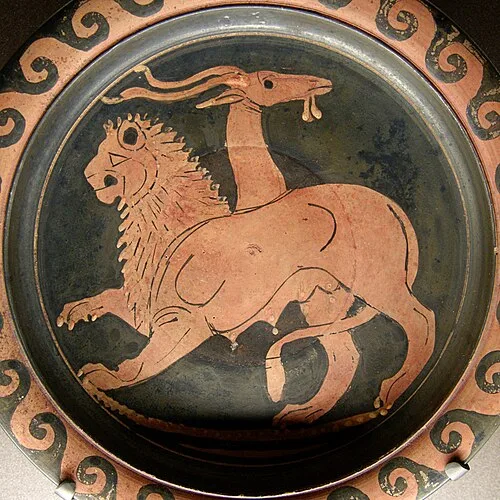
Chimera in Ancient Greek Art
Chimera inspires art from the 7th century BC. In blood vessels Archaic period is depicted in the typical triple form — often in battle scenes with Bellerophon, with the hero upon Pegasus and the monster firing flames. The movement of these performances is impressive: even within two dimensions, the artist manages to yield the dynamism of the conflict.
The most famous sculpture of antiquity that depicts it is Arejo's Chimera (c. 400 BC), an amazing Etruscan bronze statue found in Tuscany and is currently exhibited at the Archaeological Museum of Florence. This form, with the goat head emerging from the back and tail-snake turning back as if attacking, is one of the masterpieces of ancient metallurgy.
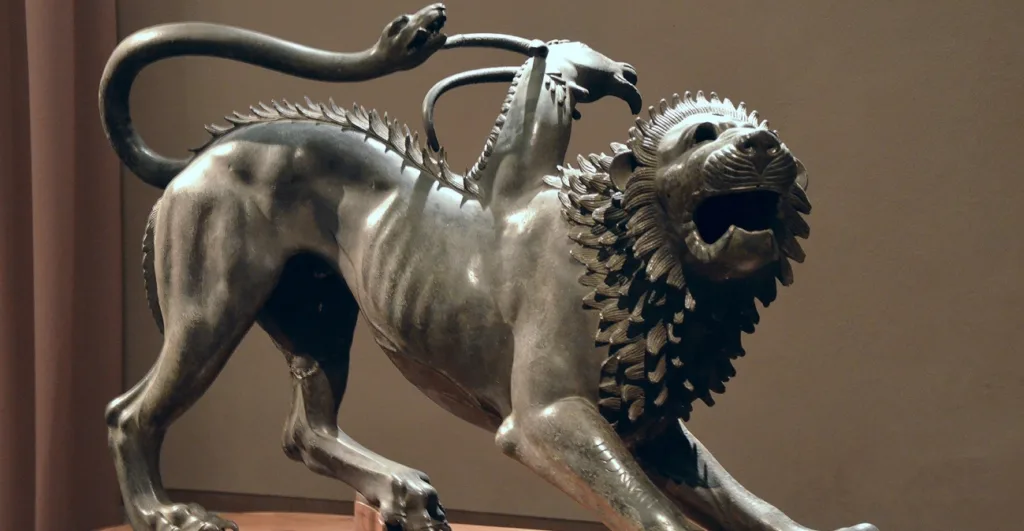
In the Hellenistic and Roman period, the iconography of Chimera becomes more refined — less horrible and more aesthetically balanced, but equally present in mosaics, reliefs and decorative objects.
The Symbolic Meaning of Chimera
The monster of chaos
In its deepest symbolic dimension, Chimera is the personification of chaos — that situation where things are not as they should be, where the boundaries between species and categories collapse. In ancient Greek thought, the world works well when everything is in place — people among humans, animals among their species, gods in Olympus. Chimera violates this fundamental principle.
The impossible and the fantastic
The evolution of the term «chimera» in linguistics is extremely interesting. In modern Greek and many European languages, the word now states something that cannot actually exist — an absurd fantasy, an impossible dream, an idea that seems tempting but turns out to be empty. «This is a chimera.» It means: don't chase it, it doesn't exist.
This metaphorical use is deeply linked to the nature of the myth: a creature combining three incompatible animals is, in definition, impossible to exist. If anything «It can't be real»If it violates the laws of nature, then it's a chimera.
Psychological and philosophical interpretations
In a psychological reading, Chimera represents internal contradictions which hosts every man. The lion is uncontrollable aggression, violent momentum. The goat is the promiscuous sexual energy and lust. The snake is the cunning, hidden side of the soul — The one who betrays and undermines.
When these three forces are not balanced, when man cannot reconcile his different instincts, he becomes a chimera himself. — a being in internal conflict, destroying everything he touches. Bellerophon who defeats Chimera is then the symbol of human ability to dominate impulses, to use intellect and bravery against internal disorder.
Chimera in Contemporary Culture
The presence of Chimera in modern times is impressively multidimensional. The fantasy literature, hybrid creatures inspired by Chimera appear everywhere — From Tolkien dragons to the creatures of modern dark fantasy novels. Chimera herself appears as a character or opponent in many works.
In cinema and television series, Chimera appears in films inspired by Greek mythology, but also as his archetype «compound monster» in countless works of imagination and terror. The video games, Chimera is one of the most classic types of opponents — present in series such as God of War, the Final Fantasy, the Dragon’s Dogma (where it gives its name to an entire class of creatures) and many others.
The table games and role games, Chimera is a key opponent in D&D and many other systems. The basic idea — one creature from three different animals — has been reproduced and altered in hundreds of forms.
The biology and genetics, the term «chimera» has obtained scientific content: describes an organism consisting of cells of two or more genetically distinct individuals. CRISPR technology and organ transplantation have rekindled discussions on «chimairates» properties of certain organisms. The ancient symbol of mixing incompatible natures has found new meaning in the field of biotechnology.
Conclusion
Chimera is not just a monster from the pages of an ancient poem. It is a living symbol that has traveled three millennia without losing anything of its power.
It began as the horrible incarnation of the disruption of the natural order — a creature that shouldn't exist, that violated the laws of nature and spread terror to Lycia. Then, through philosophical and psychological analysis, there became allegory of the inner contradictions of man. And finally, in modern times, her name has passed into the everyday language as a synonym for the unattainable and imaginary.
This triple identity — Monster, allegory, idea — It's explaining her timeless charm. The ancient myth speaks of something that never changes: fear in front of the unexplained, the charm of the impossible, and the human desire to understand it — Or beat it.
There in Lycia, eternal flames continue to burn. And with them burns, silently and uninterruptedly, the memory of a creature that may never have existed — But that, in a way, always exists.
Frequently Asked Questions About Chimera
What is Chimera in Greek mythology?
Chimera is a terrifying mythical monster of Greek mythology. It is described as a creature with a lion body, a second goat head coming out of the back and snake tail. According to legends, he had the ability to put fire out of his mouth.
Who were Chimera's parents?
According to ancient tradition, Chimera was the daughter of monsters Typhon and Echidna, considered the parents of many dangerous creatures of Greek mythology.
Where did Chimera live?
Chimera is said to have resided in her area Lycia, Asia Minor, where it caused destruction and fear to the inhabitants.
Who killed Chimera?
Chimera was killed by the hero Bellerophon, who faced her on the winged horse Pegasus.
How did the Bellerophon manage to defeat Chimera?
Bellerophon used Pegasus' ability to fly to attack from the air. According to a version of the myth, he placed a piece of lead on his spear. When Chimera set fire, lead melted and clogged her throat, causing her death.
What does Chimera symbolize?
Chimera often symbolizes something impossible or imaginary. In modern language, the word is used to describe a utopian or unrealized idea.
How is the appearance of the Chimera described?
Ancient sources describe Chimera as a creature with:
Lion head
goat’s second head
snake or dragon tail
This combination of animals made her one of the strangest monsters in mythology.
What ancient works does Chimera refer to?
Chimera refers to ancient works such as Iliad of Homer, and in Theogony of Hesiod.
Why is Chimera considered such a dangerous monster?
Chimera was considered particularly dangerous because she combined the power of many animals and had the ability to fire, causing major disasters.
How the term is used today «chimera»?
In modern language, the term «chimera» is used to describe a fantastic or impossible idea, a dream that can hardly be realized.
Ancient Sources
- Theogenia, p. 346–370 and 965–1020.
- Odyssey, various references to Nymphs and Nymphea.
- Hymns, especially the hymns to Mercury and Venus.
- Metamorphosis.
- Tour of Greece.
Modern Bibliography
- The Greek Myths.
- Early Greek Myth.
- The Complete World of Greek Mythology.
- Greek Religion.
- Dictionary of Classical Mythology.