
Symbolism of the Primordial Gods
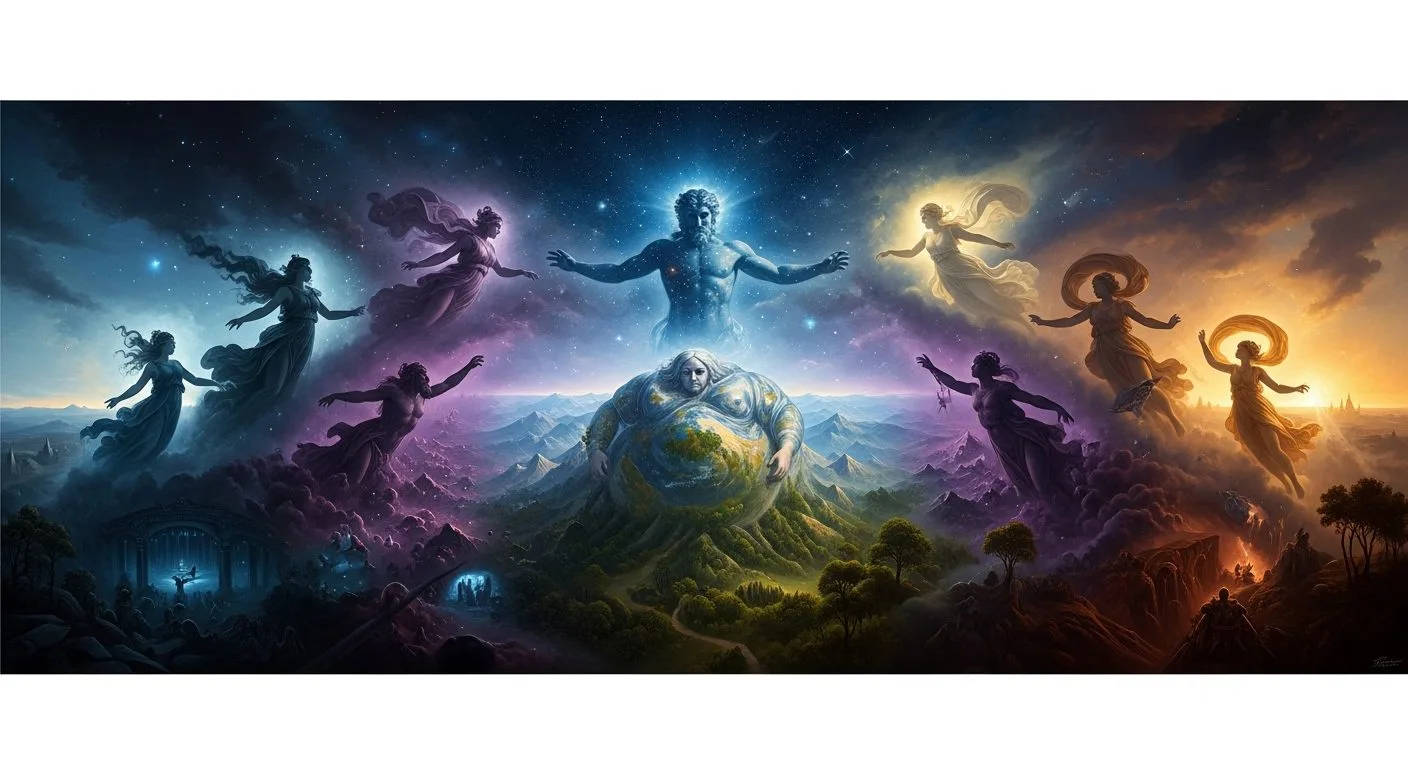
Her Ancient Gods Greek Mythology are not merely mythical forms that precede Olympian godsThey represent deeper conceptions of ancient Greeks about the structure of the world, the nature of existence and the transition from disorder to secular order. Through these myths philosophical questions are reflected that have occupied man since the early stages of civilization: how the world was created, what is the original cause of everything and how life arose.
Primordial forces as personifications of natural phenomena
Primordial deities serve as symbolic expressions of the fundamental elements of the universe.
Chaos is not an anthropomorphic god with specific actions. It represents the primordial void, the indeterminate state before the birth of cosmic order. It is an abstract concept that is transformed into a divine entity in order to be understood through myth.
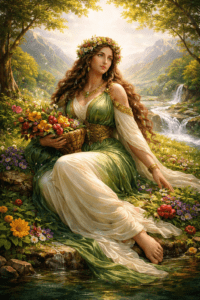
Gaia symbolizes the earth as a source of life, stability, and fertility. She is the force that gives birth to, nurtures, and sustains all beings. Her presence in many myths reflects the deep connection ancient societies had with the natural environment.
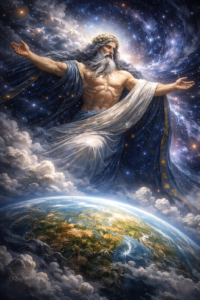
Uranus personifies the celestial dome that surrounds the earth. The union of Uranus and Gaia symbolizes the meeting of celestial and earthly forces, from which all forms of life are born.
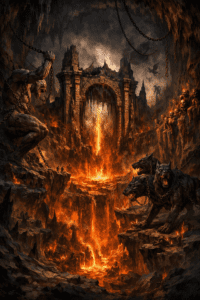
Tartarus represents the unfathomable depths of existence, the dark realm that lies beyond the boundaries of the known world. It is not only a place of punishment but also an essential element of the cosmic balance.
Nyx symbolizes primordial darkness and the mysteries of existence, while Aether represents pure celestial light. These deities embody the constant interplay of opposites that characterizes the world.
Their relationship with order and chaos
One of the most important themes in Greek cosmogony is the transition from Chaos to order.
The ancient Greeks did not view chaos as merely negative. On the contrary, they saw it as a necessary prerequisite for creation. From it, the first cosmic forces are born, and an organized world gradually takes shape.
This process is reflected in the succession of divine generations:
- Chaos
- Primary deities
- Titans
- Olympian gods
Each generation represents a greater degree of organization and stability. The overthrow of Uranus by Cronus and, later, of Cronus by Zeus expresses the continuous transition toward a more organized form of authority.
The myth therefore describes not only divine conflicts but also the birth of the secular class.
Their effect on philosophy, religion and literature
Primitive deities deeply influenced the development of Greek thought.
The pre-Socratic philosophers sought a rational explanation for the origin of the world, while retaining many elements of mythological cosmogony. The search for the “ἀρχῆς” of all things is essentially a philosophical continuation of the questions already raised in the Theogony.
In religion, the primordial forces were considered transcendent and all-powerful. Although they did not always have organized cults, their presence was felt in divination, rituals, and religious traditions.
In literature, the image of Gaia, Night and Chaos became a source of inspiration for poets, tragic writers and philosophers for many centuries.
The Influence of the Primordial Gods on Ancient Greek Civilization
The myths of the primordial deities were not limited to accounts of the creation of the world. They shaped fundamental conceptions regarding nature, religion, politics, and humanity’s place in the universe.
Religion and worship
Although most of the Primordial Gods were not as popular as the Olympian gods, they played a significant role in ancient religion.
Gaia was worshipped in various regions of Greece as the goddess of fertility and the earth. In Delphi, according to some traditions, Gaia was the first mistress of the oracle before it passed to Apollo.
Nyx was associated with mystery cults and with religious beliefs concerning death and the afterlife.
Tartarus and the dark powers of the Underworld often appear in rituals related to the memory of the dead and the chthonic deities.
Poetry and literature
Greek poetry kept the memory of the primitive gods alive.
Hesiod developed a complete cosmogonal system in Theogonia, which was a reference point for later writers.
The tragic poets, such as Aeschylus and Euripides, symbolically used the primal forces to express matters of fate, justice and divine authority.
Nyx, the Fates, and the Erinyes are often portrayed as the agents of inevitable cosmic laws that transcend even the Olympian gods.
Art and iconography
Depictions of the Primordial Gods are more limited than those of deities such as Zeus or Athena, but they are not entirely absent.
Gaia is often depicted emerging from the earth or offering infants and fruits. These performances highlight her role as the mother of all beings.
Nyx appears on vases and reliefs as a winged deity who shrouds the world in darkness.
The cosmogenic scenes became particularly popular during the Hellenistic and Roman period, when interest in the beginnings of the world increased.
Philosophy interpretations
Greek philosophers viewed ancient myths as symbolic narratives that concealed deeper truths.
Plato employed cosmological concepts reminiscent of the earlier mythological tradition, while the Stoics interpreted the deities as expressions of natural forces.
The Neoplatonic philosophers linked Chaos and the primordial beings to metaphysical stages of creation, thereby imbuing the myths with new philosophical meaning.
The Ancient Gods in Modern Culture
The influence of the primordial deities is not limited to antiquity. The figures of Gaia, Chaos, Night, and Eros continue to inspire artists and audiences around the world.
Presence in literature, cinema and video games
Modern fantasy literature often uses primitive deities as powerful secular entities.
In novels, comic books, and film productions, Gaia is often presented as the personification of nature itself, while Chaos appears as a decomposition force or uncontrolled creation.
The Primordial Gods of Greek Mythology constitute the first cosmogonic generation of divine entities, those primordial forces from which the world was born, as the ancient Greeks conceived it. They are not “gods” in the human sense—possessing a personality and a city of worship—but rather secular authorities: concepts such as Chaos, Earth, Night, and Darkness.
| Entity | Relationship | Description |
|---|---|---|
| Chaos | The beginning of everything | The original void from which all were born |
| Gaia | From Chaos | Mother Earth, foundation of life |
| Uranus | Husband of Gaia | Uranus, father of the Titans |
| Nyx | From Chaos | The goddess of night and darkness |
| Erebus | From Chaos | The dark depth |
| Tartarus | Underworld | The deepest point of the Underworld |
| Pontos | From Gaia | The primitive marine force |
The composition of the Greek Pantheos was the synthesis of a long-term process, the main changes of which are narrated by his theogeny Hesiod. Before enthroning the Zeus in Olympus as an absolute sovereign, a series of revolutions had occurred, with episodes often of dramatic interest.
According to Hesiod and his work Theogony, the first deity from which the rest came was Chaos. From Chaos came Erebus (darkness), Ether (light), Nyx (night), Hemera (day), Tartarus (the underworld) and Eros (reproduction). Theprimordial deities They were usually depicted as places or kingdoms, as shown by the above.
Chaos
The Chaos is not «ataxia» As we mean today, but one empty, vast, primary opening. From this amorphous void everything begins. It has no form, gender or consciousness with human characteristics.
From Chaos are born the first cosmic powers:
and other primary entities
Earth (Gaia)
The Darkness
the Night (Nix)
Gaia – Mother Earth
Gaia
- Gaia is the personification of the Earth itself. Of the most important primordial powers, it is the basis of life and stability.
Gaia:
- breeds mountains, seas and sky
- It brings to the world Sky (Uranus) no partner
- Then he joins him and creates the Titans
Gaia symbolizes the fertility, stability and the mother force of nature.
Uranus – the celestial dome
Uranus
- Uranus is the sky personified, the vast dome above Earth.
Key elements:
- born to Gaia
- became her wife.
- along with her, she gave birth to the Titans, the Cyclopes, and the Hecatoncheires
However, his relationship with his children is abusive, a fact that ultimately leads to his overthrow by Cronus.
Nyx – the dark night
Nyx
- Nyx She is one of the most mysterious primordial figures. She is the personification of the night and possesses immense cosmic power.
Characteristics:
- born of Chaos
- lives in the darkness of the universe
- is considered so powerful that even Zeus respects her
From Nyx are born many abstract forces, such as Sleep, Death, and Fate.
Erebus – the deep darkness
Erebus
- Erebus is the deep darkness that covers the underground and most secret parts of the world.
- born of Chaos
- joins the Nyx
- From this union arise Light and Day (Hēméra and Aether)
It symbolizes the absolute darkness before the creation of light.
Tartarus – the depth of the underworld
Tartarus
- Tartarus It's not just a place, it's a primal force.
- found deeper than Hades
- is a prison for Titans and secular punishments
- personifies the absolute abyss
It's the dark one «opposite side» Of heaven.
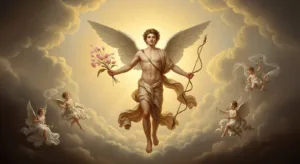
Eros – the power of attraction
Eros
The Primordial Eros is not the romantic god of love as in later traditions.
It is:
- The power that unites the elements of the world
- the principle of creation through attraction and union
- the driving force behind the birth of all beings
Without Eros, the universe would remain static.
Primordial Gods
Chaos | Gaia | Tartarus | Eros | Nyx | Erebus | Aether | Hemera

Conclusion – the cosmogenic basis of Greek thought
Primitive gods are not merely mythological figures. It's a philosophical effort to explain the creation of the world:
- from Chaos → Being born
- from Night and Darkness → opposing forces are born
- from Earth and Heaven → begins «organized» divine generation
- From the Eros → union and creation begin
This first generation of gods is essentially Cosmic «Starter engine» of Greek mythology, before the Titans and later Olympians.
 Primordial Gods
 Primordial Gods
 Primordial Gods
 Primordial Gods
 Primordial Gods
 Primordial Gods
 Primordial Gods
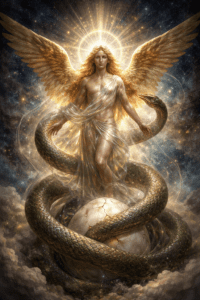 Primordial Gods
 Primordial Gods
 Primordial Gods
Frequently Asked Questions About the Primordial Gods
Who was the first god in Greek mythology?
The first god is considered Chaos, the original state of the universe.
How many primitive gods were there?
The number varies depending on the source, but usually reported 6 to 10.
What is the difference between the primordial gods and the Titans?
The primordial gods are the first generation of deities, while the Titans are the offspring of Gaia and Uranus.
Is Eros a primordial god?
In some versions of cosmogony, Eros is considered a primal deity of creation.