
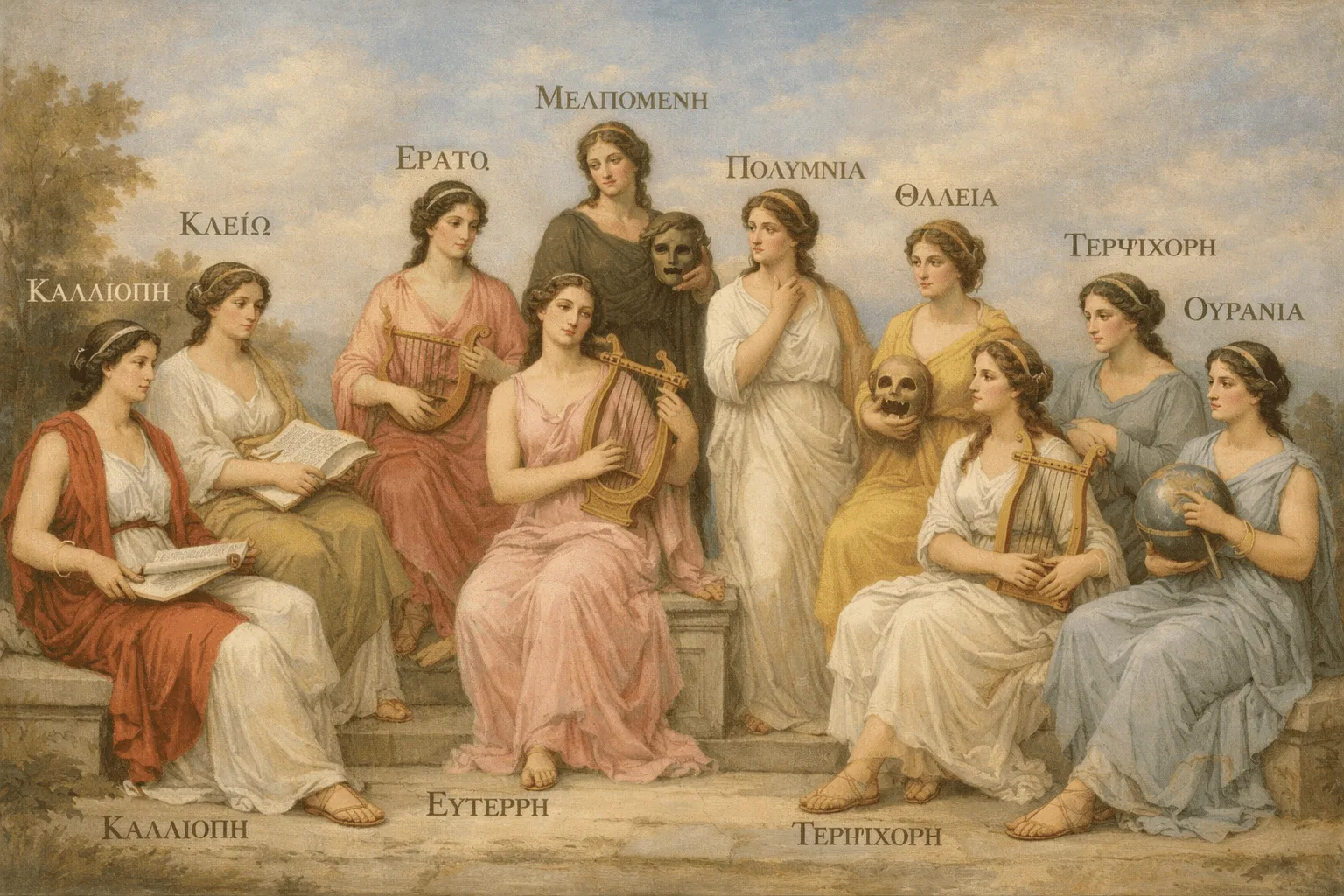
The Muses: The Goddesses of Art, Knowledge, and Inspiration
Muses are one of the most important and dear groups of deities of ancient Greek mythology. They were the divine patrons of the arts, poetry, music, history, philosophy and all forms of spiritual creation. For the ancient Greeks, artistic and spiritual inspiration was not considered exclusively human achievement, but a divine gift from the Muses. Every poet, musician, or scholar who wished to create an important work sought their favor and guidance.
According to the prevailing tradition, the Muses were nine sisters, his daughters Zeus and MnemosyneThe goddess of memory. Their origin is not accidental, as it links Zeus' divine authority to memory, which was a foundation of knowledge and cultural heritage. Hesiod reports that Zeus joined the Memorial for nine consecutive nights, and from this union were born the nine Muses, each of whom assumed a separate domain of spiritual creation.
The Muses mostly inhabited Olympus, where they entertained the gods with their singing and music. However, they were particularly associated with Mount Elikona in Boeotia and Mount Pieria in Macedonia, areas considered sacred and dedicated to their worship. These places evolved into important spiritual centers and were a source of inspiration for poets and artists of antiquity.
Each of the nine Muses had its own authority. Calliope was the muse of epic poetry, Cleo of history, Erato of erotic poetry, Euterpe of music, Melpomen of tragedy, Thalia of comedy, Terpsichore of dance, Polymnia of sacred hymns and Urania of astronomy. Together they represented all human knowledge and arts, emphasising the importance that ancient Greeks attached to spiritual cultivation.
The Muses appear in numerous myths. Poets such as Homer and Hesiod They invoke their help at the beginning of their works, asking to share with them the knowledge and inspiration needed to account for the events. Invocation to the Muses became a literary tradition that influenced western literature for thousands of years.
At the same time, the Muses are associated with stories that highlight the value of humility against divine art. A typical example is the Pierides myth, which dared to challenge the Muses in a musical competition. Their defeat and transformation into birds acts as a warning for those who display arrogance against divine wisdom and creativity.
The importance of the Muses exceeded mythology and extended to the everyday life of the ancient Greeks. Artists, philosophers, orators and historians considered their Muses to be their protectors. From these comes the word «music», while the term «museum» It comes from the Museums, places dedicated to Muses and the study of arts and sciences.
Symbolically, the Muses express the creative power of the human spirit. They represent the search for knowledge, artistic expression and perpetual effort of man to understand and capture the world around him. Their presence reminds them that art and wisdom were considered sacred values, worthy of respect and culture.
Even today, the Muses remain a universal symbol of inspiration and creativity. Their influence is distinguished in literature, music, visual arts and sciences, proving that their heritage still inspires people around the world.
The Muses are central inspirational deities in ancient Greek mythology, personifying the arts, knowledge, Mnemosyne and creative power of the human spirit. As daughters of Zeus and Monument, the Muses were considered the divine source of poetry, music, history and science, inspiring poets, artists and philosophers from ancient times to the present day.
«I believe it is not the artist who chooses the muse, but the muse who chooses the artist. The Muses are the original creators, while we humans are their instruments.»
In the quiet hills of ancient Greece, where the wind seems to whisper stories and the sources sing, the idea was born that inspiration is not human· It's divine. The Muses were not just deities· was the very breath of creation. Every poet, every musician, every historian, before his work began, invoked them.
The Muses were his daughters. Zeus and MnemosyneTheir birth was not accidental.· For nine consecutive nights, Zeus joined the Memorial, and from this long union emerged the nine deities of art and knowledge.
Their residence is mainly placed in Olympus, among the gods, but also in Helicon and ParnassosThere, near sacred springs such as Hippocrine, they are said to sing and inspire those who dare to approach them.
The Muses were nine, each dedicated to one area of
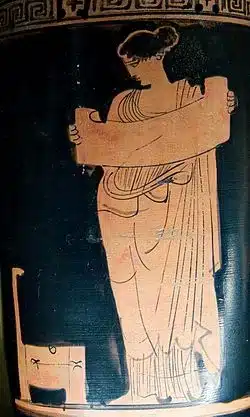
human expression:
- Calliope – Muse of epic poetry and rhetoric. He's considered their leader.
- Kleo – Muse of history, guardian of the memory of events.
- Euterpe – Music and court art.
- Thalia – Muse of comedy and cheerful poetry.
- Melpomene – Muse of tragedy, connected to drama and passion.
- Terpsichore – Muse of dance and lyric poetry.
- Erato – Muse of love poetry and lyrical speech.
- Polyhymnia – Muse of hymns and sacred poetry.
- Urania – Muse of astronomy, directed towards the stars and mysteries of heaven.
Each one embodied not only an art, but also a way of seeing the world.
Muses often appear as his escorts Apollo, which guides them as «Musketeer». Together they weave the sound of the world: songs about gods, hymns about heroes, and accounts about people.
In a known myth, they punished the king Thamiris When he dared to claim that he could overcome them in the song. The insult cost him his gift. In other traditions, they are linked to Orpheus, whose art is said to have been their gift.
The Muses, though dedicated to inspiration, did not remain without offspring. In various traditions they are referred to as mothers:
- The Orpheus (often attributed to Calliope)
- The Linseed
- The Rice
Their descendants are always associated with music, poetry or heroic tradition, as if they inherited the spark of divine creation.
Sources
- Theogony of Hesiod
- Iliad and Odyssey of Homer
- Apollodorus, Library
- Pausanias, Greece Tour
See also
How many were the Muses?
The Muses were nine, each with a separate role and symbolism.
Who was their father?
Their father was Zeus.
What did the Muses symbolize?
They symbolized the inspiration, knowledge and creative power of arts and sciences.
Where did they live?
They are mainly linked to Olympus, but also with Helicon and Parnassos.
Why were they important in ancient times?
For every form of art and knowledge was considered a result of their own divine influence.
Discover more Greek deities in our collection.
Sources and Bibliography for Muses
Ancient Sources
- Theogony
- The most important ancient source for the origin and nature of Muses.
- Works and Days
- It contains references to Muses as a source of poetic inspiration.
- Iliad
- It begins with an appeal to the Muses for the account of the events of the Trojan War.
- Odyssey
- It includes similar invocations to the goddesses of inspiration.
- Library
- It provides information on the genealogy and myths of Muses.
- Tour of Greece
- It describes sacred, statues and cult centers dedicated to Muses.
- Transformations
- It includes the Pierides myth and other stories about Muses.
Modern Bibliography
- The Greek Myths
- Greek Religion
- The Routledge Handbook of Greek Mythology
- Early Greek Myth
- Greek Mythology
- Mythology: Timeless Tales of Gods and Heroes
- Theoi Project: Mousai