
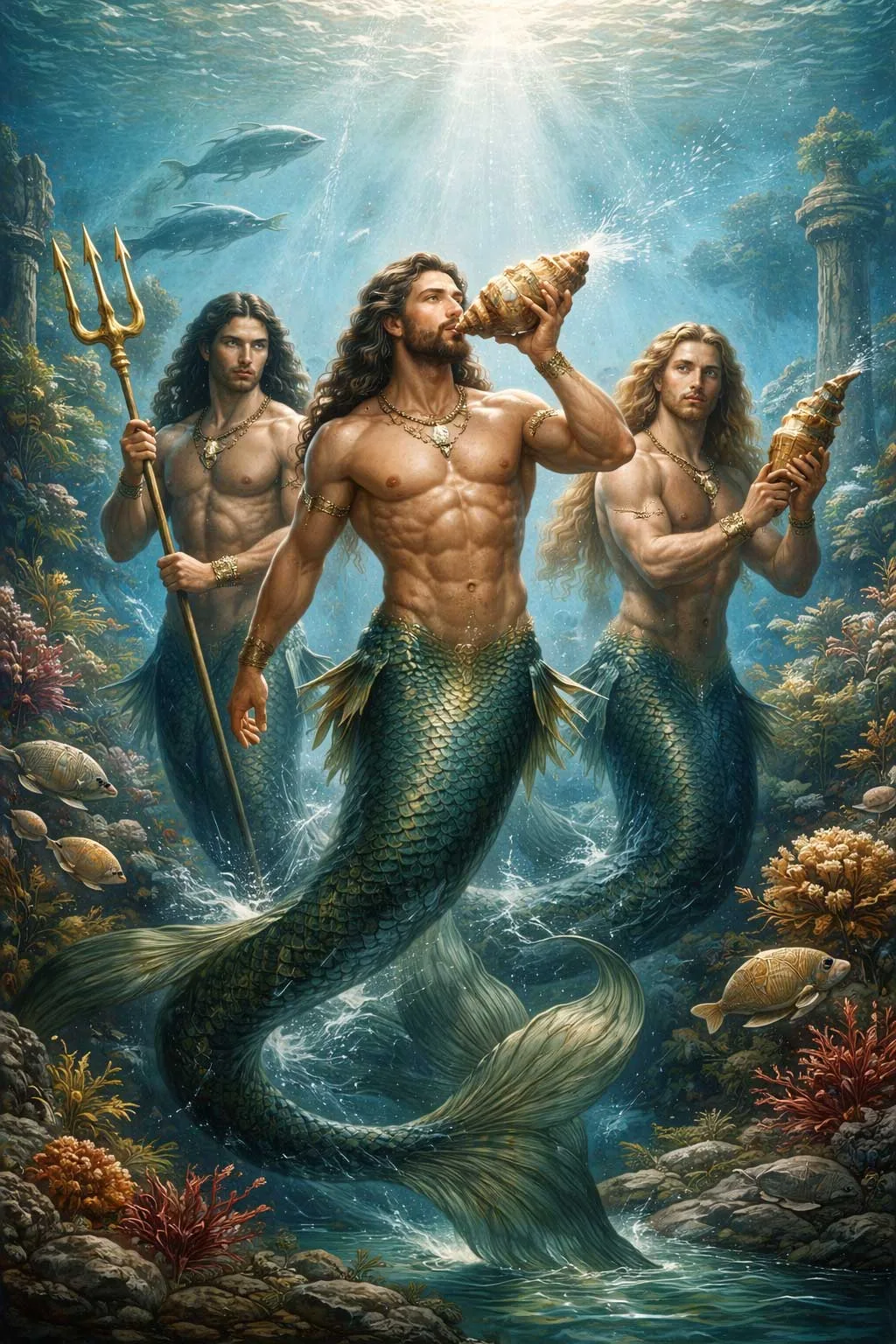
Tritons: the messengers of the seas in Greek mythology
Tritones are one of the most characteristic marine forms of Greek mythology. They directly connect to the world of Poseidon and symbolize the strength, mystery and vitality of the sea. In ancient times they were depicted as creatures with a human body from the waist and upper and tail of fish from the waist down, becoming the ancestors of later representations of mermaids and other marine beings.
First, the name «Triton» He was referring to a certain deity, his son. Poseidon and Amphitrite. Over time, however, the name was extended and used for an entire category of marine demons and deities that constituted the escort of the king of the sea.
The god Triton
According to mythology, Triton was the son of Poseidon and Amphitrite and resided in a gold palace in the depths of the ocean. Its form combined human and marine characteristics: it had human trunk, long hair and beard, while the lower part of its body ended in a fish tail.
Triton was a servant and messenger of Poseidon. He carried God's orders and had the power to control waves and sea storms. He is often presented holding a large bolt, which he used as a trumpet.
Triton's bolt
The most famous symbol of Triton was the twisting seashell he used as a trumpet. According to the myths, when blowing through it, it could calm the waves or cause sea trouble.
The bolt symbolized the power of the voice of the sea and divine authority over the waters. For ancient sailors, its sound was a sign of the presence of marine deities.
Tritons as marine beings
During the Hellenistic and Roman period, artists began depicting many Tritons accompanying Poseidon and Amphitrites in their sea processions. These Tritons are often presented as powerful warriors of the sea, sometimes with a fish tail and sometimes with dolphin or other marine creatures characteristics.
In many performances they appear to drive Hippocampus, play shells or accompany Nereids and other sea nymphs. They constituted the equivalent of satyrs in the sea world and symbolized the vitality and uncontrolled power of the oceans.
Triton and Argonauts
One of the most important myths associated with Triton comes from Argonaut Campaign. When Argonauts were lost on the Libyan coast, Triton appeared to guide them and help them find their way to the sea again.
His intervention highlights his role as patron of seamen and mediator between the gods and humans.
The Tritons in ancient art
Tritons have been particularly popular in Greek and Roman art. They appear in vases, reliefs, temples, mosaics and sculptures. They often frame Neptune's performances or sea scenes related to travel, commercial activities and sea power.
Their iconography evolved over the centuries, but the characteristic fish tail and shells remained their basic traits.
The Symbolism of Tritons
Tritons symbolize communication between the world of gods and the world of men. They represent the forces of the sea that are once calm and beneficial and sometimes wild and destructive.
At the same time, their dual nature – half people and half sea creatures – expresses the connection between the known world and the mysteries of the oceans. As patrons of Poseidon, they are symbols of power, protection and maritime sovereignty.
The Triton Heritage
The form of the Tritons deeply influenced western art and mythology. From Greek and Roman sculptures to Renaissance fountains and modern sea decorations, the Tritons remain symbols of the sea and its mysterious power.
Their presence in mythology reminds the close relationship of ancient Greeks with the sea, which was a source of life, trade, exploration and risks. As messengers of Poseidon, the Tritons continue to be one of the most impressive figures of the mythological world of ancient Greece.
The Tritons are marine mythological entities of ancient Greek tradition, with semi-divine nature and a strong presence in mythological, pictorial and worshipful thinking. They belong to the wider category of Sea demons and are considered his attendants and servants Poseidon, expressing the dynamic, ambivalent and changing nature of the sea.
Etymology and Name
Name Tritons comes from God Triton, son of Poseidon And Amphitrite. In its original use, the term stated the only god Triton· Later, it expanded to describe whole class of beings with similar characteristics.
Origin and Theogenic Inclusion
Father: Neptune (in dominant tradition)
Mother: Amphitrite or Island
Theogenic position: Marine secondary deities – demons
The Tritons do not belong to the Olympians, but to wider marine divine environment, along with the Nireides, Proteus and other demonic forms of the sea.
Morphology and Iconography
Tritons are depicted as:
Upper part human (male)
Bottom part fish (fish or dolphin tail)
Often with:
trident
shell (salpin)
Sea beings as an escort
Their form is considered path to the later image of «gorgon man».
The Role of the Shell
The most characteristic symbol of Tritons is seashell, which:
used as a trumpet
soothes or angers the sea
acts as a means of divine communication
The sound of the shell symbolizes:
the primary voice of the sea
the boundary between order and chaos
Mythological Role
The Tritons:
They accompany Poseidon and Amphitrite
protect or threaten sailors
intervene in battles and cosmogenic events
operate as messengers of the sea will
In some traditions, they appear beneficial, while in others dangerous and terrifying.
Tritons and Nereids
Tritons often appear in pictorial scenes along with Nereids, forming a Sea court around Neptune.
The contrast:
Waters → peace, grace
Tritons → power, noise, movement
It reflects the dual nature of the sea.
Worship and Religious Meaning
Tritons did not have organized worship, but:
They were depicted in temples
appear in vases, mosaics, sculptures
They functioned as repugnant forms in ports
Their presence was symbolic and protective character.
Symbolism
Tritons symbolize:
the strength and unforeseen nature of the sea
human-nature transition
the chaos that obeys divine order
the marginal situation between culture and savagery
Ancient Sources
Hesiod, Theogony
Homer, Odyssey (Indirect references)
Apollodorus
Pausanias
Angiography of Archaic & Classical Period
Educational Adaptation
For students and teachers:
Example of marine demon
Comparison with Centauri (land hybrids)
Analysis of nature-human symbolism
Conclusion
The Tritons They're not just mythical creatures, but symbolic expressions of sea world-view The ancient Greeks. They express the strength, fluidity and mystery of the liquid element, acting as a bridge between the divine, the natural and the human.
Ancient Sources
- Theogonia, f. 930–933 (genalogy of Triton).
- Argonauts, Book IV (Triton and Argonauts).
- Library (references to sea deities).
- Transfigurations, Book I (the Triton after the flood).
- Tour of Greece (local traditions for Triton).
Modern Bibliography
- The Complete World of Greek Mythology.
- The Routledge Handbook of Greek Mythology.
- Early Greek Myth.
- Dictionary of Classical Mythology.
- The Sea in Greek Mythology.