
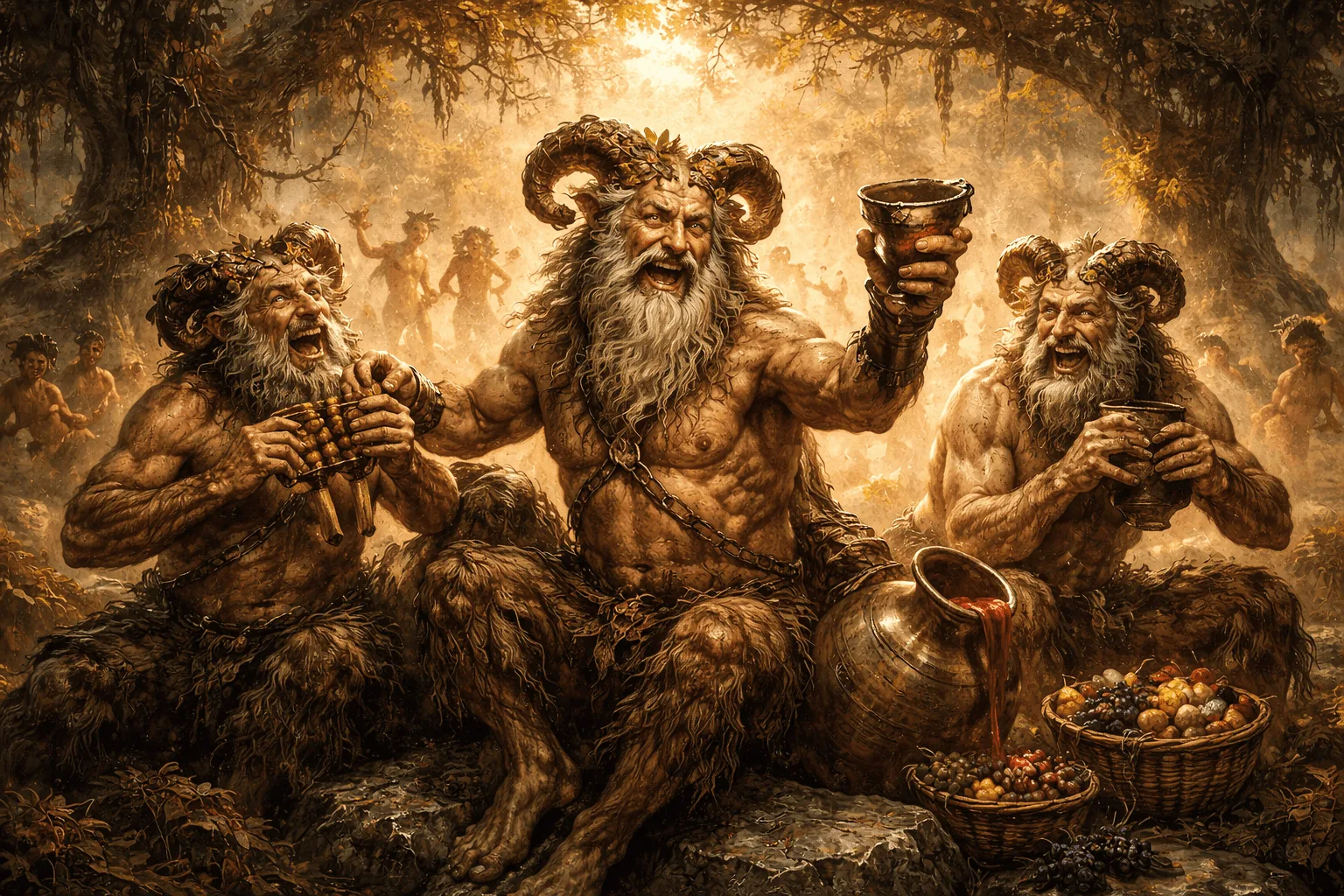
The Silenus (or Silenos) are a special category of mythological beings of the ancient Greek religious and cult tradition. They connect closely with God Dionysus and belong to the wider circle of demon spirits of nature, clearly differentiated from the satyrs due to their role as bodies of ancient wisdom and secret knowledge.
Selenians are special figures of Greek mythology, closely associated with the god Dionysus and the world of nature, wine and ecstasy. Although often confused with the Satyrs, the Selenians are distinguished by their older age, their wisdom, and their particular role in dionysian traditions. They combined the joyful and often comical appearance of the drunken follower with deep knowledge of the mysteries of life, nature, and fate of humans.
In ancient art and literature they are presented as elders with animal characteristics, usually with ears and horse tail or, in later depictions, with goat characteristics. Despite their clumsy and often ridiculous appearance, the Selenians were considered bearers of ancient wisdom and secret knowledge.
Who were the Moons?
The term «Moons» is used for both a group of mythological beings and their most known representative, the Seilen. The Moons belonged to the dionysian sequence and roamed the mountains and forests along with Satyrus, Menades and Nymphs.
Unlike younger and more vivid Satyrs, the Moons are presented as elderly, often bald or bearded, with a burly body and obvious signs of drunkenness. They often needed the help of others to walk or be carried on donkeys during the dionysal transmitters.
The Moon, master of Dionysus
The most famous of all was Selenus, who was considered a tutor, fooder and close companion of Dionysus. According to many myths, he took care of God when he was still a child and accompanied him to his wanderings around the world.
Although he often appears drunk, Selenus was considered a possessor of great wisdom. The ancients believed that he knew secrets about the origin of the world, the nature of the gods and the destiny of men. However, he did not easily reveal his knowledge and usually had to be trapped or forced to speak.
The myth of King Midas
One of the most famous myths associated with Selenus concerns King Midas of Phrygia. According to tradition, Selenus was lost after a dionysian feast and was found in the courtyard of Midas.
The king honored him for several days before returning him to Dionysus. As a reward, God offered Midas a gift of his choice, which led to his famous myth «touch gold».
In some traditions, during his hospitality, Selenus revealed to Midas philosophical truths about life and human existence. The most famous of them is the so-called «the wisdom of the Moon», according to which the best for man is never to be born and the second best to die as soon as possible. This pessimistic view impressed many later philosophers and writers.
The Moons in Art
The Moons were a favorite theme of ancient Greek art. They appear in vases, reliefs, sculptures and mosaics, usually next to Dionysus. Their artists portrayed them as cheerful old men who keep wine scrolls, play music or participate in celebrations.
During the Hellenistic and Roman period, their performances became even more popular. They are often combined with Nymphs, Satyrus, and Maenades in scenes that glorify the joy, abundance and power of nature.
The Moons and Dionysian worship
The Moons symbolized a special aspect of dionysian religion. While the Satyrians represented youthful momentum and instincts, the Selenians expressed the wisdom that may arise through experience, even through exaggeration.
Their connection to wine was not only recreational. For ancient Greeks, drunkenness could lead to ecstasy and bring man closer to divine forces. The Moons embodied this relationship between celebration, knowledge and mystery.
The Symbolism of the Moons
The Moons symbolize the contradiction that exists in human nature. On the one hand they appear as clumsy, drunk and comical characters; on the other hand they hide deep wisdom and knowledge.
This dual nature expresses an important idea of Greek mythology: that truth and wisdom are not always where they are expected. The old man who looks ridiculous can know more than kings and heroes.
The legacy of the Moons
The Moons continued to influence western art and literature for many centuries. The form of the wise old man hiding behind a strange or funny appearance reappears in a multitude of myths, fairy tales and literary works.
As followers of Dionysus, the Selenians recall that life consists not only of reason and order but also of celebration, passion, experience and deeper understanding of the world. That is why they remain one of the most interesting and philosophically charged forms of Greek mythology.
The Silenus are mythical forms of Greek mythology, closely associated with worship of Dionysus and the dionysian world of ecstasy, wine and nature. They are depicted as Elder satyrs, with human characteristics combined with animal elements such as horse or donkey tail, harsh appearance and strong signs of drunkenness and cheer.
The central form of this category is Silenus, teacher and companion of Dionysus, who is often presented drunk but at the same time carrier deep wisdom. According to ancient tradition, when Selenus was forced to speak sober, he revealed truths about the nature of life, pain, and futility of human existence.
The Moons participate in Dionysal transmitters, accompanying God with music, dancing and promiscuity. They are not necessarily malicious beings, but personifications of uncontrolled nature, drunkenness and the marginal situation between culture and savagery. In mythological and artistic tradition, they symbolize the dual nature of dionysian experience: chaos and wisdom, pleasure and revelation.
Etymology and Nomenclature
Greek: Silenus / Silenos
English: Sileni
Latin: Sileni
The word is associated with the name Silenus, the wise old attendant and tutor of Dionysus.
Genealogy and Origin
The Silenus shall be considered as:
Earlier than the Satyrs
Demon forms born of Gaia or from primary deities of nature
Members of the Dionysus troupe, with a role of guidance and ritual
- SilenusAs a primary form, it is presented as a father or model of all Silenus.
Morphology and Iconistication
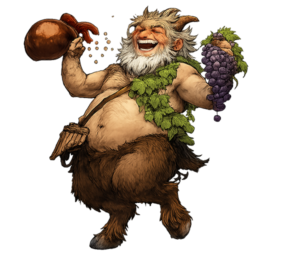
The Silenus are depicted:
As Old, bald, obese
Narin horse or goat characteristics (ears, tail)
Common drunk., but at the same time peaceful and thoughtful
Unlike the satyrs, their form states age, experience and knowledge.
Relationship with Dionysus
The Silenus:
They function as teachers and escorts of Dionysus
They participate in dionysal processions, but with a role ritual and muscular
They represent the wisdom resulting from the acceptance of nature and life
The Moon and Philosophy
Important excerpt rescued by Aristotle and Plutarch, where the Moon declares:
«Excellent not to be born, and the second quickly died.»
The phrase renders the Archaic tragic worldview, where wisdom is accompanied by awareness of human vanity.
Mythological Events
The Moon is captured by Midas and reveals worldly truths to him
Frequent presence in satyric dramas as a bearer of truth through humor
Symbolic form in ancient tragedy and philosophy
Religious and Ritual Role
The Silenus are connected to:
Mysteries of Dionysus
Fertility ceremonies
Ecstatic cults and music
They're forms. between God and man, with clear muscular function.
Silenus in Art
Angiography (red blood vessels)
Dental reliefs
Roman mosaics and sculptures
In art they function as symbols of wisdom hidden behind exaggeration.
Educational Adaptation
Primary
Forms of Dionysus who love music and nature
High school
Discrimination Satyr – Selenon
Symbolization of wisdom and experience
lyceum
Philosophy analysis and tragic worldview
Relationship with ancient texts and mysteries
Ancient Sources
Herodotus
Aristotle (excerpts)
Plutarch
Euripide (Satyrian dramas)
Symbolism and Interpretation
The Silenus express:
The wisdom of experience
The union of laughter and tragedy
The deepest knowledge of human nature
Conclusion
The Silenus are fundamental forms of Greek mythology, as they embody the wisdom resulting from acceptance of life and nature, offering valuable material for educational and philosophical approach.
Ancient Sources
- History, 8.138 (Midas and Selenus).
- Library (dynastic myths).
- Bacchas (the circle of Dionysus).
- Geographically (references to Midas and Selenus).
- Description of Greece (Sailen performances in art).
Modern Bibliography
- The Greek Myths.
- Early Greek Myth.
- The Complete World of Greek Mythology.
- Greek Religion.
- Dictionary of Classical Mythology.