
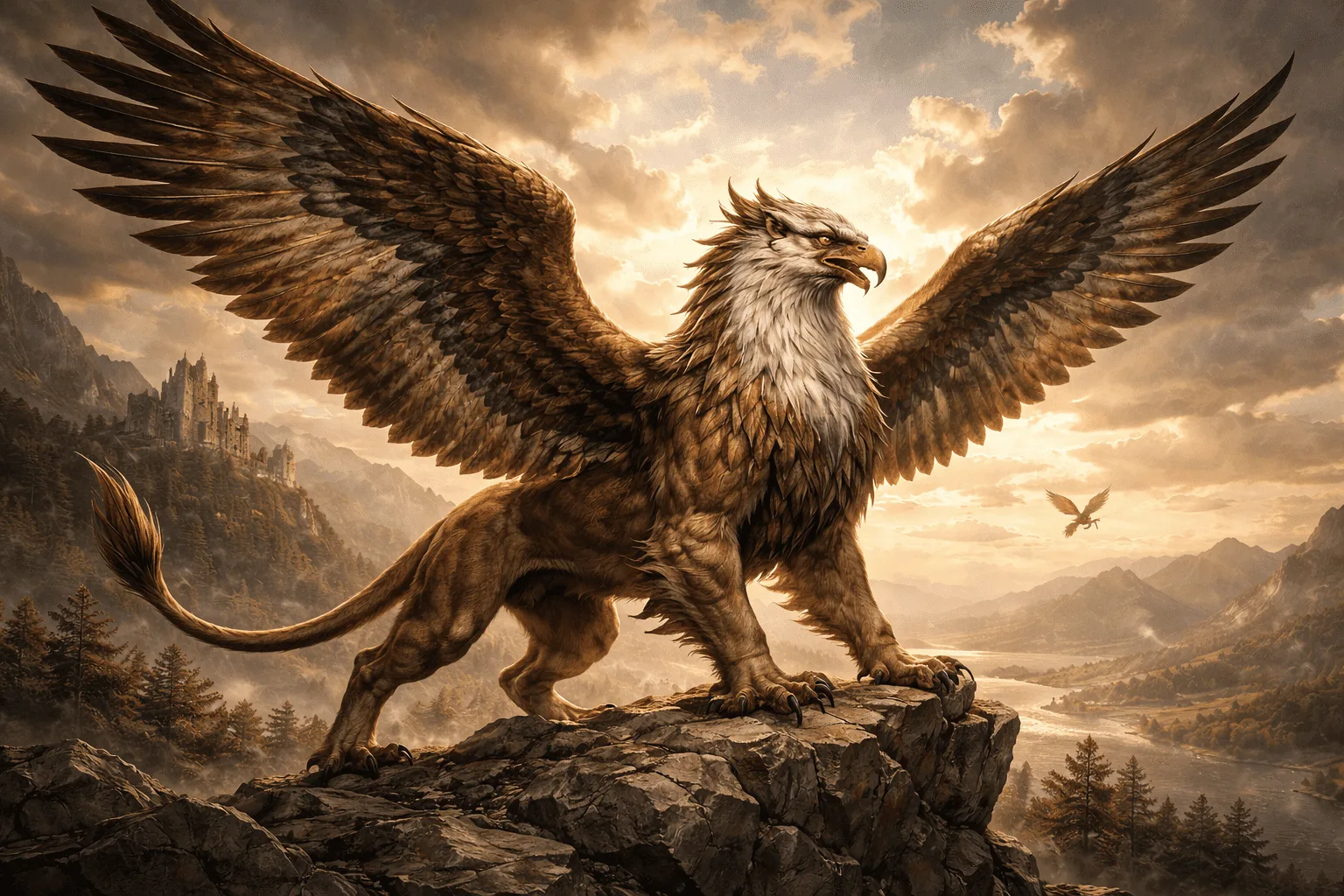
- Griffin (or GryphonLatin. Gryphon / Griffin) is one of the most iconic complex creatures of ancient mythological tradition. Pictured with body and posterior limbs of lion and head, beak and eagle feathers, combining the two most powerful animals of land and sky. His form symbolizes supreme power, alertness, and royal authority.
Grupes are among the most impressive and mysterious creatures in Greek mythology. With a lion body and head, wings and eagle claws, they combined the characteristics of two of the most powerful animals known to ancient humans: the king of beasts and the master of the airs. Their hybrid form symbolized power, power, alertness and protection, which is why the Grupes were associated with the preservation of precious treasures and sacred sites.
Although known mainly through Greek mythology, the Grupes appear to come from earlier traditions of the Near East and Central Asia. Through commercial and cultural contacts, their form was adopted by the Greeks, who incorporated them into their own mythological system. Over time, the Grupes became symbols of divine protection and supernatural power.
The Appearance of Grubs
Ancient descriptions present the Grupes with a lion's body, strong eagle's front legs, a fucking beak and large wings. The lion represented strength and courage, while the eagle symbolized sharpness, speed, and sovereignty in heaven. The combination of these characteristics created an almost invincible creature.
In ancient art, Grupes are often depicted as guarding thrones, accompanying deities, or protecting valuable objects. Their forms adorned vases, jewels, reliefs and architectural elements throughout the Greek world.
The Guardians of Gold
The most famous tradition for the Grupes is associated with treasure storage. Ancient historian Herodotus reports that the Grupes resided in distant northern areas beyond Scythia, where there were rich gold deposits. There they kept valuable treasures from the Arimaspas, a people of one-eyed warriors who tried to steal them.
According to legends, the battles between the Grupes and the Arimaspas were continuous and fierce. The Grupes were considered watchful guards who never abandoned the gold deposits that the gods had entrusted to them. This tradition was probably born of traveler accounts describing remote areas rich in mineral and precious metals.
The Globes and Apollo
In some traditions the Grupes are closely associated with God Apollo. They believed they were guarding his sanctuaries or dragging his chariot during his mythical movements to the northern countries of the Transnorian.
This relationship was not accidental. Apollo was a god of light, harmony and divine order, while the Grupes symbolized the power that protects what is precious and sacred. Thus, these mythical creatures functioned as guardians of God’s divine wisdom and treasures.
The Grubs in ancient art
Archaeological discoveries show that the Grupes were particularly popular in ancient Greek art. They appear in vases, metal vessels, jewels and sculptures already from the archaic period.
They were often placed next to gods, kings, or sacred objects, suggesting their protective capacity. In many cases they were used as decorative motifs in temples and palaces, symbolizing the strength and security of the space they protected.
The Symbolism of Grups
The Grupes represented the union of earth and heaven. The lion's body associated them with physical strength and royal authority, while the eagle's wings and head symbolized insight and divine protection.
For this reason, Grupes were considered ideal treasure keepers, sacred places and secret knowledge. They also symbolized vigilance, as they believed they could detect any threat from a long distance.
The legacy of the Grubs
The form of the Grups survived far beyond antiquity. In Byzantine and medieval art they appear as symbols of power and protection, while in modern times they were used in heraldic emblems, literary works and works of imagination.
Even today, the Grupes remain among the most popular mythological creatures. Their imposing form and role as treasure keepers still inspire artists, writers and creators around the world, keeping their presence alive in collective imagination.
In ancient Greek and eastern traditions, the Gryphon were considered keepers of sacred places and priceless treasures, especially gold. Ancient authors, such as HerodotusThey place them at the far ends of the world, where they fought with the Arimaspas to protect gold deposits. At the same time, Grupa was associated with ApolloAs a symbol of light, order and divine supervision.
Beyond mythology, Gryphon gained a strong presence in religious, artistic and heraldic tradition, maintaining his role as guardian of the sanctuary and the precious. He's not just a monster, but symbolic form of balance between power and wisdomEarth and uranium.
Etymology and Name
The term Gryphon (plural: Gryphons) comes from the ancient Greek word grips, stating a mythical bird-tower.
In Latin tradition he answers as gryphus, while in international literature as griffin or gryphon.
Morphology and Natural Characteristics
The Gryphons are depicted as:
body and posterior limbs lion
Eagle head
beak and predator claws
large wings
This combination is not random:
The lion symbolizes the royal power
The eagle insight and a connection with the divine
Origin and Mythological Background
The Gryphs do not have a clear genealogy, a fact that suggests their symbolic nature. In many traditions they are considered:
keepers of divine treasures
creatures born in the limits of the known world
Geographically linked to:
the Hyperborea
Scythia
the ends of the world
Gryphon and Apollo
In Greek mythology, the Grupes are closely related to Apollo:
They dragged his chariot.
They kept his holy places
This link underlines:
their divine nature
their function as carriers of order and light
Gold and Treasure Guardians
According to HerodotusThe Gryphons kept the gold of Scythia from the Arimaspas.
This myth probably reflects:
ancient accounts of natural resources
fears and admiration for unknown areas
Symbolism
The Gryphons symbolize:
the union of earth and heaven
protection of the sanctuary
vigilance and justice
the balance of power and wisdom
In the later tradition, symbols became:
royal power
divine protection
cultural continuity
Gryphons in Ancient Art
They are depicted:
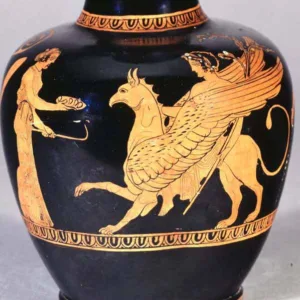
in vessels
in architectural acrocerama
in currencies
in reliefs and jewellery
Their iconography often worked charms.
Intercultural Influences
The Gryphons appear:
correspondent in Minoan art
correspondent in Mesopotamia
correspondent in Persia
This suggests wider mythological exchange in the ancient world.
Ancient Sources
Herodotus
Aeschylus
Pausanias
Archaeological findings of the Eastern Mediterranean
Educational Adaptation
Suitable for:
High School & High School students
culture courses
mythology & art
Conclusion
The Gryphons They are iconic hybrid creatures that embodie the coupling of power and wisdom. As guardians of the sanctuary and symbols of secular order, they hold a separate position in the mythological universe of ancient Greece.
Ancient Sources
- History, 3,116 and 4,13–27 (Grips and Arimaspi).
- Geographically, Book I and XI.
- Natural History, Book VII and I.
- Tour of Greece (references to art depictions of Grups).
- Arimaspia (excerpts rescued to later writers).
Modern Bibliography
- The Greek Myths.
- Early Greek Myth.
- The Routledge Handbook of Greek Mythology.
- The Complete World of Greek Mythology.
- Dictionary of Classical Mythology.