
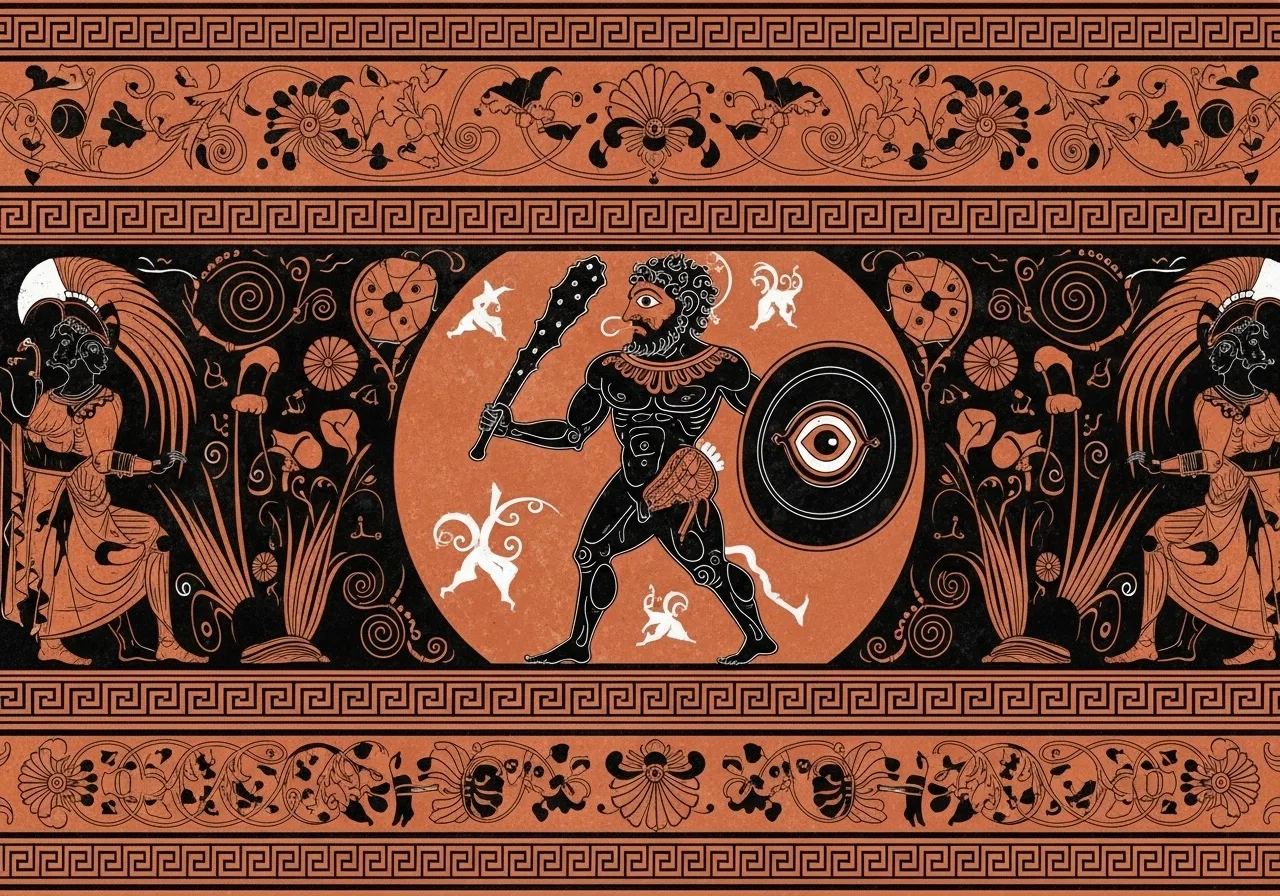
Cyclopes are one of the most famous and impressive forms of Greek mythology. Giants in appearance and gifted with a single eye in the center of their forehead, the Cyclops appear in many myths of antiquity and are associated with both creative power and wildlife. Among them all stands Polyphemus, the one-eyed giant faced by Odysseus on the journey back from Troy.
Ancient Greeks did not have a single tradition for Cyclopes. On the contrary, myths present different generations and categories of Cyclops, from divine craftsmen who built the weapons of the gods to wild shepherds who lived away from all forms of culture.
Who were the Cyclops?
Name «Cyclops» means «roundeyes» or «persons with circular eye». According to mythology, the first Cyclops were powerful giants with an eye on the forehead.
The oldest traditions present them as children of Heaven and Gaia. They were brothers of Titans and Centurions and belonged to the first generations of divine beings that appeared after the creation of the world.
The three most important Cyclops of this generation were Brontis, Steropis, and Argis. Their names are associated with lightning, shine and lightning, elements that reveal their relationship with the powers of heaven.
The Cyclops, craftsmen of the gods
According to mythological tradition, Cyclops were excellent metalworkers and craftsmen. When Zeus freed the Cyclops from Tartara during the Titanic battle, they helped him fight against the Titans.
As a token of gratitude, they built for him Zeus His thunders, the most powerful weapon in the sky. At the same time, they created Poseidon's trident and his invisible helmet Hades.
Thanks to their creations, the Olympian gods managed to prevail and establish the new secular order.
The Cyclops of Odyssey
A different tradition occurs in the Odyssey. There the Cyclops are presented as wild giants who live on isolated islands and do not recognize laws, kings or social institutions.
They live as shepherds, raise sheep and goats and do not cultivate the earth. Their lives are characterized by isolation and lack of culture. For Homer, Cyclops represent the opposite of organized human society.
Polyphemus and Ulysses
The most famous of all Cyclops is Polyphemus, the son of God. Poseidon. During his adventures, Ulysses and his companions landed on the island of Cyclops and entered the giant's cave seeking food.
When Polyphemus returned, he trapped strangers inside the cave by closing the entrance with a huge rock. He then devoured several of Ulysses' companions.
Realizing that power was not enough to defeat the giant, Ulysses resorted to cunning. He offered him strong wine and, when he got drunk, told him he was called «None».
The Blindness of Polyphemus
When Polyphemus fell asleep, Ulysses and his companions shot a wooden stake and nailed him to his only eye.
The giant woke up screaming through pain and called the other Cyclops to help. When they asked him who hurt him, he replied that he was hit. «None». Thinking there was no real enemy, the rest left.
Later, Ulysses and his men escaped hidden under the sheep of Polyphemus.
The curse of Poseidon
As he drifted away with his ship, Ulysses revealed his true identity. The enraged Polyphemus prayed to his father, Poseidon, for revenge.
This prayer became the cause of the great difficulties that Ulysses faced during the rest of his journey to Ithaca. Thus, Polyphemus was known not only for his power but also for his decisive role in the Odyssey.
The Cyclops in Art
Cyclopes were often depicted in ancient Greek art. Vases, reliefs and sculptures present Polyphemus and his conflict with Ulysses, as well as the divine Cyclops working in their workshops.
The icon of the one-eyed giant became one of the most recognizable symbols of Greek mythology and was kept alive until modern times.
The Symbolism of Cyclops
The Cyclops have multiple symbols. Divine craftsmen represent the creative power, know-how and ability of man to tame the elements of nature.
Instead, Polyphemus and the Cyclops of Odyssey symbolize raw power without logic, barbarity and removal from the rules of civilization. Ulysses' victory over them highlights the importance of intelligence over physical strength.
The legacy of Cyclops
Cyclops remain among the most famous creatures in Greek mythology. Their form influenced literature, painting, cinema, and modern fiction.
Polyphemus in particular is still considered one of the most characteristic monsters of ancient myths, while Cyclops overall are symbols of both creative power and uncontrollable savagery that may hide behind natural power.
The Cyclops are one of the oldest and most multi-shade forms of Greek mythology. Although often presented as wild and isolated beings, in other traditions are Divine craftsmen and creators of the most powerful weapons of the gods. Their dual nature reveals their deep symbolism in ancient Greek thought.
Cyclopes are one of the most impressive and mysterious forms of Greek mythology. They are giant creatures with enormous power and a single eye in the center of their forehead. Their name comes from the words «cycle» and «?» (eye), that is «the one with a round eye».
According to ancient tradition, Cyclops appear in different generations and with different roles within myths. In the cosmogony of Hesiod, the first Cyclops were children of Heaven and Gaia. They were powerful and highly skilled craftsmen, who built the most powerful weapons of the gods. They are attributed to the creation of the lightnings of Zeus, the most powerful weapon of the king of the gods.
In other mythological accounts, Cyclops are presented as wild and isolated giants living away from civilization, usually in caves or isolated islands. They did not recognize laws, nor respected gods or men, living a primitive life.
The most famous form of Cyclops is Polyphemus, the giant one-eyed shepherd who meets the Odysseus during his trip to Odyssey. In this story, the brilliant hero manages to trick the terrible giant into escaping from his cave, in one of the most famous scenes of ancient Greek literature.
The myths of Cyclops reveal a world full of power, fear, but also creation. They sometimes appear as divine craftsmen who help the Olympian gods and sometimes as dangerous monsters who threaten people. For this reason, Cyclopes remain to this day among the most exciting forms of Greek mythology.
Origin & Genealogy
Cyclops appear in two basic mythological traditions:
Primary Cyclops (Theogonia – Hesiod)
They were liberated from Zeus and became the artisans of the gods.
Homeric Cyclops
Wild and isolated beings
They lived without laws and social organization
Most known: Polyphemous
Format & Show
Human body giant
A big eye in the center of the forehead
Huge physique
Primary clothing or nudity
The single eye symbolizes the incomplete perception and the lack of balance between power and wisdom.
Powers & Skills
Superhuman physical force
Durability and cruelty
Excellent metallurgy (primary Cyclops)
Fire and metal handling
The Cyclops built:
his thunders Zeus
his trident Poseidon
his helmet Hades
Cyclops in the Odyssey
In Odyssey, Cyclops are presented as:
hostile to humans
You are wicked to the gods.
without laws and hospitality
- Polyphemous He was blinded by Ulysses, who defeated not with strength but with intelligence and strategy.
Role in Mythology
The Cyclops:
bridge chaos with order
represent the raw force without morality
act as a contrast to civilized man
Symbol & Interpretation
Cyclops symbolize:
power without logic
technical progress without social responsibility
the need for balance between knowledge and power
Ancient Sources
- Theogenia, p. 139–146 and 501–506.
- Odyssey, Rhapsody I (book 9).
- Library, 1.1.1–2.
- Praise, Book III.
- Metamorphosis, Book XIII (Polyphemus and Galatia).
Modern Bibliography
- The Greek Myths.
- Early Greek Myth.
- The Complete World of Greek Mythology.
- The Routledge Handbook of Greek Mythology.
- Dictionary of Classical Mythology.