
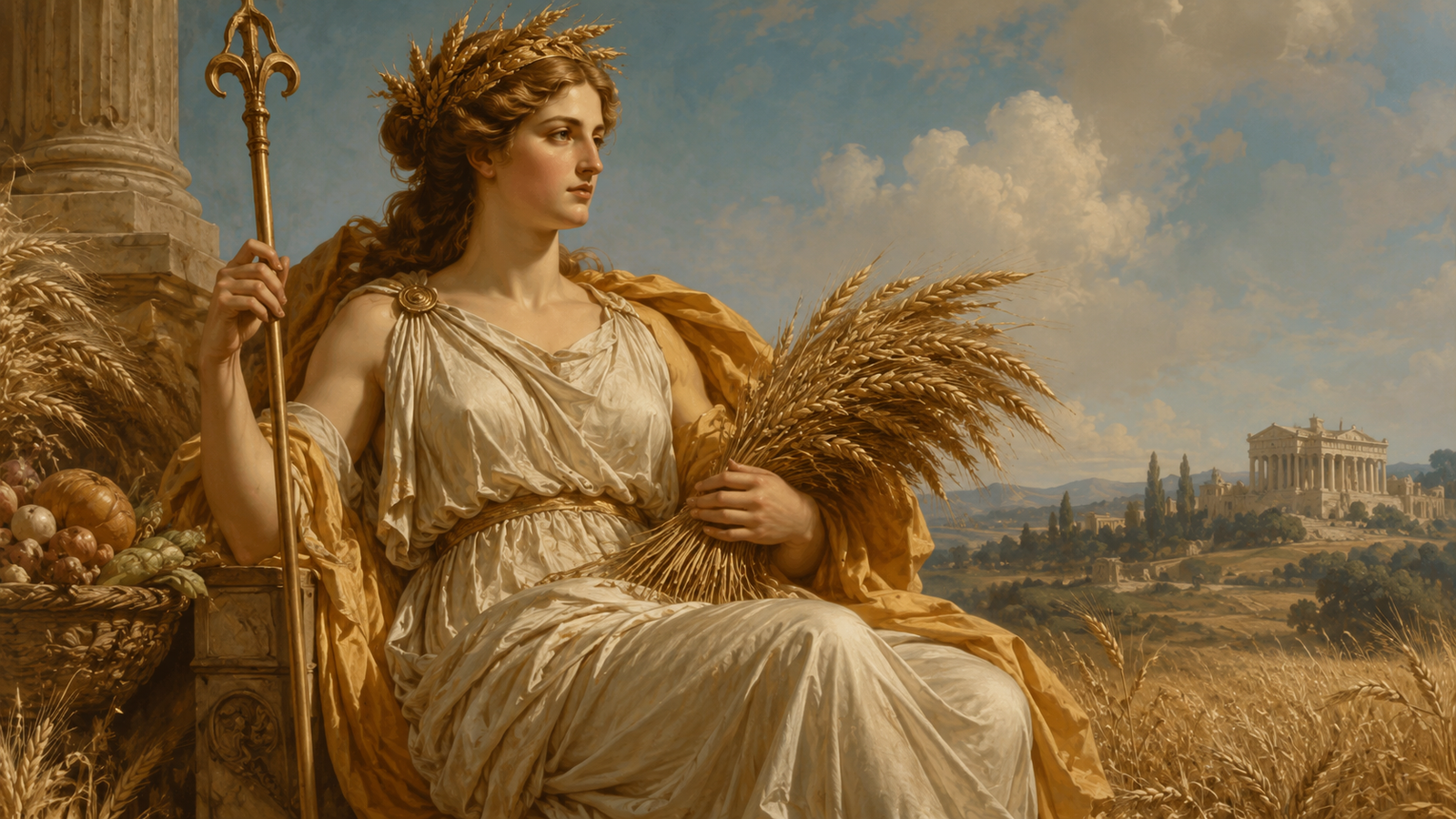
Demeter and the Circle of Seasons
- Goddess Demeter is one of her most loved and deeply human forms Greek mythologyAs a goddess of agriculture, fertility and abundance, it represents not only the power of the earth, but also the delicate balance between life, loss and renewal. In her world ancient Greece, where prosperity depended entirely on the harvest, Demeter was not just a deity of the pantheon. It was the guarantee that the seed would become an ear, that winter would give way to spring and that man would continue to hope.
Its form runs through centuries of civilization, from the Homeric epics and the Eleusinia Mysteries until modern understanding of the relationship between man and nature. The myth of Demeter and Persephone, perhaps the most famous and most touching in all Greek mythology, explains allegorically the cycle of times, but also the deepest human experience of absence and reunification. That is why Demeter remains timeless: because she talks about the earth, but also about what makes us human beings.
Who was the goddess Dimitra in Greek mythology
Dimitra belongs to the generation of grown-ups Olympian gods and is directly linked to the cultivation of land, cereals and the euphoria of nature. Her own name is often etymologically associated with her «c the mother», that is, the mother earth, which I eloquently attributes its role as a goddess that nourishes the world. Unlike deities related to war or power, Demeter represents the production, care and continuity of life.
Its importance in Greek mythology is enormous, because it connects the uncle with the everyday. It is not only about the myths of the gods but also about the real survival of humans. Seed, harvest, storage of wheat and waiting for the next harvest were life cycles for ancient societies. Demeter was the goddess who gave meaning to these circles.
Its origin and position in the 12th
Demeter is his daughter. Cronus and Rea, his sister Zeus, Hera, Poseidon, Hades and Focus. Like her brothers, she was originally devoured by Saturn and later released by Jupiter. This dramatic principle of its mythological course already links its form to the struggle to restore natural order.
As an Olympian goddess, she holds a special position, because her worship was not limited to abstract theology. Demitra was present in the fields, warehouses, fruit, and family tables. Her work was to ensure plenty, but also to remind that fertility is not given· must be cultivated, honored and protected.
The relationship of Demeter with Zeus and the other gods
Her relationship with Zeus is particularly important, mainly because of her daughter Persephone, who acquires a central role in her most iconic myth. Zeus, as a supreme god, often appears as a regulator of divine balances, but Demeter expresses something different: the endurance of motherhood and the uninterrupted connection with the earth.
In tradition, Demeter is also associated with deities and heroes that bring agricultural knowledge to people. The teaching of cultivation, the domestication of cereals and the transition from wild survival to agricultural life are fundamental elements of its divine mission. That is why Demitra is more than a mother: she is a cultural power.
The Legend of Persephone Seduction
If there is a myth that defines Demeter, this is Persephone grab from Hades. This is one of the most powerful narratives of ancient GreeceWhere the pain of loss turns into an explanation of the natural world. Dimitra's daughter, Persephone, while collecting flowers, is snatched by Hades and led to the Underworld to become his queen.
Demeter, devastated, wanders for nine days and nights searching for her daughter. During her pain she leaves him Olympus And he neglects the earth. The earth ceases to reap, the seeds do not germinate, and mankind is threatened with famine. This point of myth is decisive: the grief of a goddess is transferred to secular judgment. The fertility of the earth is directly linked to the inner state of deity.
Finally, an agreement is reached: Persephone will spend part of the time with her mother and a part in Underworld. That explains the cycle of times. When Persephone returns to Demeter, the earth blooms again. When he descends to Hades, nature withers. With this allegory, Greek mythology gave a poetic and at the same time teaching interpretation of the annual agricultural cycle.
Why does Persephone legend remain so powerful
This myth is moving to this day because it is not just a story about gods, but a story about the bond of mother and daughter, about loss and return, about death and rebirth. In symbolic terms, Persephone represents the seed that «buried» on earth to return as a new life. Demeter, respectively, expresses the durable love she expects, mourns and eventually regenerates.
This is why the myth of Demeter and Persephone transcends the limits of antiquity. It talks about global experiences: separation, memory, natural renewal, and reconciliation with change. At a time when people still depended on the crop to survive, such a myth was not only poetic· was also necessary.
The cult of Demeter in ancient Greece
Demeter worship was one of the most extensive and important in ancient Greece. The goddess of agriculture was honored in many areas, with ceremonies, sacrifices, and agricultural celebrations aimed at securing fertility, euphoria, and good crops. Ancient Greeks did not see agriculture as a simple practical process, but as a sacred relationship between man and nature.
Demeter worship also had a deep social character. The communities gathered in shrines, performed rituals and represented sowing and harvest cycles. Through this collective experience, agriculture gained a religious dimension and religion became part of everyday life.
Eleusinian Mysteries
The Eleusinia Mysteries is perhaps the most famous cult expression of Demeter. In Elefsina, near Athens, secret ceremonies were held that were associated with Dimitra and Persephone. Mysteries were considered one of the most sacred and occult religious events of antiquity, and participation in them promised the initiated a deeper knowledge of life and death.
Their importance was enormous, for it was not only about the euphoria of the earth, but also about the hope of a better posthumous fate. At this point, Demitra transcends her role as an agricultural goddess and becomes a deity of salvation and initiation. The connection between the seed that dies in the earth and the soul that hopes for rebirth makes Eleusinia Mysteries One of the most powerful symbols of the ancient world.
Rural holidays and ceremonies
Beyond the Mysteries, Demeter was honored with a variety of rural festivals related to the sowing, harvesting and storage of fruits. These festivals show that her worship was not cut off from production. Rather, worship and work coexisted as interrelated aspects of the same reality.
Offers to Demeter often included fruits, bread, cereals, and other products of the earth. The act of offering was a recognition that prosperity comes not only from human labor, but also from a power greater than man. Thus, the goddess of agriculture acted as a symbol of gratitude and humility.
Demitra as a goddess of agriculture and euphoria
Demeter is not just «the goddess associated with the fields». It is the deity that embodies the logic of cultivation as a cultural act. Agriculture in ancient Greece meant stability, installation, community and programming. Without agriculture, there were no cities, warehouses, commercial exchanges or organized social life. So Demeter is at the core of ancient civilization.
Her contribution to agriculture was more symbolic and religious than technical, but her importance was enormous. Through her worship, people understood the rhythm of nature as a sacred law. Seed requires patience, care, and faith in the invisible. The seed is lost on earth before the fruit appears. This experience was a foundation for the symbolic power of Demeter.
Her relationship with cereals
Cereals, such as wheat and barley, were deeply associated with its name. It's no coincidence that the word «cereals» It still bears its mark today. The fruit, flour, bread, and more generally the community’s food were found under its cover. In an environment where hunger was a constant threat, Demeter symbolized the certainty that the earth can feed man.
Its relationship with cereals also highlights something very important: agriculture is not just a exploitation of nature, but a participation in a living cycle. Demeter, as the goddess of agriculture, personifies this mutual dependence.
Agriculture as a culture
Entry into agricultural life marked one of the greatest transitions in human history. From nomadic or semi-nomadic forms of survival, societies have passed into permanent settlements, systematic production and social institutions. Demeter, as divine protector of this transition, becomes a symbol of civilization itself.
Fertility of the earth requires knowledge, experience and cooperation. These elements are closely linked to the role of Demeter. This is why her presence in mythology is not regional, but fundamental: where the land is cultivated, culture is born.
The symbolism of Demeter in antiquity and today
Demeter has multiple symbols. He is a mother, a feeder, a guardian of the earth, a protector of the harvest, but also a form of mourning and hope. This complexity explains why it remains so important. She is not an ideal, remote goddess without a human dimension. Instead, it is a deity that pains, seeks and insists.
It symbolizes abundance, but also its absence. It symbolizes fertility, but also the cycle of deprivation that precedes regeneration. In other words, Demitra represents not only spring and harvest, but also winter ahead. This duality is what makes her myth so dynamic.
Demeter as mother's archetype
As the mother of Persephone, Demeter acts as a powerful archetype of maternal love. It's not just affection, it's loyalty that moves the whole world. Her grief changes the climate, her absence eliminates vegetation and her joy restores euphoria. The maternal form here is not passive.· It's cosmic power.
This symbolism allowed Demeter to pass on to modern civilization as a symbol of care, fertility and ecological balance. At a time when we are searching again for our relationship with the earth, its form becomes new news.
Her relationship with life cycle
Demeter and Persephone together constitute one of the most beautiful symbolic pairs of mythology. The daughter who descends to the land of the dead and the mother who mourns and waits reflect the eternal cycle of life and death. The land is sown, «He dies.» temporarily, and reborn. Man lives, loses, mourns and continues.
This cycle is not only rural, but also psychological and existential. Demeter reminds us that every loss period may be the beginning of a new fruitage.
The influence of Demeter on culture, art and modern thought
The influence of Demeter transcends the boundaries of ancient religion. In art, literature and modern thought, the goddess of agriculture continues to inspire as a form associated with nature, motherhood and renewal. From ancient statues and reliefs to newer literary references, Demeter remains present as a universal fertility symbol.
In the modern world, its importance becomes even more pronounced due to environmental concerns and the need for sustainable agriculture. The human-nature relationship has been at the heart of public debate, and Demeter acts almost as an archetype of ecological wisdom. It reminds us that the earth is not inexhaustible and that prosperity requires respect for natural circles.
Demeter in art and literature
Its form was often depicted in vases, sculptures and reliefs as a mature woman, often with ears, torch or fruit basket. These symbols are not random. The torch refers to the search for Persephone, the ears in abundance, and the baskets in the gifts of the earth. Her iconography combines grief with generosity, search with completeness.
In literature, Demeter and Persephone myth were exploited as an allegory of the cycle of life, female experience and psychological transformation. Their history is kept alive because it allows multiple readings: mythological, social, psychoanalytic and ecological.
Dimitra and modern ecological sensitivity
Today, the goddess of agriculture can also be read as a symbol of ecological responsibility. On a planet tested by climate change, soil depletion and food crises, the reminder of Demeter is particularly appropriate: the earth needs care, respect and measure. Ancient Greek mythology offers no scientific solutions, but offers a strong moral framework to think about our relationship with the environment.
Demeter invites us to treat the earth not as an object of exploitation, but as a living system of interdependence. That is exactly what its timeless value lies in.
What Demeter teaches us today
Demeter still makes sense because it unites different levels of human experience. She is a goddess of agriculture, but also of care. She is a mother, but also a symbolic representative of the cycle of times. It is a mythological form, but also a living archetype of our relationship with nature.
From Demeter we learn that abundance is not a permanent condition, but a result of care, patience and balance. We learn that loss can turn into rebirth. And most importantly, we learn that civilization begins from the earth. Without the earth, there is no seed. No seed, no fruit. Without fruit, there is no community.
So Demeter is not just a goddess of the past. It is a form that still speaks in the present in a clear and necessary manner. In a world that often forgets its roots, the goddess of agriculture reminds us that life only blooms when we honor the rhythm of nature.
Conclusion
Demitra is one of the most substantial and timeless forms of Greek mythology. As a goddess of agriculture, fertility, and earth, it incorporates the ancient understanding that survival, culture, and spirituality are inextricably bound to nature. The myth of Persephone, worship in Elefsina, agricultural ceremonies and symbolism of rebirth compose a total that exceeds time.
Demeter is not only the protector of cereals and crops. She is the goddess who teaches patience, gratitude and respect for the earth. It is the reminder that each fruit has a cost, every spring requires winter and every return only becomes meaningful after absence has preceded it. That is why her presence remains so vivid in Greek mythology, culture and modern thought.
If we really want to understand Demeter, we must see it not only as a deity of the past, but as a symbol of a truth that never ages: the earth feeds us, but also teaches us. And as long as people continue to sow, wait and hope, Demeter will remain alive.
Frequently Asked Questions About the Goddess Demeter
Who was Demeter in Greek mythology?
Demeter was the goddess of agriculture, fertility, and harvest. It protected the crops, vegetation, and nutrition of people.
What was Demeter's relationship with Persephone;
Persephone was the daughter of Demeter. Her abduction by Hades is one of the most famous myths and explains the times of the year.
Who were Demeter's parents?
Demeter was his daughter. Cronus and Rhea.
What were Demeter's symbols?
Its symbols were the ear, wheat, torch and poppy, associated with agriculture and fertility.
Where was Demeter especially worshipped?
Demitra was widely worshipped in ancient Greece, with Elefsina's most important center of worship.
What were Eleusinian Mysteries?
Eleusinian Mysteries were secret religious ceremonies dedicated to Demeter and Persephone, promising spiritual regeneration to the initiated.
What was the role of Demeter in nature?
Dimitra was held responsible for plant development and food production for humans.
Why is Demeter important in mythology?
Demeter symbolizes the cycle of life, agriculture, and the relationship of man and nature.
How is Demeter portrayed in art?
She usually appears as a mature woman with ears or torches, symbols of fertility and harvest.
What is the meaning of Demeter today?
Demitra remains a symbol of agriculture, abundance and maternal protection in modern cultural tradition.
Ancient sources
Hesiod – Theogenia & Works and Days | Primary Sources
Primary Sources of Greek Mythology | Hesiod, Homer, Orphic Hymns
Primary Sources of Greek Mythology | Ancient Texts
Perseus Digital Library is a reliable academic database with ancient Greek texts and historical sources, particularly useful for the study of Greek mythology and Elefsinian Mysteries.