
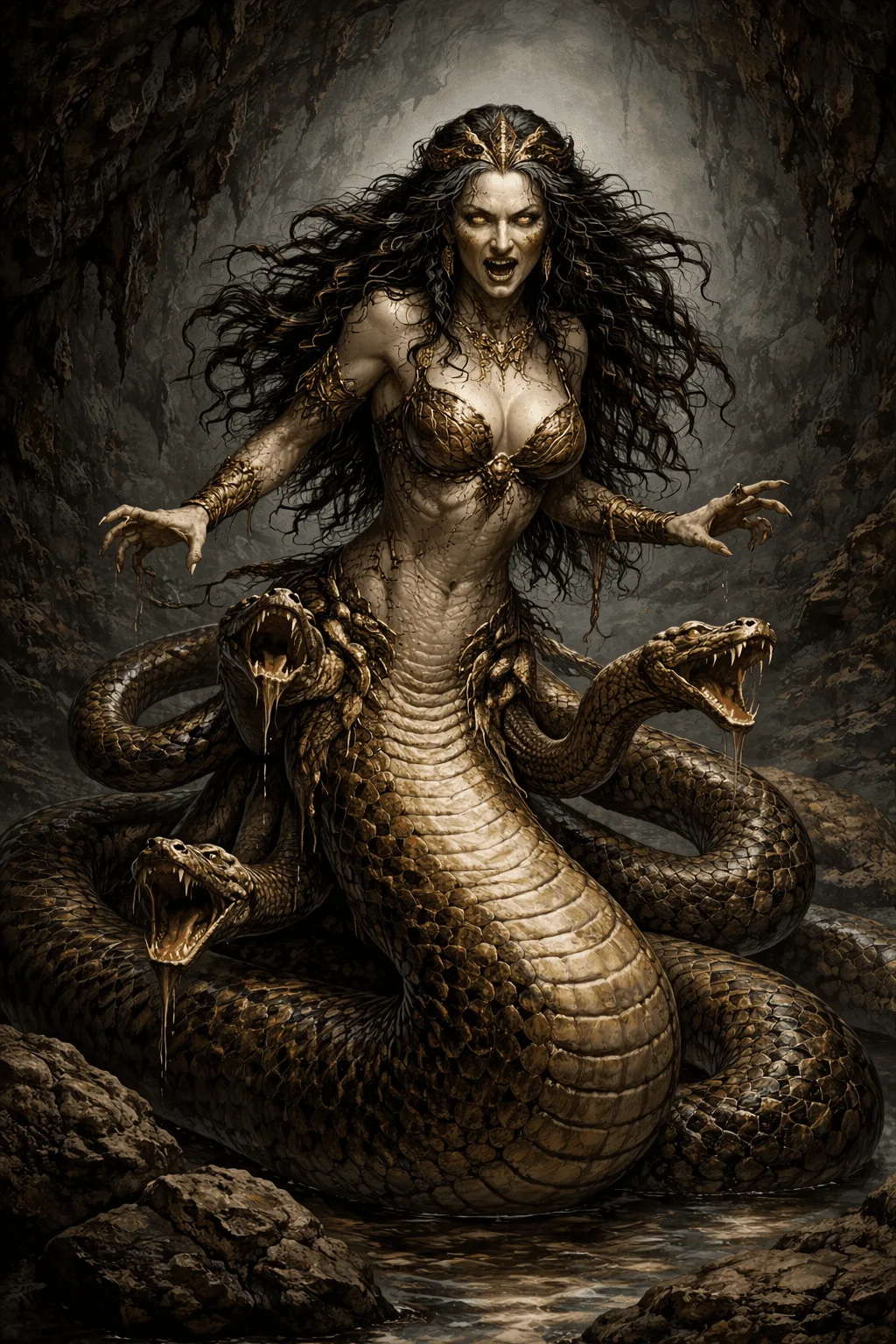
- Echidna is a mythical monster of Greek mythology known as «Mother of monsters». Described as a creature half woman and half snake and considered his companion Typhon. Together they had many famous monsters, such as Cerberus, Lernaean Hydra and ChimeraEchidna is a mythical creature of Greek mythology considered the mother of many monsters.
She is depicted with the upper body of a woman and the tail of a snake, and she was Typhon's consort.
Hesiod, Theogony:
"Men say that Typhaon [Typhoeus] the terrible, outrageous and lawless, was joined in love to her [Ekhidna (Echidna)], the maid with glancing eyes. So she conceived and brought forth fierce offspring; first she bare Orthos (Orthus) the hound of Geryones (Geryon), and then again she bare a second, a monster not to be overcome and that may not be described, Kerberos (Cerberus) who eats raw flesh, the brazen-voiced hound of Haides, fifty-headed, relentless and strong. And again she bore a third, the evil-minded Hydra of Lerna, whom the goddess, white-armed Hera nourished, being angry beyond measure with the mighty Herakles . . . She was the mother of Khimaira (Chimera) who breathed raging fire, a creature fearful, great, swift-footed and strong, who had three heads, one of a grim-eyed lion; in her hinderpart, a dragon; and in her middle, a goat, breathing forth a fearful blast of blazing fire. Her did Pegasos (Pegasus) and noble Bellerophontes slay."
Echidna: The Mother of Monsters in Greek Mythology
Introduction
Echidna is one of the most enigmatic, dark and terrifying forms of ancient Greek mythology. He is not just another monster among the many that appear in the battles of heroes. It is the form behind many of the most famous monsters of Greek mythology: Cerberus, Lernaia Hydra, Chimera, Orthoth, Sphinx and Lion of Nemea. That is why it was known as the «Mother of monsters».
In Echidna two worlds are combined: human and animal, beautiful and repugnant, female and snake, fertility and terror. Her form, half a woman and half a snake, puts her on the boundary between nature and the supernatural. She is not a goddess in the classical sense, but also not a mere beast. It is an ethic force, namely a force associated with earth, depths, caves, darkness, birth and death.
Echidna in Greek mythology acts as a central hub of an entire lineage of monsters. Through it, the ancient Greeks explained the origins of creatures threatening cities, guarding borders, testing heroes and symbolizing the chaos that had to be defeated for order to prevail. Her descendants are treated by heroes such as Hercules, Oedipus, Jason and other figures of the mythical past.
The interest with Echidna is not limited to her terrifying image. Her meaning is deeper. It represents the primordial fear of what lies beneath the surface of the world: caves, marshes, snakes, uncontrollable forces of nature and the dark regions of human imagination. The phrase «Epidna mythology» It refers not only to a mythical monster, but to a whole way in which ancient Greeks understood the boundary between culture and chaos.
Who was Echidna?
Echidna was a monstrous female form of Greek mythology, known mainly from Theogony Hesiod. Hesiod describes her as a creature of dual nature: from the waist up she had the form of a beautiful woman, while from the waist down she was a huge snake. This description is extremely important, because it does not just present it as an ugly or repugnant monster. Instead, Echidna combines attraction with terror.
In the hesiodia tradition, Echidna resides in a cave, away from gods and people. Her isolation is not accidental. Caves in ancient thought are often associated with the depths of the earth, with divination powers, with deities of fertility and with dangers. Echidna belongs to this category of beings that do not live within the organized community of the gods of Olympus nor in the world of mortals. It's in an intermediate, boundary zone.
The word «chthons» It's crucial to understand its nature. Horrible entities are those related to the earth, the subsoil, the Underworld, the burial cults, and the primal forces that precede or lie beyond the order of Olympus. Echidna is not just a resident of the earth; she seems to be the birth of her deepest and raw layers.
Hesiod calls her «aunt» in some interpretations of the text, not because it has the place of an Olympian goddess, but because it belongs to the supernatural field. In the ancient Greek world, «sulphur» did not always mean good or beneficial. It could mean powerful, superhuman, awesome, which goes beyond human measures. In this sense, Echidna is divine, but also deeply threatening.
Its place in the primal forces is also remarkable. Echidna is associated with genealogies that reach back to Ponto, Gaia, Tartarus, Forky and Keatos, i.e. forces much older than the Olympic class. The myths around it preserve memories of a world where nature has not yet been tamed and where life forms are complex, hybrid and dangerous.
Origin and genealogy
The origin of Echidna is not presented in an absolute single form in ancient sources. This is not unusual in Greek mythology. The myths were not a closed, stable system with only one «Official» version. Instead, they were transmitted orally, adapted to local traditions and often acquired different genealogies according to the needs of each poet, worship, or region.
In Hesiod, Echidna belongs to the circle of the monstrous descendants of marine and primitive forces. It is often associated with Forky and Keato, two forms that give birth to many dangerous and strange beings. Forkys and Keato belong to the old sea world, a world of mystery, depth and threat. From them come, in various traditions, the Elders, the Mermaids, and other beings who inhabit the boundaries of the known world.
Echidna's connection to Forky and Keato fits perfectly with its nature. The sea, like the earth, is for the ancient source of life but also of terror. Her depths hide unknown creatures, uncharted areas and forces that escape human control. A creature like Echidna, who breeds monsters and inhabits away from the civilized world, fits this cosmogenic family.
In another tradition, known mainly by Apollodorus, Echidna is presented as the daughter of Gaia and Tartarus. This version makes it even darker and more ethic. Gaia, the personified Earth, is the prime mother of many gods and monsters. Tartarus, on the other hand, is the deepest and darkest part of the world, below even Hades. If Echidna is the daughter of Gaia and Tartarus, then she is literally the birth of the earth and the abyssed darkness.
This variation has an intense symbolic weight. He presents it not as a mere sea monster, but as an expression of the cosmic abyss itself. Echidna thus becomes a relative of forces resisting the Olympic order, such as Typhon, who is also associated with Gaia and Tartarus in several traditions.
There are other, less widespread versions or confusions, as ancient writers often unified local monsters with known mythological forms. In some context, Echidna seems to function more as a type of monster than as a strictly defined person. Its name is associated with the snake or viper, which allows for wider interpretations.
Different genealogies should not be considered errors. Rather, they show the way mythological thought worked. Echidna could be a daughter of sea monsters when the myth wanted to highlight the abyss of the sea. But she could be the daughter of Gaia and Tartarus when the poet or novelist wanted to highlight her relationship with underground chaos and anti-lympian forces.
The Appearance of the Echid
The appearance of Echidna is one of its most characteristic elements. Hesiod imagines her as a creature with a woman's face and torso, beautiful and charming, but with a lower snake body. This image creates strong opposition. On the one hand there is the human, feminine form, which can be associated with charm, motherhood and love attraction. On the other hand, there is the snake, symbol of danger, poison, land and rebirth.
Its double form is not just a aesthetic finding. In ancient mythology, hybrid creatures often express the violation of natural boundaries. Centaurs, Satyrs, Mermaids, Sphinxes, Sirens and Chimers are forms that combine different species. Echidna belongs to this large family of creatures that do not fit into one category. Her body states that she is between man and animal, between the known and the unknown.
The snake is of particular importance in Greek thought. It is associated with the earth because it crawls upon it and often lives in holes or underground places. It is associated with death due to its poison, but also with renewal because it changes skin. In cult context, snakes appear near heroes, graves, divinations, and fertility deities. Therefore, the snake body of Echidna is not only a sign of monstrosity; it is also a sign of deep, ancient power.
Her female side is equally important. Echidna is a mother, but her motherhood is terrifying. It does not breed heroes, kings or gods that bring civilization. It breeds monsters that threaten the world. Thus the mother’s usual image is reversed as a source of protection. Echidna becomes the dark mother of mythological imagination, a form from which the trials of heroes come.
In modern art, Echidna is often depicted with elements reminiscent of medieval or fictional iconography: long hair, human face, scaly body, spiral tail and dark environment. In many modern illustrations it resembles lamia or naga, that is, other mythical forms of half a man and half a snake from different cultures. This visual affinity shows how timeless the pattern of the snake woman is.
In fantasy literature, such figures are often presented as ancient monster queens, earth witches or creatures who maintain secret knowledge. Echidna, though not always appearing under her name, has influenced this fantastic tradition. Her image combines eroticism, danger, motherhood and chaos in a way that still charms.
Echidna and Typhon
Echidna's relationship with Typhon is central to understanding her position in Greek mythology. Typhoon or Typhoon is one of the strongest and most terrifying monsters of ancient tradition. It is described as a giant creature that threatens even Jupiter and the sovereignty of the Olympian gods. The battle of Zeus with Typhon is a myth of cosmic importance: the conflict between order and chaos.
Echidna and Typhon are considered the most awesome pair of monsters because they combine two complementary forms of primordial threat. Typhon is the explosive, heavenly and stormy violence. It is associated with winds, storms, fire, volcanoes and cosmic overthrow. Echidna is more earthly, underground and maternal. He does not appear primarily as a warrior against the gods, but as a monster generator.
Together they form an anti-cosmic family. Their descendants are not random creatures. Each of them occupies a critical space of the mythological world: gates of Hades, lakes and marshes, mountains, roads, city borders, distant countries and sacred objects. Through the children of Echidna and Typhon, chaos spreads around the world and becomes a specific threat.
Jupiter's conflict with Typhon results in confirmation of the Olympic order. However, Echidna and her children show that chaos does not disappear completely. He remains present in various parts of the world and must be treated again and again by heroes. Hercules, for example, does not fight Typhon, but kills or tames many monsters belonging to the Echidna generation.
Thus, Echidna acts as a bridge between cosmogenic mythology and heroic myths. Typhon belongs mainly to the field of the fighting, the battle of gods and primal forces. The children of Echidna, on the contrary, belong to the field of heroic adventure. The hero proves his worth by defeating monsters who are remnants or expressions of primal chaos.
The Children of Echidna
Echidna's reputation as «Mother of monsters» mainly due to her descendants. Ancient writers do not always agree with what creatures were her children and who were grandchildren or related monsters. However, a large number of the most famous monsters in Greek mythology are directly or indirectly connected to it.
In myths, the children of Echidna are not merely enemies of heroes. Each has a specific role. Cerberus guards Hades' gate. Lernaia Hydra resides in a swampy area and multiplys its threat. Chimera combines lion, goat and snake. The Sphinx sets riddles. The Nemea Lion is immune to weapons. These monsters are not simple natural threats; they are symbolic trials.
Cerberus
Cerberus is one of the most famous children of Echidna and Typhon. It is the dog-guard of Hades, who prevents the dead from returning to the world of the living and the living from entering without permission into the Underworld. It is usually presented with three heads, although some ancient traditions render it more.
The most famous myth related to Cerberus is Hercules' twelfth feat. The hero had to descend to Hades and bring Cerberus to Eurysthea without using weapons. Hercules' success shows not only physical strength, but also ability to face death. Cerberus symbolizes the impenetrable border between life and death.
Lernaean Hydra
Lernaia Hydra was a multi-headed aquatic monster living in Lerni, an area connected to marshes, waters and underground entrances. According to legend, when someone cut off a head of Hydra, in its place two young people grew. One of her heads was considered immortal.
Hercules faced Hydra in his second feat, with the help of Iolaus. His victory required strategy: Iolaus burned the necks so that they would not grow heads again. Hydra symbolizes the threat that is multiplied when faced superficially. It's an image of the evil being reborn, disease, marsh and uncontrolled nature.
Chimera
Chimera is one of the most characteristic hybrid monsters of Greek mythology. It is usually described with a lion body, goat head projecting from the back and tail of a snake or dragon. It belongs to the generation of Echidna and Typhon, according to the hesiode tradition.
Chimera was killed by the Bellerophon, riding the winged Pegasus. The monster exhaled fire and terrorized Lycia. Its symbolism is intense: it is a complex creature, unnatural, consisting of incompatible parts. Even today the word «chimera» It means something fantastic, impossible or deceptive.
Orthros
Orthros was the two-headed dog of Geryone, the mythical giant residing in Erythia. Like Cerberus guards Hades, Orthros guards Geryone's herds. His form shows that Echidna's dog-shaped monsters are often associated with guarding boundaries and treasures.
Hercules killed Orthrow during his feat with Geryon's oxen. Orthros symbolizes the keeper of the wild district, the distant place where the hero must arrive to prove his power. He is less known than Cerberus, but mythologically equally important.
Nemea lion
The Nemea Lion, in several traditions, is associated with the Echidna generation. Hesiod presents it as the child of Echidna and Orthrow, while other versions vary. The monster lived in the Nemea area and had skin invulnerable in arms.
Hercules killed it in his first feat, choking it with his hands. He then used his own nail to skin the invulnerable skin and wore it as armor. The Lion of Nemea symbolizes the raw, invincible power of nature, which the hero cannot defeat by conventional means but only by direct, personal valor.
Dragon of Colchis
The Dragon of Colchis was the terrible snake or dragon guarding the Golden Fleece in the grove of Mars. In later traditions and fictional connections, it belongs to the larger monstrous generation of Echidna, although the sources are not always unanimous in its immediate motherhood.
Jason, with Medea's help, managed to acquire the Deras. Medea used magic potions to sleep or neutralize the dragon. The symbolism of the dragon is clear: it guards a precious object, a symbol of royal power and legitimacy. As a snake guard, he belongs in the same mythological world as Echidna.
Eagle of Prometheus
The eagle that tortured Prometheus in the Caucasus appears in some later traditions as a child or related monster of Echidna and Typhon. Every day he devoured Prometheus’ liver, which was reborn at night, so that suffering would continue uninterruptedly.
Hercules killed the eagle and released Prometheus, with Zeus' consent in certain versions. The eagle symbolizes punishment, repetition of pain, and the authority of the gods over those who challenge secular order. His accession to the Echidna generation shows how wide the circle of her descendants could be.
Sphinx
The Sphinx is one of the most complex monsters of Greek mythology. He usually had a lion's body, bird wings and a woman's head. In some traditions he is considered a child of Echidna and Typhon, while in Hesiod he is associated with Orthro and Echidna.
The Sphinx terrorized Thebes by setting a riddle to passersby. Those who couldn't answer were dying. Oedipus solved the enigma, answering that the being who walks in the morning at four, noon at two and at night at three is the man. The Sphinx symbolizes the deadly character of knowledge and the need to understand human life.
Cromyon monster
The Cromyon Monster, also known as Cromyon Ys, was a wild pig that terrorized the Cromyon area near Isthmus. In some traditions it is associated with Echidna or her monstrous generation. The monster was killed by Theseus during his march to Athens.
Cromyon Ys symbolizes the wild and destructive side of nature that threatens the streets and communities. Its extermination by Theseus is part of a series of acts of cleansing the site by bandits and monsters. Like Hercules, Theseus confirms the role of hero by restoring security.
Other monsters and related forms
Echidna was at times associated with more monsters than is mentioned in the basic hesiodia passages. Her mythological «motherhood» became a sort of interpretive shape. When a monster was snake, hybrid, ethnonium or boundary guard, it could easily be connected to its generation.
In this context, Echidna Greek mythology is not only a person but also a principle of classification. It acts as a mother figure for the monster world, even when sources disagree on details. Her influence is seen in how the ancients understood monsters: not as random existences, but as members of a dark family of common origin.
The Residence of Echidna
The residence of Echidna is described as a cave, away from gods and people. Hesiod places it in an occult place, in the depths or ends of the earth, in an area associated with the Arimus or Arimus, depending on the interpretation of the text. The exact geographical identification of this place was already occupied in ancient times.
Some ancient writers connected Arimus with areas of Asia Minor, Cilicia or Syria, where tradition also placed traces of Jupiter's battle with Typhon. Other interpretations relate the place to volcanic areas or places where the earth seemed to breathe fire, smoke, and gas. This matches the character of Echidna's family, associated with underground and secular forces.
The cave is a highly charged symbol. It's a space of protection and threat, a matrix of the earth, but also an entrance into the darkness. Echidna, as the mother of monsters, resides in a space that resembles a natural womb. From there come creatures that will spread around the world and be tested for gods and heroes.
The isolation of her residence also shows that Echidna does not belong to the city, market, temple or palace. It belongs to the limits. In Greek mythology, monsters often reside in marginal places: marshes, mountains, caves, deserts, distant islands, passages and borders. Where human order ends, their space begins.
The relationship of her residence with the Underworld is indirect but essential. It is not always presented as a resident of Hades, but its ethnonic nature and descendants, such as Cerberus, connect it to the kingdom of the dead. Echidna is like a pre-empty form of underground terror, a mother who gives birth to guardians, dragons and creatures of boundaries.
The Death of Echidna
Traditions about Echidna's death differ considerably. In Hesiod, Echidna seems to have almost immortal nature. She is described as a creature that does not age and dies, dwelling eternally in her cave. This version matches her primal character. Echidna is not an enemy that must necessarily be exterminated, but a constant force of the world.
In another tradition, known to us by Apollodorus, Echidna was killed by Argos Panoptes. Argos, known primarily as the keeper with the many eyes that Hera set to watch Jo, is presented here as a hero or monster exterminator. According to this version, Echidna was grabbing passers-by and Argos killed her while sleeping.
The contrast between the two traditions is interesting. In the first, Echidna is an eternal mother power of chaos. In the second, he becomes a dangerous monster who can be eliminated like other monsters. The difference reflects different mythological needs. A cosmogenic poet like Hesiod is interested in bringing Echidna into the great genealogy of the world. A novelist like Apollodorus records traditions where monsters are killed by heroes or divine servants.
The fact that Echidna may be immortal in one version and mortal in another should not alienate us. Many mythological beings have fluid status. Their function changes according to the narrative framework. When Echidna appears as a primordial mother, her immortality makes sense. When she appears as a threat to passersby, her death serves the logic of heroic cleansing.
The Symbolism of Echidna
Echidna's symbolism is multilevel. First of all, it expresses primitive fears. Snake, darkness, cave, isolation and female fertility are combined in a form that causes awe. Echidna is not just something she can attack. It's something that breeds threats. That makes her more terrifying than many of her children.
Echidna also symbolizes the power of nature before domestication. Her children reside in marshes, mountains, far countries and underground passages. They are forms of nature that has not yet entered human service. When heroes kill Echidna monsters, they do not just destroy animals; they transform wild space into a space accessible, habitable and signified.
Another key axis is chaos over order. Echidna belongs to the world of chaos, but not in the sense of absolute mischief. Instead, she has a genealogical order of her own. Her monsters form a family. This is typical of Greek mythology: even chaos is recorded, classified and included in genealogies. In this way, the myth makes the scary understand.
Echidna is also a form of test. Without her children, many heroes would have no field of action. Hercules becomes Hercules because he defeats creatures like the Lion of Nemea, Hydra and Cerberus. Oedipus acquires his theban power by solving the riddle of the Sphinx. Bellerophon is glorified killing Chimera. Thus, the mother of monsters is indirectly and the mother of heroic exploits.
Finally, Echidna expresses the ambiguity of motherhood. Mother is not always a protective form; she may also be a source of terror. In myths, birth does not always lead to culture and continuity, but can pose dangers that threaten the secular class itself. This dark aspect of creation is one of the most powerful aspects of Echidna.
Echidna in Contemporary Culture
Echidna still appears or affects modern culture, particularly in works of fiction, literature, comic books, role games and video games. The form of half a woman and half a snake remains visually strong and easily identifiable. Even when she is not explicitly referred to as Echidna, many creatures of modern imagination remind her mythological image.
In fantasy literature, Echidna is often used as an archetype of the ancient mother monsters. It can be presented as a queen of snakes, as an ancestral deity of monstrous tribes or as a dark form that breeds creatures to overthrow human order. These versions are not always faithful to ancient sources, but they exploit the core of myth: the connection of Echidna to the birth of the monstrous.
In the field of video games and role games, Echidna or creatures inspired by it appear as strong opponents, monster leaders or mythical entities with poisonous, snake or chthonic powers. The idea of a mother who gives birth to different monsters fits particularly in narratives where the player faces escalating threats.
In modern art, Echidna is often portrayed with dark, Gothic or epic aesthetics. Artists sometimes imagine her as a terrible reptilian creature and sometimes as a melancholy mother figure who is on the fringe of the world of gods. This second approach shows a younger trend: monsters are presented not only as enemies, but also as misunderstood or tragic forms.
Echidna Greek mythology has also influenced the way in which popular culture perceives «Monster genealogies». The idea that monsters have a common mother or common source often occurs in modern accounts of horror and imagination. This shows that the ancient myth has not lost its power; it simply changes forms.
Echidna’s Legacy
Echidna's legacy is enormous, although she does not star in many myths with active action. Its importance lies mainly in its genealogical and symbolic function. It is the form that unites many of the most famous monsters of Greek mythology into a family. Without it, the monster world would be more fragmentary.
Echidna shows that Greek mythology was not only interested in the gods and heroes, but also in the forces that resist them. Monsters are not just obstacles; they are necessary for narrative. They give form to fear, uncertainty, and unknown. The mother of monsters is therefore central to understanding mythological worldview.
Its influence is also seen in later myths of other cultures or literary traditions, where maternal forms of monsters appear, dragons that breed genera or dark deities of the earth. Although there is not always a direct linear effect, the archetype is common: a feminine, ethic force from which the monstrous comes.
In the Greek tradition itself, Echidna allows the myths of heroes to be associated with cosmogony. When Hercules kills Hydra or brings Cerberus, he does not just face individual monsters. He faces descendants of a primal force that lies behind the Olympic order and beyond the human world.
Table: The most important children of Echidna and their characteristics
| Plasma | Relative to Echidna | Key characteristics | Main myth | Symbolism |
|---|---|---|---|---|
| Cerberus | Usually the child of Echidna and Typhon | Multi-headed dog, guardian of Hades | Herac's twelfth feat | Limit of life and death |
| Lernaean Hydra | Child of Echidna and Typhon | Multi-headed aquatic monster with regenerative heads | Second feat of Hercules | Multiple threat, marsh, rebirth of evil |
| Chimera | Child of Echidna and Typhon | Hybrid monster, lion-goat- snake, flamethrower | Death by Bellerophon | Abnormal composition, deceptive imagination |
| Orthros | Child of Echidna and Typhon | Double-headed dog, herd guard | Athlon of Hercules with the oxen of Geryon | Keeper of distant boundaries |
| Nemea lion | In some traditions child of Echidna and Orthrow | Invulnerable lion | First feat of Hercules | Undefeated physical force |
| Sphinx | In various traditions child of Echidna | Lion body, female head, wings | Enigma of Thebes and Oedipus | Deathly knowledge, enigma of human life |
| Dragon of Colchis | Relative or later connected monster | Snake keeper of the Golden Fleece | Argonaut campaign | Saving sacred treasure and royal power |
| Eagle of Prometheus | In some later traditions associated with her generation | Huge predator | Torture and liberation of Prometheus | Divine punishment and repeated pain |
| Cromyon monster | In some versions associated with Echidna | Wild boar | Athletes of Theseus | Wild nature threatening the road and community |
Frequently Asked Questions about Echidna
1. Who was Echidna in Greek mythology?
Echidna was an ethnonian, monstrous creature, half a woman and half a snake. She is known as the mother of monsters, because she gave birth to many of the most terrible monsters in Greek mythology.
2. Why is it called «Mother of monsters»?
It is called this because it is associated with creatures such as Cerberus, Lernaia Hydra, Chimera, Orthros, Sphinx, and Nemea Lion. Her lineage brings together many of the greatest threats the heroes faced.
3. Who were Echidna's parents?
Sources disagree. In a tradition it is connected to Forky and Keato, while in Apollodorus it is presented as the daughter of Gaia and Tartarus. The differences are due to the variety of local and poetic traditions.
4. Who was Echidna's companion?
Her partner was Typhon, one of the most powerful monsters in mythology. Together they are considered the most awesome pair of monsters, as many mythical threats come from them.
5. Where did Echidna live?
Echidna lived in an isolated cave, away from gods and people. Ancient sources place it in occult or marginal areas of the earth, often with an ethnonium or underground character.
6. Did Echidna ever die?
In some traditions, such as Hesiod, Echidna is abject and almost immortal. In another version, delivered by Apollodorus, he was killed by Argos Panoptes while sleeping.
7. Who's Echidna's best-known child?
Her most famous child is probably Cerberus, the three-headed dog guarding Hades' entrance. Lernaia Hydra and Chimera are also well known.
8. What does Echidna symbolize?
Echidna symbolizes the primitive fears, the dark fertility of the earth, the chaos that resists order and the trials that heroes must overcome to confirm their value.
Conclusion
Echidna is much more than a monstrous creature of ancient imagination. It is one of the most powerful symbolic forms of Greek mythology, because it gathers in its face the earth, darkness, snake, motherhood and chaos. As the mother of monsters, she is not just the ancestor of terrible creatures, but the source of an entire mythological world of threats and trials.
Echidna mythology connects cosmogony with heroic feats. Through her children, the primal forces pass through the level of divine conflict at the level of human adventure. Hercules, Oedipus, Bellerophon, Jason and Theseus face monsters that belong directly or indirectly to her generation. Thus, Echidna is behind some of the most important moments of heroic tradition.
Its form remains alive because it touches timeless issues: fear of the unknown, the threat of uncontrolled nature, the power of birth, the need of order to face chaos. Echidna in Greek mythology is not only a monster; she is an archetype. She is the dark mother from which trials are born, but also the occasion for heroes to emerge.
This is why Echidna Greek mythology continues to interest scholars, artists and readers. In her face we see how ancient Greeks gave form to the terrifying and how they turned fear into a narrative. If the monsters of Greek mythology are the dark shadows of the world of heroes, then Echidna is the womb of these shadows: terrible, charming and unforgettable.
| Item | Information |
|---|---|
| Name | Echidna |
| Type | Mythical monster, semi-female |
| Parents | Gaia and Tartarus or Fear |
| Consort | Hurricanes (according to some sources) |
| Children | Cerberus, Chimera, Lernaia Hydra, Sphinx, Ornithes |
| Powers | Immortal, transformations, monster birth |
| Residence | Caves and wild mountains, Libya or Crete |
| Symbolism | Nature, fear, destruction, fertility, mythical creatures |
Ancient Sources
- Theogenia, p. 310–312.
- Library, 2.5.12.
- Iliad, 8.368 and later reports.
- Praise, Book VI.
- Description of Greece.
Modern Bibliography
- The Greek Myths.
- Early Greek Myth.
- The Complete World of Greek Mythology.
- The Routledge Handbook of Greek Mythology.
- Dictionary of Classical Mythology.