
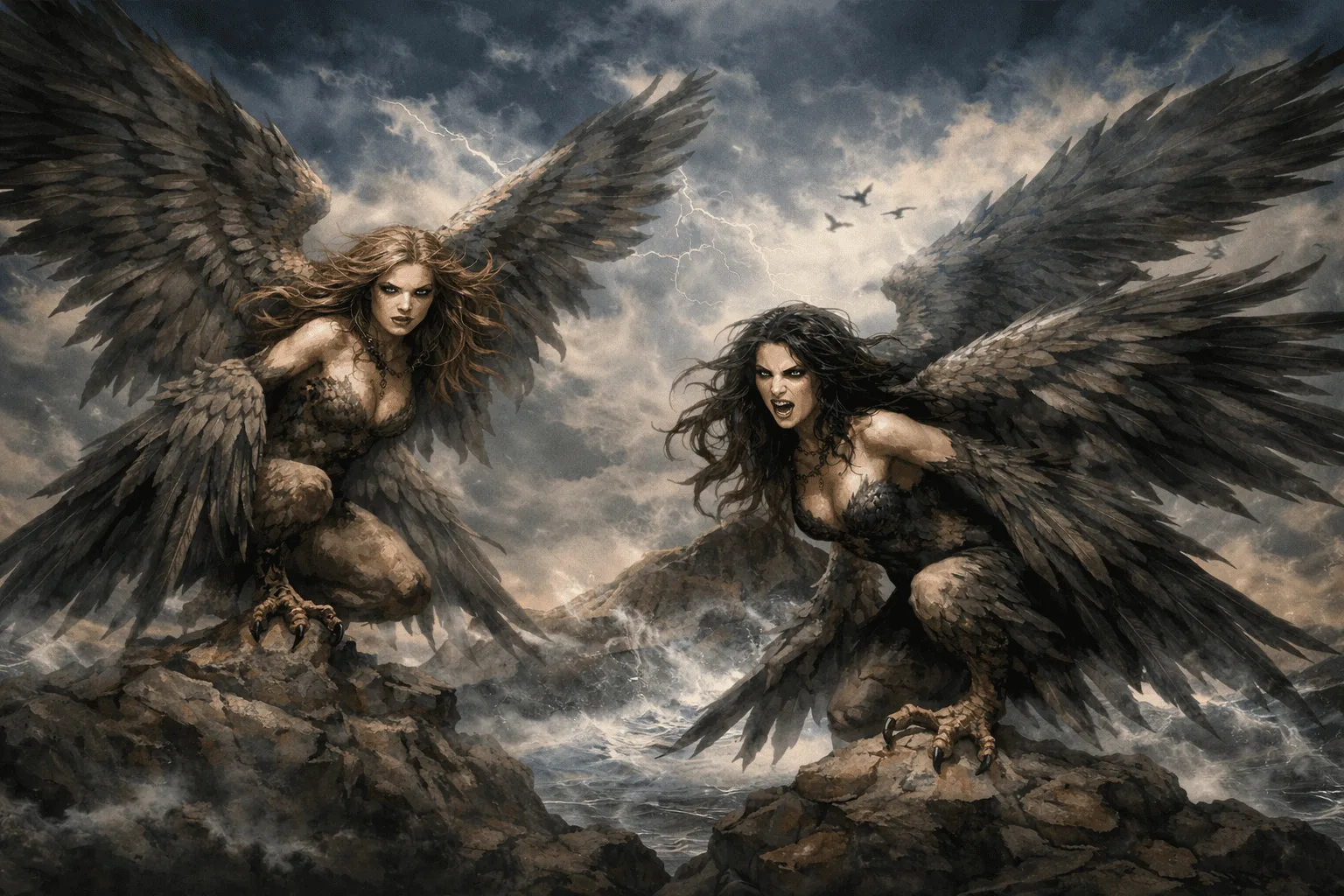
The Harpies They are among the darkest and scariest creatures in Greek mythology. They are depicted as beings with the body of a woman and birds of prey, often with fucking claws and wild face. Their name comes from the verb I'm sipping., stating their violent and sudden nature.
Arpyia are one of the strangest and terrifying forms of Greek mythology. Their name comes from the ancient Greek verb «I'm sipping.», meaning «Grab» or «I'm being violent.», and reveals their basic role as spirits that grabbed people, objects or food. In ancient myths they are not presented as monsters, but as personifications of stormy winds. Over time, however, their image became increasingly threatening, until they ended up portraying themselves as hideous creatures with a bird body and a female face.
According to Hesiod, harpies were daughters of the Wonderman and her Ocean Electra and sisters of Iris, the goddess of the rainbow. The earliest traditions mention two harpies, Aello and Ocypeti, whose names relate to the speed and power of storms. Later Kelaineau was added, resulting in many sources talking about three harpies.
In the Homeric epics harpies are mainly associated with winds and the sudden disappearance of people. They do not yet have the form of monsters but act as divine forces carrying or grabbing mortals. Later, during the Hellenistic and Roman times, their image was transformed into winged female figures with claws of predatory birds and a repugnant look.
The most famous myth that concerns them is that of King Phineas of Thrace. Phineas had acquired the gift of prophecy, but caused Zeus' wrath by revealing divine secrets to humans. As punishment, he was sentenced to hunger eternally. Every time he tried to eat, the harpies came down from heaven, grabbed his food or contaminated it with their stench, leaving him helpless to feed. This punishment ended only when Jason and the Argonauts arrived in Thrace. Borea's winged sons, Callis and Zetis, pursued the harpies and forced them to leave Phineas.
The harpies also appear in Roman tradition. In «Famine» Virgil meets Aeneas and his companions in the Strofadian islands. There Arpya Kelaineau predicts the difficulties they will face before they establish their new homeland in Italy. This account contributed to the spread of the image of harpys as terrible and ominous creatures.
Symbolically, Arpyans represented the uncontrolled forces of nature, sudden calamities, and divine punishment. For ancient Greeks, destructive winds, loss of goods or even unexplained disappearances could be attributed to the action of these supernatural beings. The evolution of their form by wind spirits to monstrous demons reflects the way myths changed according to religious and cultural perceptions of each era.
Despite their terrifying character, Arpyans hold an important place in Greek mythology, as they connect the world of gods with the ignorant forces of nature and are a typical example of the mythological effort to explain the world's unexplained phenomena.
According to the ancient secretariat, harpies were considered Wind demons, means of pollution, hunger and punishment. They appear as executive instruments of divine justice, mainly in his myth PhineasThey tortured him by grabbing and infecting his food. The intervention of the Voreas, the sons of Vorea, led to their pursuit.
The most famous harpies are Aello, - Ocypet and Keleno, names directly associated with storms, speed and dark natural phenomena. In mythological thought, harpies are not just monsters, but personifications of uncontrolled nature and divine punishment.
Etymology and Name
The word Harpies comes from the verb I'm sipping. («I grab, I grab»), stating their violent nature and function as snatch spirits.
In the Latin Secretariat they reply as Harpyiae.
Origin and Genealogy
According to Hesiod:
Father: Thavmas
Mother: Electra (Ocean)
They join the genealogy of the chthonian and atmospheric demons, related to:
Iris
Winds and storms
Morphology and Iconography
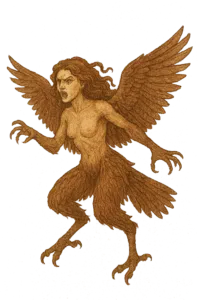
The harpies are depicted as:
bird body (harpatic)
female head
sharp nails
large wings
In the earliest performances:
are beautiful and fast
In the following:acquire repulsive form
symbolize sepsis and infection
Harpies as Wind Spirits
Originally considered wind blowing spirits, personifications of sudden grab. Their transformation into vigilantes reflects the evolution of religious thought.
Harpies and Phineas
The most famous myth concerns PhineasKing and Oracle, who was punished by the gods.
The harpies:
They grabbed or contaminated his food.
They condemned him to constant hunger.
The Boreades They were expelled, showing the limit of divine punishment.
Harpies Names
Sources shall answer:
Aello (storm)
Ocypet (fast flight)
Keleno (Dark)
Names enhance the connection to natural phenomena.
Symbolism
The harpies symbolize:
the divine wrath
punishment without mercy
loss and hunger
the inevitable consequence of the hybrid
Harpies in Art and Literature
They are depicted:
in archaic vessels
in epic and tragic works
in Roman and medieval art
Their form deeply affected Western imagination.
Ancient Sources
Hesiod, Theogony
Apollonius Rhodium, Argonauts
Virgil
*Pausanias
Educational Adaptation
Suitable for:
teaching divine punishment
comparative mythology
analysis of physical phenomena symbols
Conclusion
The Harpies They are grim but essential elements of Greek mythology, revealing the mechanism of divine justice and the fear of hubris.
Frequently asked questions about Harpies
What were harpies in Greek mythology?
The harpies were mythical creatures that had a bird body and a woman's face. They were associated with the storm, wind and were often considered punishment agencies.
What was the role of harpys?
The harpies were considered spirits that grabbed people or food and often carried out orders of gods as punishments.
How were the harpies depicted?
In ancient art they were presented as winged women with sharp claws and wild form.
What myths are the harpies associated with?
The harpies appear in hero stories such as Jason and Argonauts.
Were the harpies bad?
In mythology they are mainly presented as dangerous creatures, although their role was more punitive than absolutely evil.
What were the harpy features?
They had a bird body, wings, and a woman’s face, and were considered very fast and strong.
Where did the harpies live?
The harpies were associated with remote areas, mountains, and windy places.
What was the meaning of harpys in mythology?
They symbolized the wrath of the gods, punishment and destructive forces of nature.
What is the meaning of harpys today?
The harpies appear in literature, fictional art, and modern stories as dark mythical creatures.
Why are harpies important in mythology?
They are part of the Greek mythological tradition and are associated with stories of heroes and divine punishment.
Ancient Sources
- Theogonia, f. 265–269 (Arpyan genealogy).
- Odyssey, I and K (references to Arpyas as wind spirits).
- Argonaut, Book II (the myth of Phineas).
- Library, I 2.6 and I 9.21.
- Praise, Book III.
Modern Bibliography
- The Greek Myths.
- Early Greek Myth.
- The Routledge Handbook of Greek Mythology.
- Dictionary of Classical Mythology.
- The Complete World of Greek Mythology.