
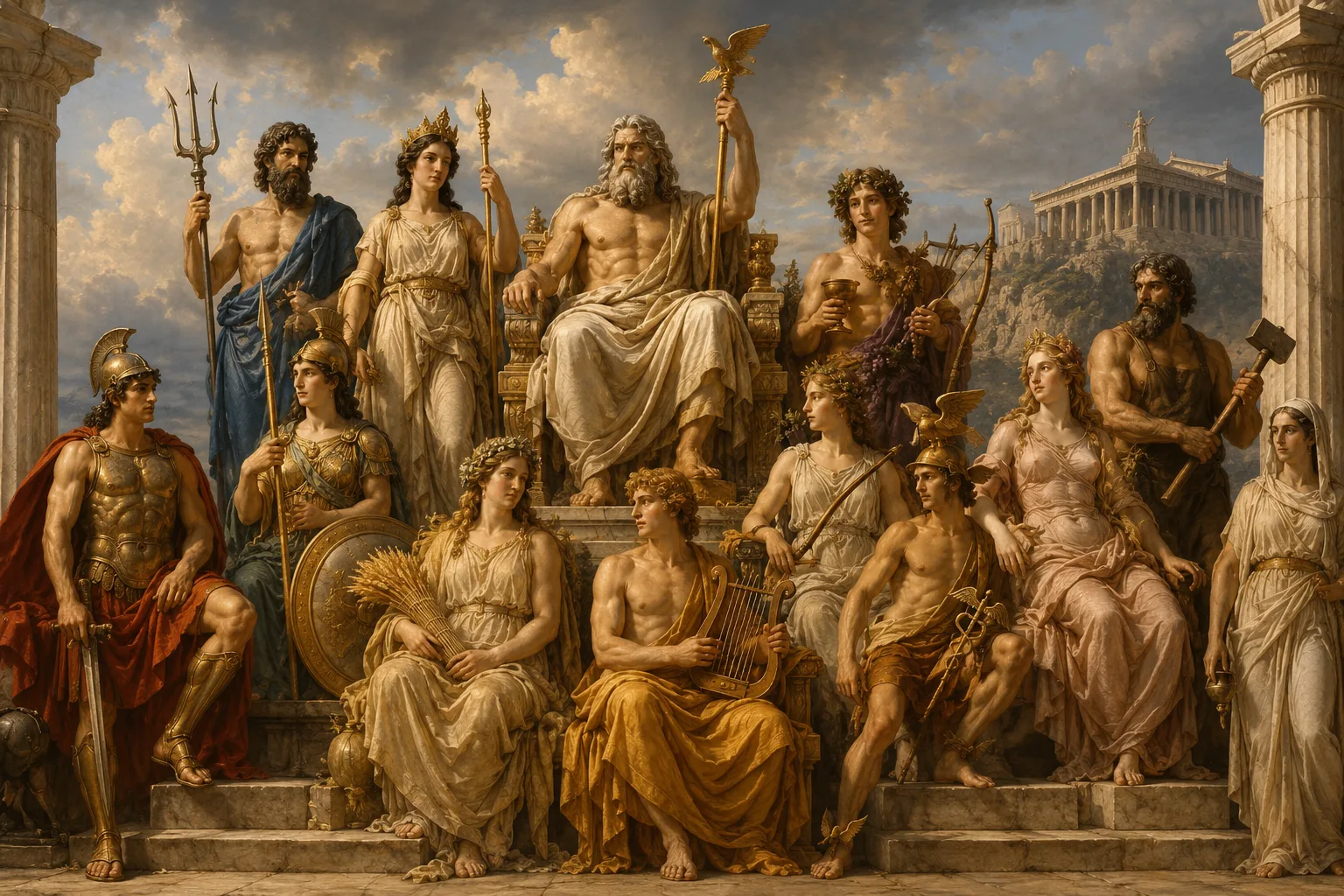
When we talk about the Dodecanese, do we refer to a real ancient religious group or an image formed much later? The question seems simple, but the deeper one digs into the sources, the more complicated the answer proves. THE Zeus With lightning, the Hera on her throne, Athena with the spear, Apollo with the lyre — all these images of us are so familiar that we rarely wonder whether they corresponded to a real, defined group of gods in the consciousness of the ancient Greeks, or whether it is a composition that was built slowly, centuries after the fall of ancient religion. The story to follow shows that the truth is somewhere between: there was indeed a tradition Twelve Gods, but not in the form of a stable, nationwide doctrine that most today imagine.
The image of the Dodecanese today
In school books, the Dodecanese is usually presented as a neat list: Zeus, Hera, Poseidon, Dimitra, Athena, Apollo, Artemis, Mars, Venus, Hephaestus, Mercury and Estia or Dionysus, depending on the source followed by the author of the book. This image is convenient for teaching purposes — gives students a clear, memorizing structure. But it is precisely this clarity that is misleading.
Modern culture has strengthened this image even more. Films such as «Percy Jackson», games like the «Hades» or «God of War», even comic books and series, present a stable «group» of the gods of Olympus, as if they were superheroes with defined roles and hierarchy. This account is dramaticly effective, but it does not correspond exactly to how ancient Greeks experienced their religion. The result is that most today believe that there was a stable, official list of twelve gods, recognized by all cities, in the same way that the Catholic Church has an official doctrine. The reality of ancient Greek religion was much more fluid.
How ancient Greek religion really worked
In order to understand why the idea of a single Dodecanese is problematic, we must first understand how the religion of the ancient Greeks worked in practice. There was nothing like the Bible or the Koran· there was not a sacred book that determines which gods there are, how many they are and in what order they are classified. There was also no central church authority, a priesthood with nationwide jurisdiction to decide on the official doctrine.
Instead, the ancient Greek religion It was deeply local. Each city-state had its own cults, its own politic gods, its own sanctuaries and its own celebrations. Athena was a patron goddess of Athens, not because someone «rule» He defined it, but because the city had developed with it a special relationship, expressed through myths such as its dispute with Poseidon to protect the city. In Argos, the dominant deity was Hera, with the famous Heraion being one of the most important sanctuaries in the area. The Sparta, Apollo in Amicycles had a special place, while in many rural areas there were cults of local heroes, nymphs or river gods that were never included in anyone «Official» list.
This diversity was not a problem for ancient Greeks — was the normal way of operating their religion. Worship was a practical matter: sacrifices, celebrations, rituals, not intellectual belief in a solid doctrine. Therefore a city could honor twelve, thirteen or more gods, depending on its tradition, without this being considered a contradiction.
Was there really the Dodecanese?
Nevertheless, it would be wrong to say that the idea of the Twelve Gods was a completely modern invention. Ancient Greeks knew very well the meaning of «Twelve Gods» as a separate religious category, and there are several ancient references to them. Herodotus refers to sacred ones dedicated to Twelve Gods, while in many Greek cities there were altars or temples dedicated collectively to this group.
The most well-known and best-documented example is the altar of Twelve Gods in Athens, in the Ancient Agora, founded around 522/521 BC by Pisistratus the youngest, grandson of the tyrant Pisistratus. The existence of this altar proves that the idea of a group of twelve gods was important enough to obtain a specific, material point of worship in the heart of the city. At the same time, however, it does not mean that this group was a mandatory religious rule for all Greeks. It was an important religious tradition, with particular symbolism, but not a binding one. «dogma» In the sense that we would mean it today.
The number twelve had its own gravity in the thought of the ancient Greeks, associated with the secular order, the twelve months of the year and a more general sense of completeness and balance. That is why the group of «Twelve Gods» It functioned as a symbolic figure expressing the fullness of the divine world, but without always being the same dozen gods in every place.
The altar of Twelve Gods
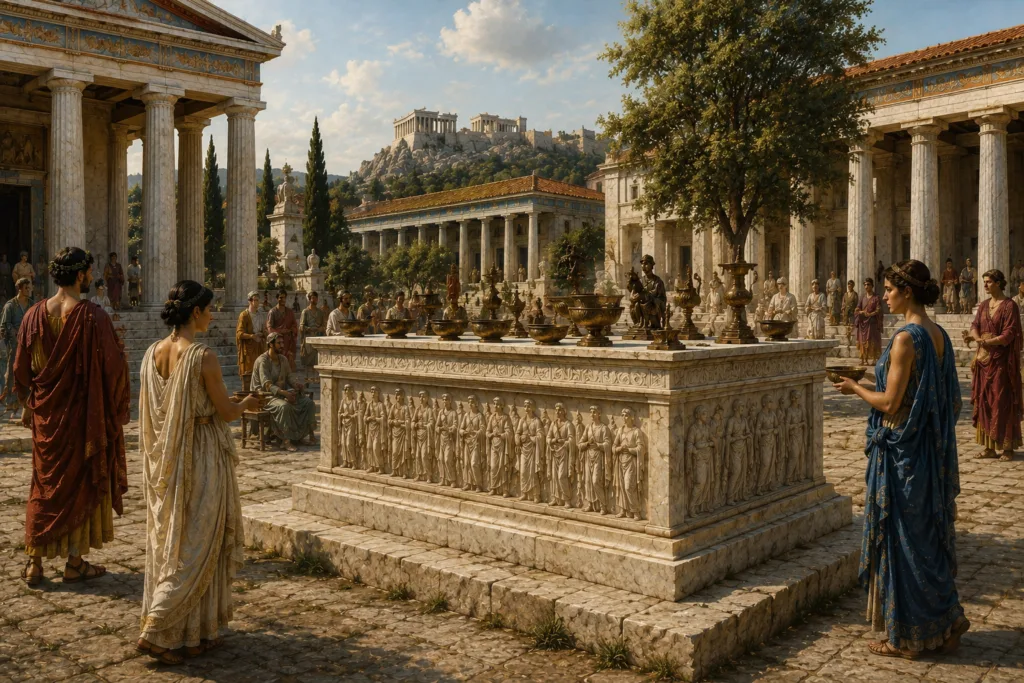
The altar of Twelve Gods in the Athenian Agora deserves special mention because it is the most tangible archaeological evidence of this tradition. It was built at a time when Athens was trying to consolidate its political and religious identity, and its position was not accidental: it was located in the center of the city, near the Agora, where the public life of the Athenians was concentrated.
The altar functioned as a reference point of multiple significance. First, it was a religious center, a place of sacrifices and rituals dedicated to the collective group of gods. Secondly, it also had a practical function as a point of zero: from there the distances to other cities were measured, which shows how central its role was in the geographic and symbolic organization of the city. Thirdly, it was a place of asylum where those seeking protection could flee.
Archaeological excavations in the area of the Athenian Market have identified the foundations of the altar, confirming its location and giving historians valuable information about its operation within the urban fabric of classical Athens. The fact that such an altar was considered so important to be placed in the heart of the city shows how deeply rooted was the idea of the Twelve Gods in collective consciousness, at least in Athens.
Who were the Twelve?
The question «Who exactly were the Twelve Gods?» has no answer, and that is perhaps the most revealing element of this whole story. There is no single, nationwide accepted list. The composition of the group differed from city to city, and sometimes even within the same city, depending on the time and the sanctuary to which we refer.
In Athens, the tradition associated with the altar of the Agora included the twelve Olympians with the most famous composition: Zeus, Hera, Poseidon, Demeter, Athena, Apollo, Artemis, Mars, Venus, Hephaestos, Mercury and Estia. In Olympia, however, tradition was different: there were the Twelve Gods worshiped in pairs, divided into six altars dedicated to two deities each, with Pindar and Herodotus referring to this tradition in somewhat different details. In other cities, composition could change even more, depending on local cult priorities.
One of the most interesting issues is its position Hestia and Dionysus. In many versions, Estia, goddess of the hearth and home, was considered a member of the Twelve because of her central position in family and political life — Every house, every city had its own hearth, sacred fire that never faded. In other, later traditions, its position seems to be occupied by Dionysus, a god of wine and ecstasy, perhaps because of the increasing importance of his worship, especially through theatre and major festivals such as Dionysia. But this is not a simple matter. «replacement» in chronological order, but for two parallel traditions that coexisted in different contexts.
| Version | Gods | Remarks |
|---|---|---|
| Athenian (Market altar) | Zeus, Hera, Poseidon, Dimitra, Athena, Apollo, Artemis, Mars, Venus, Hephaestus, Hermes, Estia | The most famous version today, connected to the altar of 522/521 BC. |
| Olympic tradition | Six pairs of gods in separate altars | Different organization, with emphasis on duality of cults |
| Issue with Dionysus | Same as Athenian, but with Dionysus instead of Estia | Associated with the rise of dionysian worship and theatre |
| Local variations | Different combinations by city | They reflect local cult priorities, not nationwide rule |
Why was the number twelve chosen?
The number twelve was not accidental in ancient Greek thought. It was closely linked to the idea of secular order — an organized, balanced structure of the universe, unlike chaos. The most obvious connection is with the twelve months of the year, which gave the group of gods an almost calendar, circular symbolism: as time ends in twelve months, so the divine world could be represented as a complete, complete dozen.
The religious organization around this number also served practical purposes: it gave a sense of order to a world with dozens, if not hundreds, of local deities. Interestingly, the number twelve appears with similar symbolic weight in other ancient cultures. — the twelve gods of Anatolia to the Hittites, the twelve main gods of Roman tradition (Dii Consentes), even the twelve-month cycle in astrological systems of Mesopotamia. This shows that the choice of twelve was not exclusively a Greek particularity, but part of a wider tendency of the ancient world to organize the divine universe around numbers with symbolic gravity.
Worship of the gods in everyday life
Beyond the Twelve Gods and the great Olympians, the daily religious life of ancient Greeks was full of cults that never joined any official list. Each family had its own family cults, usually dedicated to Estia and ancestral gods or heroes. The public sacrifices made at large festivals addressed the politic gods of each city, not necessarily to an abstract «group 12».
At the same time, there was a whole universe of local heroes — persons who, after their death, gained worship of an almost divine character, such as Theseus in Athens. Nymphs inhabited springs, forests, and mountains, and were worshiped locally with small rituals. River gods, such as Acheloos, had their own cult tradition in areas near rivers. None of these deities ever belonged to the so-called Dodecatheus, but they were equally, if not more, present in the daily religious experience of the average Greek than Zeus or Hera.
What do ancient sources say?
It is useful to see what ancient writers actually write, because often the modern image is based on misunderstandings around these texts. Homer, in Iliad and Odyssey, presents a living world of gods of Olympus, but without ever explicitly referring to a closed group «12» of gods — presents many more gods to act, while some of them later «12» have a relatively limited role in its epics. Hesiod, in Theogony It mainly deals with the genealogy of the gods and the creation of the world, without setting as its goal the definition of a closed dozen.
- Herodotus He refers to sacred and altars dedicated to the Twelve Gods at various points in his work, giving us valuable evidence of the geographical spread of this worship. Thucydides mentions the altar of the Twelve Gods in Athens in relation to historical events of his time, confirming the existence and importance of this monument. Pausanias, in «Tour of Greece», details the organization of worship in OlympiaWith the six double altars. Xenophon occasionally refers to rituals related to these gods, while Pindar, in his Olympians, praises Olympia and her religious tradition in a poetic way, emphasising the importance of the place as a nationwide shrine.
| Ancient Author | What does it say? | What we conclude |
|---|---|---|
| Homer | Olympus gods in action, without closed dozens | The idea of «Twelve» was not central to the Homeric religion |
| Hesiod | Genealogy of the gods (Theogony) | He's interested in origin, not a closed group of twelve. |
| Herodotus | Holy and altars of Twelve Gods in various regions | Worship was widespread but not single |
| Thucydide | The altar of the Twelve Gods in Athens | Confirms the historical significance of the monument |
| Pausanias | The organization of worship in Olympia at six altars | It shows different structure than Athenian tradition |
| Xenophon | Occasionally ceremonial reports | Confirms the spread, not the singularity of worship |
| Pindar | Poetical praise of Olympia as a nationwide sanctuary | It emphasizes the symbolic, not dogmatic significance of the gods |
How was the modern image of the Dodecanese created?
The image of the Dodecanese as we know it today is not just «ancient» — is the product of a long systemization process that began many centuries after the decline of ancient Greek religion. During the Renaissance, European scholars, fascinated by ancient texts, began to systematically study Greek mythology, trying to organize it in logical, comprehensible shapes, according to their own perception of how to operate a «religion». This attempt to systemize gradually led to the creation of a stable list of twelve gods, more settled than was actually the ancient worship.
The modern 18th and 19th century historiography further strengthened this trend, as researchers of the time sought clear structures and classifications — a tendency that matched the general spirit of Enlightenment to categorize knowledge. The following school textbooks adopted this simplified version, making it teachingly convenient but historically inaccurate as to the complexity of true worship. The museums, presenting the findings with thematic organization around them «12 Olympians», and tourism, which needs simple and attractive narratives, helped further consolidate this image. Finally, the modern cinema and pop culture, as mentioned at the outset, gave this image its final, impressive form that dominates popular perception today.
Common misconceptions
There are several widespread misconceptions around the Dodecathus, which deserve to be cleared up.
| Myth | What really applies |
|---|---|
| There was an official Dodecanese | There were local traditions of Twelve Gods, not a single, binding doctrine |
| All Greeks worshiped the same gods | Each city had its own cult priorities and politic gods |
| Estia was permanently replaced by Dionysus | These were parallel traditions, not a linear substitution. |
| Homer presents the complete Dodecanese | Homer describes many gods, without a closed group of twelve |
| All cities had the same holidays. | Celebrations and rituals differed considerably from city to city |
Interesting historical data
It is worth mentioning some smaller, but revealing stories. Travellers and merchants arriving in Athens often passed through the altar of the Twelve Gods, not only for cult reasons but also because it was a geographical reference point for measuring distances to other cities — something like the ancient equivalent of a modern «kilometre zero».
In Sparta, the worship of Apollo in Amyles had its own, particularly typical, very different from the Athenian worship of the same god. In Delos, the island considered to be the birthplace of Apollo and Artemis, developed one of the most important nationwide sanctuaries, a meeting point for cities from all over the Greek world. In Olympia, the worship of Zeus dominated because of the Olympic Games, while in Athens Athena remained undisputed at the centre. These differences were not random — They reflected the history, geography and political identity of each city, showing why certain gods were more important in certain areas than in others.
Conclusion
The truth about the Dodecanese is more interesting than the simplified myth that we are used to. Ancient Greeks did know and honor a group of Twelve Gods — The altar of the Athenian Market, the references of Herodotus and Thucydides, the organization of worship in Olympia, proves it. But there was not a single and unchanged «Dodecathus» for the whole Greek world, with stable composition, recognized by all cities in the same way. Instead, there were multiple local traditions, with a common symbolic nucleus around the number twelve, but with significant variations in the composition and importance of individual deities.
The present image of the Dodecanese is, ultimately, a combination of ancient tradition and modern historical systemization. — a product built on real religious foundations, but formed by Renaissance, modern historiography, education and modern culture in something more neat, more «clean» than it ever was in the real religious experience of ancient Greece. Understanding this difference, we lose nothing of the charm of myth — Instead, we get a richer, more human image of how ancient Greeks actually experienced their relationship with their gods.

FAQ
Was there really the Dodecanese in ancient Greece?
Yes, the ancient Greeks referred to «Twelve Gods» and in some cities there were sacred dedicated to them, such as the altar of Twelve Gods in the Athenian Market. However, there was not a single and unchanged list of gods valid throughout the Greek world.
It's the term «Dodecathion» ancient or modern?
The idea of a group of twelve great gods is ancient and documented in the sources. But today's perception of a strictly defined «Dodecathus» It is largely the result of newer historical systemization and education.
Who were the Twelve Gods?
Most catalogues include Jupiter, Hera, Neptune, Demeter, Athena, Apollo, Artemis, Mars, Venus, Mercury and Hephaestus. The twelfth place differs according to tradition, as it is sometimes attributed to Estia and sometimes to Dionysus.
Why are there different lists of Twelve Gods?
Ancient Greek religion had no central church, sacred book or official doctrine. Each city-state kept its own cult traditions, resulting in different versions of the Dodecanese.
What was the altar of the Twelve Gods in Athens?
It was an important public and religious monument founded in the late 6th century BC in the Athenian Agora. Apart from a place of worship, it was also a reference point for measuring distances to the other Greek cities.
Did all ancient Greeks worship the same gods?
Nope. Although the Olympian gods were widely known, each region highly honored its own protected gods, local heroes, nymphs and other deities, creating a particularly rich and diverse religious landscape.
Did Dionysus replace Estia in the Dodecanese?
There is no ancient evidence that some official replacement has been made. Some traditions include Estia, while others Dionysus. These different versions coexisted without one being considered the only or the official.
Does Homer mention the complete Dodecathus?
Nope. Homer presents many Olympian gods in Iliad and Odyssey, but it does not quote an official and complete list of the Twelve Gods as we know it today.
Why was the number twelve chosen?
The number twelve had special symbolism in the ancient world and was associated with completeness, order and organization. This is probably why it was used to express a representative group of the most important Olympian gods.
What is the difference between the Dodecanese and the Olympian gods?
The Olympian gods form the whole of the gods who symbolically inhabited Olympus. The Dodecanese is a specific group of twelve of them, whose composition was not always the same in all regions of ancient Greece.
Bibliography and Sources
Ancient Sources
- Homer. Iliad and OdysseyTranslation and ancient text available from the Library Perseus.
- Hesiod. Theogony. Basic source for the genealogy of the gods and the formation of the Greek pantheon.
- Herodotus. HistoryIt includes references to the worship of the gods and the religious traditions of the Greeks.
- Thucydides. History of the Peloponnesian WarReferences to sacred and public religious practices.
- Xenophon. Greek and Memories. Precious information about the religious life of classical Athens.
- Pausanias. Greece TourDetailed descriptions of sacred, altar and local cults.
- Pindar. Olympians and other victories, with references to the Olympian gods and the nationwide shrines.
Modern Bibliography
- Burkert, Walter. Greek Religion. Harvard University Press, 1985.
- Parker, Robert. On Greek Religion. Cornell University Press, 2011.
- Parker, Robert. Polytheism and Society at Athens. Oxford University Press, 2005.
- Bremmer, Jan N. Greek Religion. Oxford University Press, 1994.
- Mikalson, Jon D. Ancient Greek Religion. Wiley-Blackwell, 2010.
- Larson, Jennifer. Ancient Greek Cults: A Guide. Routledge, 2007.
- Sourvinou-Inwood, Christiane. Reading Greek Culture. Oxford University Press, 1991.
- Nilsson, Martin P. A History of Greek Religion. Oxford University Press, 1949.
- Mikalson, Jon D. Religion in Hellenistic Athens. University of California Press, 1998.
Archaeological and Digital Sources
- The Athenian Agora Excavations (American School of Classical Studies at Athens).
- Hellenic Ministry of Culture – Archaeological site of Ancient Agora Athens.
- Perseus Digital Library (Tufts University).
- ToposText – Digital basis of ancient Greek texts and locations.
- Oxford Classical Dictionary.
- Encyclopedia Britannica – Greek Religion.
- Theoi Greek Mythology – Database with ancient sources for Greek mythology (usable for references, but not as a unique scientific source).