
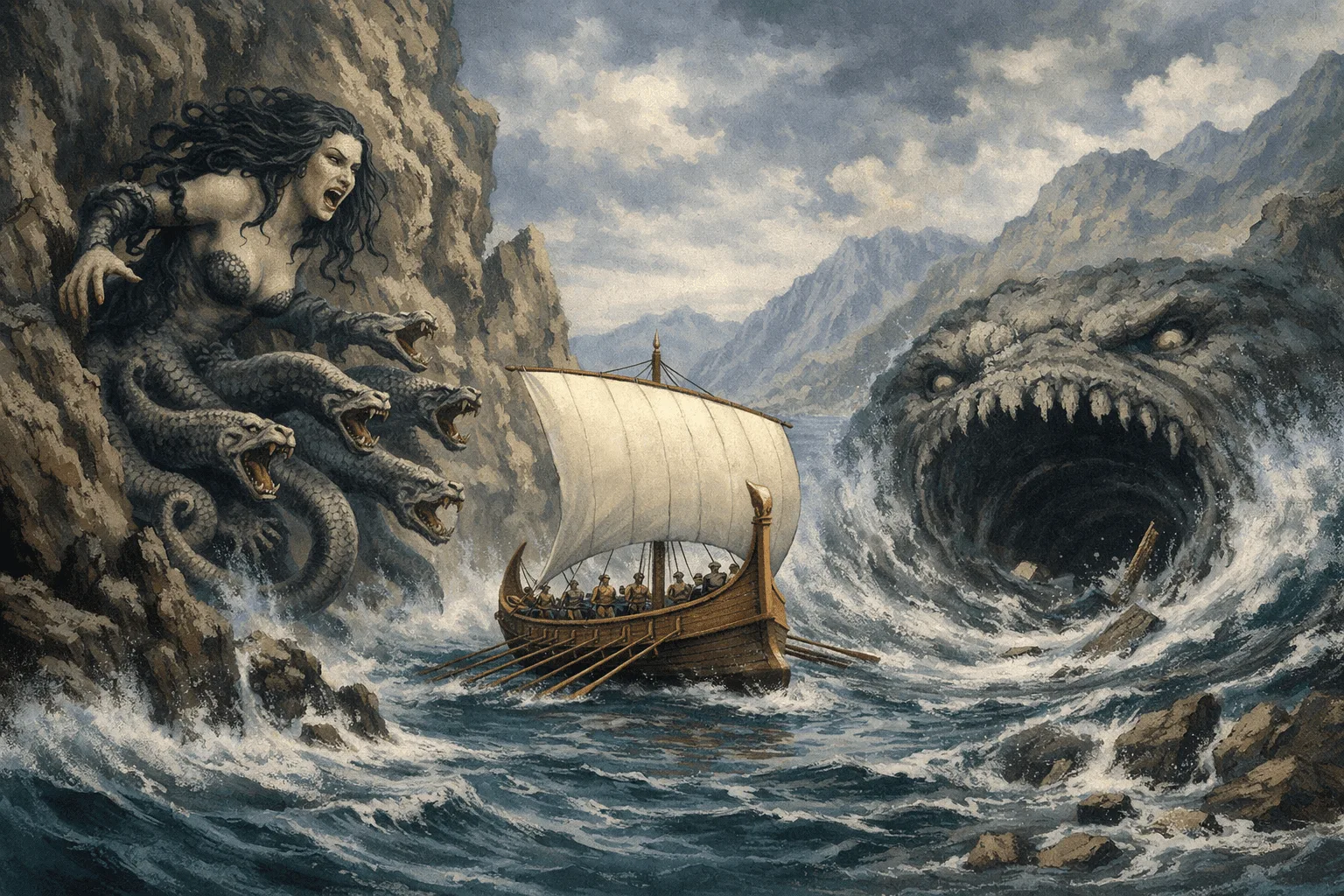
Scylla and Charybdis
- Skylla and Charybdis They are two of the most famous and terrifying monsters of Greek mythology. They lived facing each other on opposite sides of a narrow strait, making any passage through it extremely dangerous. This strait is associated with mythical maritime adventures, such as those of Jason, Odysseus and Aeneas.
From their co-existence the timeless expression was born "between Scylla and Charybdis", stating a situation where each option leads to serious risk.
Charybdis in Greek Mythology
- Charybdis is considered the oldest of the two monsters. Usually referred to as his daughter Pontus and Gaia, although in some traditions he is presented as his daughter Poseidon and Gaia.
Charybdis – The personification of the vortex
Harybdi was the mythological personification of a Giant Marine Warp. Three times a day she sucked and released huge quantities of water, capable of swallowing entire ships. Her move was associated mythologically with the tides.
Harybdi’s punishment
In later myths, Harybdi was not born a monster but transformed By Zeus:
either for stealing his oxen Hercules
or because it helped Poseidon expand his maritime sovereignty against Zeus
In some traditions, Charybdis is considered and Mother of the Scylla, which enhances their close mythological connection.
Scylla in Greek Mythology
- Skylla He is most often presented as the daughter of the ancient sea god Forky and Ketus (Krataidas), who were parents and other sea monsters, such as Graeae and Gorgons.
The Figure of Scylla
Scylla is described as:
creature with 12 feet
six long necks
six heads full of sharp teeth
voice She barked like a dog
Whatever ships were getting too close, they lost crew members, which Scylla grabbed and devoured.
Symbolism
Scylla is considered personification dangerous rocks or reefs, that could destroy the ships of antiquity.
The Metamorphosis of Scylla
Although often considered a born monster, in later myths Scylla was originally beautiful sea nymph.
The Amphitrite Version
- Amphitre, his wife Poseidon, he envied the attention God showed to Scylla and poisoned the water in which she bathed, causing her transformation.
Version of Circe
The most famous version is about the witch Circe.
The sea god Glaucus, in love with Scylla, he asked Circe for a love potion. But she, in love with Glaucus, gave him poison, which transformed Scylla into a monster.
The Pass of Scylla and Charybdis
The two monsters lived on the opposite sides of a narrow passage, less than the range of an arrow. No ship could pass without casualties.
This passage is usually identified with the Strait of Messene, between Italy and Sicily.
Heroes who faced Scylla and Charybdis
Jason and Argonauts
With her help Hera, The Athena and Nitrides, - Argo It passed safely.
Hercules
He killed Scylla when she stole his oxen, but her father, Phorcys, brought her back to life.
Odysseus
Following her advice Circe, he preferred to pass near Scylla, losing six menInstead of being completely destroyed by Charybdis.
Aeneas
He managed to cross the pass with strength and persistence in the oars.
Conclusion
Scylla and Charybdis are powerful symbols of Marine risks, unavoidable loss and dilemmas without ideal solution. Their presence in mythology explains both physical phenomena and deeper human experiences.
Read more
The Journey of Odysseus – A Detailed Guide Through Each Stop
Odysseus: His Story, Adventures, and the Lessons of the Odyssey