
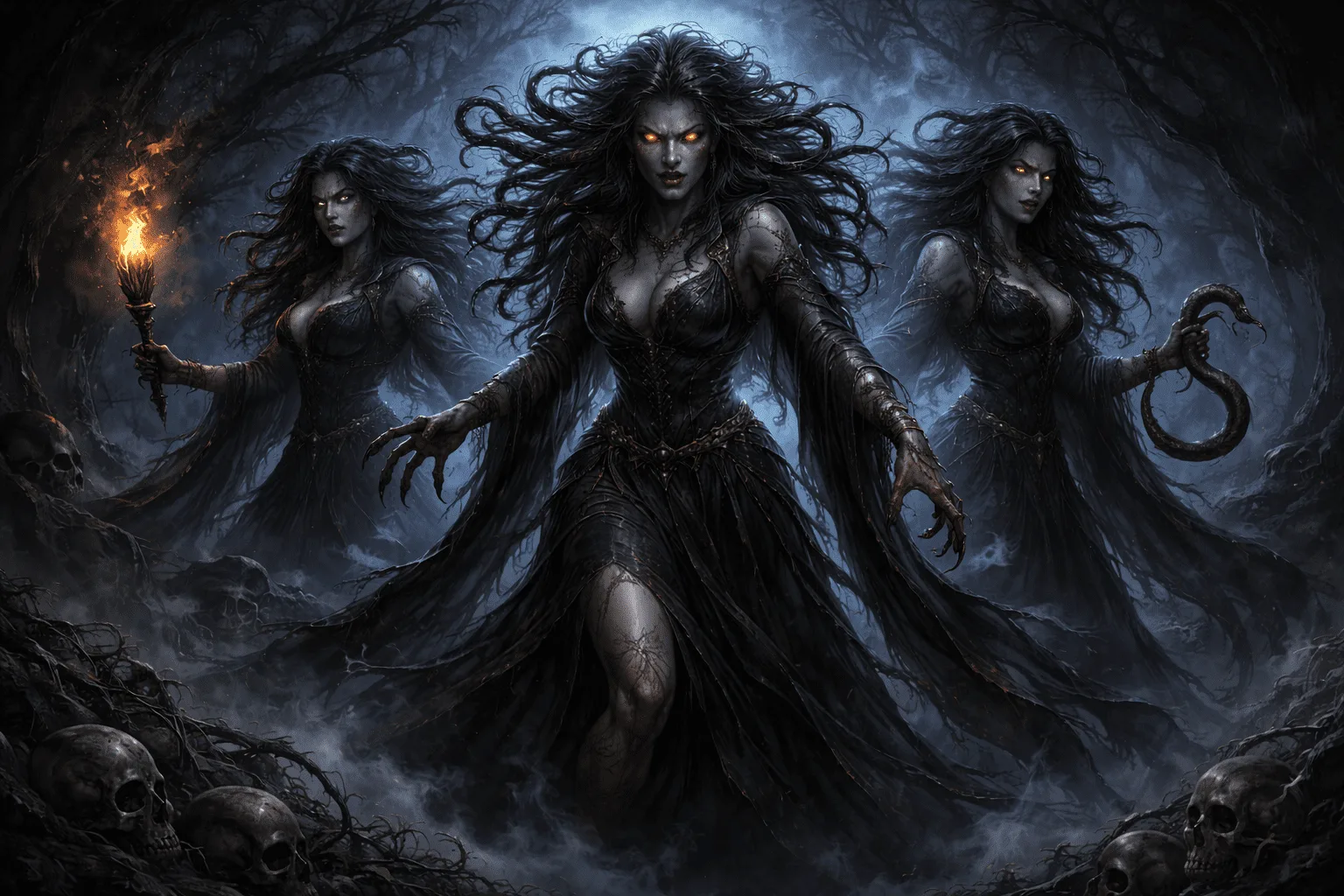
The Furies as Guardians of Divine Justice
Erinyes are one of the darkest and most important groups of deities of ancient Greek mythology. Although they are often presented as horrifying forms that pursue the guilty, their role far exceeds mere punishment. The Furies were the relentless guardians of moral order and divine justice, ensuring that no serious crime would remain unpunished, even when human laws failed to deliver justice.
According to ancient traditions, the Furies had a special responsibility for punishing crimes directed against blood ties and family. Matricide, patricide, fraticide, and treason of relatives were considered by the heavier sins and immediately caused their anger. For ancient Greeks, the family was a sacred institution protected not only by human laws but also by supernatural forces.
The image of Furies is closely linked to the concept of inevitable guilt. They weren't just punishing the crime.· They psychologically tortured the guilty, causing fear, remorse, paranoia and uninterrupted internal conflicts. In this way, ancient Greeks attributed mythological form to the power of consciousness. The Furies could be regarded as the personification of the guilt that follows a man after an unfair act, constantly reminding him of the responsibility of his actions.
One of the best known examples of their action is found in the myth of Orestes. When Orestes killed Klytemnestra's mother to avenge his father's murder, he was faced with a moral dilemma that had no easy solution. Although he acted to render justice, he also committed one of the heavier crimes, matricide. The Furies pursued him relentlessly, proving that even acts done in the name of vengeance do not rid anyone of the consequences of his actions.
The importance of Furies evolved over time. To tragedy «Eumenides» of Aeschylus, these deities are symbolically transformed by revenge carriers into protectors of the law order. In its intervention Goddess Athena and the establishment of a court for the case of Orestes, personal revenge grants its place to institutionalised justice. This transformation reflects a profound change in Greek society: the transition from the cycle of bloody retaliation to an organized legal system.
The Furies, therefore, were not merely punishment demons. They represented the belief that the universe is governed by moral laws that go beyond the will of men and kings. Their presence reminded them that injustice, however well hidden, will sooner or later be revealed and dealt with its consequences.
The influence of the Furies was not limited to antiquity. Their form inspired later writers, poets, philosophers and artists, who saw in them a timeless symbol of guilt, moral responsibility, and seeking justice. Even today, the idea that no one can escape the consequences of his actions remains deeply rooted in human culture, keeping the legacy of the Furies alive.
Through the myths surrounding them, the Furies reveal a fundamental aspect of ancient Greek thought: the belief that justice is an integral element of the secular order. They were not merely terrifying deities of the Underworld, but the tireless guards of a moral balance that kept harmony between the gods, humans and the universe itself.
Erinyes are one of the darkest and primitive deities of ancient Greek mythology. They are associated with the concept of divine justice, vengeance, and moral order of the world.
The Erinyes (also known as Eumenides) were chthonic deities that embodied punishment for serious moral crimes, such as manslaughter, disrespect to the gods and perjuries. Their presence reflects the deep need of the ancient Greeks to restore secular and moral balance.
Origin and Genealogy
The origin of Erinyes varies according to the source:
According to Hesiod, they were born of the blood of Heaven after his castration by Cronus .
Other traditions call them her daughters NYX Or the Darkness and the Earth.
The different versions demonstrate their primal character, as they belong to the pro-lympian forces of nature.
Number and Names
Although initially their number was not defined, in classical tradition three are established:
Alikto (the unceasing rage)
Tisifone (the punishment of murder)
Megera (the envious and hostile)
This trinity symbolizes different aspects of the vindictive force.
Function and Role
The Erinyes had as their main mission:
The punishment of blood crimes (especially domestic)
Protection of moral order
The enforcement of unwritten laws
Particularly important was the punishment of patocide and matricide, as in the case of Orestes, which they constantly pursued.
Moreover, they were considered personified curses, especially when they came from parents to children.
Form and Iconography
The Erinyes are portrayed as terrifying figures:
With snakes instead of hair
In black garments
With blood dripping eyes
Their freaky appearance reflects their nature as punishment and terror carriers.
The Erinyes in Dramaturgy
Their most important literary presence is in tragedy:
Aesthelus – Orestia

To tragedy Eumenides, the Erinyes pursue Orestes for his matricide. Finally, through Athena's intervention, they turn into Eumenides (a benevolent deities), marking the transition from revenge to justice.
This point is considered crucial for the evolution of the concept of law in ancient Greece.
Philosophical and Symbolic Interpretation
Erinyes are not merely mythological beings, but deep symbolic forms:
They represent conscience and guilt
Incarnate the inevitable character of justice
They represent the balance between chaos and order
Their evolution into Eumenides suggests the transition from vengeful justice to a more organised legal system.
The Erinyes and Religious Thought
As chthonic deities they are associated with:
The Underworld
Earth and fertility
Thes primary forces
They belong to a pre-lympic religious system, where the forces of nature function independently of the Olympian gods.
Conclusion
Erinyes are one of the most complex forms of Greek mythology. Their dual nature —destructive and ultimately balancing— reflects the transition of ancient Greek society from personal revenge to institutionalised justice. Their study reveals not only religious beliefs but also deeper perceptions of morality, responsibility, and social order.
Indicative Bibliography
Hesiod, Theogony
Assylus, Orestia (in particular) Eumenides)
Euripides, tragedies
Apollodorus, Library
Modern studies of Greek mythology