
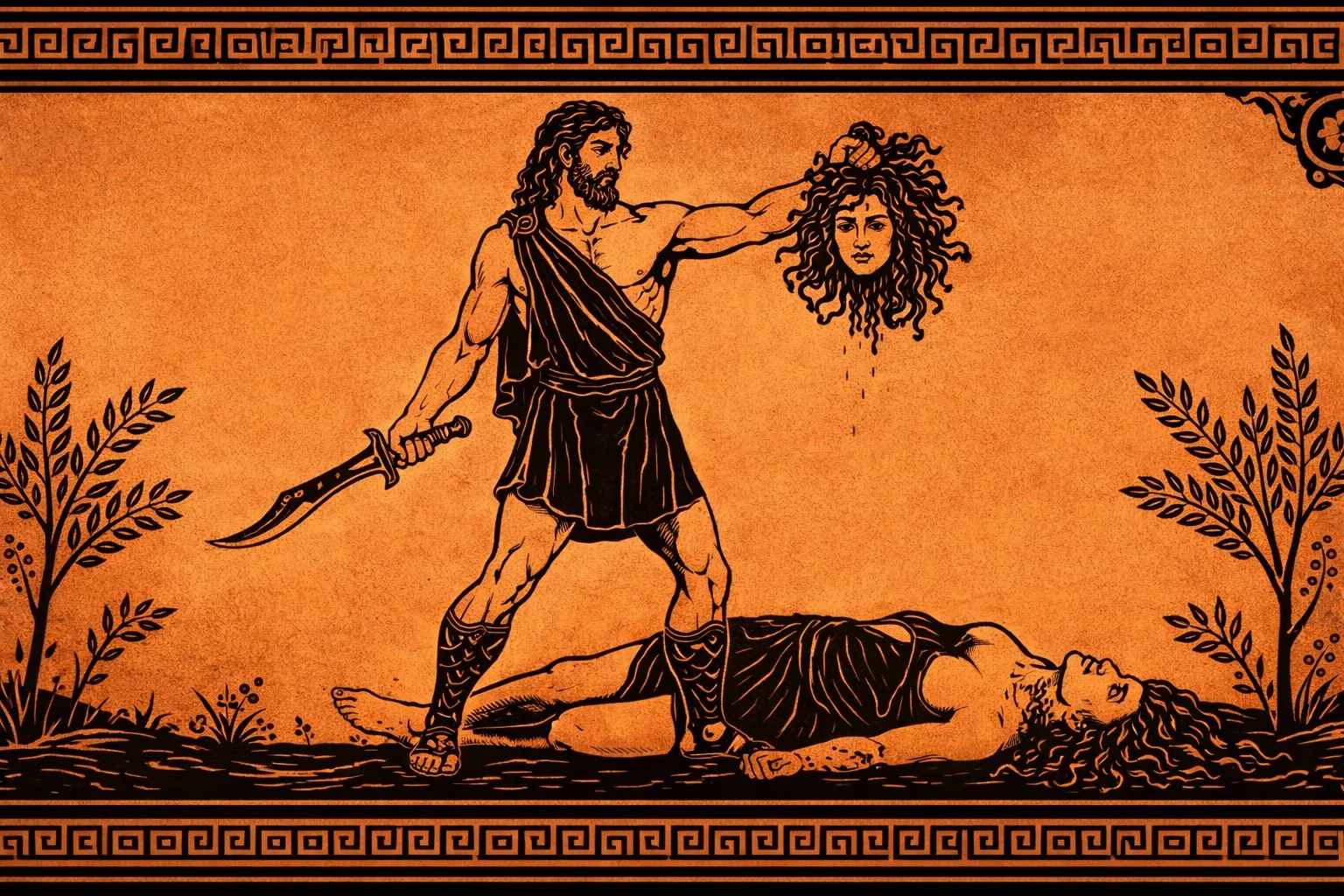
- Perseus is one of her most iconic heroes Greek mythology. Son of Danae and Zeus, grandson of King Acrisius, connected to one of the most famous myths of all time: the killing of Medusa, the most famous of GorgonsHis history combines divine intervention, heroic courage, intelligence and deep symbolism, which is why he remained alive in ancient art, literature and the collective memory of the Greeks.
| Name | Perseus |
|---|---|
| Parents | Zeus and Danae |
| Residence | Argos, Serifos, Tiryns |
| Roles and Responsibilities | Hero, winner of Medusa, savior of Andromeda |
| Other Names | Perseus Refinery |
| Husbands | Andromeda |
| Children | Persian, Alcaeus, Stenelus, Electricity etc. |
| Symbols | Gorgonium, sword, shield, feathered sandals |
| Roman Name | Perseus |
The Origins of Perseus: Danae, Zeus and Acrosios
The oracle that changed Argos' fate
Perseus' story begins with a tragic oracle. King Acrisius was informed that he would die by the hand of his grandson. To escape fate, he isolated Danae in a bronze chamber so she wouldn't have a child. But destiny is not avoided.
The birth of Perseus by Zeus
Zeus approached Danae in the form of golden rain and Perseus was born from this union. The image of golden rain shows the divine power that transcends human obstacles.
Perseus' position in the genealogy of heroes
Perseus joins the divine with the human and belongs to the great heroic houses of mythology, where fate and divine will constantly clash.
Perseus' position in the genealogy of heroes
Perseus’s lineage places him among the great heroic houses of ancient tradition. He is not merely a warrior, but a figure who unites the divine with the human. His relationship with Zeus, Danaë, and Acrisius creates a mythological framework in which fate, power, and divine will are in constant conflict.
The Mission with Medusa
Who Were Medusa and the Gorgons?
- Medusa was the most known of the Gorgons, terrifying forms of ancient mythology. In the most widespread version, Medusa was once a mortal woman who transformed herself into a monster. Her eyes had the power to petrify anyone who looked at her. Mermaids are associated with terror, chaos and boundaries between the human and supernatural world.
Why was Perseus sent to kill her?
The King Polydectys used Perseus to drive him away and asked him to bring her the head of Medusa, a mission that seemed impossible. This is a typical motif of a mythical feat: the hero is called upon to face an enemy that transcends human capabilities, thereby proving his worth, his ingenuity, and the favor of the gods.
The Help of Athena and Hermes
Perseus failed to accomplish the feat himself. The Athena and Hermes stood by his side. Athena, goddess of wisdom and strategy, gave him a polished shield so that he could see Medusa in the reflection and avoid looking at her directly. Hermes, the messenger of the gods, offered him the sharp sword or sickle he needed for the final act. The assistance of these two deities shows that Perseus’s victory was based not only on strength, but also on wisdom and divine guidance.
How Perseus defeated Medusa
The strategy of reflection
Perseus approached the Gorgons by looking at their reflection in Athena’s shield. In this way, he avoided Medusa’s deadly gaze. This scene is one of the most ingenious in all of mythology, because the hero does not triumph through brute force, but through self-control, caution, and the proper use of the image as a means of protection.
The Beheading of Medusa
When Medusa was asleep, Perseus approached her and cut her head off. From her blood were born Pegasus and ChryssaorTwo wonderful beings linking death to birth. This scene shows the dual character of mythology: the horrible and the wondrous coexist, and through destruction something new is born.
The mermaid and the atrocity
Medusa's head became known as gorgonium and gained great importance in ancient Greek art. It was used as a repugnant symbol on shields, temples, coins and other objects, because it was considered capable of removing evil. Thus, the most awesome face of mythology turned into a sign of protection and power.
The return of Perseus and Andromeda
The meeting with Andromeda
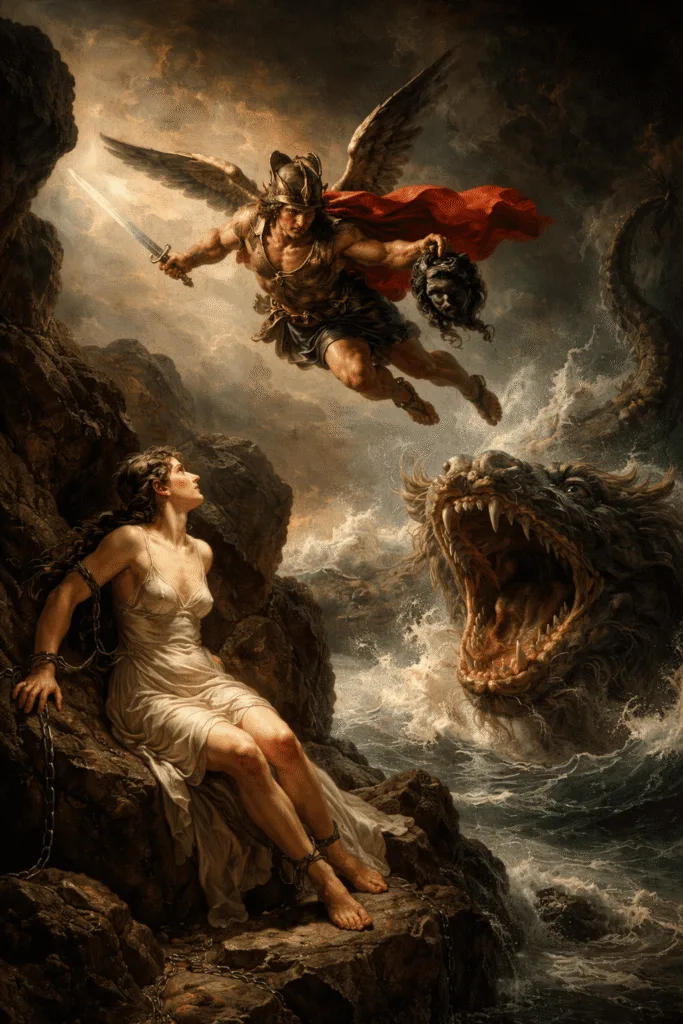
In the course of his return, Perseus met Andromeda, which was tied to a rock as a sacrifice to a sea monster. Her mother had caused the wrath of the gods, and the girl's family had to pay the price. Perseus, seeing her, decided to save her and faced the monster with the same courage and determination he had shown against Medusa.
The marriage of Perseus and Andromeda
After his victory, Perseus married Andromeda. This union is not just a romantic episode, it is part of heroic integration. In mythological narrative, marriage often marks the restoration of order, the establishment of a new generation and the transition of the hero from the test to the establishment.
The fulfillment of the oracle of Acresium
Perseus’s return is also linked to the ultimate fulfillment of the oracle. In several traditions, Acrisius is unintentionally killed by Perseus in a contest or in a manner that had not been foreseen. This element highlights one of the most characteristic ideas of ancient thought: no one can escape their fate, no matter how hard they try to avoid it.
Perseus' symbolism in Greek mythology
The hero of intelligence and divine favor
Perseus symbolizes the hero who defeats not only with physical strength, but also with intelligence, calm and divine support. His battle with Medusa is at the same time a conflict between man and the monster, between knowledge and fear, between the light of thought and the darkness of chaos.
Medusa as a form of terror and transformation
- Medusa He's not just Perseus' opponent. It is a form that embodies terror, strange and borderline. Her transformation into a monster and her final defeat by the hero express the constant need of ancient Greek imagination to impose order upon the amorphous and threatening.
The look, image and power of mediation
Perseus' choice to look at Medusa through the reflection of the shield is deeply symbolic. The image acts as a protective filter between man and absolute evil. This act reveals that thought, distance, and mediation can defeat fear better than impulse.
The cultural importance of Perseus in ancient Greece
Perseus in art and iconography
The myth of Perseus and Medusa deeply inspired ancient Greek art. Vases, reliefs, sculptures and paintings depict the hero's victory, Athena's presence and the mermaid. Medusa became one of the most recognizable forms of antiquity, with pictorial power that passed through the Roman era.
Genetic and political importance
Perseus was considered the general of important royal lines. His connection with cities, houses and dynasties shows that myths also functioned as bearers of historical memory and prestige. Through Perseus, mythology gave legitimacy, antiquity and symbolic depth to communities that wanted to link their origins to heroic standards.
The atrotropic element of the mermaid
The use of Medusa's form as a mermaid reveals a basic mechanism of ancient religiousity: the terrible is not simply destroyed, but transformed into a force of protection. This makes Perseus' myth particularly rich in meanings, as it unites terror with salvation and monster with shield.
Main persons and elements of myth
- Perseus: The hero who defeated Medusa
- Danae: mother of Perseus
- Jupiter: father of Perseus
- Extreme: grandfather of Perseus and king of Argos
- Medusa: The most famous of the Mermaids
- Athena: goddess of wisdom and strategic assistance
- Hermes: God who offered the sword to the hero
- Andromeda: The woman Perseus saved and married
- Gorgonium: Medusa's head as a repugnant symbol
Perseus’ legacy
A hero between fate and action
Perseus remains one of the most powerful forms of mythological tradition, because it unites many levels of meaning. He is the son of a god, bearer of a prophecy, winner of a monster, savior of an innocent woman and ultimately a person who cannot escape the oracle. His story is about the power of action, but also about the limit of human will.
The Timeless Charm of the Myth
The myth of Perseus continues to captivate because it combines adventure, fear, wisdom, and divine radiance. His battle with Medusa, his relationship with the Gorgons, and the help he received from Athena and Hermes make the narrative rich in symbolism and easily recognizable in every era. That is why Perseus is not merely a mythical warrior, but a timeless hero of Greek mythology.
Frequently Asked Questions About Perseus
Who were Perseus' parents?
Perseus was the son of Danae and Zeus. Acricius was his grandfather and king of Argos.
Who helped Perseus kill Medusa?
Athena and Mercury helped Perseus. Athena gave him the shield and Mercury the sharp sword.
Why is Medusa so important in mythology?
Medusa is one of the most iconic forms of Gorgens and symbolizes terror, transformation and atrotropic power.
What's a mermaid?
The mermaid is the depiction of Medusa's head. In ancient Greece they were used as a symbol of protecting and preventing evil.
What is Perseus' relationship with Andromeda?
Perseus saved Andromeda from a sea monster and married her. Their story is one of the most famous episodes of the hero's march.
Why does Perseus ’ myth remain timely?
Because he speaks of man’s fate, fear, wisdom and need to overcome the impossible. These themes remain timeless and explain Perseus' constant charm.
Read also:
Article: Perseus and Andromeda: Myth, Salvation, and Punishment of the Gods