
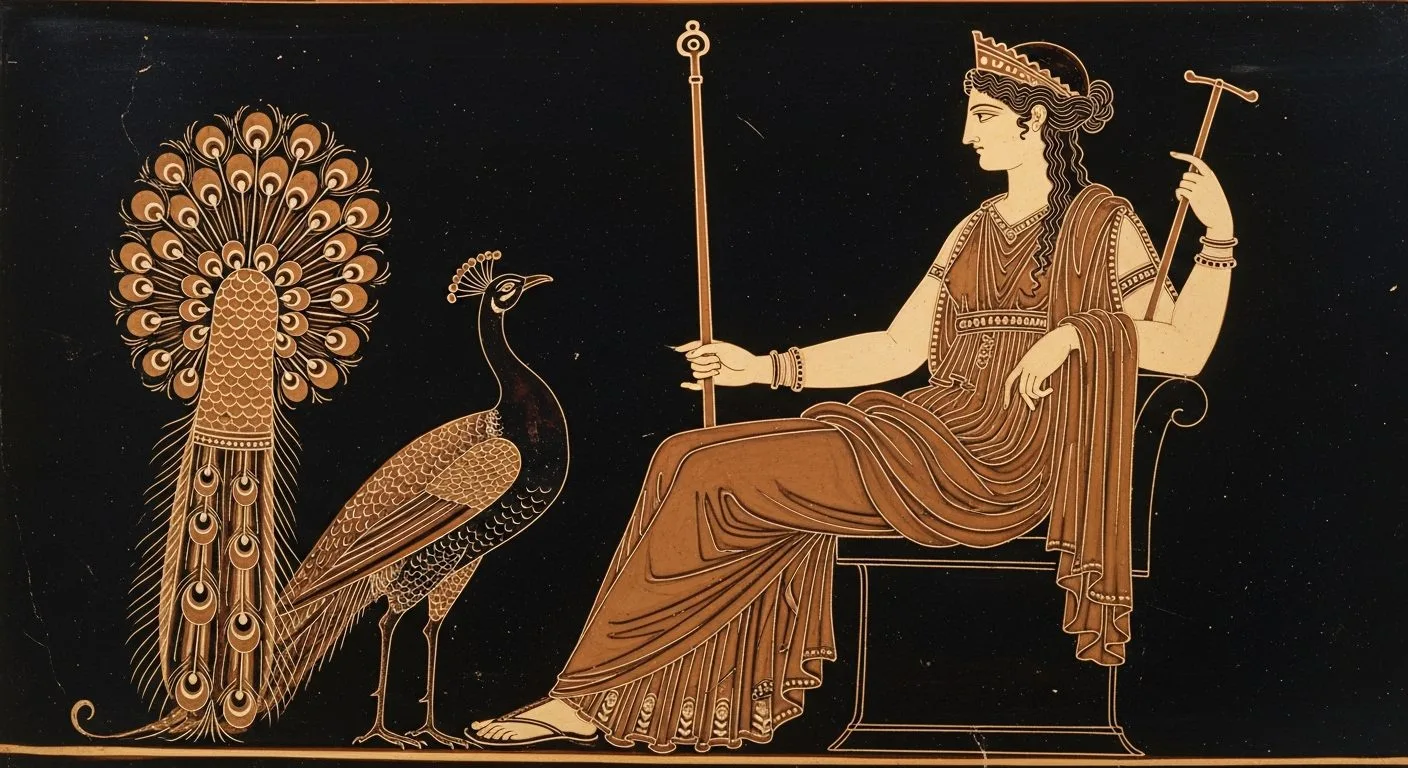
- Hera is one of the most important deities of Greek mythology. In the collective memory of the ancient Greeks was the queen of Olympus, protector of marriage, legal union and family order. Her name was associated with power, royal dignity and maintaining social cohesion.
Although often presented through the well-known stories of jealousy against his love adventures Zeus, its form is much more complex. Hera was not merely the wife of the supreme god; she was an autonomous deity with strong worship, an ancient presence in the Greek world and a special prestige in the religious practices of antiquity.
Key Elements Hera
Name and Etymology
The etymology of the name «Hera» has not been fully clarified. Scholars have proposed various interpretations. One of the most widespread links the name to its meaning «Madam», «Lady» Or the woman of high authority. This interpretation matches her role as queen of the gods.
Other approaches claim that this is a particularly ancient, pre-Greek theonym. This means that her worship probably existed before the classical Greek pantheon and was later incorporated into the Olympic religion.
Antiquity itself perceived Hera as a form old, respected and closely bound to the institutional order of society.
Origin and family
Hera was his daughter. Cronus and Rea, belonging to the generation of Titans. Like her brothers, she was devoured by her father immediately after her birth. Saturn feared that one of his children would dethron him.
When Zeus came of age, he forced Saturn to free his children. Thus Hera returned to the world of the gods and participated in the new divine order formed after the Titanomachy.
Her position within the Olympian family was particularly high. They were not merely considered the sister of Zeus, but the deity standing next to him as a legitimate royal companion. In Greek thought this had deep symbolism: the supreme authority was not only power but also institution.

- Perfect Gift for those that love Greek
- Great craftmanship.
- Measurement: H: 10
Lovers
Unlike many other deities, Hera is not usually presented as a goddess with many lovers. Her basic and almost exclusive relationship is with Zeus.
In some local traditions older myths are found that connect it to pre-Greek forms of worship or ritual associations, but in the classical world its image is clear: Hera is the divine expression of the legal marital relationship.
Mythological intensity is not derived from her own love adventures, but from Jupiter's countless relationships. These stories are a key core of many myths.
The descendants
Tradition attributes to Hera several divine children.
- Ares — God of war.
- Hebe — goddess of youth.
- Illiteracy — goddess of childbirth.
- Hephaestus — god of fire and metallurgy.
Of particular interest is the myth of Hephaestus. In some traditions Hera gave birth to him without his contribution Zeus, wanting to prove that she too could create life autonomously. This myth reveals a side of independence and creative power.
Appearance
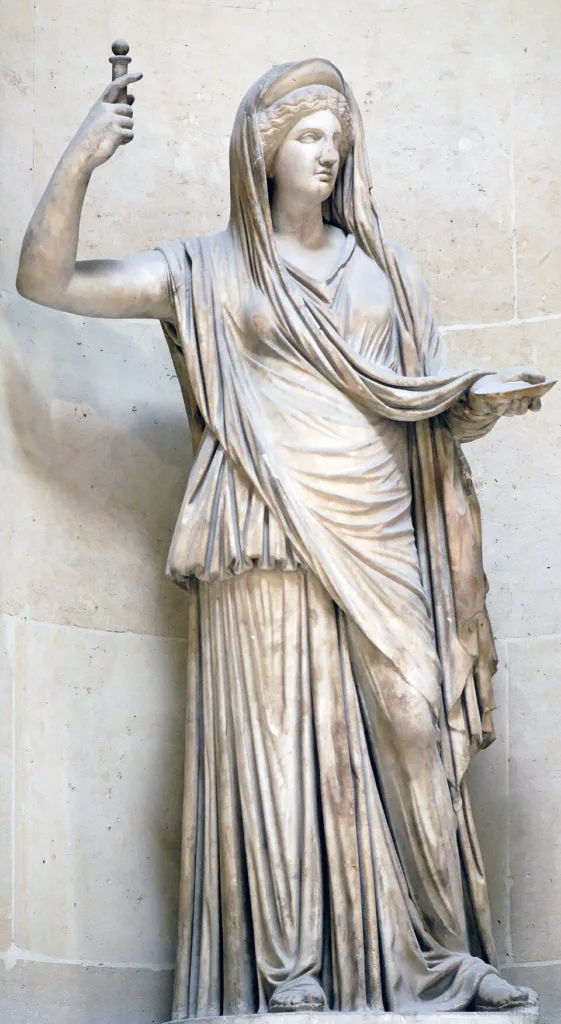
Hera is depicted as an imposing, mature and extremely magnificent figure. Ancient artists usually show it with a straight look, a calm expression and a royal body attitude.
He often wears a long robe and a garment. The head bears a diadem or crown. He often holds a scepter, a sign of authority. Her iconography avoids overdramatism· prefers stability, order and dignity.
The personality
Hera's personality is multidimensional.
On the one hand she is a goddess imposing, strict, proud and deeply associated with honor. On the other hand, in myths she appears sensitive to the insult, especially when marriage is violated or her position is questioned.
Her famous jealousy should not only be read as a personal feeling. For the ancients he often expressed the reaction of a deity who defends regularity, legality and social order.
That is why many stories present her harsh, but not accidentally harsh. Her actions are usually associated with the restoration of disturbed balance.
The forces
Hera had authority over marriage, marital legitimacy, royal sovereignty and female dignity.
In myths he could:
- to bless or prevent marriages;
- affect births and births,
- protect legal families,
- intervene in the fate of heroes and royal houses,
- act as a power of institutional order within the world of the gods.
Its power is not primarily warlike like Mars's nor thunderbolt like Jupiter's. It is institutional, social and symbolic.
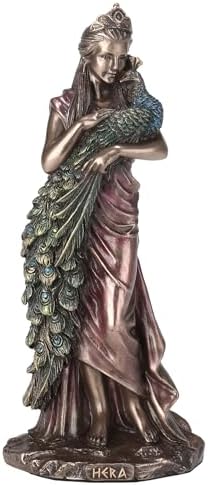
- QUIALITY PRODUCTION: Made with high quality designer resin and cold cast bronze technique
- COLD CASTING: Cold casting is the technique that mixes resin and bronze to create detailed culture with metallic feat...
- MEASUREMENT: L 2 3/4 * W 2 3/8 * H 6 1/8 Inches
Sacred symbols
Scepter
The scepter declares royal authority and sovereignty.
Diadema
The diadem is associated in its capacity as Queen of Olympus.
Pomegranate
The pomegranate is associated with fertility, marital union and the continuity of life.
Sacred animals and plants
peacock
The peacock is Hera's most famous sacred animal. According to later legend, his tail eyes were associated with Argos Panoptes, the centenary keeper of the goddess.
Cow
The cow often appears as an ancient sacred animal, symbol of magnificence, fertility, and maternal power.
Lily and pomegranate
Among the plants associated with her worship are the lily and pomegranate, symbols of purity, fertility and sanctity.
Roles and responsibilities
Hera had an important role in organizing the divine and human world.
She was a patron:
- of marriage,
- legal marital union,
- family stability,
- women's honour,
- royal legitimacy.
In many cities its presence was linked to public life and political communities. Her worship was not limited to the private space of the house, but also had an intense state dimension.
Religious worship
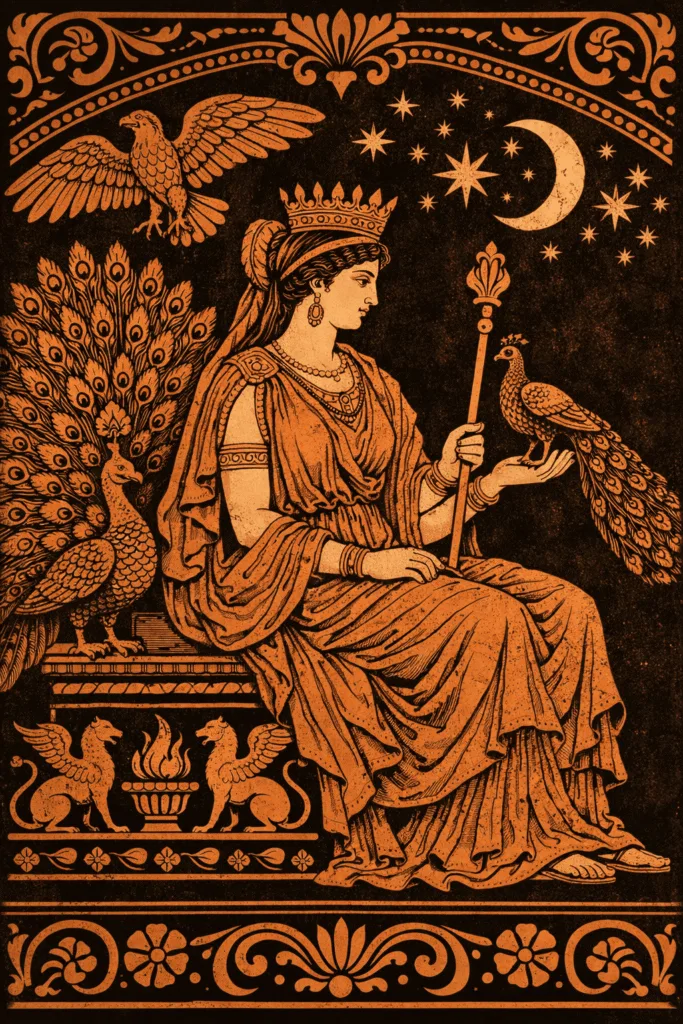
The worship of Hera was particularly strong and very old.
Its most important cult center was Heraios Argos. There the goddess was honored as a patron and patron of the community.
Equally important was Heraios Samos, one of the oldest and most important sanctuaries in the Greek world.
The festivals in her honor included processions, sacrifices, musical games, and ceremonies related to the marriage transition. Her worship was of social importance because she connected religion to the city institutions.
Representations in art
Hera often appears in ancient angiography, sculpture and architectural decoration.
Artists preferred to emphasize the splendor and calmness of its form. Unlike other deities depicted within intense action, Hera is rendered with stability, imposing and ceremonial seriousness.
In classical art her image shaped a model of divine royal presence that also influenced later times.
Notable quotes
Hera on Zeus
“Foolish ones, who foolishly resent Zeus and strive to subdue him with persuasion! Sitting aloof, he does not deign to acknowledge us; he scorns us, boasting that he is the strongest and most powerful of all the gods. Endure, then, the hardships he sends to each of you.”
Homer
FAQ
Who was Hera?
Hera was the queen of the gods in Greek mythology and goddess of marriage, legal union and family stability.
Who was her husband?
Her husband was Zeus.
Why does Hera often appear jealous?
Because many myths relate to Jupiter's sexual relations. Her reaction is linked to defending marital legitimacy.
What are her sacred animals?
The peacock and the cow.
Where was he especially worshipped?
Argos and Samos.
What children did he have?
According to the most widespread tradition, Mars, Evie, Ilithyia and Hephaestus.
Sources
- Theogony
- Iliad
- Odyssey
- Library
- Modern studies on ancient Greek religion and Olympic mythology

OLYMPIAN GODS
ZEUS | HERA | ATHENA | ARES | ARTEMIS | DIONYSUS | HERMES | HADES | Apollo | POSEIDON | HEPHAESTUS | APHRODITE