
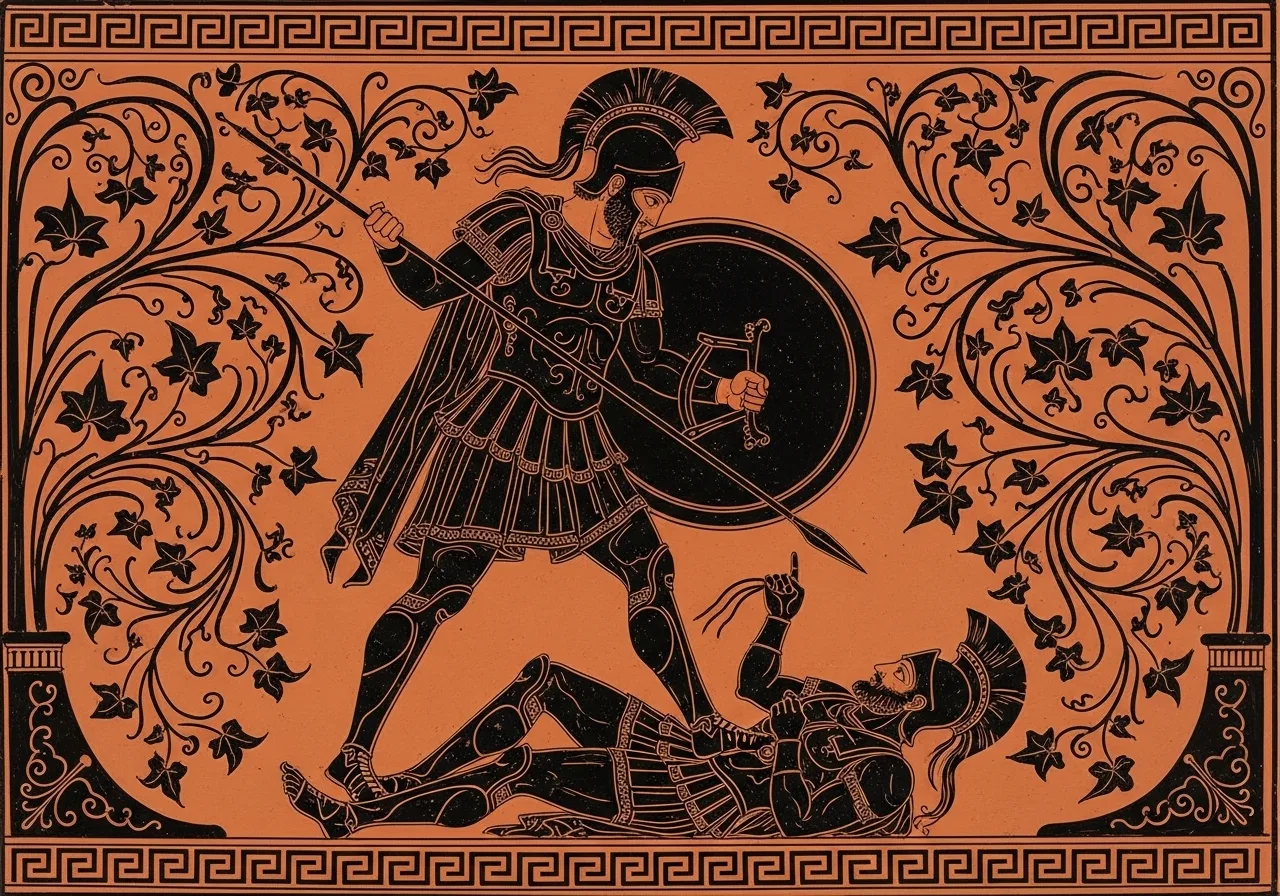
Achilles is presented as the greatest hero of the Trojan War, the son of Thetis and Peleas, with his central feature of rage. The text follows its origin, its upbringing from Chiron and the decision to gain eternal glory through a short life.
His clash with Agamemnon, his departure from battle, the death of Patroclus, his return to battle and duel with Hector are examined. The narrative closes with Achilles' death from the arrow of Paris and the formation of the myth of Achilles heel.
| Name | :Achilleus |
|---|---|
| Parents | Clay and Thetis |
| Residence | Phthia (Thessalia), Troy (camp) |
| Roles and Responsibilities | Top hero of the Trojan War, leader of the Myrmidons, symbol of bravery and anger |
| Other Names | Peleides |
| Husbands | Deidemia |
| Children | Neoptolemus (Pyrros) |
| Symbols | Spear, shield, Achilles' armor, speed, heel (Achilles' heel) |
| Roman Name | Achilles |
Introduction: When a hero's anger shakes the world
At the edge of the sea, where the waves of the Hellespont break against the soil of Troy, a man sits alone.He does not look toward the black ships of the Achaeans. He does not gaze at the towering walls of Troy, gleaming beneath the sun. His eyes are turned inward. Deep within him, a fire is burning—one that no god and no mortal can easily extinguish.
He is Achilles.
The greatest warrior of the Trojan War. The son of the sea goddess Thetis and the mortal king Peleus. A hero born for glory, yet doomed to pay for that glory with his life. In Greek mythology, Achilles is far more than an invincible fighter on the battlefield. He is the living embodiment of rage, honor, love, grief, and the tragic destiny that shadows all human greatness.
Homer’s Iliad does not begin with the fall of Troy. It does not begin with Helen, nor with the wooden horse that would one day seal the city’s fate. It begins with a single word that would echo through the ages: mēnin—rage.
And that rage, rising like a storm from the sea, sweeps kings, armies, friends, enemies, and even gods into its path. Through the myth of Achilles, ancient Greek mythology tells a story far greater than the story of a war. It speaks of the price of glory, the fragility of life, and the heartbreaking beauty of a man who touched the divine, yet never stopped suffering like a mortal.
The Origins of Achilles: Son of Thetis and Peleus
Achilles was born from a union unlike any other in Greek mythology—strange, sacred, and shadowed by prophecy. His mother was Thetis, one of the Nereids, the sea nymph daughters of ancient Nereus, the “Old Man of the Sea.” She was a goddess of the waters, gentle as sea foam yet powerful as the hidden depths of the ocean.His father was Peleus, king of the Myrmidons in Phthia, a brave mortal warrior. Peleus did not win Thetis because he was stronger than a god, but because he endured. When she changed shape in his arms—becoming fire, water, beast, and serpent—he refused to let go. In that struggle, mortal determination overcame divine resistance.
According to the myth, both Zeus and Poseidon had once desired Thetis. But a prophecy warned that the son born from her would become greater than his father. No god wished to risk being overthrown by his own child. So Thetis was given in marriage to a mortal man: Peleus. From that wedding, attended by gods and humans alike, Achilles was born.
Yet even his birth carried the shadow of death.Thetis knew that her son would never live an ordinary life. She tried to protect him from the fate that awaited all mortals. In later myths, she dipped the infant Achilles into the waters of the River Styx, the river of the Underworld, holding him by the heel. Every part of his body became invulnerable—except the place touched by his mother’s hand: the famous Achilles’ heel.Other traditions tell the story differently. In some versions, Thetis anointed him with ambrosia and held him over the fire, hoping to burn away the mortal part of him. But Peleus, terrified by what he saw, interrupted the ritual. Wounded and angered, Thetis abandoned the palace and returned to the sea.
And so Achilles grew up between two worlds. In his veins flowed the blood of the gods, but over his life hung the fate of men.He was raised by the wise centaur Chiron on Mount Pelion, where heroes were trained not only to fight, but also to heal, sing, listen to nature, and understand themselves. Chiron taught Achilles the arts of war, medicine, music, discipline, and wisdom. But even under the guidance of the noblest teacher in Greek mythology, the young hero’s heart leaned toward battle.
From childhood, Achilles seemed made for something terrible and magnificent. He was swift as the wind, radiant as flame, beautiful as a god. But hidden within his greatness was the choice that would define him forever: to live a long, quiet life without glory, or to die young and win eternal fame.
Like all great tragic heroes, Achilles chose the flame over the shadow.
The role of Achilles in Greek mythology
In Greek mythology, Achilles is more than a war hero. It is the person through whom the ancient Greeks thought of the concept of honor, fate and human pride. He's not perfect. He's not always fair. He's not calm or easily forgiving. His power is terrible, but his passion is even more terrible.
Achilles belongs to the world of heroes, those creatures found among gods and men. They have divine origins, but they die. They have supernatural ability, but they suffer. They can change the course of a war, but not escape their fate.
In the Trojan War, Achilles is the heavier weapon of the Achaeans. Without him, the Greek generals, however powerful, cannot break Troy. Agamemnon has power. Ulysses has intelligence. Aias has the physical strength. Diomedes has courage. But Achilles has something else: the ultimate war glow. When he enters battle, the earth seems to retreat under his feet.
Yet his myth is not the myth of a mere winner. It is the myth of a man who knows that his victory leads him to death. His Thetida has revealed the dilemma: if she stays in Troy, she will win a stealthless, unspoiled glory, but she will die young. If he leaves, he will live many years, grow old at home, but his name will be lost.
Achilles' choice is not easy. That’s why it thrills us. It's not a war machine. He's a young man who knows that every step towards immortality is a step away from life.
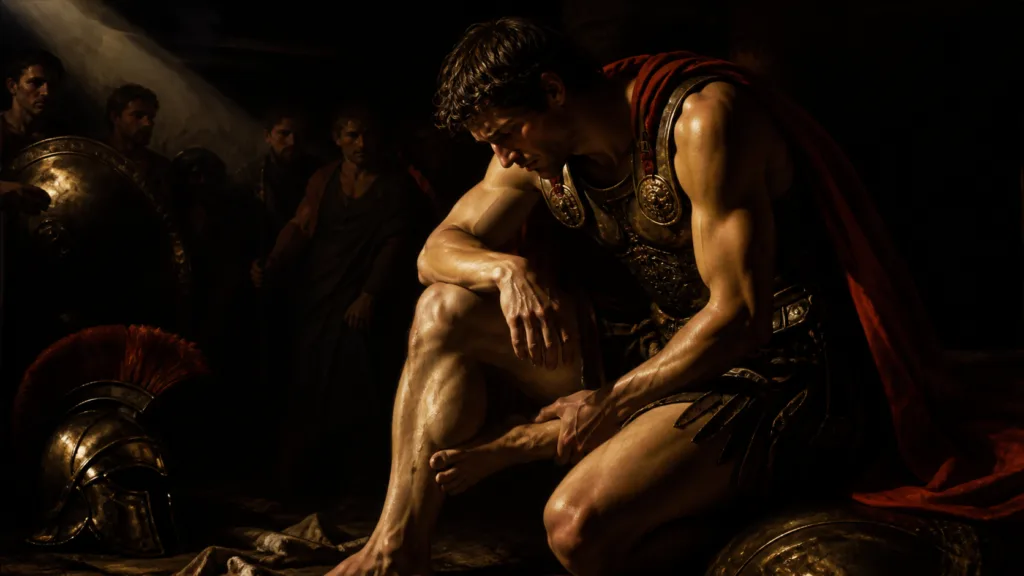
The Trojan War and the wrath of Achilles
The Trojan War began with an insult, a love and a grab. Helen, wife of Menelaus of Sparta, left or was kidnapped by Paris, Prince of Troy. The Greek kings, bound by oaths, gathered an army and fleet to take her back. Among them was found Achilles, head of the Myrmidons.
In the early years of the war, Achilles became the fear of the Trojans. He conquered cities around Troy, killed heroes, brought spoil and glory to the Achaeans. But Iliad doesn't tell the whole war. It tells a few weeks from the tenth year of the siege. And it all begins with a conflict not between Greek and Trojan, but between two Greeks: Achilles and Agamemnon.
- Agamemnon, commander-in-chief of the Achaeans, had taken as a spoil Chrysidida, daughter priest of Apollo. When her father asked for her return, Agamemnon insulted him. THE Apollo He sent a plague to the camp. The Greeks were dying, the fires were burning, and Achilles called a convention to find the cause.
Oracle Calhas revealed the truth: Gold had to be returned. Agamemnon agreed, but demanded another spoil as compensation. And then he reached out his hand to Brissida, the woman given to Achilles as an honorary prize.
For the modern reader, this may just look like a spoil fight. In the heroic world, however, the spoil was a sign of honor. When Agamemnon took Vrisida, he not only removed one woman from Achilles. He publicly took away his honor. He humiliated him in front of the entire army.
Achilles touched his sword. For a moment, everyone's fate was hung by a breath. Would he kill Agamemnon? Would the Achaean army disband from its own interior? Then Athena appeared, invisible to others, and kept the hero from blond hair. He held him. Achilles did not kill the chief general, but swore something more terrible: he would withdraw from battle.
And so Achilles' anger became a disaster.
The Myrmidones stayed on the ships. The best Achaean warrior no longer fought. Thetis, listening to her son's cry on the shore, ascended from the depths of the sea. Achilles asked her to beg him Zeus to help the Trojans so the Achaeans can understand how much they needed him.
Thetis went to Olympus. She kneeled before Zeus, touched his knee, caressed his chin and sought vindication for her son. Zeus nodded. From that moment on, the balance began to lean for the Trojans.
The Achaeans suffered. Hector, Troy's greatest hero, was pushing them closer and closer to the ships. The fire of war was literally approaching their ships. Embassies were sent to Achilles. THE Odysseus, Aias and Phoenix went to his tent, offering gifts, riches, return of Brisida, honors. But Achilles remained unflinching.
It wasn't just stubbornness. It was a wound. And the wound of insult in the heroic world bled deeper than flesh.
Patroclus and the return of the hero
Near Achilles was Padroclus, his favorite companion. Friend, brother of the soul, man who knew his heart better than anyone. When the Trojans arrived on the ships and destruction seemed inevitable, Patroclus could no longer stand to see the fire licking the Achaean ships and men falling like ears under the sickle of war. With eyes full of tears, but not fear, he entered Achilles' tent. The hero sat heavy and silent, like a lion wounded who refused to rise, while outside they echoed cries, copper, and death.
«Achilles»"Patroclus said, "and his voice trembled with pain, «If you don't want to fight, leave me. Give me your armor, let the Trojans see me and think you're back. Maybe then they'll pull behind the ships and save our people.».
Achilles looked deep at him. In him struggled the rage and love, the wound of insult and the fear of the man he loved most of all. He rose slowly, and his shadow fell upon his weapons, hanging brightly like a sun prisoner. «Patrocle», said, «Take my armor and lead the Myrmidons. Get the Trojans off the ships. But listen to me: don't pursue glory to the walls of Troy. Don't let the war get you drunk. Come back.».
Patroclus bowed his head. She promised, but fate had already spread its wings over the stage. Achilles dressed him with his own hands. He tied his chest, gave him the shield, put on his helmet with the weed shaking like a flame. Only the heavy pole of Pelides could not lift Patroclus· No other mortal would ever tame it.
When he came out in battle, the Myrmidones followed with a scream terrible. The Trojans, watching Achilles' armor shine again in front of them, were shaken. Their hearts were firmed, because they thought Thetis' son had returned, unquenchable like fire. Patroclos swooped among them, and the field filled with copper and dust. He pushed the enemies away from the ships, saved the Achaeans from the flame, and death walked on his side.
But as he saw the Trojans retreat, his heart began to rise. Forget Achilles' voice, forget the warning. He chased the warriors into the plain, closer and closer to the great walls of Troy. There, above the ramparts, Apollo saw him and stood against him as invisible destruction. Three times Padroclos swooped toward the walls, and three times God pushed him away. On the fourth, Apollo's voice thundered like a dark sky: «Back off, Patrocle. You're not meant to take Troy.».
Then God struck him from behind. The helmet fell into the dust, the shield slipped out of his hand, the chest was solved. The hero stood naked by the glow that was not his. Fairy hurt him first, but he didn't dare stay. And then came Hector, the great defender of Troy, with eyes burning from war rage.
Patroclus, heavily wounded, tried to stand. Between the two men a silence fell terrible, as if the earth were holding its breath. Hector lifted the spear and stabbed it deep. Patroclus bent, and as life left him, he spoke with a bitter smile: «You didn't beat me alone, Hector. First I was struck by God. But just so you know, death stands near you. Achilles will come.».
And in these words his soul flew to Hades, mourning youth and light. Hector pulled Achilles' armor from the dead body, but around him the air was already getting heavy. Because far away, on ships, Achilles did not yet know that he had lost half of his soul.
When the news arrived at his tent, his world fell apart. Patroclus, wearing his armor, had fallen under Hector's hand. Achilles broke out in a cry so loud that his mother, Thetis, heard it in the depths of the sea and went up to comfort him.
But no comfort could fit in his heart. The rage that until then kept him away from the battle turned into something darker and more terrible: in need of revenge. He knew that if he returned to war, his fate would be sealed. The glory would be his, but his life would be short.
Thetis brought him new armor, forged by Hephaestus. His shield shined like a small world, full of images of life, war, peace and human destiny. Wearing it, Achilles no longer resembled a mortal, but with power sent by the gods.
His return to the battlefield spread horror to the Trojans. Hector, though aware of the danger, stood against him. Their duel took place outside the walls of Troy, in front of the eyes of Priam, Ekabe and Andromache. There, Achilles killed Hector and tied his body to the chariot, dragging it around the city.
But even in revenge, the grief did not go away. Hector's death didn't bring Padroclu back. Only when old Priam entered the tent of Achilles at night and kissed the hands that had killed his son, the hero's heart broke. For the first time since his loss, Achilles saw in his enemy a man who was in pain as he was.
So he delivered Hector's body for burial and the battles stopped temporarily. But Achilles' fate had already come close. His glory would remain immortal, but he would not escape the end that the gods and fate had woven for him.
The death of Achilles
Achilles' death is one of the most famous episodes of the Trojan cycle, although it is not described in the Iliad itself. Homer foretells the fate of the hero many times, but the epic ends with Hector's burial, before Troy's fall and before the loss of the greatest Achaean warrior.
According to the later tradition, Achilles was killed near the Shadow Gates of Troy. Paris, the prince who had caused the war by grabbing Helen, fired an arrow at him. The arrow, guided by Apollo, hit Achilles in the heel, the only vulnerable spot of his body. So the hero, who had stood almost undefeated throughout the war, fell from a wound seemingly small but fatal.
The idea of «heel Achilles» It is associated with a well-known myth about his mother, Thetis. When Achilles was an infant, the goddess plunged him into the waters of the Styx to make him invulnerable. But he held him by the heel, and this spot did not touch the magic water. From there came the expression used to date to declare a man's weakness, however strong it may seem.
After his death, the Achaeans deeply mourned the hero. Aias and Ulysses, according to tradition, fought to take his body off the battlefield and not fall into the hands of the Trojans. Thetis ascended from the sea along with the Nireides to mourn her son, while the Muses sang in his grave.
Achilles' armor became then the object of great controversy. Aias and Ulysses claimed the weapons of the dead hero, because they had both contributed to saving his body. The Achaeans eventually awarded them to Ulysses, which led Aiada to madness and suicide. Thus Achilles' death caused new calamity in the camp of the Greeks.
The loss of Achilles symbolizes the tragic fate of the hero who chooses glory instead of long life. From the beginning he knew that if he stayed in Troy, he would gain immortal fame but would die young. His choice made him a symbol of bravery, anger, and human vulnerability, as even the strongest warrior could not escape his fate.
Read more
Achilles’ vulnerability – Achilles heel