
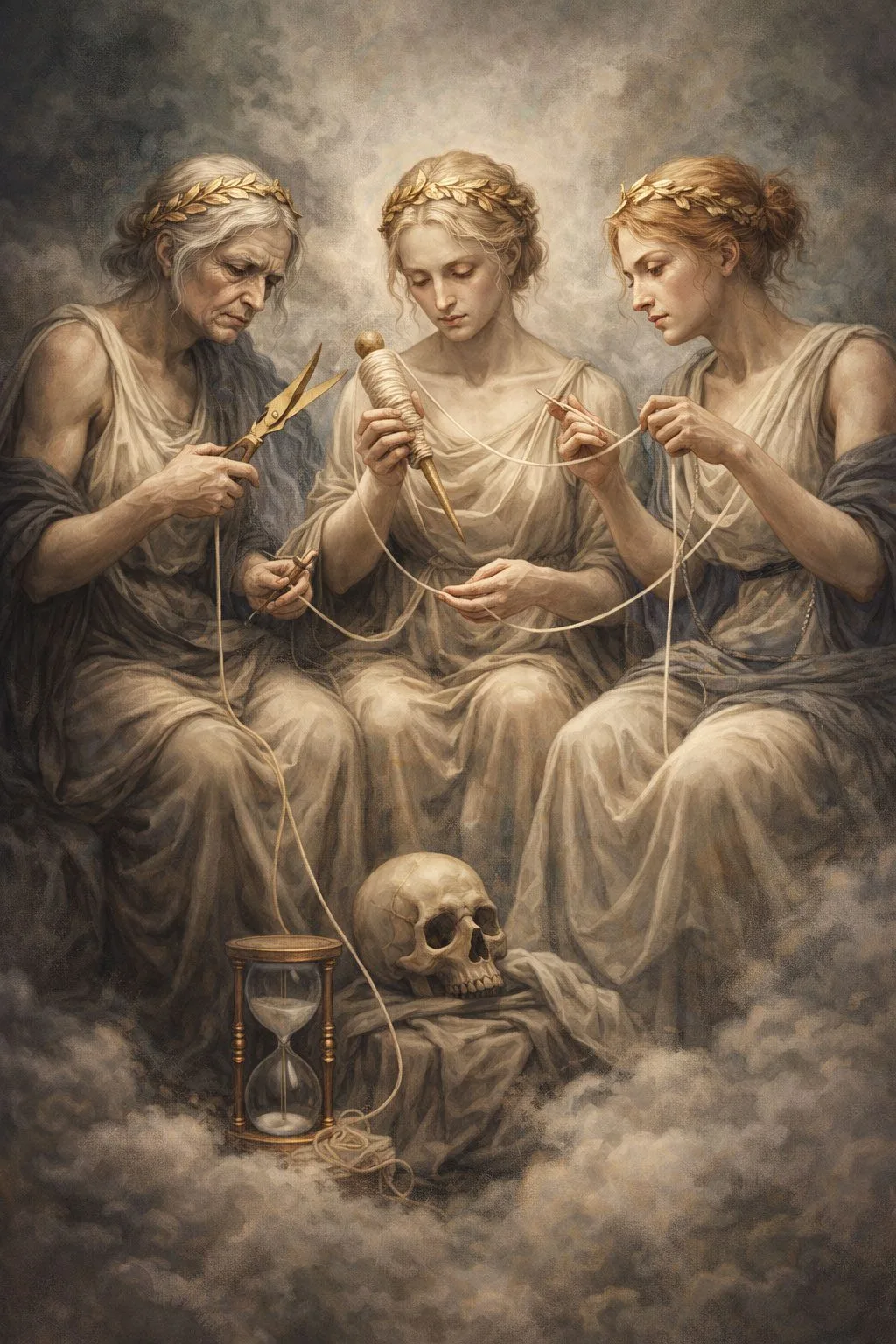
The Moirs hold a unique place in ancient Greek mythology, as they were considered the powerful deities that determined the fate of every man and the gods themselves. Unlike other deities ruling certain areas of nature or human life, the Fates represented a force superior to any divine or mortal power: the inevitable destiny.
The ancient Greeks believed that every man was born with a predetermined life share, which was determined by the three Fates. These were Clotho, Lachesi, and Atro. Cloth was the thread of life, symbolizing birth and the beginning of existence. Lahesis measured the length of the thread and determined the experiences, opportunities and trials that each man would encounter. Finally, Atrous, the most relentless of three, cut the thread when the time of death came, ending earthly life.
The image of the thread of life was one of the strongest symbols of Greek mythology. Through this metaphor, the ancients tried to explain the mystery of human existence and the inability of man to fully control his future. Despite his efforts, desires or ambitions, every man was obliged to follow the course he had been assigned to him by the Fates.
The prestige of the Fatals was so great that even the Gods of Olympus They could not always oppose their decisions. In many myths, Zeus is presented as the world's supreme ruler, but neither could he easily change the destiny that the Fates had set. This perception underlined the existence of a secular class superior to any authority, a force that maintained the balance of the universe.
The Fates often appear in important myths and heroic narratives. The heroes of Greek mythology, such as Achilles, Odysseus and Perseus, they knew that however great their power or intelligence was, they could not escape their fate. Achilles, for example, knew that he had to choose between a long but insignificant life and a glorious but short life. His decision to participate in the Trojan War proves how the ancients understood the relationship between free will and destiny.
Beyond their mythological role, the Fates also had deep philosophical significance. They symbolized the boundaries of human power and recalled that there are aspects of life that cannot be controlled. Their existence inspired respect and humility, as people recognized that fortune, time, and death lie beyond their absolute control.
The cult of the Fates was widespread in various areas of the Greek world. Although they did not have the imposing sanctuaries of other deities, they were honored through ceremonies and offerings associated with important moments of life, such as birth, marriage, and death. People sought their favor and prayed for a good fate, but knowing that their decisions remained irreversible.
The influence of the Squadrons exceeded the limits of antiquity and deeply influenced the literature, philosophy and art of the next centuries. Similar forms appear in many European myths and traditions, which shows how timeless the human need is to understand its destiny and place within the world.
Today, the Fates are still one of the most recognizable symbols of Greek mythology. Their form reminds them that life is a precious and finite thread woven from birth to death. At the same time, they express the timeless human search for answers about the future, fate and forces that shape the course of existence. Through the myths of the Fates, ancient Greek thought offers a deep and timeless interpretation of the relationship between freedom, necessity and inevitable destiny.
The Moirai – or Fates – are a group of three gods who weave and assign individual destinies to mortals at their birth. Their names are Clotho (the Clote), Lahesis (the Alote) and Atrotos (the Rigid). In the oldest myths, they were her daughters Nyx , but later, they are more often depicted as descendants of Zeus and Themis. In Orphic cosmogonyTheir mother is said to have been the Need.
«Fate leads those willing and drags those who are unwilling.» (An interpretation of the stoic era summarizing the general theme of fate and destiny in Greek mythology).
Presented consistently as three female weavers, each of the three Fates had a different mission, as revealed by her own name: Clostom nodded the thread of life, Lachesi measured its length and Atros cut it with her scissors. Sometimes, each of the Fates corresponded to a certain period of time: Atropos – the past, Clotho – the present and Lachesis – the future.
Only once the Fates were deceived by someone, and that someone was no other than Apollo . Once he learned that Admitus, his beloved, was doomed to die, Apollo got the Fates drunk and persuaded them to spare Hadmitus' life if he could find a replacement. He didn't. But the wife of Hadmit, Alceste, always the epitome of faith and love, came forward voluntarily and eventually saved her husband's life.
The The Moirai (Fates) They are one of the oldest, deepest and philosophically most important deities of Greek mythology. They are chthonic and secular forces that incarnate necessity, the destiny and the fate of every mortal and immortal being. No deity – not even Zeus – can fully violate their authority.
The Fates are not just personifications of chance, but custodians of the secular order, regulating birth, duration and end of life.
Name and Etymology
The word Moira comes from the verb Share («I get my share.») and means:
share
allotment
destined measure of life
Etymology reveals the deep ancient Greek perception that each being receives preordained share of existence. That's what he deserves.
Origin and Genesis
The origin of the Fates shows variety in ancient sources:
Hesiodic Tradition
The Theogony of Hesiod, the Fates are:
The second version emphasizes the connection between fate and Justice and institutional order.
Pre-Οlympian Character
Regardless of genealogy, the Fates maintain pre-Olympic and super-divine character, falling within the meaning of Ananke (Necessity)..
Number and Names of Fates
Three Fates are established in classical tradition:
Clotho
weaves the thread of life
symbolizes the birth and beginning of existence
Lachesis
determine the length and quality of the filament
represents the share of life
Atropos
cutting the thread of life
personifies irrevocable death
Atropos is the most terrifying form, as her decision is admits no reversal.
Form and Iconography
The Fates are depicted:
as mature or elderly women
with a serious and unexpressed face
holding:
spindle or distaff (Clotho)
measuring rod or scroll (Lachesis)
scissors or knife (Atropos)
Their form is simple, without exaggeration, suggesting Inflexible nature of fate.
Role and Function
1. Life and Death Regulators
The Fates:
determine the life span
define critical events
oversee the end of all existence
2. Supreme World Authority
Even the Olympian gods:
know fate
But they can't always change it.
Zeus himself often appears as ExecutorNot a creator of fate.
3. Moral and Philosophy Dimension
The Fates don't punish for revenge, but:
require necessity
ensure the balance of the world
The Fates in Literature and Tragedy
The Fates appear:
In tragedy:
operate as invisible force
guide events towards the inevitable end
The concept of tragic destiny It is directly connected to the Fates.
Symbolism
The Fates symbolize:
the time
the necessity
the limits of human freedom
the conflict of will and destiny
They are the foundation of the ancient Greek philosophy of freedom.
Relationship with Other Fatal Forces
They are closely linked to:
Worship and Sacred Places
The cult of the Fatals was limited and modest:
local shrines
related to births and deaths
desisting and appraising ceremonies
The approach was respectful and phobiaNot triumphant.
Educational and Cultural Value
The Study of Fates
illuminates the ancient conception of the world
links mythology, philosophy and tragedy
is a key theme in classical studies
Discover more Greek deities in our collection.
Modern Bibliography
Digital collection of ancient fragments and translations for Fates, particularly useful for references to primary sources.
The Greek Myths
Extensive analysis of myths and different traditions concerning the Fates.
Greek Religion
Fundamental work on Greek religion and the position of the Fatians in the religious system of ancient Greece.
The Routledge Handbook of Greek Mythology
Modern scientific presentation of Greek myths with references to ancient sources.
Mythology: Timeless Tales of Gods and Heroes
Classical work that presents the Fates in the wider context of Greek mythology.
Early Greek Myth
Two-volume academic work with detailed analysis of ancient sources and myth variants.
Primary sources: Hesiod, Theogony· Homer, Iliad and Odyssey· Plato, State· Apollodorus, Library.
Secondary sources: Burkert, Walter. Greek ReligionHarvard University Press, 1985. · Graves, Robert. The Greek MythsPenguin Books, 1992. · Hard, Robin. The Routledge Handbook of Greek MythologyRoutledge, 2004. · Gantz, Timothy. Early Greek MythJohns Hopkins University Press, 1993.