
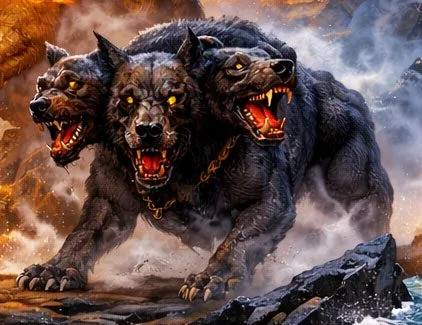
Cerberos: the Guardian of the Underworld in Greek mythology
- Cerberus is one of the most famous and recognizable creatures of Greek mythology. Known as his terrible dog Hades, stood at his gate Underworld and prevented the dead from returning to the world of the living. His form, usually with three heads, snake tail and snakes emerging from his body, inspired fear and awe in ancient Greeks and became a symbol of the inevitable boundary between life and death.
The myth of Kerberos is closely connected with Hades, the god of the Underworld, but also with several of the most important heroes of Greek mythology. The most famous story that concerns him is Hercules' last feat, when the hero descended to Hades to capture him.
The Origins of Cerberus
According to mythology, Cerberus was his son Typhon and EchidnaTwo of the most terrible monsters in the mythological world. From the same generation also came the Lernaean Hydra, - Chimera, Orthos and other terrifying creatures.
This origin explains its terrible power and horrible form. Ancient writers describe him as a monster combining dog, snake, and dragon characteristics, becoming one of the most powerful creatures who served the gods.
The form of Cerberus
The most famous depiction of Cerberus presents him with three dog heads. However, ancient sources do not always agree on the number of his heads. Some poets say he had fifty or even a hundred heads.
Beyond multiple heads, Cerberus had a snake tail and often snakes that emerged from his back or neck. These features highlighted his connection with the ethnonic forces and the world of the dead.
His voice was deafening and frightening, while his teeth were considered capable of devouring anyone who attempted to violate Hades' boundaries.
The Keeper of the Underworld
The main role of Kerber was to guard the gates of the kingdom of Hades. Contrary to what is often believed, his mission was not so much to prevent the living from entering as to prevent the dead from escaping.
Thus, Cerberus ensured that the physical order of the world remained undisturbed. Anyone who passed through the Underworld could not easily return, as the terrible dog stood unscathed guard at the entrance of the kingdom of the dead.
Hercules and the twelfth feat
The most famous story related to Cerberus is his twelfth and final feat HerculesKing Eurystheus ordered the hero to descend to Hades and bring Cerberus alive to the world above.
With the help of the gods, Hercules entered the Underworld and requested Hades' permission to take the monster. God agreed on one condition: the hero had to subdue Cerberus without using weapons.
After a hard struggle, Hercules managed to tame the monster with his naked power and transfer it to the world of the living. When Eurystheus faced the awesome dog, he was terrified and ordered his immediate return to Hades.
Cerberus in other myths
Cerberus appears in other mythological accounts. The musician Orpheus He managed to calm him down with the magnificent music of his lyre when he came down to the Underworld to seek out her Eurydice.
Also, Soul passed ahead of Cerberus during the tests imposed by Venus, offering him food to appease him.
These stories show that, although powerful, Cerberus could be fooled or calmed down with wisdom, music or divine help.
The symbolism of Cerberus
Cerberus symbolizes the border between life and death. As guardian of the Underworld, he represents the physical order of the universe and the inability of mortals to escape their fate.
His multiple heads have been interpreted in various ways. Some scholars associate them with the past, present, and future, while others consider them symbols of the almighty surveillance he exercises over the realm of the dead.
At the same time, Cerberus embodies fears associated with death and the unknown, becoming one of the most important chthonic guards of ancient Greek religion.
The legacy of Cerberus
The image of Cerberus has survived until modern times. He appears in works of art, literary texts, film productions and fantasy games, remaining one of the most famous monsters of world mythology.
Its form still symbolizes the gate to the unknown and guarding the boundaries that should not be violated. As the unscathed guard of Hades, Kerberos remains one of the most imposing and timeless creatures of Greek mythology.
- Cerberus He is one of the most famous and terrifying mythical creatures in Greek mythology. He guards the entrance to Hades and does not allow the dead to leave or the living to enter without permission. His form, his role in the world of the gods, and his symbolism make him a central figure in Greek mythology.
Form and Description
Cerberus is described as triskefalus dog with the body of a giant dog or a werewolf, often with snake tail And sometimes with Snake or dark nails. Each head symbolizes a different aspect of Hades’s guardianship: surveillance, intimidation, and the terror of the impious. Some traditions state that he had from three to one hundred heads, depending on the author and the area.
His terrifying form is not only for fear· reflects the separation of the living from the dead and the natural order of the world according to ancient Greeks.
His Role in Hades
Cerberus is the exclusive guardian of Hades, the kingdom of the dead commanded by Hades and Persephone. His main mission is:
Here. Don't let the dead out. from Hades.
Here. prevent the living from entering without divine permission.
Cerberus embodies the Greek belief that death is inevitable and that the worlds of the living and the dead must be strictly separated.
Myths and Heroic Meetings
Cerberus appears in various myths, and particularly in the story of Hercules, which is the most famous episode:
Hercules' twelfth feat: The hero was tasked with bringing Cerberus from Hades to the surface of the earth without using weapons. With the help of the gods, Hercules managed to lure and subdue the monster, bringing it temporarily into the world of the living.
The myth of Cerberus and Hercules teaches the concept of strength, patience and proper use of courage.
Symbolism
Cerberus symbolizes:
The death and absolute order of the world
Protecting and guarding Hades' secrets
The concept of delimitation: live/dead, heroism/fear
In art and literature, Cerberus appears as a depiction of protection, power, and fear connected to death.
Cerberus in Popular Tradition
In folklore, Cerberus often embodies threat of death and appears in traditions and stories of dark rivers or springs, reminding people of the dividing line between life and death.
Ancient Sources
- Theogenia, p. 310–312.
- Library, 2.5.12.
- Iliad, 8.368 and later reports.
- Praise, Book VI.
- Description of Greece.
Modern Bibliography
- The Greek Myths.
- Early Greek Myth.
- The Complete World of Greek Mythology.
- The Routledge Handbook of Greek Mythology.
- Dictionary of Classical Mythology.