
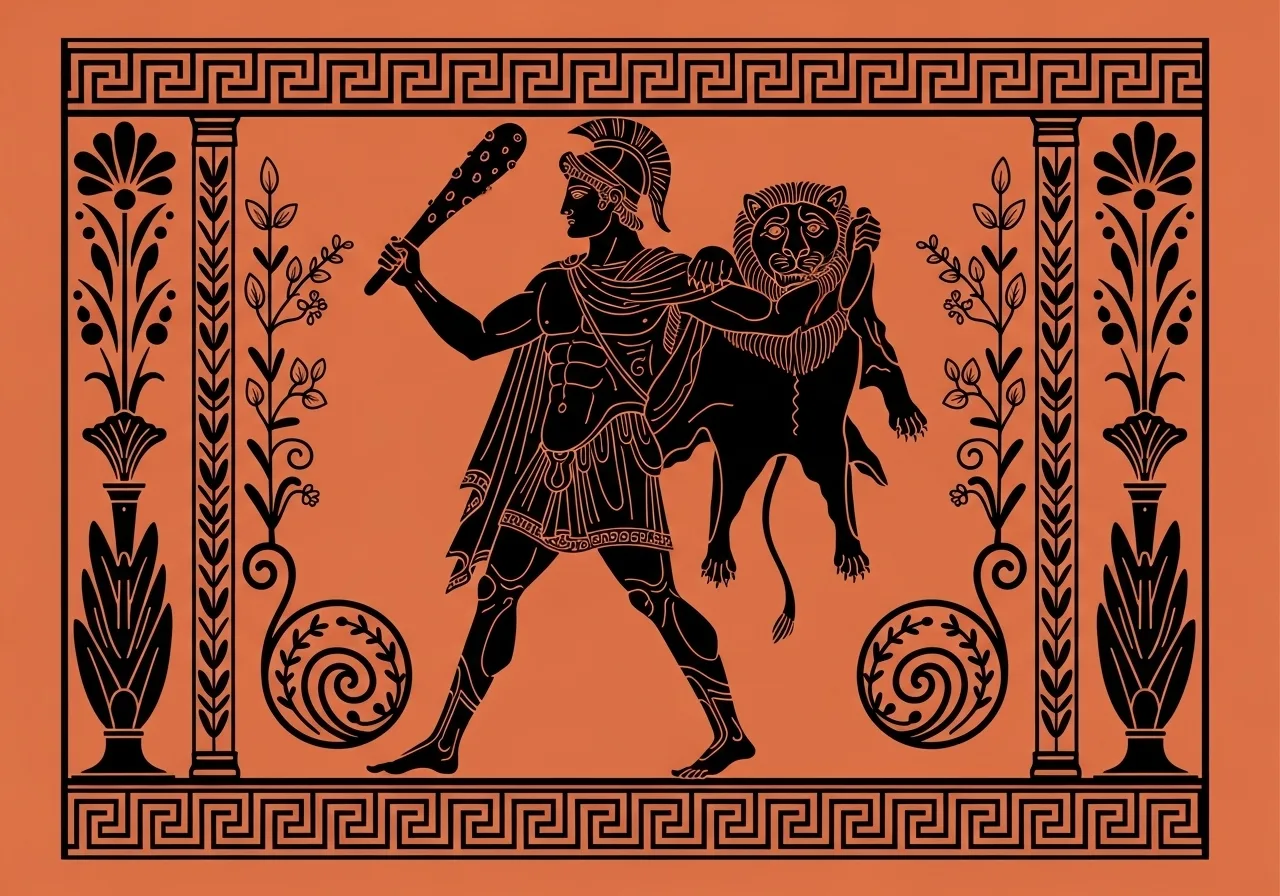
Hercules is perhaps the most recognizable figure among the heroes of Greek mythology. Son of Zeus and the mortal Alcmene, he combined divine origin with human trial, physical supremacy with tragic fate, violence with redemption, and immortality with suffering. In the tradition of ancient Greece, he was not simply a powerful warrior; he was the hero who fought monsters, cleansed lands of dangers, endured punishments, was crushed by guilt, and finally rose to Olympus.
Its form remains timeless because it condenses one of the deepest human ideas: that power is not enough without patience, self-knowledge and redemption. Hercules in Greek mythology symbolizes the man who is tested at his limits, errs, suffers, but continues to struggle. The 12 feats of Hercules, his adventures and his final disposal were a source of inspiration for ancient art, theatre, philosophy, Roman tradition and modern pop culture.
Who Was Hercules in Greek Mythology
Hercules' origins link the world of gods to the world of men. His father was Zeus, the supreme god of Olympus, while his mother was Alcmene, the wife of Amphitryon and his descendant Perseus. This dual ancestry is decisive to its myth. On the one hand, Hercules was the son of Zeus and brought within him divine power. On the other hand, he was born of a mortal woman and had to live within the boundaries, pains and moral conflicts of men.
The story of his capture is typical of the mythological narrative about Zeus. According to ancient sources, such as Apollodorus THE «Library» and later novelists, Zeus fell in love with Alcmene and, taking the form of her husband Amphitryon, approached her. This union led to Hercules' birth. On the same night, or in a near time during certain versions, Alcmene was also joined by the real Amphitryon, resulting in twins being born: Hercules, son of Zeus, and Iphicles, son of Amphitryon.
The hero's original name was Alkeides or Alcaeus, a name referring to strength and valor. Name «Hercules» means, in the prevailing interpretation, «glory of Hera» or «The person who praises the Hera»Ironically, hera was the hero's relentless persecutor, because Hercules was the fruit of another infidelity of Zeus. However, through her persecutions, the hero was led to the great exploits that gave him eternal glory. Thus, even the hostility of the goddess contributed to his greatness.
Heracles’ position among heroes and gods is unique. He is not simply a demigod, like many other heroes of Greek mythology. He is the hero who, after a life full of labors and suffering, passed from mortality into immortality. In ancient worship he was honored both as a hero and as a god, something rare and indicative of his special importance. In many Greek cities there were sanctuaries, altars, and festivals in his honor, while athletes, soldiers, and rulers regarded him as a model of strength, endurance, and victory.
The Birth and Childhood of Hercules
The birth of Heracles was marked by the wrath of Hera. When Zeus boasted that a child from the line of Perseus would become king, Hera made sure to delay the birth of Heracles and hasten the birth of Eurystheus. Thus Eurystheus was born first and became the ruler to whom Heracles would later be subjected in order to perform his labors. This intervention already reveals the central motif of the myth: Heracles is destined for greatness, but his greatness will come through oppression, injustice, and trial.
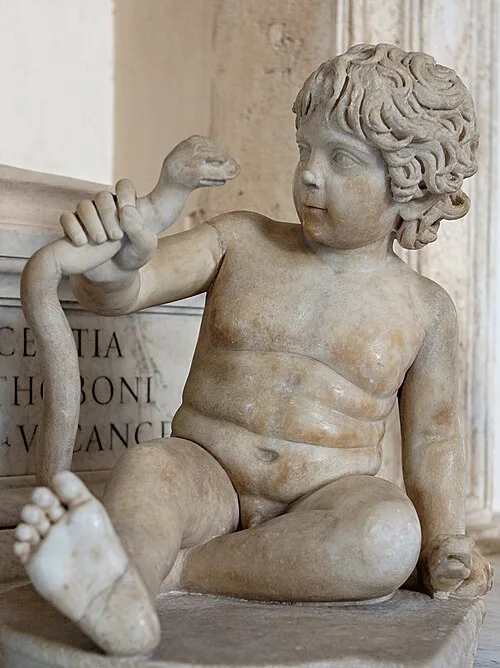
One of the most famous episodes of his childhood is sending two snakes to his crib. The Hera, wanting to eliminate the infant, he sent two large reptiles into the room where Hercules and Iphicles slept. Iphicles scared and began to cry, while little Hercules grabbed the snakes with his hands and drowned them. This scene became a favorite subject in ancient angiography, for it presented in a simple and powerful way the superhuman power of the hero already from infancy.
The first signs of his strength are not limited to the episode of the snakes. From childhood Heracles stood out for his physical development, energy, and bravery. But his strength was difficult to control. Mythology presents him as a child with an explosive character, capable of great deeds but also of violent reactions. This dual nature—the blessing and danger of excessive power—would follow him throughout his life.
His education was worthy of a hero. Amphitryon made sure he was taught martial arts, music, archery, wrestling, chariot driving, and the use of weapons. Castor, according to some traditions, taught him the art of arms; Eurytus or other teachers taught him archery; and Linus taught him music and the lyre. The upbringing of Heracles shows that the ancient hero was not merely naturally gifted; he had to be trained, disciplined, and integrated into a system of values. Nevertheless, his explosive nature often exceeded the limits of education.
Hercules as a Young Hero
As a young hero, Heracles began to prove that he was no ordinary man. His first achievements are connected with the protection of communities from threats, a theme that recurs throughout his mythological career. The hero does not fight only for personal glory, but often to free people, cities, and regions from monsters, robbers, or unjust rulers.
The killing of Linus is one of the most characteristic episodes of his youth. Linus, his music teacher, reprimanded or punished Heracles for his reluctance or clumsiness with the lyre. The young hero, in an outburst of anger, struck him with the lyre and killed him. The episode reveals that Heracles’ strength was not always beneficial. Without self-control, even heroic power can become destructive. Amphitryon, fearing further outbursts, sent him to the mountains to live among shepherds.
In the mountains of Cithaeron, Heracles faced the lion that was terrorizing the region and destroying the flocks of Amphitryon and King Thespius. The battle with the Cithaeronian lion was a precursor to the labor involving the Nemean lion. Young Heracles killed the beast and gained fame as a protector of humans against the wild forces of nature. During his stay with Thespius, various traditions state that he united with the king’s daughters, producing many descendants, a mythological explanation for the ancestry of various families.
His marriage to Megara, daughter of King Creon of Thebes, came after the help Heracles gave the Thebans against the Minyans. Creon, grateful for the victory, gave him Megara as his wife. For a while, Heracles seemed to gain ordinary human happiness: home, wife, children, and social recognition. But in the myth of Heracles, happiness is often fragile. Hera had not stopped persecuting him, and his next trial would be the most tragic.
The Madness Sent by Hera
The divine punishment that struck Heracles was decisive for his entire mythological path. Hera, continuing her hostility, sent madness upon the hero, a god-sent frenzy that clouded his reason. In ancient Greek thought, madness was not merely a psychological condition but often a divine intervention. A human being could lose control of himself because the gods invaded his consciousness.
In this state, Heracles killed Megara and his children, believing in some versions that he was fighting enemies. This tragedy is presented with particular intensity in Euripides’ “Heracles Mad,” where the hero returns from his labors and saves his family from the tyrant Lycus, only to destroy them himself under Hera’s influence. The contrast is shocking: the savior becomes a murderer, the protector destroys his own household.
After his reason returned, Heracles sank into guilt. The search for redemption is one of the most important elements of the myth. Heracles is not presented as an infallible hero. On the contrary, he carries an unbearable crime, even if it was caused by divine madness. His need to be purified from pollution leads him onto a path of submission, toil, and pain.
The Oracle of Delphi gave the solution: Heracles had to serve Eurystheus, king of Mycenae or Tiryns, and perform whatever tasks he assigned him. There, according to many traditions, the hero definitively received the name Heracles. The oracle’s command was not simply a punishment; it was a path of transformation. The 12 Labors of Heracles were born from the need for redemption, but they became proof of his endurance and heroic worth.
The Twelve Labors of Hercules
The 12 Labors of Heracles form the most famous cycle of stories about the hero. Originally, according to some versions, the labors were ten, but Eurystheus did not recognize two of them: the Lernaean Hydra, because Heracles had the help of Iolaus, and the Augean Stables, because payment had been requested or agreed upon. Thus two additional tasks were added. The labors are not merely adventures. Each one reveals a form of chaos that must be subdued: beasts, monsters, filth, violence, death, greed, or the unattainability of divine knowledge.
The Nemea Lion
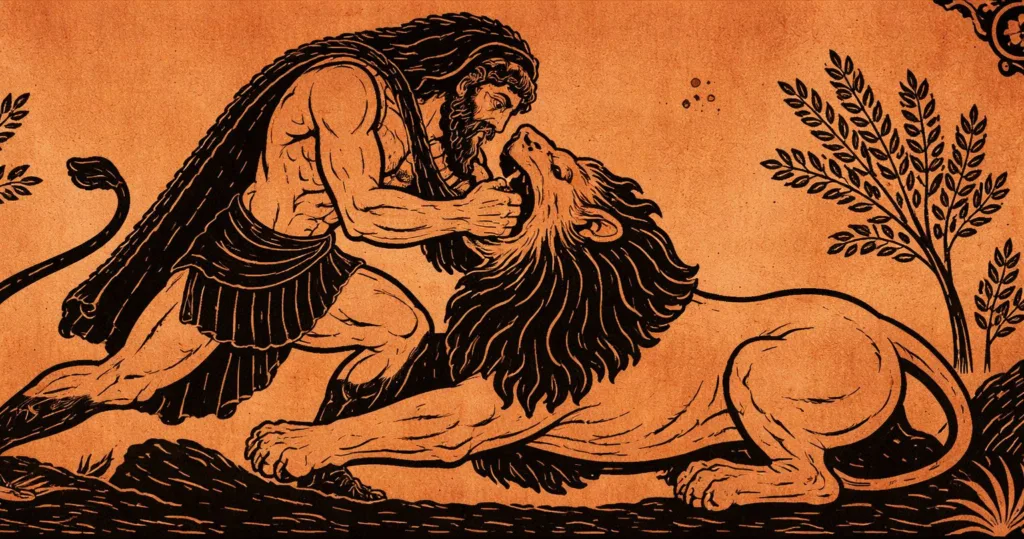
Heracles’ first mission was to kill the Nemean Lion, a monstrous beast with a hide impenetrable by weapons. The lion terrorized the region of Nemea and could not be defeated by ordinary means. The difficulty of the labor lay not only in the animal’s strength, but also in its invulnerability. Arrows and swords had no effect.
Heracles understood that he had to face the beast with his bare hands. He trapped it in its cave, wrestled it hand to hand, and strangled it. Then he used the lion’s own claws to skin it and wore its hide as armor. From then on, the lion skin became the hero’s most characteristic feature in art.
The symbolism of the labor is clear: Heracles defeats raw, wild violence not with external weapons, but with his own inner strength. The lion skin shows that the hero incorporates the strength of his opponent and transforms it into protection.
The Lernaean Hydra
The second mission was to eliminate it. Lernaia Hydra, a multi-headed monster living in the marshes of Lerna. Every time Hercules cut off a head, two new ones grew in place. Furthermore, one of her heads was immortal, while her breath and blood were poisonous. Hera, wanting to make the hero difficult, also sent a big crab to bite him.
Heracles could not win by strength alone. With the help of Iolaus, he cut off the heads while Iolaus cauterized the necks with fire so that no new heads would grow. He buried the immortal head under a heavy rock. Then he dipped his arrows in the Hydra’s poisonous blood, obtaining a terrible weapon for future battles.
The labor symbolizes the struggle against problems that multiply when addressed superficially. The Hydra is an image of evil that regenerates, of pollution and chaos. Victory requires strategy, cooperation, and determination.
The Ceryneian Hind
The third mission was to capture alive Crynitis Calfos, her sacred animal Artemis. The deer had golden horns and bronze hooves, and it was so fast that no one could catch it. Here Hercules should not have killed a monster, but conceived without insulting the goddess.
The difficulty lay in the duration and delicacy of the task. Heracles pursued it for an entire year, crossing mountains and distant regions. Finally he lightly wounded it or captured it near the river Ladon, taking care not to kill it. When Artemis and Apollo protested, Heracles explained that he was carrying out Eurystheus’ order and promised to return the animal.
The symbolism differs from the previous labors. Here heroic virtue is not destruction, but control. Heracles must combine perseverance, respect for the sacred, and self-restraint.
The Erymanthian Boar
The fourth mission was the capture of the Erymanthian Boar, a huge wild boar that was ravaging the region of Mount Erymanthus. The beast was fierce, strong, and dangerous, but Eurystheus demanded that it be brought back alive.
Heracles hunted it in the snowy mountains and exhausted it by driving it into deep snow. There he bound it and carried it to Eurystheus. Tradition says that the king was so terrified when he saw the animal that he hid in a large jar. The episode involving the Centaurs and Pholus is often placed within the same journey, where the opening of a jar of wine caused conflict and death.
The labor symbolizes the taming of uncontrolled nature. Heracles wins not only through brute strength but through endurance, knowledge of the environment, and patience. The boar, a wild and destructive creature, becomes captive to human ingenuity.
The Augean Stables
The fifth mission was seemingly humiliating: Heracles had to clean in one day the stables of Augeas, king of Elis, where countless herds lived and filth had accumulated over many years. The difficulty was not battle, but the scale of the filth and the pressure of time.
Heracles did not try to clean them by hand. He opened channels and diverted the waters of the rivers Alpheus and Peneus so that they would pass through the stables and clean them. Augeas later refused to keep his promise of payment, and Eurystheus did not recognize the labor because it was considered to have been done for reward.
The symbolism is powerful: the hero cleans accumulated corruption and filth not with simple muscular strength, but with intelligence and the use of natural forces. The labor shows that Heracles is not only strong, but also practically intelligent.
The Stymphalian Birds
The sixth mission was to drive away or kill the Stymphalian Birds, which lived near Lake Stymphalia. These birds had metallic feathers, attacked humans, and destroyed the land. They lived in a dense marsh, where it was difficult to approach them.
Athena helped Heracles by giving him rattles or metallic instruments made by Hephaestus. With the loud noise, the birds flew out of their hiding place, and Heracles killed them with his arrows or forced them to leave.
The labor symbolizes the neutralization of hidden dangers. The Stymphalian Birds live in a marsh, a space between land and water, which in ancient imagination was often associated with ambiguity and threat. Victory comes through divine help, courage, and the right tool.
The Bull of Crete
The seventh mission was the capture of the Cretan Bull. The animal is connected with the myth of Minos and, according to some traditions, with the bull sent by Poseidon from which the Minotaur was born. The bull had become wild and was causing destruction in Crete.
Heracles traveled to Crete, faced the animal, subdued it, and brought it alive to Eurystheus. Eurystheus released it, and the animal later wandered through Greece until it became connected with other myths, such as that of Theseus at Marathon.
The symbolism of the labor concerns the taming of fertile but destructive power. The bull is an ancient symbol of strength, royal authority, and wild energy. Heracles imposes order on a force that has escaped control.
The Horses of Diomedes
The eighth mission was to bring to Eurystheus the horses of Diomedes, king of the Bistones in Thrace. These horses fed on human flesh and were terrifying in their savagery. The difficulty lay both in the animals themselves and in the warlike people who protected them.
Heracles defeated Diomedes and, in many versions, threw him to his own horses, which devoured him. After they had fed, the animals calmed down and the hero was able to lead them to Eurystheus. This labor often includes the death of Abderus, Heracles’ companion, who was devoured by the horses. In his honor, according to tradition, the city of Abdera was founded.
The labor symbolizes the reversal of violence upon its own agent. Diomedes, who fed his horses with human beings, becomes the victim of his own inhumanity. Heracles restores moral order.
The Belt of Hippolyta
The ninth mission was to acquire the belt of the Knight, Queen of the Amazons, as a gift for Eurysthea's daughter, Hadmit. The belt was a symbol of power and war power. Hercules traveled to the land of the Amazons, a people of war women who particularly impressed Greek imagination.
In some versions, Hippolytes agreed to give him the zone peacefully. But Hera, disguised, spread to the Amazons that Hercules wanted to kidnap their queen. A battle broke out, and Hercules killed Hippolyte or other Amazons and took the belt.
The symbolism of the feat is associated with the hero's contact with an unconventional world, where female war power overthrows Greek standards. The zone represents power, sovereignty and social difference. The feat also shows how Hera's interference turns possible peace into conflict.
The Oxen of Geryon
The tenth mission was to bring the cattle of Geryon, a monstrous being with three bodies or three heads, living in distant Erythia, to the ends of the West. The journey was in itself a huge test. Hercules had to reach the limits of the known world, beyond the Mediterranean.
On his way he set up the so-called Hercules Columns, which identified with the Straits of Gibraltar. To cross the Ocean, he used the Sun's gold cup, according to a poetic tradition. In Erythia he killed the Orthrow dog, the shepherd Eurytion and eventually Geryon. Then he led the oxen back, facing many adventures.
The feat symbolizes the conquest of the ultimate horizon. Hercules isn't just cleaning up a place from a monster.· It widens the boundaries of the world. The march to the West connects the hero to the exploration, transcendence and dissemination of culture.
The Apples of Esperides
The eleventh mission was to bring the golden apples of the Esperides, located in a garden on the edge of the world and guarded by the nymphs Esperides and dragon Ladon. Apples were a gift of Earth to Hera for her marriage to Zeus and were of divine importance.
The difficulty was first the ignorance of the location. Hercules wandered, sought information, fought Nerea or met Prometheus, depending on the version. Finally reached the AtlasTitan holding the sky. In a well-known version, Hercules temporarily raised the sky, while Atlas went to pick up the apples. When Atlas tried to avoid taking the weight again, Hercules tricked him into asking him to hold it for a while, supposedly to settle better, and left with the apples.
The feat symbolizes the search for the inaccessible divine good. Apples are an image of immortality, knowledge, and divine blessing. Hercules reaches the limits of the world and touches things that don't normally belong to people.
Cerberus and the Descent into Hades
The twelfth and final mission was the most terrifying: Hercules had to descend to Hades and bring Eurysthea the CerberusThe three-headed dog guarding the gates of the underworld. Here the hero faces not only a beast, but death itself.
Before descent, he was initiated in Eleusinia Mysteries, according to a significant tradition, to clean and prepare for contact with Hades. In the underworld he met the souls of heroes, free him Theseus against certain versions, and asked Pluto for permission to take Cerberus. God accepted on condition to defeat him without weapons. Hercules fought the monster, subdued it and brought it to Eurysthea, who once again feared. Then Kerber returned to Hades.
Symbolism is deep: Hercules exceeds the limit of human existence. He descends into the world of the dead and returns alive. This feat heralds its apotheosis, for it shows that the son of Zeus can even defeat the fear of death.
Other Important Achievements of Hercules
Hercules' participation in Argonaut Campaign shows its importance within the wider circle of heroes. Hercules joined the crew of Argos, along with Jason, Orpheus, Distillates And other famous heroes. However, he did not complete the journey to Colchis. In many versions he abandoned the campaign when his beloved companion Ylas was lost, snatched from nymphsHis departure underlines that Hercules is such a great hero that he hardly fits into a collective narrative.· His presence would overshadow Jason.
The release of Prometheus is one of his most symbolic achievements. Prometheus, punished by Zeus for giving fire to people, was tied to the Caucasus, where an eagle ate his liver daily. Hercules killed the eagle and freed Titan, with Zeus' consent or tolerance. This act presents Hercules as a benefactor not only of men but also of divine figures who suffered for the sake of humanity.
The battles against giants and monsters are numerous. In Giant combat, according to important traditions, the gods needed the help of a mortal to defeat the Giants. Hercules, with his poisoned arrows, played a decisive role. He also fought Antaeus, a giant who drew power from Earth· Hercules defeated him by lifting him into the air and depriving him of contact with his mother. He faced Busiris in Egypt, Swan, Laomedon of Troy and many other persons who embodied arrogance, violence or disrespect.
His campaigns in various areas of the Greek world were mythologically explaining the establishment of cities, cults and generations. THE Hercules appears in Peloponnese, Boeotia, Thessaly, Aetolia, Crete, Thrace, Asia Minor, Italy and the West. His wanderings created a kind of heroic map of antiquity. Wherever he went, he left traces: altars, descendants, local traditions and domestication stories.
The Wives and Children of Hercules
Megara was Hercules' first important wife and the form associated with his greatest tragedy. As Creon's daughter, he represented the hero's social rehabilitation in Thebes. Their marriage could be the end of a heroic story: the new warrior saves the city, marries the princess and has children. But Hercules' myth does not follow this simple happiness. The fury Hera sent destroyed the family and turned the hero into an exile of his own consciousness. In some traditions, Megara does not die but is later given to Iolaus, but the tragic version prevailed mainly through the theatre.
Deianeira is Hercules' second main wife. Daughter of Oinea, King of Calydon, is associated with the last cycle of the hero's life. Hercules won her after fighting the river god Acheloos, who also claimed her. This struggle is full of symbolism: the hero struggles with a transformed physical force, as Acheloos changes forms. Marriage to Deianeira brought new offspring, but also the final tragedy.
His descendants were many, as fit a hero associated with a multitude of local genealogies. Among his children are the Matter, the Ctesippus, the Glenos, the Oneite and others, depending on the sources. From various women he had sons considered ancestors of cities, tribes or royal houses. mythology often used Hercules to give prestige to families and communities who claimed to be descended from him.
Heraclides, the descendants of Hercules, hold a special place in Greek tradition. The myth of the descent of the Herakles in Peloponnese was associated with historical memories of movements and with the establishment of gifted royal houses. The Spartan kings, for example, considered themselves descended from Hercules. Thus, the hero was not only a mythological person but also a foundation of political legitimacy.
The Death of Hercules
Hercules' death came from the tunic of Nessus, one of the most tragic episodes of Greek mythology. Nessus was a Centaurus who tried to grab or rape Deianeira, when he carried her to the River Evenenos. Hercules hit him with an arrow soaked in the poison of Lernaia Hydra. Dying, Nessus deceived Deianeira: he told her that his blood could function as a love potion, so as to keep Hercules' love forever.
Deianeira's tragic fate was completed when, fearing Hercules loved another woman, Ioli, she smeared a tunic with Nessus' blood and sent him to her husband. He didn't know the blood was contaminated by Hydra's poison. When Hercules wore the robe, the poison began to burn his flesh and cause unbearable pains. Deianeira, learning the truth, committed suicide. This story is presented with dramatic force in «Trachinia» Sophocles.
The fire on Mount Oite was the end of Hercules' mortal life. Unable to withstand pain and knowing that no human means could save him, he asked for fire to be lit. Philoctetes or Poias, depending on the version, lit the fire and as a reward received the hero's bow and arrows. Hercules' image at the stake is one of the most touching of ancient mythology: the indestructible hero, who defeated monsters and descended to Hades, suffers from a poison indirectly derived from his own weapons.
The transition from mortality to immortality takes place through fire. The fire is not just death.· It's cleansing and transformation. The mortal body burns, while the divine nature of the hero rises. Hercules thus completes his course by a man suffering to an immortal being honored.
The Apotheosis of Hercules
The rise in Olympus is the culmination of Hercules' mythological course. After his death in Oiti, Zeus accepted him among the gods. This apotheosis distinguishes Hercules from most heroes of Greek mythology. Other heroes were honored after death, but Hercules became immortal with full divine standing.
Reconciliation with Hera is necessary to complete the myth. The goddess who pursued him from his birth finally accepts him. Some traditions speak of symbolic adoption of Hercules by Hera, so that he can fully join the divine world. This reconciliation does not undo the suffering it has caused, but integrates them into a secular order where the test leads to glory.
Marriage with Evie, goddess of youth and daughter of Hera and Zeus, seals the apotheosis. Evie offers Hercules eternal youth, the opposite of the decay he suffered as a mortal. This marriage is also political and family integration in Olympus: the former persecuted becomes the son-in-law of Hera and a member of the divine community.
His position among the immortal gods was special. Hercules was worshiped as a god savior, protector of the wrestler, high schools, warriors, travelers and people seeking power. In ancient worship he could accept both heroic and divine honors. This dual worship reflects his dual nature: he was a man who suffered and a god who defeated corruption.
Hercules ’ Symbolism
Hercules symbolizes power first of all. His physical strength is proverbial and appears in every myth, from the snakes of the cradle to Cerberus. But this power is not mere muscle supremacy. It's cosmic energy, ability to deal with chaos and restore order. That is why Hercules became a model of athletes, soldiers and leaders.
It also symbolizes perseverance. Many of his feats require time, patience and endurance: the pursuit of Elafus Crynitis lasts a year, the search for the Hesperides Apples requires wandering to the ends of the world, descent to Hades requires mental preparation. Hercules is not only the hero of the instantaneous explosion, but also of the long effort.
Atonement is perhaps his deepest human element. Hercules does not do the feats to become just famous, but to be cleansed of a crime that crushes him. His story shows that even the greatest hero can fall, become infected, and need correction. Atonement doesn't come easily· requires pain, service and humiliation.
The transcendence of human boundaries is ubiquitous. Hercules reaches the ends of the earth, raises the sky, descends to Hades and ascends to Olympus. His life is a continuous crossing of boundaries: between man and god, life and death, nature and culture, guilt and redemption.
The fight against chaos and monsters is the core of the sung mission. The monsters he faces are not random. The lion, Hydra, Capros, man - eating horses, and Cerberus represent forces that threaten human order. Hercules acts as a civilized hero: he opens roads, cleans places, punishes the unjust and makes the world more habitable.
Hercules in Ancient Art and Literature
In pottery Hercules has been one of the most favorite subjects. From the archaic to the classical era, the angiographers portrayed scenes such as drowning snakes, fighting with the lion of Nemea, Hydra, Kerberos, Athena who accompanies him and his apotheosis. His lion, bat, and bearded form became pictorial symbols directly identifiable.
In sculpture its form evolved from an archaic warrior to an ideal body of strength and fatigue. Especially in classical and Hellenistic art, Hercules is not only presented triumphant but also tired. His famous model «Hercules Farnese», Roman copy of Hellenistic work associated with Lysippos, shows the hero exhausted, touched on his bat, with the apples of Esperides hidden behind the back. This picture highlights that heroic power has cost.
In the theatre Hercules appears in a multidimensional manner. Euripides in «Hercules» examines madness, guilt, and human endurance. Sophocles on «Trachinia» He focuses on Deianeira, Nessus' tunic and the tragic death of the hero. Tragic poets are not only interested in accomplishments, they are interested in the mental weight the hero carries.
In Hellenistic and Roman times Hercules, known to the Romans as Hercules, gained enormous popularity. The Romans honored him as a protector of power, victory, and military virtue. Emperors and generals identified themselves in his form, while art continued to reproduce its feats in reliefs, statues, mosaics and coins. Hercules became a bridge between the Greek and Roman world.
Hercules in Modern Culture
In the books Hercules remains a basic form in covers of Greek mythology for children, young and adults. It appears in encyclopedias of mythology, historical novels, comic books and modern reinterpretations. He is often presented either as an indestructible warrior or as a tragic hero trying to reconcile with his past.
In cinema his form experienced many transformations. From Italian films «peplum» of the 20th century until Hollywood productions, Hercules appeared as a muscular savior, wandering hero or fictional warrior. Often film versions simplify the myth, emphasising action and less on tragedy.
On television Hercules became more widely known through adventure and fantasy series, which present him in a lighter, heroic or family style. These versions helped spread the name «Hercules» internationally, although they are often removed from ancient sources.
In video games Hercules appears in worlds of action, strategy and imagination. Sometimes he is a protagonist, sometimes an ally or opponent, and is usually associated with supernatural power, bat, lion, and feats. His mythological identity easily adapts to interactive environments, because his feats already resemble successive missions.
His influence on modern pop culture is enormous. Its name is used as a synonym of the force: «Project» means something extremely difficult. The image of superhero possessing supernatural power but facing ethical dilemmas has much in common with Hercules. From comic books to superhero films, his legacy is obvious.
Interesting Facts about Hercules
1. The name Hercules means probably «glory of Hera»Though Hera was his greatest enemy.
2. His original name was Alkeidis, from the root associated with alki, i.e. power.
3. Hercules had a twin brother, Iphicles, but a different father: Hercules was the son of Zeus, while Iphicles the son of Amphitryon.
4. His feats were not always twelve· in earlier versions there were ten, but two were not recognized by Eurysthea.
5. Athena often appears as his patron and assistant, although Hercules is mainly known as the son of Zeus.
6. The poison of Lernaia Hydra, which gave him strong arrows, eventually became an indirect cause of his death through the tunic of Nessus.
7. Eurystheus was so afraid of Hercules that in some scenes he hides himself in a large jar.
8. Hercules was worshiped in a double way: as a hero with chthonic honors and as a god with Olympia worship.
9. The Spartan kings claimed they were descended from Hercules, using the myth for political legitimacy.
10. Hercules was considered a patron of high schools and wrestlers, because he embodied the ideal of physical exercise.
11. In Roman tradition, as Hercules, it gained even greater connection with military power and imperial projection.
12. His descent to Hades brings him close to muscular traditions, especially because of his connection to Eleusinian Mysteries.
13. The myth of Adaeus shows that Hercules did not always win with simple force, but with observation and strategy.
14. The lion of the Nemea lion became such an important symbol, that it often suffices alone to recognize the hero in art.
15. Despite his reputation as a stronger hero, many ancient accounts present him deeply vulnerable, tired, and tragic.
Conclusion
Hercules remains one of the most important symbols of Greek mythology and world culture because it unites contrasts that touch man over time. He is the strongest among the heroes of Greek mythology, but also a hero wounded by guilt and loss. He is the son of Zeus, but he lives as a suffering mortal. He defeats monsters, but must first defeat his own fate. Hercules' 12 feats are not just exciting adventures· are symbolic trials that speak of man's attempt to impose order in chaos, to cleanse the stench, to transcend fear and to turn pain into power. That is why Hercules in Greek mythology is not only in the past. He remains alive as an archetype of struggle, endurance and redemption, a form that continues to inspire art, thought and imagination around the world.
Sources and Bibliography
Apollodorus, LibraryHomer, Iliad and OdysseyHesiod, Theogony and Heracleus shieldSophocles, TrachiniEuripides, HerculesGraves, Robert, The Greek Myths. Kerényi, Karl, The Heroes of the GreeksStafford, Emma, HeraclesHard, Robin, The Routledge Handbook of Greek MythologyGantz, Timothy, Early Greek MythBurkert, Walter, Greek Religion.
Online Academic Resources
- Theoi Greek Mythology – Hercules
- Encyclopedia Britannica – Hercules
- Perseus Digital Library
- World History Encyclopedia – Hercules
| Name | Hercules |
|---|---|
| Parents | Zeus and Alcmene |
| Residence | Olympus (apotheosis) and Tiryns |
| Roles and Responsibilities | Hero of mythology, executioner of 12 feats, protector of strength and endurance |
| Other Names | Alcaeus, Heraclid |
| Husbands | Megara, Deianeira, Hebe |
| Children | Clementus, Archemachus and others |
| Symbols | Bat, lion's mane |
| Roman Name | Hercules |
