
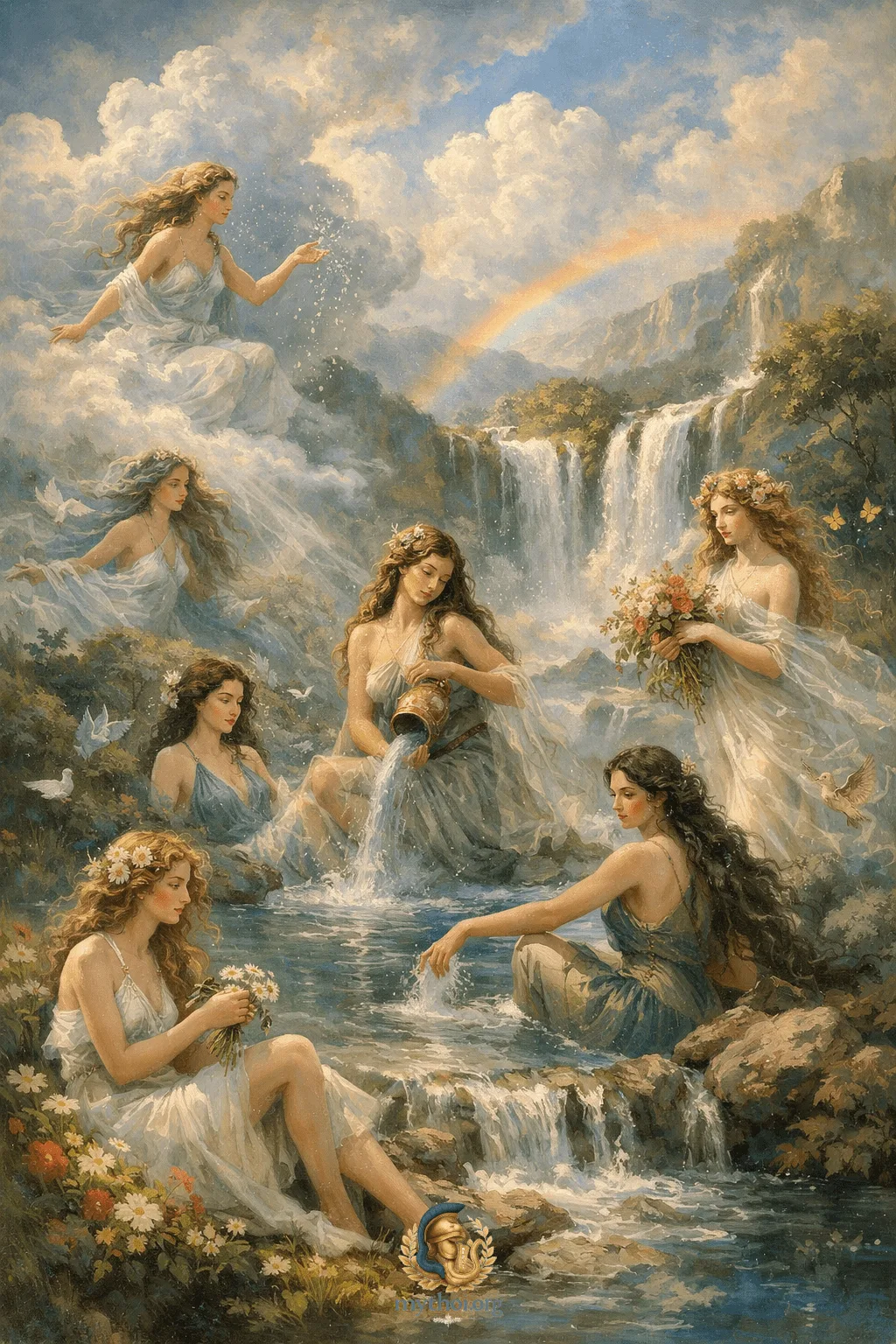
Oceanids: Water Deities in Greek Mythology
What are oceans? Oceans are deities nymphs of Greek mythology, daughters of Titan Oceanus and Tethys, symbolizing the springs, rivers and waters of the earth.
The Oceanids Numbering three thousand, the Oceanids were nymphs who presided over the earth’s freshwater sources, from rain clouds to underground springs and fountains. Among their ranks were various types of nymphs, including the Nefeles (Nymphs of the Clouds), Aurae (breeze nymphs) Naiads (freshwater nymphs of springs and fountains), Leimonides (meadow nymphs), and Anthousae (Flower nymphs). All were considered daughters of the great encircling river of fresh water, Oceanus and his consort Tethys.
The eldest among them were counted among the Titanesses, including Styx, - Dione, - Neda, - Metis, - Clymene,, - Eurynome, - Doris, - Electra and Pleione. These figures were likely associated with the heavens and clouds.
Some oceans personified divine blessings, such as Metis (Sophia), the Clymene, (Fame), Plouto (Nuclear), Tyche (Good luck), Telesto (Success) and Peitho The goddess. Nemesis She was sometimes included among them, as the one keeping the balance by punishing the unjust good fortune that could result from the gifts of her brothers. These beneficent spirits were seen as fleeting in nature, much like the darker spirits—the evils—born of Nyx., Bad Demons.
Another group of Oceanids served as attendants to Olympian goddesses. Notable among them were the sixty Oceanids who accompanied Artemis, - Peitho As her maid Aphrodite and Clymene, As her maid Hera.
The Naiades- Oceans were mainly nymphs of sources, wells and fountains. Often depicted as their husbands Rivers (river gods) and younger mothers Naiad.
Oceanids were sometimes described as sea nymphs. During the late classical era, the earth's mythical, circular freshwater river Oceanus It was increasingly identified with the salty Atlantic and Indian Ocean, and its nymph-daughters were rebranded as sea deities.
FAMILY OF OCEANIDS
PARENTS
Oceanos & Tythis (Hesiod, Theogony 346· Assylus, Suppliers of Bond 136· Apollodorus 1.8· Young, Preface· Nonnos, Dionysian 38.108)
Oceanus (Homerary Hymn 2.5)
NAMES
(follows the list of names as delivered by ancient sources)
List of Notable Oceanids (Selected Entries)
ADMETE – An Oceanid whose name means “the untamed” or “the unmarried.”
AKASTE – Meaning “unstable” or “irregular,” possibly a goddess of unpredictable flows.
AMPHITRITE – A sea goddess, more commonly classified among the Nereids.
ASIA – A nymph associated with the region of Asia, described as either the wife or mother of Prometheus.
DORIS – Meaning “pure water,” wife of Nereus.
ELECTRA – “Amber-hued,” mother of Iris.
KALYPSO – “The hidden one,” a nymph of concealed springs or unseen breezes.
METIS – Goddess of wisdom and prudence, swallowed by Zeus.
STYX – Goddess of the river Styx, symbolizing dark and poisonous waters.
TYCHE – Goddess of fortune and chance.
ZEFXO – Goddess of marriage and union.
(The full catalogue includes dozens more Oceanids, each associated with natural phenomena, places, virtues, or divine powers.)
Frequently Asked Questions About Oceanids
What do Oceanids symbolize in Greek mythology?
Oceanids symbolize water powers, nature's fertility, and the vital importance of rivers and springs for life.
Where does the name Oceanids come from?
The name comes from their father, OceanusThe Titan who personified the cosmic river that surrounded the earth.
Who were the Oceanids parents?
Oceanids were his daughters Oceanus and TethysTwo of the ancient Titans of Greek mythology.
How many Oceanids does Greek mythology mention?
According to Hesiod the project Theogony, the Oceanids were about three thousand.
What was the most famous Oceanid woman?
One of the most well-known oceans is Styx, deity of the river of the Lower World.
What was the Oceanids relationship with the rivers?
Many oceans were considered patrons of certain rivers, springs, and water sites of nature.
What was the relationship between the Oceanids and the rivers gods?
Oceanides were often associated with Rivers, considered their brothers and faces the great rivers.
Where are the Oceanids mentioned in the ancient secretariat?
Oceanids refer mainly to the Theogony, where the genealogy of the gods and Titans is presented.
What Oceanids have become mothers of important deities?
Some Oceanides became mothers of important gods or heroes, thus contributing to the genealogy of many mythological figures.
Are Oceanids connected to the creation of the world?
Oceanids belong to the Titan generation and are associated with the primary forces of nature that shaped the world.
Are there Oceanids in other myths than Theogenia?
Yes, some oceans appear in other myths of Greek mythology, often as nymphs of rivers or springs.
What was the difference between the Oceanids and the Nereids?
The Oceanids were mainly related to global water currents and rivers, while the Nereids They were sea nymphs.
Were Oceanids considered immortal?
As nymphs of divine descent they were considered immortal and part of the divine world of Greek mythology.
How were the Oceanids depicted in ancient art?
In ancient art Oceanides were usually presented as young women associated with water, often next to rivers or springs.
What is the importance of Oceanids in mythology?
Oceanides represent the sanctity and power of water, which was considered a key element of life in ancient Greek cosmology.
Discover more Greek deities in our collection.