
Who were the Mermaids?
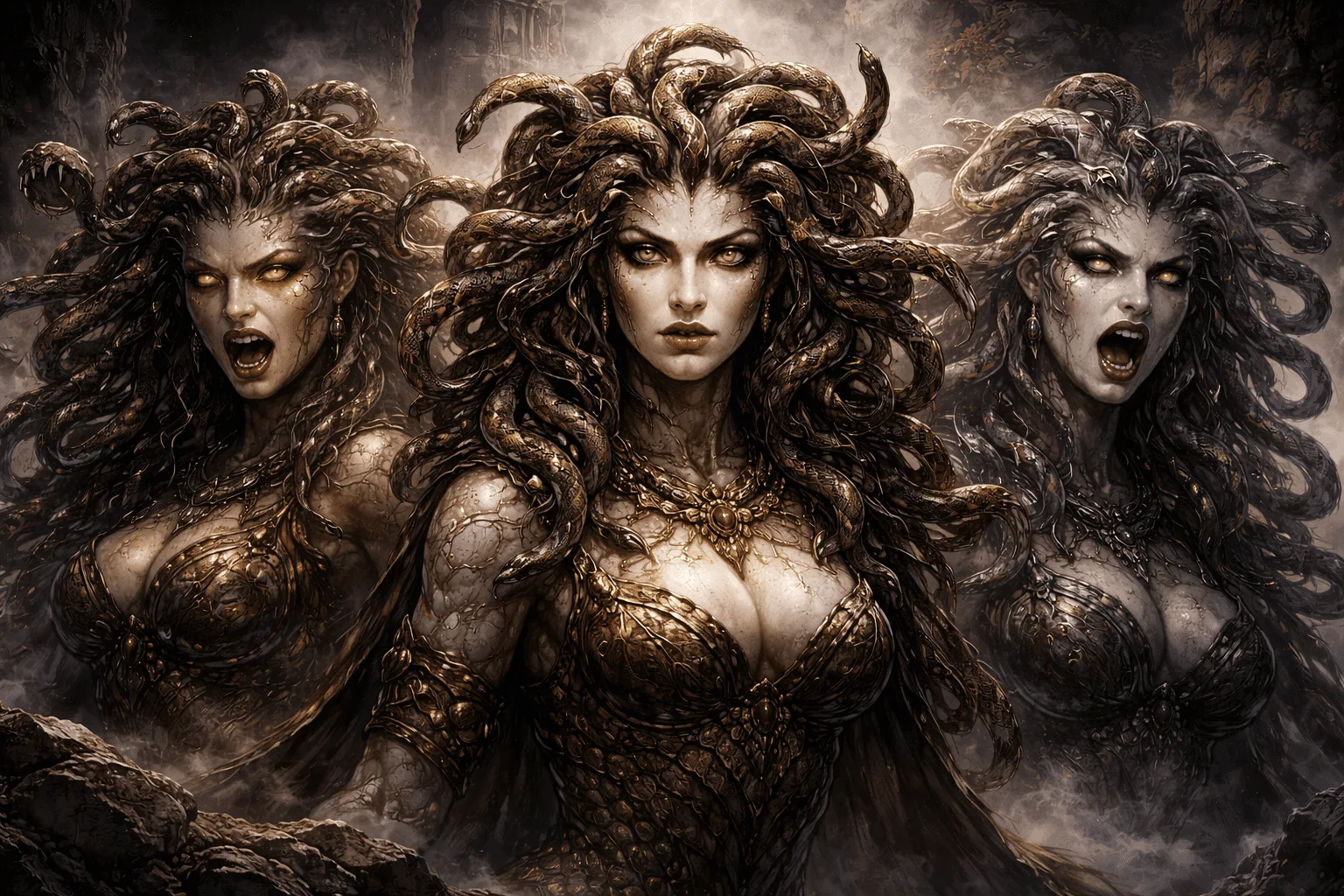
In the universe of Greek mythology, few creatures manage to combine terror as effectively with charm as the Mermaids. These are three terrible female beings who inhabited the ends of the known world — in a land dark and eerie, where the sun sets for the last time before it is lost in darkness. Their very presence in mythology serves as a reminder that the ancient world was full of forces unrestrained and uncontrollable, which man treated with ambivalence: at the same time he feared and respected.
Name «Mermaids» comes from the ancient Greek adjective quick, meaning «wild», «terrible.», «rushing». The word not only describes the outward appearance, but an essential quality — a primitive energy emitted and crushed. From the archaic years, their description was almost unchanged: female beings with snakes instead of hair, large wings, gold hands, copper hands and a look that could turn into stone whoever dared to face them. This image, so eloquent in its horror, was deeply reflected in collective imagination and continues to employ researchers, artists and readers around the world.
The Origins of Gorgons
The genealogy of Gorgens incorporates them into the ethnian and marine tradition of Greek mythology. According to Hesiod, the most important ancient source (Theogony, f. 270–283), their father was Forkys and their mother Goat — Both sea deities of primitive order, descendants of Pontus (the deification of the sea) and Gaia. Forkis was one of the so-called «old» gods, before the Olympians even prevail — a being associated with the depths of the sea and the hidden dangers hidden in it. Keato was the personification of the terrible creatures living in the dark waters.
From this union were born not only the Mermaids, but also other terrifying creatures: Graeae ( «Elders»), three sisters who shared an eye and a tooth between them, and the Echidna, the half-woman-beast who was the mother of many monsters. This family is a whole family. «monster dynasty», a cosmological tradition that places the creatures of chaos and terror at the ends of the world, away from human civilization but always threateningly present.
The affinity of Gorgons and Elders is particularly important for his myth PerseusAs the hero used the Elders to find out where the Mermaids are. These two groups of brothers — One dark and strong, the other old and submissive — are two aspects of the same primitive world.
The Three Mermaids
Stheno
- Stheno (from Greek) vitreous, that is «force», «rome») was the firstborn and most powerful sister. She was immortal, as was Euryal, and was considered the fiercest and most deadly of the three. According to some traditions, Steho had killed with her own hands more victims than the other two sisters together. Although Steno was not the central person of some autonomous myth, its presence is important as a constituent element of the triad: it represents physical power and raw violence.
The radiation of Strong in mythology is mainly indirect — acts as a strong shadow that highlights the difference between the immortal and invincible power and the vulnerable beauty of Medusa. This contrast makes the myth of Medusa even more tragic.
Evryali
Name Evryali means «that which extends widely» or «the wide sea», perhaps implying her connection to the vast and impenetrable marine element from which her generation came. And she was immortal. Some ancient sources give her a special voice — a cry so loud and terrible that it could paralyze mortals.
In his myth PerseusEuryal appears as the sister who mourns the death of Medusa more expressively. This detail, though fragmentary, gives her a dimension of emotional depth that no one expects of such a creature. Euryal is not just a monster — is also a grieving sister, an element that makes the whole trinity more human, so more complex.
Medusa
- Medusa is undoubtedly the most famous of the three Gorgons and one of the most recognizable figures in all Greek mythology. Her name means «The one who rules» or «the dominant» (from verb) med I rule, protect, which strangely contradicts its fate — a being with such a strong name that has become the victim of a heroic mission.
What makes Medusa unique among her sisters is that she was the only one mortal. She was born with fleshly substance, without the immortality available to Steno and Euryal, and this vulnerability of her was ultimately allowing Perseus to defeat her. But its mortality also meant something deeper: it was closer to the human world, more fragile, and that is why its history could develop into narrative depth.
Medusa’s transformation
In the oldest Greek traditions, Medusa was born Mermaid — He was a monster in the first place, without any previous human nature. However, in later versions, mainly during Hellenistic times and through the Roman poet Ovid (Transformations, Book IV), the history of Medusa gained a completely different color.
According to this tradition, Medusa was originally an extremely beautiful woman. — So nice, in fact, that it was thought that her beauty was not similar. Her priest Athena, was under the protection of the goddess until the Poseidon He raped her inside the temple of the goddess. Athena, angry at the local desecration, turned against her own Medusa — She punished her by transforming her into a Mermaid, replacing her wonderful hair with snakes and making her look deadly.
This version is morally controversial and has revived modern discussions about how antiquity faced victims of violence. The evolution of myth by «born monster» in «Victim punished for his beauty» reflects deeper social concerns and attitudes still being discussed to date.
The look that petrifies
The most characteristic property of Gorgens — and in particular Medusa — was the stone looking: the ability to turn anyone looking at them into stone. This power was not accidental invention. It represents one of the deepest human anxiety: that there may be something so frightening in the world that its mere sighting is enough to destroy you.
In symbolic analysis, the rock from the look is interpreted in a variety of ways. Some scholars link it to fear of death: Medusa's gaze does not kill but freezes — It turns the living into dead matter. Others link it to her idea «incomprehensible» women's power, which in the western patriarchal tradition was often portrayed as threatening and destructive. Sigmund Freud in his famous essay «Das Medusenhaupt» (1922) developed a psychoanalytic interpretation of the symbol, linking it to castration anxiety, while other psychoanalysts and philosophers opposed this reading, suggesting interpretations that highlight female autonomy and power.
Perseus and the expedition against Medusa
His myth Perseus and Medusa is one of the greatest adventurous myths of Greek tradition. Perseus was his son. Zeus and Danae, immortal father but raised as a mortal. When the tyrant Polydectys of Serifou, wanting to get rid of the young hero to acquire his mother, commissioned him to carry Medusa's head, no one believed he would return alive.
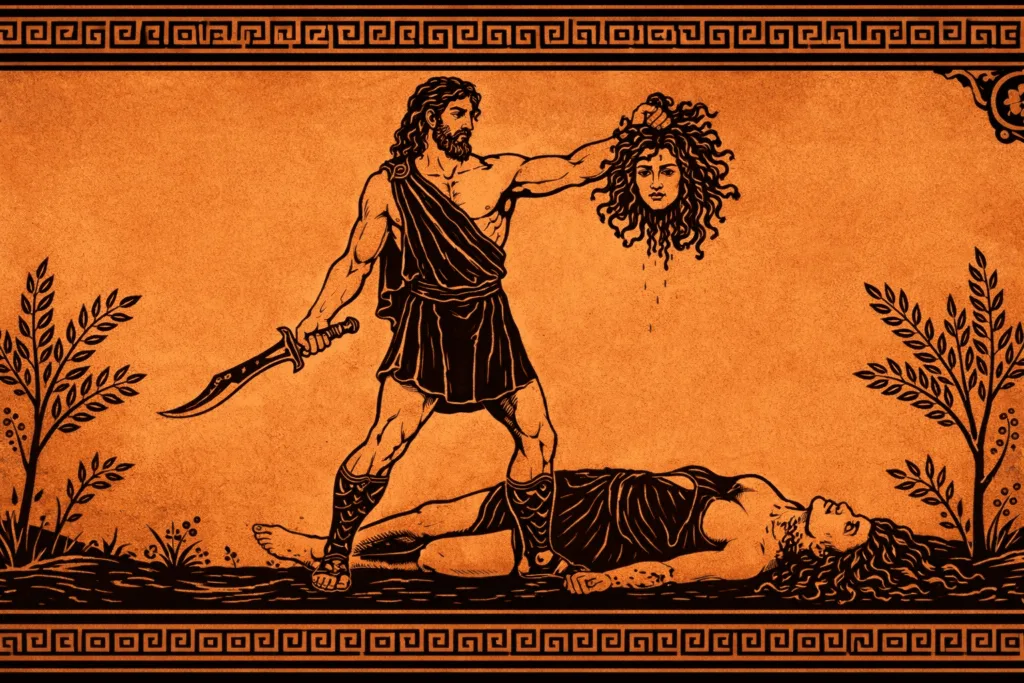
The execution of this mission required divine help. The Athena He gave him a bronze shield polished like a mirror. THE Hermes He gave him a pair of feathered sandals and a diamond sword. The Cybels (or, in other versions, Nymphs) gave him a magic bag skip) to carry the head, as well as Hades' hunt — The aortic cap. Finally, after making the Graeae to reveal the position of the Gorgons, Perseus headed for their dark habitation.
The crucial element of the hero's victory was the shield-mirror: instead of looking directly at Medusa, she was looking at her idol on the shield surface. So he managed to reach her without getting petrified and with a decisive move he decapitated Medusa while sleeping. This use of reflection as a way of dealing with terror has a profound symbolic weight: the hero defeats the monster not directly, but through indirect, intelligent observation.
The birth of Pegasus and Chrysaora
Immediately after the beheading of Medusa, something unexpected and wonderful happened: from her body — or, according to some sources, from the blood flowing into the sea — Two wonderful creatures emerged.
The first was Pegasus, the famous winged horse that was a symbol of poetic inspiration and supreme freedom. The second was the Goldsmith, a being with a golden sword (or golden body), for which some sources say he became the father of the tricephalous Geryon. Both were his children. Poseidon and MedusaIn other words, they were born pregnant before death found their mother.
This birth from death has a profound mythological significance. Pegasus, especially, represents a supreme transformation: from the scariest and destructive (the look of Medusa) is born the freest and inspired (the winged horse). The mythology often works that way — A new life emerges through corruption.
Medusa's head as a weapon
After Medusa died, Perseus did not abandon her head — Instead, he used it as the strongest weapon in his arsenal. On the way back, head in the kivis, he stoned Titan. AtlasBy turning him into the mountain that today bears his name. Still, he used the head to save her Andromeda from the sea monster Cetus, petrifying the creature. In Serifos, he untangled himself with the tyrant Polycetes and his followers, turning them into stone in front of a concentrated crowd.
After completing his missions, Perseus gave Medusa's head to Athena, which incorporated it into its shield (the Aegis) or her chest. This symbol was named Gorgonium and evolved into one of the most widespread deterrent symbols of antiquity.
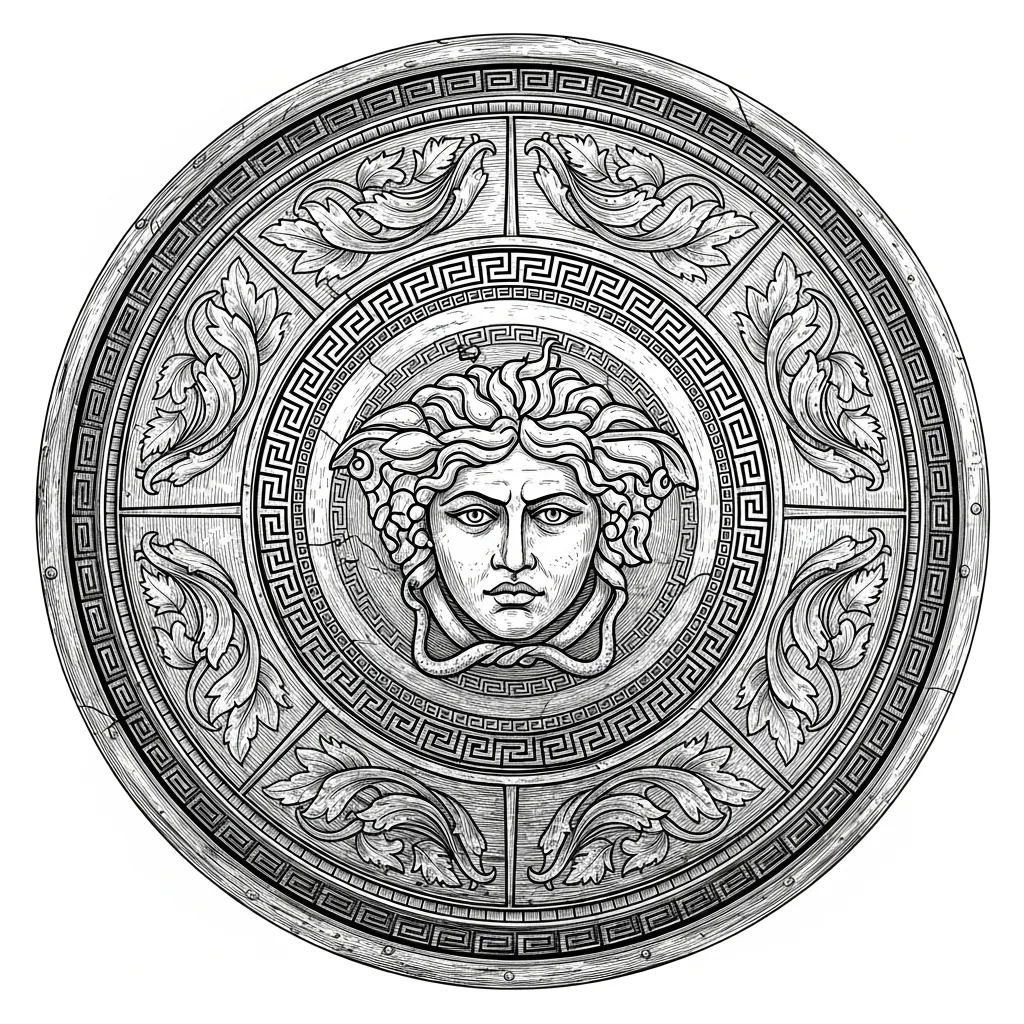
The Gorgonium: The deterrent symbol of antiquity
The Gorgonium — the depiction of the mermaid’s head or face — was one of the most widely used protection symbols in the ancient Greek world. It was placed in temple eagles, warrior shields, city coins, ceramic vases, jewelry and building lintels.
Logic was simple: the monster who can petrify with the look becomes the same victim of himself — Any enemy facing Gorgonium will be paralyzed by terror. At the same time, his presence in religious buildings stated that the site is under supernatural protection.
A typical example is the magnificent sculpture Gorgonio of the pediment of her archaic temple Artemis in Corfu (c. 580 BC), one of the most impressive sculptures that have survived. Athena is also depicted in many ancient statues and reliefs to bring Gorgonio to the center of her chest or shield.
The Mermaids in ancient art
The iconography of Gorgos evolved significantly during Greek antiquity. In archaic period (8th–6th century BC), the depiction was deliberately monstrosity: large open mouth with prominent teeth, penetrating eyes, tongue hooked into the air, and often a face of horror. It was the thematic debate on the beauty of other divine forms — a deliberate aesthetic of aversion.
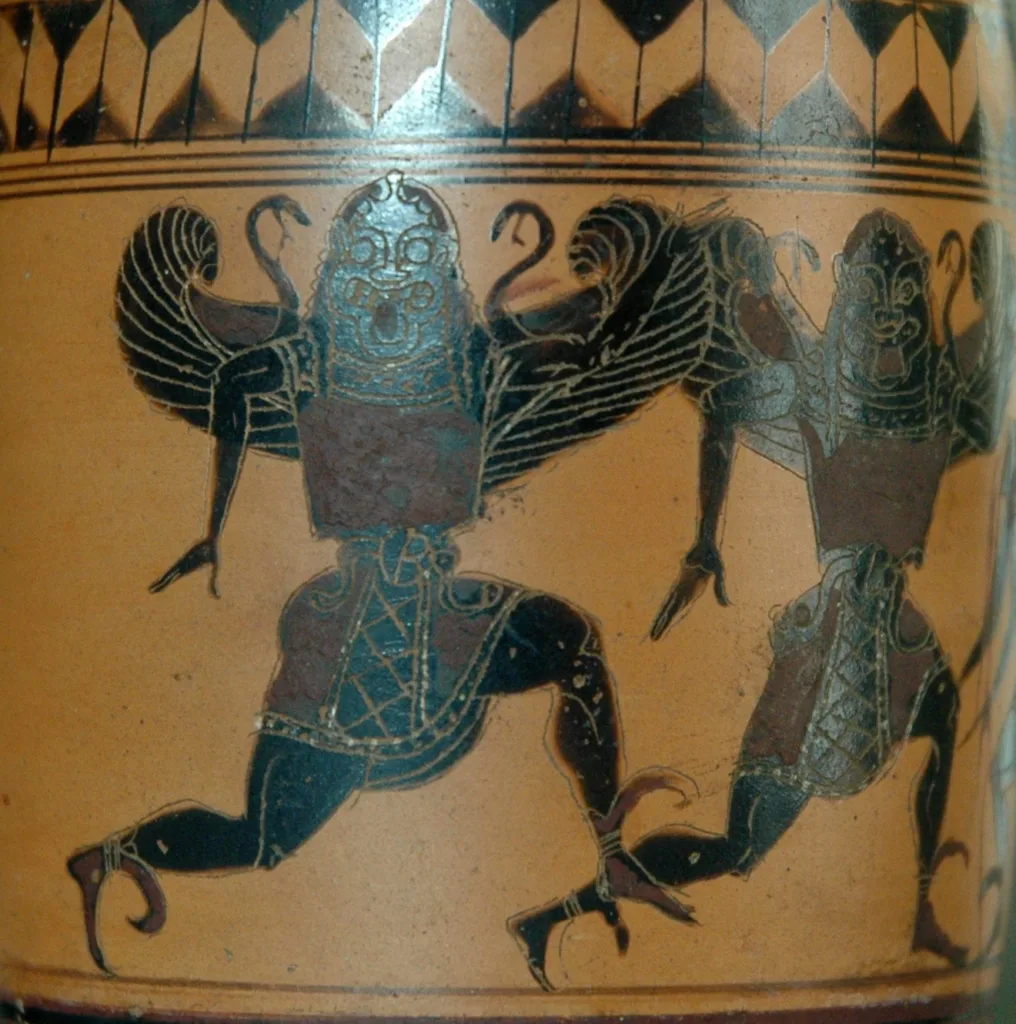
In Classical period (5th–4th century BC) and even more in Hellenistic (3rd–1st century BC), the form of Medusa began to be humanized. Her characteristics were milder, the expression passed from scary to melancholy and ultimately tragic. In Roman times, Medusa's face is often portrayed with almost human beauty — a beautiful female face with snakes instead of plocomus, an image ambivalent, combining charm and threat.
This transition reflects the wider cultural development: horror no longer needs to be repugnant to be strong — He can hide in beauty.
The symbolism of Gorgons
Mermaids are not just «Bad monsters» — are multifaceted symbols that host a host of interpretations.
Fear and death: They lived at the ends of the world, where the sun sets and darkness dominates. They represented the final threat — the irrevocable, sudden and heinous death.
Protection: Surprisingly, the face of terror became a protective symbol. The Gorgonium proves that horror can be used as a shield.
Women's power: At a time when powerful female figures were often demonized, the Mermaids represent an autonomous, unfailing female power that does not submit to male authority — and that is exactly why we must «beaten».
Go and threshold: As guardians of the boundaries (between the world of the living and the dead, between known and unknown), the Mermaids represent the difficult, terrifying transition.
Mermaids in modern culture
- Medusa Especially has become one of the most powerful cultural symbols of our time. In literature, it is exploited by contemporary poets such as Sylvia Plath who in her poem «Medusa» explores the mother-daughter relationship. Anne Carson, Madeleine Miller ( η) is a woman named Anne Carson.Circe) and other writers have rewritten the myth from different perspectives.
In cinema, Medusa appears in films such as Clash of the Titans (1981 and 2010), but also in a Marvel franchise. The video games, Medusa appears as an opponent or ally in series such as God of War and SmiteThe comic books and graphic novels, the form of the Mermaid is used as a symbol of female rebellion or supernatural power.
In modern feminist thinking, Medusa has been radically re-evaluated. Hélène Cixous in her famous essay «The Laugh of the Medusa» (1975) uses the figure as a symbol of female writing power and liberation. Instead of being a monster to be exterminated, Medusa becomes the name of a voice that refuses to silence.
Interesting Facts about Mermaids
- According to Pausanias, there was faith that Medusa's blood had a dual nature: blood from the right hand side gave her life and treatment, while that from the left was killing.
- The Court of Justice held that the Houghforus refers to Medusa to describe a sense of nightmare tension terror, showing how deeply rooted the figure was in collective imagination.
- Gorgonio decorated the shield of the city-state of Athens and is found in coins of ancient Corinth.
- In Libya, some ancient writers placed the northern African place of residence of the Gorgons, and the word «mermaid» It exists in local place names even today.
- Pindar reports that Perseus heard Euryal's lamentation of her sister's death and that of this crying inspired the court.
- Hercules' shield, as described in the pseudo-scientific poem Shield, she was adorned in the form of a Mermaid.
- In modern times, the fashion house Versace chose as its logo the face of Medusa, linking the ancient image of horror to modern aesthetic luxury and power.
Conclusion
Mermaids are not just «Monsters» From our children's mythology books. They are complex, multi-level symbols expressing deep human concerns: about death, about power, about the boundaries of the known world, about women's nature, about the relationship between beauty and threat.
- Medusa, the most complex of the three, has come a surprising cultural course: from a primitive monster that petrifies, to the victim of divine injustice, to a symbol of female power and writing voice. This flexibility of the symbol is what explains its longevity — a symbol that can be enriched, challenged, overturned, remains alive.
The Mermaids remind us that mythology is not just a narrative of miracles and heroes. It is the language with which a society speaks of its deepest fears, the boundaries of human understanding, that something that lies «out of there» — And he's still looking at us.
FAQ
Who were the three Mermaids?
The three Mermaids were Steno, Euryal, and Medusa. They were daughters of Forkyos and Keatos, marine deities of Greek mythology. Of three, only Medusa was mortal, while Steno and Euryal were immortal.
Why was Medusa the only mortal?
The ancient myth gives no justification for this difference — It simply states it for granted. In later versions, especially through Ovid, her mortality is associated with her transformation: she was originally a man punished by Athena.
Who killed Medusa?
- Perseus, son of Zeus and Danae, decapitated Medusa during her sleep. He used his shield as a mirror to avoid facing her directly, while bringing feathered sandals, magic bag and sword that the gods had given him.
What was Gorgonium?
Gorgonio was the depiction of Mermaid's head or face (mainly Medusa). widely used as a deterrent symbol — to prevent enemies and evil — and decorated temples, shields, coins and jewels.
What creatures were born of Medusa?
After the beheading of Medusa, from her body emerged Pegasus, the famous winged horse, and the Goldsmith, a being bearing a golden sword. Both were children of Poseidon, which Medusa was pregnant at her death.
What did the Mermaids symbolize in ancient Greece?
The Mermaids symbolized much at the same time: fear, death, the ends of the known world, but also the deterrent force that protects those who use them as a symbol. They also represented the uncontrolled, primitive nature that does not obey human or divine laws.
Ancient Sources
- Theogenia, p. 310–312.
- Library, 2.5.12.
- Iliad, 8.368 and later reports.
- Praise, Book VI.
- Description of Greece.
Modern Bibliography
- The Greek Myths.
- Early Greek Myth.
- The Complete World of Greek Mythology.
- The Routledge Handbook of Greek Mythology.
- Dictionary of Classical Mythology.
