
Her mythical creatures Greek mythology are one of the most charming and durable elements of ancient Greek imagination. They are not just strange beings who appear in adventures of heroes, but bodies of symbolism, religious perceptions, cosmological ideas and social fears. In Greek mythoi, monsters, hybrid creatures, demonic forms, divine forces and spirits of nature are associated with the order of the world, human fate, the concept of hubris and the need to transcend boundaries.
Ancient Greek mythology took shape through a long oral tradition, which was gradually recorded in epics, hymns, tragedies, lyric poetry, historical works, and collections of myths. Homer, Hesiod, the Homeric hymns, the tragic poets, Pindar, the Apollodorus and many later writers contributed to the preservation and adaptation of these myths. These accounts do not always agree with one another, as mythology was not a unified “book of faith,” but rather a dynamic collection of local traditions and poetic interpretations.
Greek mythological monsters and hybrid beings often appear at the edges of the known world: in caves, mountains, marshes, seas, isolated islands, and the entrances to Hades. This placement is no accident. It expresses humanity’s uncertainty in the face of the unknown, as well as the process by which civilization attempts to impose order on chaos. For this reason, monsters and heroes are closely linked: the hero proves his worth when he confronts a force that transcends ordinary human measures.
What are mythical creatures in Greek mythology
In Greek mythology, the term “mythical creatures” encompasses a wide range of beings. These include cosmic forces such as the Titans, monstrous races such as the Giants, hybrid monsters such as the Chimera and the Sphinx, sea creatures such as Scylla and Charybdis, as well as spirits of nature such as the Nymphs. Many of these are not “monsters” in the strict sense—that is, hostile or repulsive beings. Some are divine, some are dangerous, some are protective, while others fall into multiple categories.
Greek mythology does not always draw a clear distinction between gods, monsters, spirits, and heroic creatures. The centaur Chiron, for example, belongs to a race of creatures often associated with violence and unbridled instincts, yet he is portrayed as a wise teacher of heroes. Pegasus, though born from Medusa’s blood, becomes a symbol of inspiration, speed, and divine grace. Medusa, on the other hand, appears as a monster who kills with her gaze, but in later interpretations she also takes on tragic dimensions.
Ancient sources reveal that mythical creatures operated on multiple levels. On the narrative level, they created tension and trials. On the religious level, they were associated with divine powers, sacred sites, or ritual concepts. On the psychological and social level, they expressed fears of nature, savagery, uncontrolled desire, death, or the loss of human reason. Therefore, the mythical creatures of Greek mythology are not merely imaginary figures, but complex cultural symbols.
It is also important to note that many of these creatures are associated with the geography of the ancient world. The Lernaean Hydra belongs to the region of Lerna, the Chimera to Lycia, the Sphinx to Thebes, and the Sirens to sea routes dangerous to sailors. Greek myths thus transformed real or imaginary places into settings for cosmic conflicts, heroic feats, and moral trials. Overall, the mythological beings of Greek tradition are key to understanding how the ancient Greeks perceived the world, nature, and the limits of humanity.
Giants and Giant Fight
The Giants are one of the most important monstrous races in ancient Greek mythology. According to Hesiod’s *Theogony*, they were born of Gaia when the blood of the mutilated Uranus fell upon the earth. This origin directly links them to the violence of the first cosmic conflict and to the generative power of the earth. The Giants are depicted as beings of immense physical strength, often warlike and a threat to the order of the gods.
In ancient art, particularly from the Archaic and Classical periods onward, the Giants are often depicted with human upper bodies and snakes instead of legs, although this form is not the only one. The serpentine imagery emphasizes their chthonic nature—that is, their connection to the earth and the underworld forces. In mythological narrative, their most significant moment is the Gigantomachy, the war of the Giants against the Olympian gods.
- Gigantomachy It appears in various sources and was a favorite subject of ancient Greek art. Apollodorus, in his *Bibliotheca*, provides a detailed account according to which the Giants could not be defeated by the gods alone, but required the participation of a mortal as well. That mortal was Heracles, whose presence highlights the collaboration between divine and human power to restore order. Athena, Zeus, Apollo, Dionysus, and other gods took part in the battle, defeating specific Giants.
The symbolism of the Gigantomachy is similar to that of The Titanomachy, but it has a different focus. Here, the threat does not come from an ancient divine generation, but from a violent, chthonic force that seeks to overthrow the Olympian order. The Giants represent the excess of unchecked power, the earth’s rebellion against the heavens, and the constant threat of chaos. The Gigantomachy, therefore, affirms the need for balance between nature, divine power, and human contribution.
Cyclops and Polyphemus
The Cyclopes appear in various traditions of Greek mythology. According to Hesiod, the first Cyclopes were Brontes, Steropes, and Argus, sons of Gaia and Uranus. They have a single eye on their forehead and are craftsmen of divine weapons. They bestow the thunderbolt upon Zeus, the trident upon Poseidon, and the helmet that renders him invisible upon Hades. In this version, they are not ferocious monsters, but all-powerful craftsmen who play a decisive role in the victory of the Olympians.
In Homer’s *Odyssey*, however, the Cyclopes are portrayed differently. Polyphemus, son of Poseidon and the nymph Thoosa, lives on a remote island along with other Cyclopes. He is a shepherd, enormous, one-eyed, and uncivilized by Greek standards. He knows nothing of the laws of hospitality, political organization, or respect for the gods. When Odysseus and his companions enter his cave, Polyphemus imprisons them and devours some of them.
The episode involving Odysseus and Polyphemus is one of the most striking examples of the conflict between brute force and intelligence. Odysseus cannot defeat the Cyclops through sheer strength. He tricks him by claiming his name is “Nobody,” and, after getting him drunk, blinds him with a red-hot stake. When the other Cyclopes ask Polyphemus who has harmed him, he replies, “Nobody,” allowing Odysseus to escape. Cunning, wit, and strategy prevail over brute force.
Polyphemus symbolizes the world beyond the boundaries of civilized life as the Greeks understood it: a world without laws, hospitality, or moderation. However, he is not merely a caricature of barbarism. In later poetry, such as that of Theocritus and other Hellenistic traditions, Polyphemus also appears as a shepherd in love who mourns for Galatea. His character demonstrates that Greek mythological monsters can take on different aspects depending on the genre and era of the narrative.
The Hundred Hands, Tartar's Mighty Guards
The Hecatoncheires, also known as the Hundred-Handed Ones, are among the most impressive beings in Hesiod’s cosmogony. Their names are Cottus, Briareus, and Gyges. According to the *Theogony*, they are the children of Gaia and Uranus, and each possesses one hundred hands and fifty heads. Their monstrous form expresses not merely size, but an excess of strength on a scale almost inconceivable to humans.
Uranus, either fearing or loathing his children, imprisons them in the depths of the earth. Later, Cronus, though he overthrows his father, continues to keep them imprisoned. During the Titanomachy, Zeus frees them on the advice of Gaia. The Hundred-Handers repay the favor by fighting alongside the Olympians and hurling enormous boulders at the Titans. Their participation is decisive for the outcome of the war.
After the Olympians’ victory, the Hecatoncheires took on the role of guardians in Tartarus, where the defeated Titans were held captive. This position is significant because it transforms them from imprisoned monsters into guardians of the new cosmic order. Although their appearance is terrifying, their role is not chaotic. On the contrary, they serve the stability of the world established by Zeus.
Their symbolism shows that power is neither good nor evil in and of itself. The very same supernatural power that once inspired fear can become a pillar of justice when it is integrated into an organized order. The Hundred-Handed Giants thus occupy a special place among the mythological beings of Greek tradition, because they link the monstrous with worldly security.
Typhon, the most terrible monster of Greek mythology
Typhon, or Typhoeus, is often considered the strongest and most fearsome monster in Greek mythology. In Hesiod’s *Theogony*, he is presented as the son of Gaia and Tartarus, born after the defeat of the Titans as a final threat to Zeus’s rule. His appearance is terrifying: a gigantic body, serpent heads, the voices of humans, animals, and monsters, fire in his eyes, and strength capable of overturning the heavens.
The battle between Typhon and Zeus is a quintessential cosmic conflict. Typhon is not merely an adversary, but the embodiment of unbridled destruction. Zeus confronts him with thunderbolts and ultimately defeats him. In some traditions, such as later accounts, Typhon temporarily manages to weaken Zeus by severing his tendons, before the god regains his strength. These variations illustrate the magnitude of the threat he represents.
Typhon is also associated with the birth of monsters. Together with Echidna, he is considered the father of many of the best-known monsters of Greek mythology, such as Cerberus, the Lernaean Hydra, the Chimera, Orthros, and, in some traditions, the Sphinx and the Nemean Lion. Thus, he serves as the source of an entire lineage of menacing creatures that gods and heroes will face.
The symbolism of Typhon is cosmological and natural. He has been associated with storms, volcanic eruptions, gale-force winds, and catastrophic natural phenomena. His defeat at the hands of Zeus signifies the triumph of organized celestial power over uncontrolled, chaotic energy. In conclusion, Typhon represents the most complete mythological image of the chaos that threatens the world and, at the same time, the necessary trial through which Zeus’s sovereignty is affirmed.
Lernaia Hydra and Heracles' feats
The Lernaean Hydra is one of the most famous monsters that Hercules faced. According to Hesiod and later sources, such as Apollodorus, she was the daughter of Typhon and Echidna. She lived in the marshes of Lerna, in Argolis, a region associated with water, springs, and chthonic cults. Hydra is described as a serpent-like monster with many heads, one of which was immortal. In later versions, whenever Hercules cut off a head, two new ones would grow in its place.
Hercules’ second labor was the slaying of the Hydra. The hero did not face the monster alone, but with the help of Iolaus. As Hercules cut off the heads, Iolaus cauterized the necks so they would not grow back. Finally, the immortal head was buried under a heavy boulder. Hercules dipped his arrows in the Hydra’s poisonous blood, acquiring deadly weapons that would play a significant role in later episodes, even in his own death.
Hydra symbolizes a resurgent threat, the evil that multiplies when dealt with superficially. The need to collaborate with Iolaus shows that even the strongest hero requires strategy and assistance. The region of Lerna, with its marshes and waters, reinforces the monster’s connection to subterranean and unstable forces. The Hydra is one of the most characteristic examples of the relationship between monsters and heroes, where heroic victory requires not only strength but also ingenuity.
Cerberus, the Guardian of the Underworld
Cerberus is the fearsome dog that guards the entrance to Hades. In Hesiod’s *Theogony*, he is described as the son of Typhon and Echidna, and the brother of the Hydra, the Chimera, and other monsters. He is described as a dog with multiple heads—most often three in classical and later traditions—a serpent’s tail, and snakes coiled around his neck or body. The number of its heads varies in ancient sources, a fact that reveals the fluidity of mythological tradition.
Cerberus’s role is not to prevent the living from entering Hades, but primarily to prevent the dead from returning to the world of the living. He is the guardian of the boundary between life and death. He appears in various myths about descents into the Underworld, but the best-known account is Hercules’s final labor. Hercules descends into Hades—with Pluto’s permission in some versions—and brings Cerberus to Eurystheus without using weapons.
Cerberus is not evil in the moral sense. He is terrifying because he serves an inescapable law: the separation of the worlds. His presence signifies that death has boundaries and that these boundaries cannot be crossed without extraordinary divine or heroic power. For this reason, Cerberus is one of the most powerful creatures in Greek tradition and continues to serve as a symbol of guardianship, prohibition, and transition.
Chimera, the fiery monster of Lycia
According to Hesiod, the Chimera is a hybrid monster descended from Typhon and Echidna. Its form is described as a combination of a lion, a goat, and a snake or dragon. It usually has the front part of a lion, the body of a goat protruding from its back, and a serpent’s tail. Furthermore, it breathes fire, a trait that makes it one of the most dangerous monsters in Greek mythology.
The main mythological story about the Chimera is associated with Bellerophon. The hero, with the help of Pegasus, confronts the monster in Lycia. Pegasus’s ability to fly allows Bellerophon to evade the fire and slay the Chimera. The myth is already mentioned in the Iliad, where Homer refers to the monster’s divine origin and fearsome nature.
The Chimera symbolizes the disorder of composition, the union of incompatible elements into a menacing form. In modern language, the word “chimera” often refers to a fantastical, unattainable, or illusory goal, while in biology it is used to describe organisms with genetically distinct cell populations. The mythological Chimera thus maintains a striking linguistic and cultural continuity as a symbol of the monstrous born from the union of disparate forces.
Pegasus, the winged horse of the gods
Pegasus is one of the most positive and radiant mythological creatures in Greek mythology. According to Hesiod, he was born from the blood of Medusa when Perseus beheaded her. Chrysaor was also born at the same time. Despite his terrifying origins, Pegasus is not a monster, but a winged horse associated with the sky, speed, and divine inspiration.
The best-known story about Pegasus involves Bellerophon. The hero manages to tame the winged horse with the help of Athena, who, in some traditions, provides him with a golden bridle. Riding Pegasus, Bellerophon defeats the Chimera and carries out difficult missions. However, when he attempts to ascend Mount Olympus, he is punished for his hubris. Pegasus continues his journey toward the gods and becomes associated with Zeus, serving as a carrier of thunderbolts in later versions of the story.
Pegasus symbolizes elevation, poetic inspiration, and power that must be guided with moderation. His connection to the Muses and the Hippocrene spring on Mount Helicon reinforces his link to art and creativity. His descent from Medusa also shows that something marvelous can be born from the death of a monster. Thus, Pegasus holds a unique place among the creatures of Greek tradition, as a symbol of divine grace and creative transcendence.
The Sphinx and the Enigma of Thebes
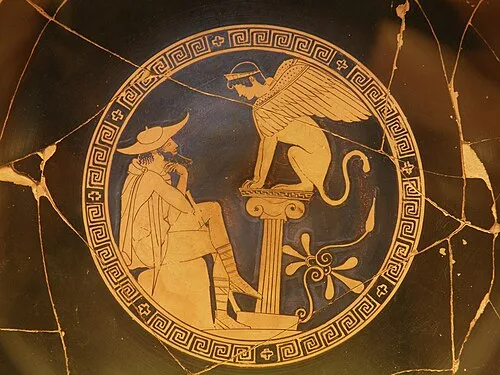
The Sphinx of Greek mythology is a hybrid creature with the body of a lion, the wings of a bird, and the head of a woman. Its origins vary depending on the source, but it is often associated with Typhon and Echidna or with other monstrous beings. Unlike the Egyptian sphinx, which is primarily protective in nature, the Greek Sphinx is menacing and deadly.
Her most famous myth concerns Thebes. The Sphinx settles near the city and poses a riddle to passersby. Anyone who cannot solve it is put to death. The most famous riddle asks which creature walks on four legs in the morning, two at noon, and three at night. Oedipus answers that it is man, who crawls as an infant, walks upright as an adult, and leans on a cane in old age. After the riddle is solved, the Sphinx either destroys herself or falls from a cliff.
The Sphinx links physical threat with an intellectual challenge. Military might alone is not enough to defeat her; an understanding of human nature is required. The myth sets the stage for Oedipus’s tragic journey, as depicted by Sophocles in *Oedipus the King*, where knowledge is both salvific and destructive. In conclusion, the Sphinx is one of the most complex mythological beings because she embodies the fear of the unknown and the power of the question.
Sirens and the power of the magical song
The Sirens are among the best-known mythical creatures of Greek mythology, mainly thanks to Homer’s *Odyssey*. In the Homeric narrative, they live on an island and enchant sailors with their song, leading them to their deaths. Homer does not describe their appearance in detail, but in ancient art they are often depicted as bird-like women, with the body of a bird and a woman’s head. Later tradition gradually transformed them into female sea creatures, bringing them closer to the image of the mermaid in modern popular imagination.
Odysseus faces the Sirens with preparation and self-control. Circe warns him of the danger. He plugs his companions’ ears with wax and orders them to tie him to the mast so that he can hear the song without being led astray. The Sirens’ song promises knowledge, not merely pleasure. They claim to know everything that happened in Troy and everything that is happening on earth; thus, their temptation is also intellectual.
The Sirens symbolize the dangerous allure of knowledge, pleasure, and the loss of one’s purpose. The hero does not defeat them by destroying them, but by devising a way to pass close by them without being lost. Their story shows that in Greek myths, the greatest threat is not always violence, but the seduction of desire and the allure of listening.
The Harpy, messengers of divine punishment
The Harpies are winged female figures associated with abduction, storms, and divine punishment. In Hesiod, they are referred to as the daughters of Thaumas and the Oceanid Electra, with names such as Aello and Ocypete. The very etymology of their name is related to the verb “to snatch,” a fact that aligns with their role as forces that suddenly take away people or possessions.
The best-known story about the Harpies is connected to Phineus, the blind seer of Thrace. Because he had revealed divine secrets or committed some other act of impiety, he was punished with unending hunger: every time he was served food, the Harpies would snatch it away or taint it. During the Argonautic expedition, the Boreads, Zethes and Calais, pursued the Harpies and freed Phineus from his torment, according to the tradition recounted in various sources, including Apollonius of Rhodes.
The Harpies are not merely monsters of the air. They symbolize sudden loss, hunger, divine wrath, and humanity’s powerlessness in the face of invisible forces. Their flying nature links them to winds and storms. Their significance in ancient Greek mythology lies in the fact that they serve as instruments of punishment, reminding us that knowledge and hubris have consequences.
The Mermaids and Medusa
The Gorgons are three sisters: Stheno, Euryale, and Medusa. In Hesiod’s *Theogony*, they are the daughters of Phorcys and Ceto, primordial sea deities. Of the three, only Medusa is mortal. The Gorgons are characterized by snakes instead of hair, a terrifying gaze, often fangs, wings, and repulsive features. Their gaze has the power to turn anyone who looks at them to stone.
The myth of Medusa is linked to Perseus. With the help of Athena and Hermes, the hero acquires divine objects, such as winged sandals, a head-covering, and an invisible helmet in later versions. Avoiding looking directly at Medusa, he uses the reflection in his shield and beheads her. From her blood, Pegasus and Chrysaor are born. Her head, the Gorgon’s Head, retains its deterrent power and is placed on Athena’s aegis.
Medusa is rich in symbolism. In antiquity, the Gorgon’s head was used as an apotropaic symbol on temples, shields, vases, and architectural elements, with the aim of warding off evil. Her terrifying appearance was not only a threat but also a form of protection. In later literary traditions, such as those of Ovid, Medusa is portrayed in a more tragic light, as a woman who was transformed following a violent incident in the temple of Athena. Among the mythical creatures of Greek mythology, Medusa stands out because she embodies terror, protection, victimization, and transformation.
Centaurs between ferocity and wisdom
Centaurs are hybrid creatures with the upper body of a human and the lower body of a horse. Their origin is often linked to Ixion and Nephele, a cloud-like figure created by Zeus. From this paradoxical union emerged the centaur, the progenitor of the race. Their form expresses the union of human reason with animal instinct, which is why they are one of the most interesting examples of hybridity in Greek mythology.
In most myths, the Centaurs are portrayed as savage, drunk, and violent. A classic example is the Centauromachy, their clash with the Lapiths at the wedding of Perithous. The drunken Centaurs attempt to abduct the Lapith women, sparking a battle that was often interpreted in ancient art as a clash between civilization and barbarism. The scene adorns, among other works, the sculptures of the Parthenon, demonstrating its ideological significance in classical Athens.
However, Chiron is a notable exception. Unlike the other Centaurs, he is wise, just, and knowledgeable in medicine, music, and the education of heroes. Achilles, Jason, Asclepius, and others studied under him. The figure of Chiron shows that hybridity does not necessarily lead to savagery; it can serve as a bridge between nature and knowledge. The Centaurs, as a whole, symbolize the dual nature of humanity, caught between instinct and culture.
The Satyrs and the Seleni, companions of Dionysus
Satyrs and Selenes are creatures closely associated with the worship of Dionysus. Satyrs are often depicted with a human body, an animal’s tail, and animal ears—sometimes with the features of a goat and other times with those of a horse, depending on the period and local tradition. The Seleni, related figures, usually appear as elderly, cheerful, drunken followers of Dionysus. Selinos, in the singular, is also depicted as the god’s tutor.
In ancient art and satirical drama, the Satyrs embody physicality, sexuality, laughter, intoxication, and the breaking of social constraints. They are not monsters in the sense of a deadly threat, but mythological beings who represent the extreme experience of Dionysian ecstasy. In theater, particularly in the satyr plays that followed the tragic trilogies, the Satyrs introduced a comic and subversive element.
Their symbolism is associated with the power of nature and unbridled vitality. Dionysus is the god of wine, intoxication, theater, and transformation; the Satyrs and Selenes embody his realm. They represent everything that the organized city tries to control but cannot eradicate: desire, laughter, fertility, and ecstatic experience. Thus, among the creatures of Greek tradition, they play a special role as expressions of life beyond strict order.
The Dragons of Greek mythology
The dragons of ancient Greek mythology are not entirely identical to the winged dragons of medieval European folklore. The Greek word “drakon” is etymologically linked to a piercing gaze and usually refers to a large snake or a serpentine monster. Dragons are often guardians of sacred sites, springs, golden objects, or divine trees. Their form is subterranean, menacing, and linked to the earth’s antiquity.
One of the best-known dragons is Python, the serpent of Delphi, which Apollo slew before establishing his oracle. This myth symbolizes the transition from an older, chthonic form of worship to a new Apollonian order of light, divination, and moderation. Another important dragon is the one that guarded the Golden Fleece in Colchis and was put to sleep with the help of Medea, so that Jason could complete his mission. Furthermore, the dragon of Ares in Thebes was slain by Cadmus, who sowed its teeth, from which the Spartans were born.
Dragons symbolize primordial protection, the power of the earth, and the trial that precedes the establishment of a new order. The hero or god who slays a dragon does not merely defeat a monster, but gains access to knowledge, land, power, or sanctity. This is why dragons constitute a fundamental category among the mythical creatures of Greek mythology and have profoundly influenced later European imagination.
Mythical sea creatures and ocean monsters
The sea played a central role in the lives of the ancient Greeks and, of course, in Greek mythology. It was a means of communication, a source of wealth, but also a place of danger, loss, and uncertainty. That is why Greek myths are full of mythological sea creatures, ranging from deities such as Poseidon, Nereus, and Proteus to monsters such as Scylla, Charybdis, and the sea monster that threatened Andromeda.
Scylla and Harybdi are known mainly from the Odyssey. Scylla is presented as a monster with many heads that grab sailors from ships, while Harybdi is a sinkhole or sea vortex that sucks and vomits water. Ulysses is forced to pass among them, choosing the smallest loss. This episode is typical of naval experience: there is often no safe choice, but only painful risk weighting.
Andromeda's fish is associated with Perseus' myth. Cassiopeia, the mother of Andromeda, boasts that she excels in beauty from the Nireides, causing Poseidon's wrath. A sea monster is sent to destroy the country, and Andromeda is offered as a sacrifice to appease divine wrath. Perseus saves her by killing the monster. The myth unites the sea threat with the hybrid, sacrifice and salvation through heroic intervention.
Other sea figures, such as the Nireides, Tritons, and Proteas, show that the sea is not just terror. It is also wisdom, transformation, and divine presence. Proteus, an old sea, changes forms and knows the truth, while Triton is depicted as a hybrid form of man and fish. The sea creatures of Greek tradition thus express the ambivalence of the Greeks towards the sea: admiration, dependence and fear.
The symbolism of mythical creatures in ancient Greek thought
Her mythical creatures Greek mythology They cannot be understood only as fiction products. In ancient Greek thought, they function as boundary symbols. They are on the border between man and animal, nature and culture, life and death, the well-known and unknown. The hybrid form of many creatures, such as Chimera, Sphinx or Centauri, states precisely this crossing between categories normally considered separate.
A key axis of symbolism is the concept of chaos and order. Titans, Giants, Typhon, and dragons represent forces old, chthonic or uncontrolled. The gods and heroes facing them not only destroy the monstrous, but establish or confirm a class. This class can be secular, as in the case of Zeus, politics, as in Thebes of Oedipus, or morality, as in Hercules' feats.
Another axis is the test of human ability. Ulysses against Polyphemus and Sirens needs intelligence and restraint. Hercules against Hydra and Cerberus needs strength, endurance and discipline. Perseus against Medusa needs divine help and strategy. Greek myths teach that heroic success is not one-dimensional· requires a combination of physical virtue, mental intelligence and respect for divine forces.
Monsters are often associated with the hybrid. When a man or community transcends boundaries, a threat arises that restores or requires a restoration of balance. The marine hull of Andromeda, the divine punishment of Phineas through the harpies and the fall of Bellerophon after the arrogant attempt to climb Olympus show that mythology uses monsters and wonderful creatures as means of moral teaching.
Overall, Greek mythological monsters and related mythological beings are a way of thinking. Through them ancient Greeks explored questions about nature, power, knowledge, desire, death and human identity. Their symbolism remains alive because it concerns experiences that still concern man.
The influence of Greek mythical creatures on art and contemporary culture
The influence of the mythical creatures of Greek mythology on art is enormous and it has begun since ancient times. Vases, reliefs, sculptures, temples and murals depict scenes such as Giant combat, Centaur fighting, Perseus with Medusa, Hercules with Hydra and Bellerophon with Chimera. Art functioned not only decoratively, but also educationally, transmitting myths, values and political ideas.
In classical Athens, for example, Centaur fighting and Giant fighting were used as visual allegory of class victory over barbarism. The Gorgonium appeared on shields and architectural elements as a repugnant symbol. The Sphinxes were placed in burial monuments, linking the enigma and guarding to the memory of the dead. Thus, the creatures of Greek tradition were incorporated into the daily visual experience of ancient societies.
During the Renaissance and modern times, Greek myths became a source of inspiration for painters, sculptors, poets and composers again. Medusa, Pegasus, Sirens and Centaurs appeared in works that reinterpreted antiquity through new aesthetic and philosophical quests. The form of Medusa, especially, acquired multiple meanings, from a symbol of terror to a symbol of traumatic memory and resistance.
In modern culture, Greek mythological monsters appear in fantasy literature, cinema, television series, comic books, video games and educational material. Cerberus, Hydra, Pegasus, Sirens and Chimera have become internationally recognized figures. They often adapt to new narrative environments, but maintain basic elements of their original symbolism: storage, regeneration of threat, temptation, hybridity and transcendence.
Their timeless success is due to their combining strong image and deep sign language function. A monster with many heads, a horse with wings or a woman with snakes in the hair are images directly identifiable, but at the same time open to interpretation. For this reason the mythological beings of Greek tradition remain active in collective imagination and continue to be basic material for understanding ancient Greek mythology and its global cultural heritage.
Conclusion
The mythical creatures of Greek mythology are much more than impressive narrative inventions. From Titans and Giants to Medusa, Hydra, Cerberus, Sirens, Centaurs and Nymphs, each form expresses a special aspect of man's relationship with the world. Other creatures personify chaos, other nature, other death, other desire, knowledge or need to protect boundaries.
Ancient sources, such as Hesiod, Homer, tragic poets, Pindar, Apollodorus and later novelists, allow us to see that these myths evolved through time. There were no static stories, but living traditions that adapted to different times, places and social needs. This diversity explains why Greek mythological monsters and other creatures of Greek tradition can be interpreted in many ways without losing their identity.
Their study is essential to anyone who wants to understand ancient Greek mythology. Through them it seems that Greeks were thinking about the birth of the world, the conflict of order and chaos, the boundaries of human knowledge, the relationship with nature and the inevitable of death. The monsters and heroes of Greek myths continue to thrill us because they talk about timeless human experiences: fear, desire, courage, wisdom, hubris and need of meaning.
Thus, the mythical creatures of Greek mythology remain alive part of global cultural memory. Their presence in art, language, education and contemporary entertainment proves that Greek myths still offer strong symbols for understanding man and his world.
«Because Greek myths encode certain fundamental biological and social confrontations as well as ways of self-perception in man's history, they remain as a living heritage in collective memory and consciousness.
We return to them like our psychic roots.»
— George Steiner, «Antigone»
The myths of mythical creatures
The mythical creatures of Greek mythology are among the most impressive beings in ancient mythology. From the Chimera and Medusa to the Minotaur and the Lernaean Hydra, these monsters symbolize cosmic forces, fears, and trials that heroes had to face.
In this section you will find detailed articles on the most important mythical monsters of Greek tradition, their origin, their stories and their role in ancient myths.
The mythical creatures of Greek mythology are among the most fascinating elements of ancient Greek myths. From giant monsters and hybrid beings to mysterious spirits of nature, these mythical creatures inhabited mountains, caves, seas and the underworld, causing fear and admiration.
In Greek mythology we find forms such as Harpies, mermaids, cyclops and many more mythical monsters of Greek mythology, which appear in myths of heroes, gods and cosmogenic narratives. Each creature had its own origin, symbolism and role within the mythological world of ancient Greece.
On this page you will discover the most important mythical monsters of Greek mythology, their stories, their powers and their position in ancient myths.
«And our bodies are constantly changing, and what we were or are not what we will be tomorrow.»
— Ovid, «Transformations»
Frequently Asked Questions About Mythical Creatures
What are mythical creatures?
Mythical creatures are imaginary beings that appear in myths, legends, and ancient traditions. In Greek mythology, they are often associated with gods, heroes, and symbols of natural or supernatural forces. Creatures such as the Chimera, Medusa, and the Minotaur are among the best-known examples.
Why were myths created about mythical creatures?
The ancient Greeks used mythical creatures to explain natural phenomena, convey moral lessons, and symbolize the struggle between humans and unknown forces. For example, the Lernaean Hydra symbolized the difficulty of solving recurring problems.
Who is the most famous mythical monster?
One of the most famous mythical creatures is Cerberus, the three-headed dog that guarded the entrance to the underworld. Equally well-known is the Sphinx, which challenged travelers with riddles.
What was the role of mythical creatures in ancient myths?
Mythical creatures served as trials for heroes. Hercules, for example, was called upon to face many monsters during his labors, such as the Lernaean Hydra.
What mythical monsters were Echidna's children?
According to mythology, many monsters are considered descendants of Echidna and Typhon. Their children include Cerberus, the Sphinx, and the Chimera.
Were there mythical sea monsters?
Yes. Greek mythology mentions sea monsters that threatened sailors and coastlines. Notable examples include Scylla and Charybdis.
Where did Minotaur live?
Minotaur lived in the labyrinth of Crete and according to legend he was fed with human sacrifices until Theseus killed him.
Why did Medusa have snakes in her hair?
Medusa was one of the mermaids. Her appearance with snakes in the hair symbolized terror, as anyone looking at her turned into a stone.
Are there creatures guarding the underworld?
Yes, Cerberus (Greek mythology) was considered the guardian of Hades and prevented souls from escaping from the underworld.
What is the meaning of mythical creatures today?
Mythic creatures remain an important part of cultural heritage and affect literature, cinema, and modern culture. Stories like Chimera continue to inspire scholars and creators.
Conclusion
The mythical creatures of Greek mythology represent fears, natural powers and trials of heroes. Through stories such as Chimera's ancient tradition remains alive.