
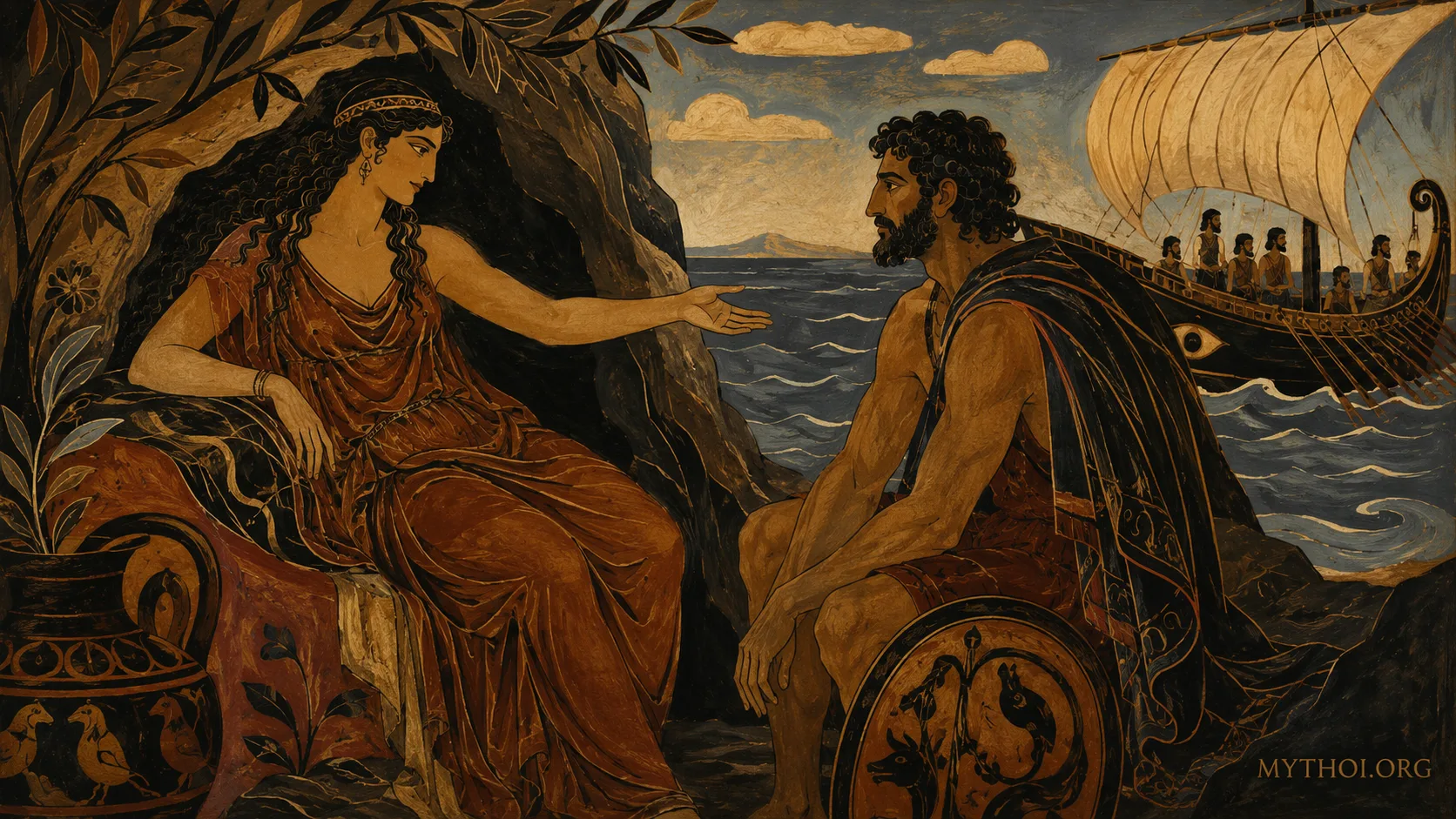
Calypso and Odysseus – The Mythical Love Story in the Odyssey
There are stories that aren’t about war or monsters, but about something more subtle and, perhaps, more painful: about a person who has everything he could possibly want and yet dies of nostalgia. This, at its core, is his story Odysseus on the island of Calypso.
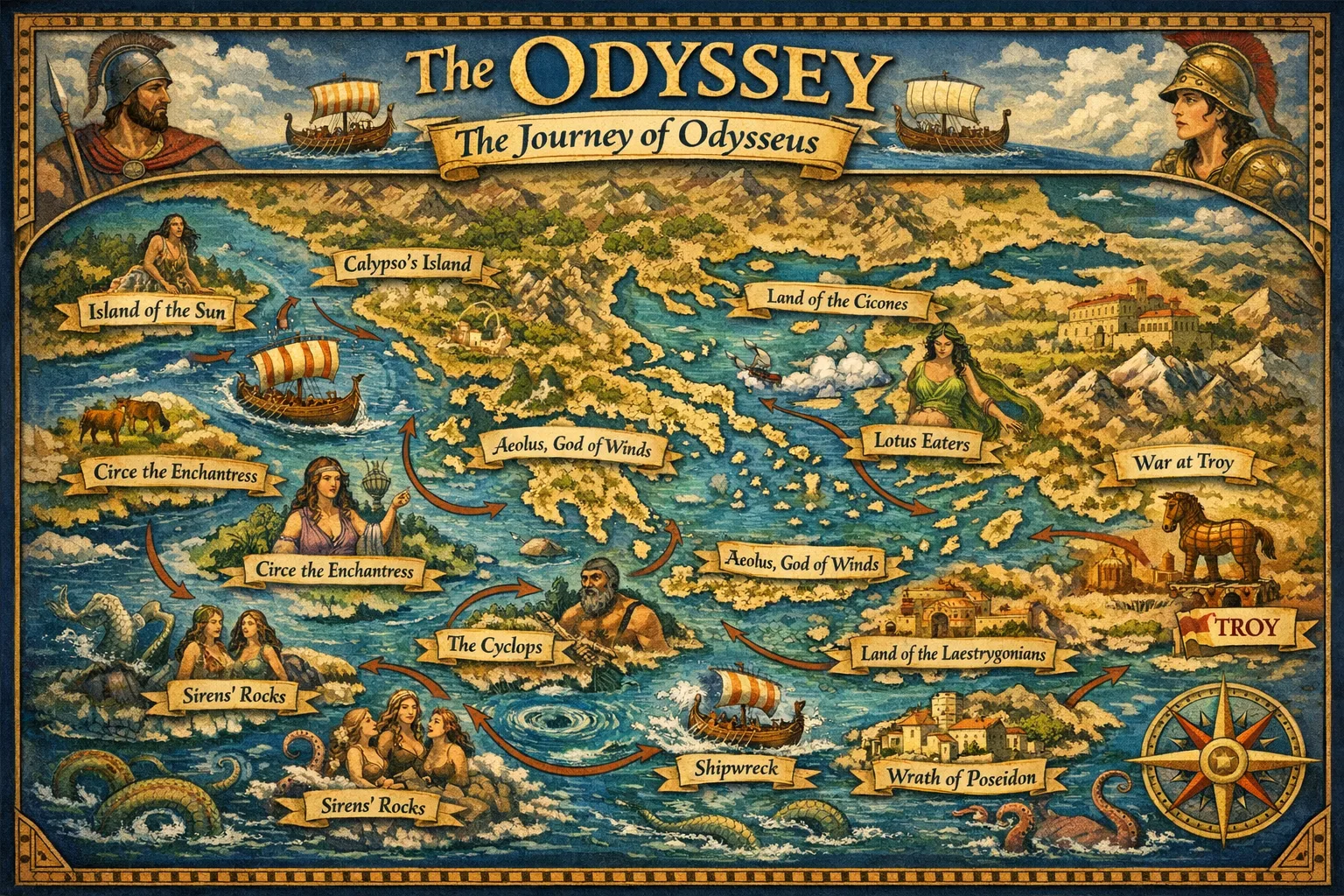
Homer starts the Odyssey not from Troy, not from Cyclops, but from there: from a hero sitting on a beach, gazing out at the sea with tears in his eyes. And beside him, almost invisible, the goddess who loves him—Calypso.
Who was Calypso?
Her name comes from the Greek verb *kalypto*, which means “to cover” or “to hide.” It is a word that embodies both care and commitment. Calypso is not just a character—she is a nymph, the daughter of Titan Atlas, who lives alone on the island of Ogygia, a place so remote that even the gods themselves rarely visit it.
Ogygia, as described by Homer, is a place of superhuman beauty. Dense cypress forests, vines laden with grapes, four springs with crystal-clear water. In a different context, it would sound like paradise. Here, however, it functions as a golden cage.
Calypso herself is a form that combines tenderness and power. He loves Odysseus deeply — This is not in doubt anywhere in the text. He has saved him, cares for him, offers him immortality. And yet, that's exactly what her love is holding him captive.
How Odysseus got there
After a series of disasters on his journey home from Troy—and especially after the destruction of his last ship and the loss of all his companions—Odysseus finds himself alone at sea. Calypso finds him, rescues him, and brings him to her island. Hermes, who later visits the island at the behest of the gods, famously says that he pulled him out of the water as if he were a shipwreck.
So there they live together for seven years. Seven years, which in a human life is an entire chapter. Calypso gives him everything an immortal can give: love, beauty, serenity, and the promise of eternal life. Odysseus sits on the shore and weeps.
The proposal for immortality
The crucial question raised by this story is simple yet profound: why does Odysseus refuse immortality? What does Ithaca have that Ogygia does not?
Calypso hides nothing from him. She tells him openly that if he stays with her, he will live forever, never grow old, never die. She asks him—with a hint of bitterness in her words—if Penelope is more beautiful than she is. “She cannot compare to me, neither in beauty nor in stature,” she says. And Odysseus does not deny it. He acknowledges that Penelope is mortal and therefore “inferior” in all external criteria.
And yet he chooses to return.
This moment is one of the most human in all of ancient Greek literature. Odysseus does not choose the beautiful, the safe, or the eternal. He chooses the familiar, his own, the finite. He chooses to be mortal among his own people rather than immortal in a meaningless paradise.
The intervention of the gods
Η απελευθέρωση του Οδυσσέα δεν έρχεται από μόνη της. Απαιτεί θεϊκή παρέμβαση. Athena, the hero’s protector, intercedes with Zeus during an absence of Poseidon—the only god who is hostile toward Odysseus. Zeus sends Hermes to convey the order to Calypso: Odysseus must leave.
This scene is remarkable for one reason: Calypso gets angry. She does not immediately comply with politeness or acceptance. She protests in a way that makes her seem more like a mortal woman than a goddess. She says that the gods are hypocrites—they allow themselves to love mortal women, but when a goddess loves a mortal man, they intervene to take him back. Her observation is fair. And Hermes does not refute her.
In the end, Calypso obeys. She goes to find Odysseus and tells him he is free to leave. But even at that moment, her love does not fade. She helps him build a raft, gives him provisions, and guides him by the stars. It is as if she is seeing him off, knowing that they will never see each other again.
The Portrait of Calypso: Unrequited Love
Calypso is one of the most tragic figures in the *Odyssey*, and the paradox is that she does not die, does not suffer a violent death, and is not punished. Her tragedy is more subtle: she loves someone who cannot be hers.
Homer doesn’t portray her as evil. She isn’t the witch Circe who turns men into pigs, nor is she the Sirens who sing to kill. She is a woman—albeit an immortal one—who loved the wrong man, or the right man in the wrong place. Ogygia was her world, not his. Odysseus.
What makes her form unique is that, despite her power, she cannot change what Odysseus desires. She can grant him immortality, but she cannot give him Ithaca. She can keep him close to her, but she cannot make him stay of his own free will. And in the end—and this is perhaps her most human trait—she lets him go.
What this relationship symbolizes
Scholars have interpreted Odysseus’s stay on Ogygia in many ways. Some see it as a symbol of “oblivion”—the temptation to forget one’s obligations, history, and identity. Others interpret it as an allegory for death, since Odysseus essentially “disappears” for seven years and returns as a reborn man.
But there is also a more everyday interpretation: the island of Calypso represents every convenience that keeps us from doing what we truly want to do. It is the temptation of a carefree life, of risk-free security, of beauty without meaning. And the Odysseus — even though he doesn't seem happy — it will take divine intervention to get him out of this situation.
Seen in this light, Calypso is not an enemy. She is a beautiful distraction.
Odysseus as a symbol of human choice
What makes this story timeless is the choice. Odysseus knows exactly what he is leaving behind when he departs: immortality, eternal youth, and a goddess who loves him. And he also knows what awaits him: a perilous journey, old age, and a death that he himself Teiresias He's been prophesying to him.
Nevertheless, he chooses to return home. He chooses Penelope. He chooses Ithaca.
This choice says something profound about human nature: that we are not creatures who simply seek pleasure or survival. We are beings who need meaning, identity, and a sense of belonging. Ogigia was not Odysseus’s home. It was a beautiful prison.
One last thought
The story of Calypso and Odysseus has no winner. Odysseus returns, yes. But Calypso is left behind, alone, on her perfect island, which is now a little emptier. And Homer doesn’t tell us how she feels about that. He doesn’t need to. We know.
Perhaps that is why this story has endured for so many millennia. Because it touches on something we all understand: the pain of loving someone who must take a different path. And the courage—or perhaps the folly?—to choose the difficult path that is your own, rather than the easy one that does not belong to you.
The Journey of Odysseus – A Detailed Guide Through Each Stop
Odysseus: His Story, Adventures, and the Lessons of the Odyssey