
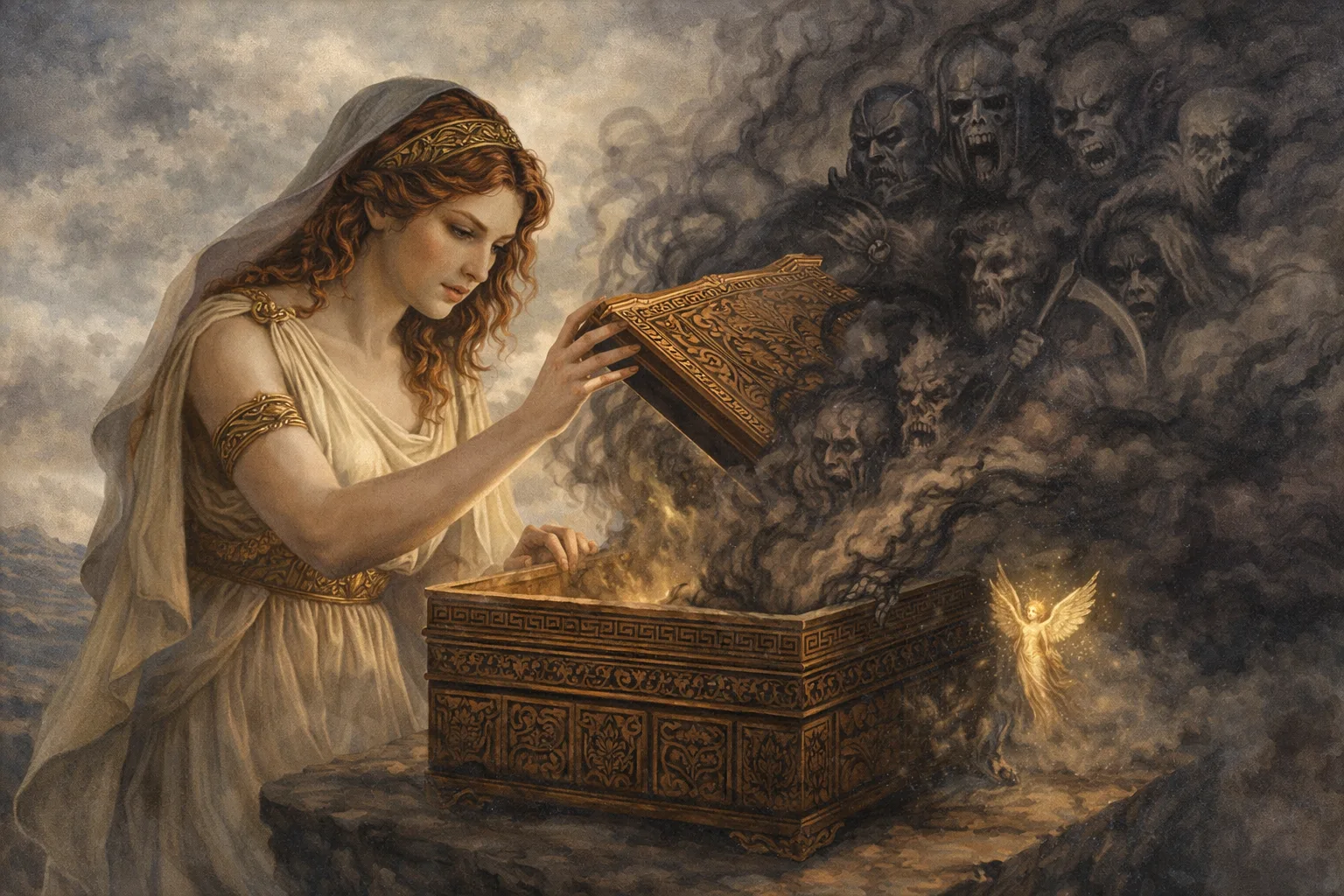
What is “Pandora’s Box”? The myth of Pandoraexplains how opening the box released all the evils into the world, leaving only hope inside.
The myth of Pandora tells how Zeus sent the first woman as punishment for humanity, after the fire that was stolen by Prometheus. When she opened the jar she had been given, all the suffering was released into the world, while only hope remained inside.
The text also explains that the term “box” derives from a later translation of the original “pitari” and presents the phrase as a symbol of uncontrollable consequences. It connects the myth to modern uses, as well as to broader themes of curiosity, punishment, and human endurance.
What does Pandora's Box mean?
The phrase «Open Pandora's box» is used today to describe an act or decision that initially appears small, but causes chained and often uncontrolled consequences. In everyday language it can be said of political decisions, technological discoveries, personal revelations or social changes that bring to the surface problems that were hidden or undervalued. For example, a public complaint may be «Open Pandora's Box»If it leads to a multitude of new revelations.
The expression is directly related to the myth of Pandora, one of the most famous myths in Greek Mythology. According to tradition, Pandora was the first woman, made from Hephaestus by order of the Zeus. The gods bestowed upon her various gifts: beauty, grace, charm, and skills, but also a dangerous curiosity. She was sent to Epimetheus, her brother’s Prometheus, as part of the divine punishment for stealing the fire that had been given to humankind.
The object Pandora opened was not originally a “box,” but a pithos, a large storage jar or vessel. A later rendering as “box” in the Western tradition made the phrase widely known as “Pandora’s Box.” When Pandora opened the vessel, all evils were released into the world: diseases, hardships, sorrows, and misfortunes. Only Hope remained inside.
Thus, the modern meaning of the phrase preserves the basic symbolism of the ancient myth: a careless or unavoidable act can bring unforeseen difficulties. At the same time, it reminds us that even amid consequences and crises, hope remains a defining element of human experience.
The Symbolism of Pandora Box
The symbolism of Pandora’s Box is multilayered and has occupied both mythological interpretation and philosophical thought. In the myth of Pandora, the box—or, more accurately, the ancient pithos—functions as a symbol of the unknown and the forbidden. It is the container that holds everything humans cannot fully control: pain, illness, decay, death, sorrow, and the hardships of everyday life. Once it is opened, the world ceases to be innocent and becomes a place where human existence is accompanied by trials.
In Greek Mythology, Pandora’s act is not presented merely as an individual mistake, but as part of a larger divine order. Zeus seeks to punish humankind for the gift of fire that Prometheus gave them. In this way, Pandora’s Box also symbolizes the limits between divine authority and human ambition. The evils that are released are not only punishments, but also elements that explain why human life is filled with labor and uncertainty.
Hope, which remains inside the vessel, is the most enigmatic element of the myth. One interpretation sees it as consolation: although evils exist, humans endure because they hope. Another, more philosophical approach views Hope as ambiguous, because it can encourage patience but also prolong illusion. In modern thought, the myth is often read as an allegory for technology, science, or politics, where every discovery can bring progress but also unforeseen dangers.
Overall, the symbolism of Pandora’s Box shows that knowledge, curiosity, and action have consequences. The myth is not limited to a warning; it also highlights the deeply human need to find meaning and endurance amid difficulties.
Pandora’s Box in Modern Culture
Pandora’s Box has gained a strong presence in modern culture because the myth of Pandora offers a flexible symbol for the unknown, danger, and unforeseen consequences. In literature, the idea of an object or action that releases hidden forces often appears in fantasy, science fiction, and psychological thrillers. Even when Pandora is not mentioned directly, the structure of the myth is recognizable: a character crosses a boundary and faces results they cannot reverse.
In cinema and television, the symbolism of the box is often used to represent secrets, experiments, or forbidden knowledge. James Cameron’s film Avatar uses the name Pandora for the planet where human interference unleashes conflicts of an ecological and moral nature. Science fiction and mystery series also use the phrase “Pandora’s box” for cases in which a revelation triggers a chain of developments. In this way, Greek Mythology becomes a modern narrative tool.
In video games, the myth appears either directly or indirectly. In the God of War series, elements of ancient mythology are combined with a dramatic portrayal of gods, punishments, and symbols, while Pandora and her box take on a central role in specific narrative moments. In other games, the idea of “opening” a dangerous source of power is connected to player choices and moral dilemmas. In the visual arts, from Renaissance paintings to contemporary installations, Pandora is often depicted as a charming, restless, and tragic figure.
In conclusion, Pandora’s Box remains alive in the modern imagination because it expresses a timeless fear: that human curiosity may reveal forces beyond our control. At the same time, it retains its appeal because it connects danger with hope and destruction with the possibility of meaning.
Lessons From the Myth of Pandora
The myth of Pandora offers important moral and philosophical lessons because it examines issues that remain relevant: curiosity, responsibility, the consequences of actions, and the importance of hope. Pandora is not simply a mythological figure driven by the desire to know what is hidden inside the forbidden vessel. She represents the human tendency to seek answers, even when there is risk. This curiosity can lead to progress, but it requires judgment and self-awareness.
In Greek Mythology, the story is connected to the actions of Prometheus, the reaction of Zeus, and the fate of humankind. Pandora’s Box thus becomes a narrative about the responsibility that accompanies every form of knowledge or power. Modern people can see in the myth a warning about decisions made without sufficient understanding of their consequences. This applies to technology, science, the environment, and also personal relationships, where a reckless revelation or choice can radically change a situation.
Another lesson concerns the consequences of actions. The myth does not present a world in which mistakes are easily undone. On the contrary, it shows that some decisions release situations that cannot return to their previous state. This does not mean that action should be avoided, but that it requires awareness, moderation, and the acceptance of responsibility. The symbolism of the box serves as a reminder that every choice opens possibilities, both positive and negative.
Hope, which remains inside the vessel, gives the myth its most human dimension. Although evils spread throughout the world, humanity is not left with fear alone. In conclusion, the myth of Pandora teaches that curiosity needs wisdom, knowledge requires responsibility, and difficulties demand endurance. Hope does not erase consequences, but it helps people continue to act, learn, and create.
“In the dawn of the ancient world, Prometheus stole a shining spark from the sacred fire of the gods and gave it to all mortals to protect them from the cold of the night. But Zeus, the king of the gods, was angered that such a gift had been taken from him, and, in revenge, decided to offset the blessing of fire with a curse. He ordered Hephaestus to fashion a woman of extraordinary beauty, whose destiny was to bring great sorrow to the human race. She would be named Pandora.
As Hephaestus shaped the clay into a stunning woman, a primordial evil named Atrox watched longingly from the shadows. As soon as she was finished, Hermes took Pandora to Epimetheus, Prometheus’s brother, and presented her to him as a gift from Zeus. When he saw the beautiful Pandora, Epimetheus forgot his brother’s warning not to accept any gift from the great god and took her as his wife.
As a dowry, the gods had given Pandora a huge, mysterious jar, but Atrox knew what it contained. At the wedding feast, he cleverly piqued her curiosity and persuaded her to open the lid. And when she did, countless evils poured out into the world. Only hope remained inside, a consolation for all the evils that had been unleashed. But no one saw the demon that Aatrox sent to destroy hope and kidnap Pandora. Selene, the goddess of the Moon, however, finally heard Pandora’s cries and stopped the demonic creature.
Atrox reflected on this defeat and envisioned a way to inflict even greater suffering upon humanity. “As he journeyed to the far reaches of the night, he encountered the three Fates, goddesses older than time itself, who wove the threads that predetermined the course of every life. Once they agreed to Atreus’s plan, their decision became irrevocable. Not even the great Zeus himself could change their decision. Only Selene dared to defy their decree, and she alone swore to alter fate.”
— Lin Eing, The Becoming
Who was Pandora?
The name "Pandora" itself offers some clues. In Greek, the word “Pandora” translates to “all-powerful” or “she who possesses all gifts.” This refers to the many blessings bestowed upon her by the gods. Each deity gifted her with a specific talent or talisman.
- Athena He gave her intelligence.
- Aphrodite It gave her beauty.
- Apollo gave her music ability and so on.
In this way, Pandora was created to be «Perfect woman».
Pandora's Box in Greek Mythology
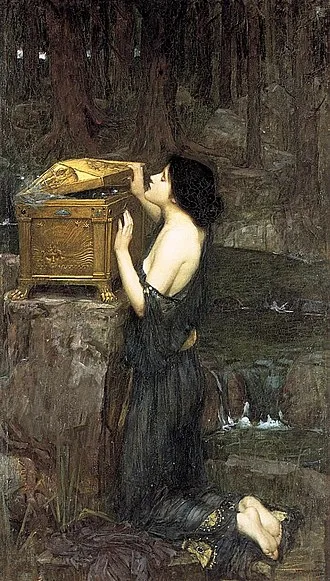
The phrase «The Pandora Box» is one of those expressions that are found in modern language and have their roots in Greek mythology, as are the expressions «The touch of Midas» and «Fear the Greeks, even when they bring gifts».
Today, the term “Pandora’s Box” is generally used to describe the source of problems or a gift that is actually a curse. In Greek mythology, however, there was a real, physical “Pandora’s Box.”
Pandora's jar
According to the ancient Greek myth, it would be more accurate to refer to it as the “Pandora’s Jar” rather than “Pandora’s Box,” since the original Greek word was pithos, meaning a large storage vessel.
Jars like the pithos, along with amphorae, were common containers in antiquity used for storing and transporting goods.
The shift from “Pandora’s Jar” to “Pandora’s Box” occurred in the 16th century AD, when Desiderius Erasmus, in his work Adagia (1508), translated the word pithos as pyxis, meaning a container with a lid or a box. Adagia (1508), translated the word pithos as pyxis, i.e. a container with a lid or a box.
The Pandora Box
As the name states, the Pandora Box belonged to Pandora, the first mortal woman. Created by Hephaestus Of clay, he came alive with his will Zeus And gifted with various gifts from the rest gods of Olympus.
Pandora was destined to become the wife of the Titan Epimetheus, and she brought with her to the wedding a box that Zeus had given her, along with strict instructions not to open it.
According to HesiodWhen the PrometheusHe stole fire from the heavens, and Zeus, the king of the gods, took his revenge by presenting Pandora to Prometheus’s brother, Epimetheus. Pandora opened a jar that had been left in her care, which contained disease, death, and many other unspecified evils, which were then released into the world. Although she hurried to close the jar, only one thing remained inside—usually translated as Hope, though it could also carry the pessimistic connotation of “deceptive expectation.”
The Punishment of Mankind
Pandora, however, was not a benevolent gift from the gods to Epimetheus, but part of the punishment that had been devised by Zeus for mankind.
His brother Epimetheus, Prometheus, he had stolen the fire from his workshop Hephaestus and had given it to people so that they would never be cold again. Furthermore, he had taught people how to perform sacrifices, keeping the best parts of the animals for themselves and leaving the scraps to the gods.
For these crimes, Prometheus He was severely punished, chained for centuries to a mountain in the Caucasus. Pandora, however, was part of Zeus’s more elaborate plan to punish humanity.
The Opening of Pandora's Box
Pandora brought not only the box to her wedding, but also curiosity—one of the traits that the goddess Hera had bestowed upon her.
Despite his warning Zeus, Pandora felt a strong urge to see what was hidden inside the box. Finally, her curiosity got the better of her, and, lifting the lid slightly (or removing the cap), she tried to take a peek inside.
Unbeknownst to him, the gods of Olympus had imprisoned all manner of suffering inside the box: toil, war, greed, disease, and pain—things unknown to humans until then. Although the box was opened only slightly, that opening was enough to release all these evils into the world. In the end, only one thing remained inside Pandora’s Box: Hope.
Consequences for Humanity
After Pandora's Box was opened, people were forced to work hard to survive, to toil in the fields, and to face injuries, illnesses, and diseases for the first time.
This generation of people came to an end with the arrival of the Great Flood. However, Pandora’s daughter, Pyrrha, and the son of Prometheus, Deucalion, survived. Nevertheless, mankind’s suffering continued.
Pandora's Box Analysis:
Whenever we hear the phrase “you’ve opened Pandora’s box,” we immediately know what it means: something we shouldn’t have touched, but did, and now the consequences are out of control. Behind this everyday expression lies one of the deepest and darkest myths of ancient Greek mythology—a myth that speaks not merely of a woman and a box, but of the human condition itself.
The birth of Pandora
According to Hesiod, in «Works and Days» and «Theogenia», the myth begins as punishment. The Prometheus, the Titan who loved humanity, had stolen fire from the gods and given it to mortals. Zeus, enraged, decided to restore the balance by creating an “evil” that would counterbalance Prometheus’s gift.
Hephaestus, the god of craftsmanship, shapes a woman “virgin and flawless” out of clay. The gods bestow upon her their finest gifts: Athena clothes her and teaches her, Aphrodite gives her grace and desire, and Hermes endows her with cunning and quick wit. They name her Pandora, meaning “given by all.” Epimetheus, Prometheus’s brother (and the one who doesn’t think before he acts), takes her as his wife despite the warnings.
Along with Pandora, the gods sent humans a sealed vessel—in fact, a large jar (pithos), not a small box as we later imagined it through Latin translations. Inside it were sealed all the sufferings of the world: diseases, pains, hatred, envy, old age, death, and every kind of misfortune. Only Hope remained at the bottom.
The moment that changed everything
Pandora, whether out of curiosity or because of the very nature the gods had given her, opened the jar. In an instant, evils burst forth like black smoke and spread throughout the world. Humans, who until then had lived in a golden age free from suffering, suddenly found themselves exposed to endless torment. Pandora hurriedly closed the lid, but it was too late. Only Hope remains inside, either because Pandora managed to close the jar before Hope could escape, or—according to some interpretations—because Zeus wanted her to remain locked inside so as not to fully relieve humanity’s suffering.
The myth is not merely a story of punishment. It is a profound parable about the loss of innocence and the entry of evil into the world.
Philosophy analysis and symbolism
The «Pandora box» It works at many levels. First of all, it symbolizes curiosity as a fundamental human trait. Just as Adam and Eve with the apple in the Old Testament, Pandora represents humanity’s inevitable need to know, to open, to explore—even when it brings pain.
Evil is not created by Pandora; it is simply set free. This shows that suffering already existed, locked away, waiting for the right moment. The myth speaks of the human responsibility but also for the limited freedom we can open the box, but we can't always control what will come out.
Its position is particularly interesting. Hope. It remains inside the jar. For some ancient commentators, this meant that Hope is an illusion or that it is not available to humans. For others, Hope is the only thing left to us when all else is lost—it is kept out of sight so that we do not destroy it or exhaust it. In modern interpretations, many view Hope as the last bulwark against despair.
Pandora herself is not “evil.” She is the instrument of divine vengeance, but also the first woman—the mother of us all. The myth thus carries a patriarchal undertone: women as the source of suffering. However, contemporary feminist interpretations view her as a victim of a system that used her to punish men.
Pandora Box in modern culture
The phrase has become a global idiom. We hear it in politics (“The decision on Brexit opened Pandora’s box”), in technology (“Artificial intelligence could be Pandora’s box”), and even in personal relationships (“Don’t bring that up—you’ll open Pandora’s box”).
It appears frequently in literature and film: from G.W. Pabst’s *Pandora’s Box* (1929), starring Louise Brooks, to contemporary science fiction films in which humanity opens “boxes” that it cannot close (nuclear energy, genetic engineering, climate change). In video games (e.g., *God of War*) and comic books, Pandora appears as a mysterious figure who holds the secrets of the world.
In psychology, the term “Pandora’s syndrome” is used metaphorically to describe a situation in which someone begins to investigate something and discovers a whole web of problems they didn’t want to see.
Connections with other myths
Pandora’s box has parallels in many cultures. In Jewish tradition, there is Eve and the Apple of Knowledge. In Norse mythology, the myth of Pandora evokes the unleashing of forces when the balance of the world is disrupted. Even in Japan, the story of O-Inari and the spirit boxes bears similarities.
In Greek mythology, it is directly linked to Prometheus and Epimetheus, as well as to the Bronze Age and the transition to harsher times. Hesiod uses the myth to explain why the world is full of suffering: it wasn’t always this way. Things used to be better. And we—or rather, our ancestors—are to blame for ruining it.
The Timeless Course
Pandora’s box is not merely a warning against curiosity. It is a profound acknowledgment that human beings are made to open boxes. We cannot remain forever shut away in the safety of ignorance. The price of knowledge is always high, but the alternative—a life without curiosity, without risk, without Hope rising from the depths—is perhaps worse.
Every time science advances, every time a society changes, every time a person decides to look deep within themselves, a small Pandora’s box is opened. And amid all the turmoil and pain that follows, somewhere at the bottom, there may still be Hope.
As long as we don't let her stay locked up forever.
Frequently Asked Questions About Pandora’s Box
1. What's Pandora's Box?
The Pandora Box is a mythical object of Greek mythology, which was given to Pandora by the gods. When he opened it, all the sufferings of mankind were released, while only Hope remained inside.
2. Who was Pandora?
- Pandora is considered the first woman in Greek mythology. Created by Hephaestus at his command Zeus as punishment for people, after the theft of fire by Prometheus.
3. Was it really a box or something?
In his original narrative Hesiod, the object was not a box but a jar (pithos). The concept of a “box” emerged later, mainly due to a translation error during the Renaissance.
4. Why did Zeus create Pandora?
- Zeus He wanted to punish people because Prometheus He gave them fire, symbol of knowledge and culture.
5. What suffering was released from the box?
According to legend, when the box was opened, disease, pain, old age, toil, and every form of evil that torments humanity spread throughout the world.
6. What does the Hope that remained inside symbolize?
Hope symbolizes the power of man to continue despite difficulties. There are different interpretations: others see it as a comfort, while others as an illusion that keeps man on hold.
7. Who recorded Pandora's myth?
The most famous version of the myth comes from his works Hesiod, particularly from «Theogenia» and «Works and Days».
8. What is the relationship between the myth and Prometheus?
The myth of Pandora is a continuation of its history Prometheus, who stole the fire from Zeus to give it to people.
9. How the phrase is used today «Open Pandora's box»?
In modern language, the phrase means that an action can cause chained and uncontrolled consequences.
10. What is the basic message of the myth?
The myth highlights the concepts of curiosity, punishment, human weakness and hope as a necessary element of survival.

- Pandora’s Box: Inspiring by Greek mythology is our exclusive Nemesis Now design, Pandora’s Box
- Box For Storing Small Accessories: This exquisite box beckons you to reveal the terrifying tinkets that lie within
- Gold Detailing with Red Velour Interior: Gold detailing surrounds the box as well as blue gemstones, then within the box...
Bibliography
Ancient Sources
- Hesiod, Works and Days (f. 42–105) – The oldest and most important account of the creation of Pandora and the pit.
- Hesiod, Theogony (f. 570–616) – The creation of Pandora as punishment for people after the theft of the fire by Prometheus is described.
- Apollodorus, Library, 1.7 – Summary reference to the myth of Pandora.
Modern Bibliography
- Gantz, Timothy. Early Greek Myth: A Guide to Literature and Artistic SourcesJohns Hopkins University Press, 1996.
- Lamberton, Robert. HesiodYale University Press, 1988.
- West, M. L. Hesiod: Works and DaysOxford University Press, 1978.
- Verdenius, Willem J. A Commentary on Hesiod: Works and Days 1–382Brill, 1985.
- Panofsky, Dora & Erwin. Pandora’s Box: The Changing Aspects of a Mythical SymbolPrinceton University Press, 1956.
- Fraser, Lilah-Grace. "A Woman of Consequence: Pandora in Hesiod’s Works and Days." The Cambridge Classical Journal 57 (2011).
External Links
For SEOs and reliability, 4–6 external links to valid sources shall be sufficient:
- Perseus Digital Library (Ancient Greek texts and translations)
- Cambridge Classical Journal – Pandora in Hesiod’s Works and Days
- National Documentation Centre – Study for Pandora