
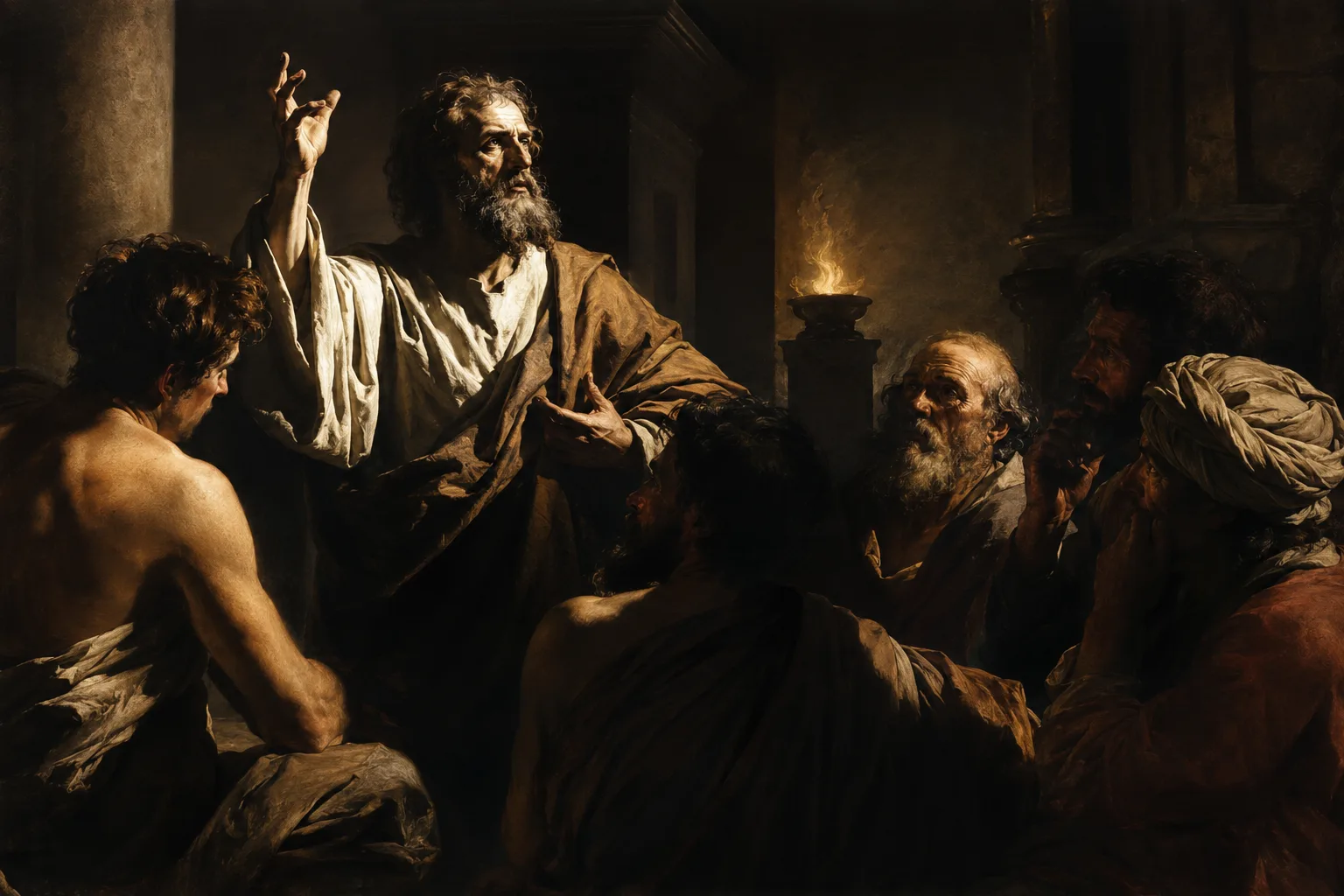
Who was the Apollonius of Tyana?
THE Apollonius of Tyana was a Greek philosopher and wandering sage who acted during the 1st century AD, in the early Roman Empire. It came from Tyana, a city of Cappadocia in Asia Minor, and was closely associated with the Pythagorean tradition, of which he was considered one of the most important expressions in his day. His reputation was based on both his philosophical action and the ascetic lifestyle he allegedly followed.
It is important to clarify from the outset that Apollonius is not a mythological person, nor is it related to God Apollo except for the similarity of the name. He is a historical figure, about whom, however, we have very little contemporary and independent evidence. His reputation as a miracle-worker, prophet, and sage with supernatural abilities was largely shaped later, primarily through the extensive biographical work of the sophist Philostratus, written about a century after Apollonius’s death, at the request of Empress Julia Domna.
This temporal gap between the life of the historical Apollonius and the writing of the primary source about him is crucial to understanding the man: what we know comes largely from a narrative of a literary, rhetorical, and partly propagandistic nature, rather than from a contemporary historical account.
Origin and youth years
According to Philostratus, Apollonius was born in Tyana, Cappadocia, into a wealthy family. The tradition recounted by Philostratus surrounds his birth with miraculous elements—such as omens and signs that foreshadowed his distinguished destiny—elements which, as is often the case in ancient biographies of wise and distinguished men, cannot be independently verified and must be regarded as part of the literary convention of the genre.
According to Philostratus, the young man Apollonius sent for his education in Tarsus, Cilicia and then in Aeges, where he allegedly came into contact with various philosophical schools —stoic, platonic, walking, epicuria— before turning permanently towards Pythagoism. This choice, as the source presents it, was not accidental, but the result of a conscious search for a lifestyle that combines philosophical knowledge with spiritual and physical purity.
It should be stressed that for Apollo's youth we have no independent testimony beyond Philostratus. What is mentioned here is solely in the biographical tradition.
THE Apollonius and Pythagoism
Apollonius was regarded, as early as antiquity, as one of the most important figures of so-called Neopythagoreanism, a philosophical movement that revived, during the early centuries of the imperial era, the teachings attributed to Pythagoras of Samos. Neopythagoreanism was not a unified doctrinal system, but rather a combination of ethical philosophy, religiosity, numerology, and ascetic practices.
The main element of this tradition was the belief that the Psyche can be cleansed and approached by divine through a certain way of life: self - control, abstinence from certain foods (mainly meat and, at times, legumes), silence, simplicity in clothing and habits, as well as philosophical self - discipline. THE Philostratus He presents Apollonios as a man who fully embodied these principles, even reaching, according to the narrative, to observe for a long time absolute silence in the context of Pythagorean exercise.
It is important that the Apollonius as the founder of a new religion or philosophical school. He did not teach a new doctrine, but sought to revive and incarnate an already existing tradition, that of Pythagoras, giving it personal prestige through his own way of life.
His ascetic life
The picture that Philostratus paints of Apollonius’s daily life is that of a man who had renounced material comfort in favor of philosophical and spiritual cultivation. It is reported that he wore simple linen garments instead of woolen ones—a custom associated with Pythagorean notions of purity—that he avoided wine, meat, and other foods considered incompatible with spiritual clarity, and that he devoted much of his time to contemplation, prayer, and study.
Silence held a special place in this practice: in the Pythagorean tradition, abstinence from the speech was considered an exercise of self-control and an instrument of internal cleansing. THE Philostratus states that the Apollonius He observed five years of silence in his youth, as part of his philosophical initiation.
The model of the wandering philosopher-ascetic was not unknown during the Roman imperial era. Cynic and Stoic philosophers, as well as other religious teachers, traveled from city to city, teaching in public and criticizing the authorities or the mores of the time. Apollonius, as presented by the source, is part of this broader tradition of the “sage as a public figure,” who derived his authority not from an institutional position but from his personal way of life.
Apollo’s travels
One of the central elements of the biography compiled by Philostratus is the presentation of Apollon as a man who traveled extensively to the then known world, seeking knowledge and meeting wise different traditions. It should be stressed from the outset that the extent and historicality of these travels are the subject of intense discussion in modern research, as many elements bear intense literary and rhetorical characteristics.
Asia Minor and Syria. Philostratus' narrative places the principle of Apollon's public action in his hometown and in the neighbouring towns of Asia Minor, where he allegedly began teaching and gathering his first students, including Dami, who would become his permanent attendant in tradition.
Mesopotamia and Babylon. According to Philostratus, Apollonius He crossed Mesopotamia and arrived in Babylon, where he allegedly met with the magicians there —the priestly branch of the Zoroastrian tradition— and discuss philosophical and religious issues with them. The historicality of this meeting cannot be confirmed independently.
Persia. The source reports further heading eastward, through Persian territory, with stops in courtyards of local rulers, where the Apollonius he was reportedly accepted with honors due to his reputation as a wise man.
India. The journey to India is the most extensive and most controversial part of the narrative. According to Philostratus, Apollonius He reached the foothills of the Caucasus (with the ancient name then attributed to mountain ranges of the region) and then to India itself, where he met the so-called wise Brahmans. It should be pointed out clearly that modern research does not regard this journey as a proven historical fact.· On the contrary, many scholars incorporate it into the literary tradition of the exotic travel accounts of late antiquity, a species with its own rhetoric and its own conventional places.
Egypt and Ethiopia. In the later books of the project, Philostratus describes Apollon's visit to Egypt and Ethiopia, where he allegedly met with the so-called Gypsophists, a group of ascetic philosophers of the region, with whom he discussed matters of theology and ethics.
Greece and Rome. The narrative also places Apollonios in important Greek centers —The Athens, Olympia, the Delphi— where he allegedly participated in rituals and commented on religious practices, as well as in Rome, where his action is linked to the political history of the time, as will be analyzed below.
In any case, evaluation of the historical reliability of these travels should be done with caution, taking into account that this is a biography with an intense praise and literary character, written generations after the events it describes.
The meeting with the wise men of India
A special place in Philostratus' narrative is held by Apollon's meeting with the Brahman wise, which the source presents as holders of higher spiritual knowledge. The dialogues attributed to this meeting concern matters such as the nature of the soul, the relationship of body and spirit, self-dominance, the place of man in nature and the approach of the divine.
The image of India formed through these pages should not be treated as a reliable ethnographic record, but as a literary construction, shaped under the influence of earlier Greek traditions for the East —traditions dating back at least to the era of Alexander the Great and to the accounts that followed his campaign. THE Philostratus exploits this already existing imaginary background to construct an image of India as a place of supreme wisdom, in which its protagonist can compete with the local wise and become their equal, if not superior.
THE Apollonius as a wise and a teacher
In addition to his ascetic and travel life, Apollonius is presented by the source as an active teacher and public speaker. According to Philostratus, he was openly teaching in cities he visited, discussing with local rulers, philosophers and priests, and he did not hesitate to criticize practices he considered contrary to philosophical ethics —Like certain forms of sacrificial worship or excessive luxury.
His moral philosophy, as attributed to the narrative, was based on the idea that virtue is acquired through personal exercise and self-control, rather than simply through theoretical knowledge. The wise, according to this concept, had to be a living example of the principles he taught.
THE Apollonius and religion
The religious dimension of Apollon's thinking, as presented in the sources, is based on the belief that man can approach the divine through the purity of the soul and not necessarily through the formal observance of religious rituals. THE Philostratus gives Apollonios a critical attitude towards certain forms of bloody sacrifice, arguing that genuine piety does not depend on the quantity or luxury of offers, but on the inner disposition of the believer.
At the same time, Apollonius presented as a man deeply religious, honoring them gods, he visited sanctuaries and divinations, and considered prayer and spiritual purity necessary conditions for any genuine relationship with the divine. However, he should not be assigned theological positions which are not explicitly documented by ancient sources.
Miracles and supernatural abilities
One of the most characteristic elements of tradition for Apollonios is the multitude of miracles and supernatural abilities attributed to him by Philostratus. It should be made very clear that these are source accounts rather than historical factual facts.
Among the episodes mentioned are patient treatments, prophetic abilities that allowed Apollonio to predict future events, knowledge of distant events at the time they took place, as well as episodes of dealing with what the narrative presents as demonic or unexplained presences. At some points in the account there is also an unexpected appearance or disappearance of Apollon, an element that enhances the image of a man with a particular relationship with the transcendental.
To understand these accounts it is useful to distinguish between different types of persons recognized by ancient thought: wise (the holder of philosophical knowledge and moral authority), Wondermaker or charm (person engaged in impressive displays, often with a negative accent), Wizard in the technical sense of the term, i.e. someone who practices specific ritual practices, often considered suspicious by official authority, and God (theios aner), a type of man that Greco-Roman society recognized as a carrier of particular, almost superhuman wisdom and power, without however considering him a god.
THE Philostratus He consistently seeks to include Apollonios in this latter category —of Uncle Man— and not that of the common magician or charmer, a distinction that had significant social and legal consequences in the Roman Empire era, as will be seen in unity for the trial against Domitian.
Apollonius and magic
In the ancient world, the term «magician» did not always have a negative meaning· He originally referred to the priests of the Zoroastrian religion of Persia. However, the term gradually acquired negative notions, associated with practices considered suspicious, illegal or dangerous to social order —In particular when it concerned influence over powerful persons or predicting the future in ways that could be interpreted as a threat to power.
A philosopher with a reputation for supernatural abilities, such as Apollonius, was therefore in a sensitive position: the same reputation that gave him prestige could be used against him as a category of charm or magic, especially in times of political suspicion. THE Philostratus, writing his biography, seems to have as one of his goals exactly the defence of Apollo's memory from such accusations, presenting him as a carrier of divine wisdom rather than as practicing suspicious techniques.
Later writers, especially in the context of the confrontation of paganism and Christianity, stood in a different way towards the issue, sometimes rendering Apollonios a demonic origin of his abilities and sometimes attempting to delegate him to mere charms.
THE Apollonius and Nero
Tradition places Apollonios in Rome and during the reign of Nero, an era of intense suspicion towards philosophers, especially those considered critics of imperial power. THE Philostratus He mentions persecutions against philosophers in Rome at that time and presents Apollonios as being cautious but intransigent towards authority, without betraying his philosophical principles.
It should be noted that the exact nature and extent of Apollo's presence in Rome on Nero cannot be confirmed independently of other sources, and that directing these events largely serves Philostratus' wider goal: to present Apollonio as a model philosopher who does not succumb to tyranny.
THE Apollonius and Domitian
The most extensive and dramatic political episode of biography concerns Apollon's conflict with Emperor Domitian, known for his strict and suspicious attitude towards the philosophical opposition. According to Philostratus, Apollonius He was accused of plotting against the emperor and of having participated in rituals with a magical character, charges that could bring death penalty.
The account describes his capture, his transfer to Rome and the trial before the emperor himself. According to Philostratus, Apollonius He faced the process with philosophical indifference, defending himself with arguments focused on the distinction between genuine philosophical wisdom and magic, and eventually, according to tradition, miraculously disappeared from the courtroom before the decision was even announced.
This episode is one of the most characteristic points of Apollo's image as a philosopher who defies tyrannical power, an icon particularly popular in the Roman philosophical secretariat, where the wise man contrasts with the tyrant as his morally superior. At the same time, the spectacular nature of the narrative —In particular the disappearance— makes it clear that we are in the field of literary and miraculous tradition, not documented history.
The disappearance and the end of his life
For the end of Apollo's life, sources do not agree on a single version. THE Philostratus mentions different traditions regarding the place and manner of his death —In the case of Crete or Crete Tyana— without being bound to a single version, which highlights the legendary character already acquired by the form of Apollon. In some versions it is even said that his death was not clear, but that he simply disappeared, thus strengthening the image of a man with a particular, almost transcendental fate.
Tradition also mentions appearances of Apollon after his death, including in a young student dream, in the context of discussion on the immortality of the soul. All these accounts belong to the biographical and miraculous tradition and cannot be treated as historically documented evidence of the actual death of the historical person.
The sources for Apollonios Tyaneas
Philostratus – Life of Apollonius of Tyana
Flavius Philostratus was a Greek sophist who acted in the late 2nd and early 3rd centuries AD, associated with the circle of Empress Julia Domnas, the wife of Emperor Septimius Severus. On her order, she composed the extensive Vio Apollone of Tyane, organized in eight books, which is the far more important and extensive source for Apollonios.
The work was written about a century after Apollon's death and combines elements of biography, philosophical dialogue, travel narrative and praiseworthy rhetoric. As a historical source it presents serious problems: time distance from events, the praiseworthy purpose of the project, the use of disputed sources (such as the supposed memos of the Damides) and intense literary editing make it necessary to constantly criticize the material it contains.
Damis
THE Philostratus argues that it was largely based on calendars or memos that someone allegedly wrote Damis, student and permanent escort of Apollon during his travels. The existence and authenticity of this source is strongly challenged by modern research· Many scholars consider it possible that it is a literary trick of Philostratus himself, in order to give his account increased reliability through a alleged eyewitness.
Other ancient sources
Beyond Philostratus, antiquity also had other, shorter, references to Apollonios, such as that of a Sharagenes, whose work is not preserved but referred to by Philostratus himself, as well as testimonies related to Maximus of the Aegs. A collection of letters attributed to Apollonios is also saved, however the authenticity of which is largely questioned by literary research. The Christian author Eusebius of Caesarea composed later the project Against Hierocles, in response to Apollon's comparison with Jesus attempted by the Roman official Hierocles· This text is an important indirect source for the recruitment of Apollon in late antiquity.
THE Apollonius and Christianity
Apollon's form has often been compared to that of Jesus Christ, mainly because of common surface elements: both are presented by their respective traditions as people with healing abilities, with students who follow them, with a reputation of wisdom that transcends the ordinary human boundaries, and with unusual accounts around the end of their earthly life.
This comparison is not modern invention· already dates back to late antiquity, with a more typical example of Roman official Jerocles' attempt, in the late 3rd century, to contrast Apollonios to Jesus, arguing that the former was equally reliable —if not higher— an example of a divine man. Eusebius Caesarea's response, as mentioned, is the most important Christian reaction to this confrontation.
THE Apollonius in Roman Empire
The time in which he lived Apollonius It was characterized by intense movement of philosophers, sayings and religious teachers in the Greek-speaking and Latin-speaking area of the Empire. Greek education remained a reference point for the higher social class, while philosophy often acted not only as a theoretical quest but also as a way of life with a public, even political, dimension.
At the same time, the worship of the emperor was an important element of formal religiousism, creating at times tensions with philosophers who held a critical or independent attitude towards authority. Within this context is also included the image of Apollon as a wandering wise man who moves between cities, courtyards and sanctuaries, maintaining distances from official authority whenever it contradicts his philosophical principles.
THE Apollonius as «Uncle man»
The term theios aner (God’s name) is used by modern research to describe a type of person particularly widespread in the Greco-Roman antiquity: people who, without being considered gods, were recognized as having excellent, almost superhuman wisdom, moral authority and —in many cases— miraculous or prophetic abilities. THE Apollonius It is, according to many scholars, one of the most typical examples of this type.
This model combined philosophical knowledge, ascetic lifestyle, religiousity, moral authority over authority and reputation of supernatural abilities. The popularity of this model in the Roman Empire partly explains the great impact the Apollon form had, both in Philostratus' time and later.
Apollo's later reputation
After antiquity, Apollo's form continued to employ writers of various traditions. In the context of the confrontation between paganism and Christianity, as mentioned, it was used both as an example of alternative religious authority and as a goal of Christian criticism, which sometimes featured him as charms with demonic help.
In the younger centuries, Apollo's form was revived in internal and occult currents of the 19th and 20th centuries, which often approached him in a way independent of historical data, rendering him qualities and teachings not documented by ancient sources. He also occasionally appeared in works of literature and references to popular culture, usually as a symbol of the mysterious ancient sage. In the context of an encyclopedic article, it is important to avoid excessive or conspiracy approaches around this later intake.
Historian Apollonius and legendary Apollonius
The historian ApolloniusAs far as we can reach him through the sources, he was a Greek philosopher with a close relationship with pethagoism, active in the 1st century AD, who gained considerable fame already during his life or immediately after his death, so that a few generations later he could be considered worthy of an extensive biography ordered from an imperial environment.
THE Apollonius delivery, as we know him mainly through Philostratus, is a much richer one —and largely literaryly shaped— form: miraculous, prophet, traveler to the ends of the then known world, man with a special, almost transcendental relationship with the divine.
Modern historical research cannot treat this narrative as biographical events. Instead, he must distinguish carefully between the core of historical elements, the literary processing of Philostratus and the later additions of tradition.
What do we really know about Apollonio?
In view of the above, we can summarize as follows: it is possible to know that there was indeed a Greek philosopher from Tyana Cappadocia, with a close relationship with pethagoism, who lived in the 1st century AD and gained considerable fame as a wise and ascetic. It is uncertain the exact range of his travels, the extent to which he actually clashed with emperors such as Nero and Domitian As well as details of his death.
They come exclusively from Philostratus —and should therefore be treated with particular caution.— the almost all of the miraculous episodes, the journey to India with its detailed description, the dialogue with the Brahman wise, and the dramatic scene of trial and disappearance before Domitian. It is possible several of these elements are literary construction, adapted to the objectives and rhetorical conventions of Philostratus' time.
Despite these uncertainties, Apollonius remains an important form for understanding the religious and philosophical life of the Roman Empire: it captures the pattern of wandering philosopher-soccer, illuminates the relationship between philosophy, religion and authority, and provides valuable material for studying how antiquity understood its concept «man uncle» —a concept that, as we have seen, also relates to the early intake of Christian tradition.
FAQ
Who was the Apollonius of Tyana? He was a Greek philosopher and ascetic sage of the 1st century AD, closely associated with pethagoism, known mainly through the biography compiled by Philostratus about a century after his death.
When did he live? Apollonius of Tyana? He acted during the 1st century AD, in the early years of the Roman Empire, with his action extending, according to tradition, until at least the time of Emperor Domitian.
Where did he come from? Apollonius? From Tyana, city of Cappadocia in Asia Minor.
It was the Apollonius Pythagorean? He was considered one of the most important forms of neopythagoism, following in tradition ascetic lifestyle inspired by the principles attributed to Pythagoras.
It really went by Apollonius India? It cannot be confirmed independently. The journey is extensively described by Philostratus, but his historicality is questioned by many modern scholars, who incorporate it into the literary tradition of exotic travel narratives.
Did he really have miraculous powers? The miracles attributed to him derive exclusively from the biographical tradition, mainly from Philostratus, and are not historically documented events.
It was the Apollonius A magician? THE Philostratus He constantly seeks to present him as a divine man rather than as a common magician or charmer, a distinction important to his social and legal position in his day.
Did he meet Jesus? There is no historical testimony to document this.
Why is comparison Apollonius Jesus? Due to superficial similarities in the image of the miraculous sage with students, a comparison that already goes back to late antiquity, especially through the work of Jerocles and the response of Eusebius Caesarea.
Who wrote Apollo's Life? The Greek Sophist Flavius Philostratus, in the late 2nd to early 3rd century AD, at the order of Empress Julia Domna.
What do we know about Dami? It is presented by Philostratus as a student and permanent companion of Apollonio, whose alleged memos were, according to Philostratus, a key source of the work· its existence and authenticity are questioned.
How did he die? Apollonius? Sources do not agree· different traditions are mentioned, including concerning Crete or Tyana, while in some versions the end of his life is presented as extinction rather than conventional death.
Why is he important today? Because it offers valuable material for understanding the philosophical and religious life of the Roman Empire, its model «man uncle» and the way in which the biographies of wise persons were shaped in ancient times.
Sources and bibliography
- Philostratus, Life of Apollonius of Tyana.
- Letters attributed to Apollonio (their authenticity is largely questioned by modern literary research).
- Eusebius of Caesarea, Against Hierocles.
- Modern academic studies on Apollonios Tyaneas, Neopythagoism and its concept «man uncle» (theios aner) in Greco-Roman antiquity.
The god Apollo in Greek mythology
Orphism and mysterious cults in ancient Greece
Dodecathus: Institution or subsequent arrest?