
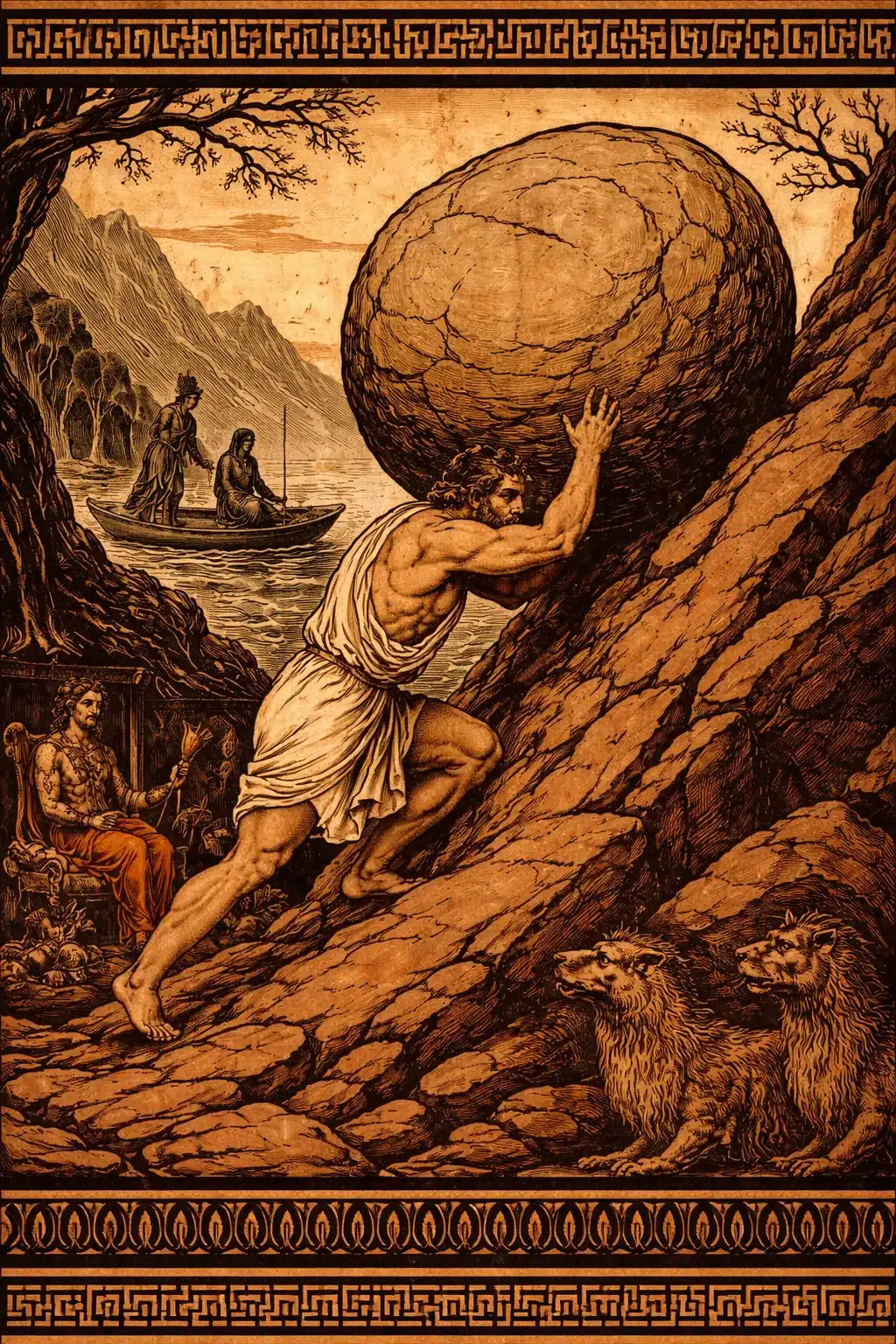
The Myth of Sisyphus: Eternal Punishment, Hubris, and the Meaning of Human Effort
Sisyphus myth belongs to the most powerful and timeless myths of Greek Mythology. Sisyphus, king of the Fountain, the later Corinth, he was known for his cleverness, cunning and arrogant challenge to the gods. His punishment to Hades, where he was convicted of pushing eternally a huge rock to the top of a hill, only to see him each time rolling down again, became a universal symbol of the vain effort, repetition and struggle of man against the inevitable. From Homer and Apollodorus to Albert Camus and the modern philosophy of absurdity, Sisyphus is not just a punished king· is a form that raises questions about freedom, hybrid, human perseverance and the meaning of life.
Origin and Ancient Sources of the Myth
Sisyphus appears in important ancient sources, which shows how old and widespread his myth was in the Greek world. The most famous ancient description of his punishment lies in Homer’s Odyssey, in Nekya, when Ulysses descends to Underworld And sees the souls of famous dead. There he faces Sisyphus constantly tormented, trying to climb a rock that, once near the top, slips and falls back into the plain.
The myth also appears in Pindar, Apollodorus, Pausanias, and later mythographic traditions. Apollodorus preserves important details about Sisyphus’ ancestry, kingship, and tricks, while Pausanias connects him with Corinth, local cult traditions, monuments, and regional lore. In ancient Greek thought, Sisyphus embodied the person who, although gifted with intelligence, oversteps the limits set by divine order.
The presence of the myth in such varied sources shows that there was not one single version. As often happens in Greek mythology, traditions differ according to region, period, and author. However, the central core remains stable: Sisyphus violated the boundary between mortals and gods, tried to deceive death, and was punished with an endless torment.
The Ancestry and Place of Sisyphus in Greek Mythology
Sisyphus is considered the son of Aeolus, ancestor of the Aeolians, and Enarete. He was the brother of figures connected with important mythological houses, placing him within a broader genealogical framework of ancient Greek tradition. He was the founder or king of Ephyra, a city identified with ancient Corinth, one of the most important commercial and political centers of the Greek world.
His wife was Meropi, one of his Pleiades, daughters Atlas. According to one tradition, Meropi is the faintest star of the Pleiades constellation because she was ashamed to marry a mortal or because she was ashamed of Sisyphus' punishment to Hades. From the generation of Sisyphus important mythological forms descended. His son is considered Glaucus, his father Bellerophon, the hero who tamed him Pegasus and killed her Chimera.
There is also a later tradition linking Sisyphus to Odysseus. According to her, Sisyphus was Ulysses' real father, because he had joined Anticlea before she married Laertis. This version, although not the Homeric main tradition, was used by some ancient writers to explain the proverbial intelligence and deceit of Ulysses, presenting him as a spiritual descendant of the most cunning king of mythology.
Sisyphus as King of Corinth
Corinth, known in earlier tradition as Ephyra, held a central place in the myth of Sisyphus. The city stood at a strategic point between the Peloponnese and mainland Greece and developed into a powerful commercial center. Its mythical king is presented as extremely capable, inventive, and politically perceptive, but also as someone who used his intelligence in dishonest ways.
In some traditions, Sisyphus is associated with the development of the city, the organization of power and the securing of water resources. A well-known version states that he revealed to the river god Astos that Zeus He had grabbed his daughter, Aegina. In return, the Asopos He gave Corinth a source or water, a vital element for the city. This act apparently benefited his people, but it was tantamount to betraying a secret of Zeus. Thus, Sisyphus has already appeared from the beginning as a form of duality: benefactor of his city, but at the same time abusive against divine authority.
The most important versions of the myth
The revelation of Zeus' secret
One of the main causes of the gods’ anger was Sisyphus’ revelation of Zeus’ abduction of Aegina. Asopus was searching for his daughter, and Sisyphus, knowing the truth, revealed it to him. In doing so, he indirectly challenged the authority of the supreme god of Olympus. Zeus, offended by this betrayal, decided to punish him.
This act is a typical example of the ancient concept of hybrid. Sisyphus did not content himself with his mortal position, but intervened in divine affairs, taking advantage of his knowledge of personal or political benefit. In Greek Mythology, hybrids almost always lead to nemesis, i.e. the divine retribution.
The Chaining of Thanatos
Perhaps the most impressive version of the myth is the one in which Sisyphus deceives himself Thanatos. When Zeus or the gods decided it was time to die, they sent Death to lead him to Hades. Sisyphus, however, with deceit and wit managed to chain him up.
The result was secular upheaval: no man died. The warriors did not fall into battles, the patients did not end, and the physical order of the world was disrupted. THE Ares, god of war, angered, as the battles lost their meaning without dead. Finally, Death was released, in some versions of Mars, and Sisyphus was inevitably led to Downworld.
This scene is especially important because it presents Sisyphus as the human being who attempts to abolish the most irreversible boundary of human existence: mortality. It is not merely a trick, but a rebellion against the structure of the world.
The Trick with the Burial and the Return from Hades
Even after his death, Sisyphus did not give up trying to deceive the gods. Before he died, he ordered his wife, Merope, not to bury him and not to perform the customary funeral rites. In ancient Greek religious belief, burial was a sacred duty. The soul of an unburied dead person could not find peace, and the neglect of funeral customs was considered a serious impiety.
When he reached Hades, Sisyphus complained to Persephone that his wife had dishonored him, not performing funeral duties. So he asked to return temporarily to the world of the living to punish or care for his burial. Persephone, convinced by his words, allowed him to leave. But he didn't return. He lived for years, enjoying life and delaying his fate.
Eventually, when the gods brought him back to Hades, his punishment was exemplary. He had deceived the gods, trapped Death, exploited the laws of the dead, and refused to accept the limits of human nature.
The Eternal Punishment in Hades
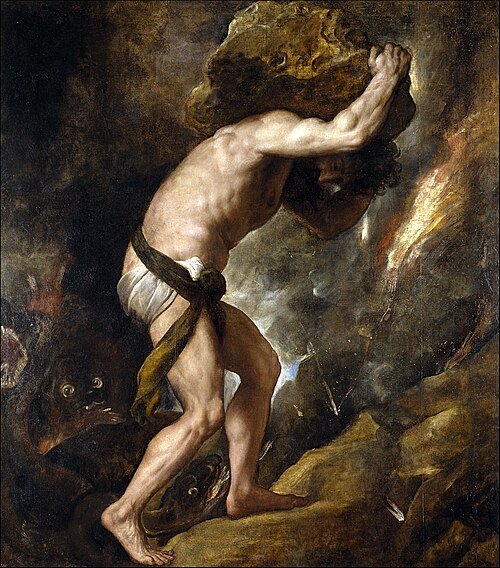
The punishment of Sisyphus is one of the most emblematic scenes of the ancient Underworld. In Hades, he was condemned to push a huge boulder toward the top of a steep hill. Each time, after unimaginable effort, he came close to completing his task, the boulder slipped from his hands and rolled back down to the base. Sisyphus had to begin again from the start, without rest, without progress, without end.
The Homeric description emphasizes physical exhaustion: sweat, strain, violent effort, and inevitable failure create an image of absolute torment. The punishment is not merely pain; it is frustration. Sisyphus is not tormented because he does not try, but precisely because he tries endlessly. His effort is superhuman, yet the result is always zero.
In the world of Greek mythology, punishments in Hades often reflect the crime of the punished person. Tantalus is tormented by the impossibility of eating and drinking, the Danaids fill a leaking jar, and Ixion spins bound to a wheel. Similarly, Sisyphus, who tried to overturn the natural and divine cycle, is condemned to a cycle of endless repetition.
Symbolism and Deeper Meaning of the Myth
The myth of Sisyphus is multi-level and therefore remains alive until today. At first level, it acts as a warning against the hybrid. Sisyphus is the mortal who believed he could fool them Olympian Gods, trap him Thanatos and indefinitely postpone his fate. His punishment shows that ancient Greek thought recognized limits to human activity, even when it relied on intelligence.
On a second level, the boulder of Sisyphus symbolizes repetitive human effort. Every person can recognize in the myth moments of working, struggling, hoping, failing, and beginning again. That is why the expression “Sisyphean task” is still used today to describe an extremely laborious, repetitive, and seemingly futile undertaking.
On a third level, the myth raises the issue of the relationship between knowledge and ethics. Sisyphus is neither weak nor foolish; he is excessively intelligent. His problem is that his intelligence is separated from moderation, justice, and respect for the order of the world. Thus, the myth does not condemn intelligence itself, but rather its arrogant and irresponsible use.
The myth of Sisyphus in philosophy and Albert Camus
In modern times, the myth of Sisyphus gained a new global dimension thanks to Albert Camus. In the philosophical essay «The Myth of Sisyphus», published in 1942, Camus used the ancient myth to develop the theory of irrational. For Camus, man seeks meaning in a world that offers no clear or absolute answers. This conflict between the human need for meaning and the silence of the world breeds the absurd.
In Camus’ thought, Sisyphus becomes the “absurd hero.” He knows his punishment, he knows that the boulder will fall again, and yet he continues. The moment when he descends the hill to take up the boulder again is, for Camus, a moment of consciousness. There is no illusion there, but a clear awareness of his fate. And precisely in that awareness lies his freedom.
Camus’ famous phrase, “One must imagine Sisyphus happy,” does not mean that his torment is pleasant. It means that human beings can find dignity and inner freedom even in a world without final justification. Revolt, persistence, and consciousness transform mechanical punishment into an act of human endurance.
Sisyphus in art and literature
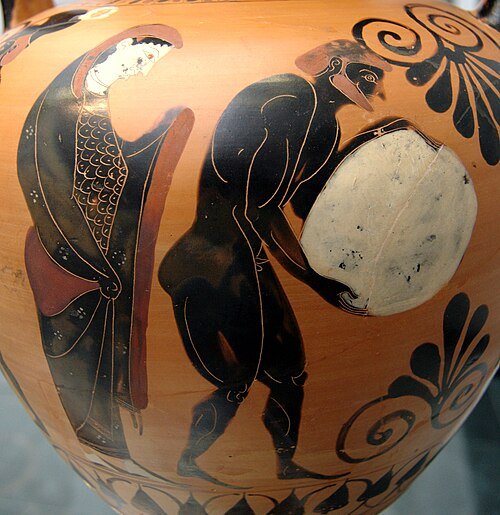
The figure of Sisyphus was depicted in ancient and modern art with particular intensity. In ancient vase painting, especially in black-figure and red-figure pottery, Sisyphus is often shown pushing his boulder, in a posture of exhaustion and anguish. The scene of his torment was immediately recognizable to ancient viewers, as were the punishments of other great sinners of Hades.
Pausanias mentions depictions of the Underworld, such as those connected with the great painting of Polygnotus, where figures of punished souls functioned as moral examples. In later European art, Sisyphus appears in works by painters such as Titian, while in the 19th and 20th centuries his image was used by artists interested in tragedy, human labor, and existential anguish.
In literature, the myth influenced poets, novelists, and essayists. Sisyphus appears as a symbol of the person who struggles against fate, the worker of repetition, the intellectual searching for meaning, and the human being who persists even when there will be no final victory.
The Modern Use of the Term “Sisyphean Task”
Today, the term “Sisyphean task” is widely used to describe any undertaking that requires immense effort but never seems to be completed. It may refer to everyday work, bureaucracy, politics, scientific research, social change, or even personal self-improvement.
In psychology and sociology, the myth is often used as a metaphor for the repetitiveness of human life, professional burnout, and the feeling of futility. In the modern workplace, where many people feel that they repeat the same efforts without meaningful progress, Sisyphus becomes an exceptionally relevant image.
However, the modern reading is not only pessimistic. The myth can also be interpreted as a hymn to persistence. Although Sisyphus fails again and again, he does not stop moving. His boulder is a burden, but also proof of ceaseless human action. Thus, the myth invites us to ask not only whether our work has an end, but also what attitude we maintain toward the effort itself.
Historical and religious context of the Underworld
To fully understand the punishment of Sisyphus, one must take into account the ancient Greek view of Hades. The Underworld was not merely a place of punishment, but the realm where the souls of the dead ended up. Its rulers were Hades and Persephone, while figures such as Hermes Psychopompus, Charon, and Cerberus were connected with the passage of souls.
Especially severe punishments were reserved for those who had committed crimes against divine order, hospitality, kinship, or the fundamental laws of the world. Sisyphus belongs to this category not simply because he was cunning, but because he disrupted the balance between life and death. His punishment, therefore, is theologically and morally consistent within the ancient Greek system of values.
Conclusion: why the myth of Sisyphus remains timeless
The myth of Sisyphus endures because it combines mythological power, moral depth, and philosophical relevance. Sisyphus is at once a king, a deceiver, a rebel, a transgressor, and a symbol of the human being who never stops struggling. His eternal punishment in Hades reminds us of the limits of human arrogance, but also of the power of persistence in the face of frustration.
From Homer to Camus, the boulder of Sisyphus changes meaning without losing its force. In antiquity, it was an exemplary divine punishment; in modern thought, it became a symbol of the absurd, freedom, and human dignity. Every age recognizes something of itself in Sisyphus: effort, failure, repetition, but also the possibility of continuing with awareness. That is why the myth of Sisyphus remains one of the most meaningful myths of Greek mythology and one of the strongest symbols of universal human experience.
FAQ
Who was Sisyphus in Greek Mythology?
Sisyphus was the mythical king of Ephyra, later Corinth, the son of Aeolus and husband of Merope. He was known for his extraordinary intelligence and cunning, but also for his hubris toward the gods. He is genealogically connected with important heroes, such as Bellerophon.
Why was Sisyphus punished?
Sisyphus was punished for deceiving the gods, revealed Zeus' secrets, framed Death and tried to avoid his fate. By his actions he disrupted natural and divine order, especially the boundary between life and death.
What was Sisyphus' punishment on Hades?
His punishment was to forever push a huge rock to the top of a hill. Every time he approached the top, the rock rolled down again, forcing him to start over. This image became a symbol of the vain and endless effort.
What does the expression “Sisyphean task” mean today?
A “Sisyphean task” means an exhausting, repetitive, and seemingly futile undertaking that never reaches a final result. It is used in many contexts, from daily work to social and political efforts that seem to begin again and again from the start.
How did Albert Camus interpret the myth of Sisyphus?
Albert Camus saw Sisyphus as a symbol of the man who lives in the absurd, namely in a world without guaranteed meaning. Nevertheless, Sisyphus continues his effort with full consciousness. For Camus, this conscious persistence is a form of freedom and dignity.
What are the basic ancient sources for the myth of Sisyphus?
The most important sources include Homer’s Odyssey, where his punishment in Hades is described, as well as references in Pindar, Apollodorus, and Pausanias. These sources preserve different aspects of the myth, from his genealogy and connection with Corinth to the causes of his divine punishment.