
Generic selectors
Exact matches only
Search in title
Search in content
Post Type Selectors
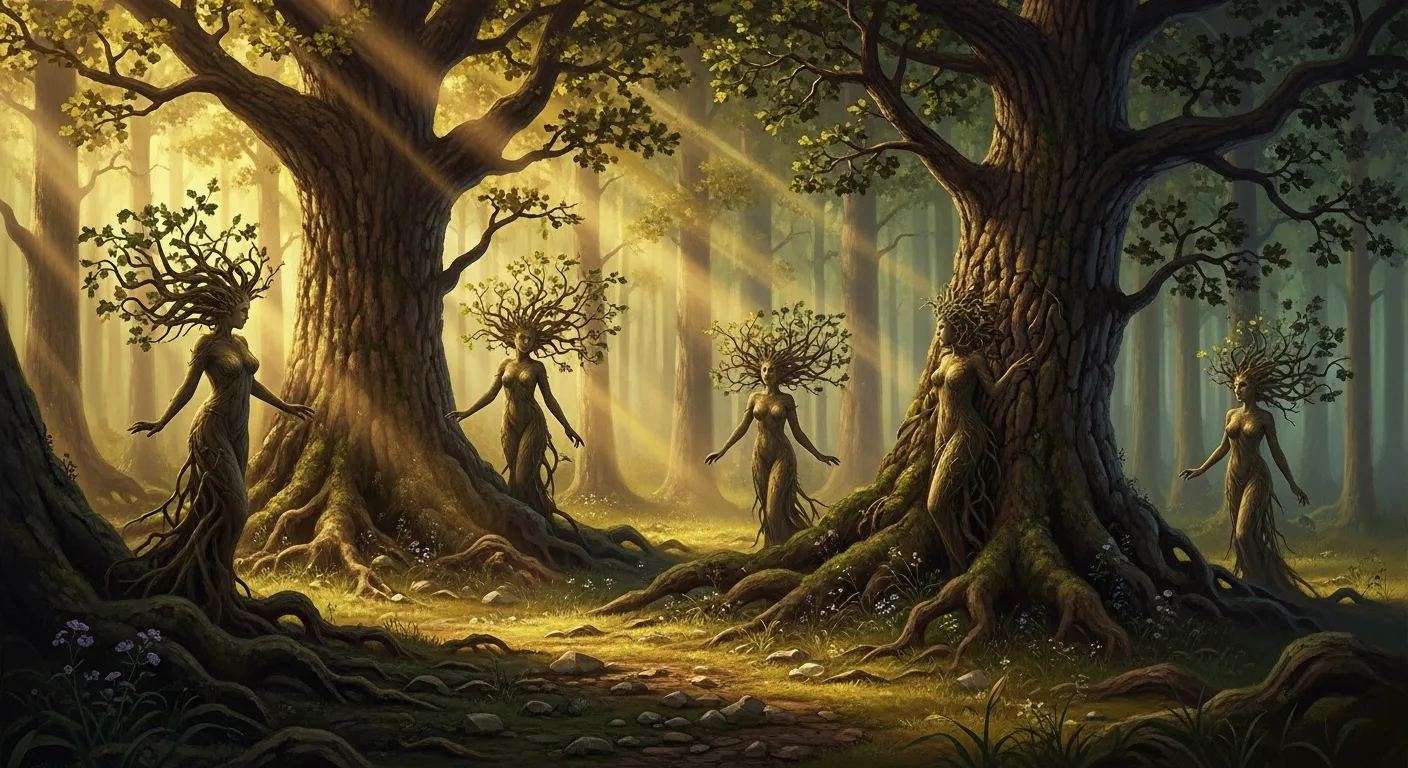
    Dryades, the nymphs of the trees of ancient Greek mythology, appear within a sacred forest with sun filtering through the leaves, with natural colors and magnificent atmosphere.

    Dry forest Nymphs

    1024 559 Greek Mythology – Gods, Heroes & Myths

      Dryads – Tree Nymphs in Greek Mythology

      The Dryads were nature nymphs in ancient Greek mythology and were considered spirits who lived in trees and forests. Their name comes from the word "δρῦς", meaning oak, as initially the Dryads were particularly associated with oak trees. Over time, however, the term was used more broadly to describe nymphs who lived in any type of tree.

      The Dryads belonged to the large family of Nymphs, the female spirits of nature associated with mountains, forests, rivers and springs. In Greek mythology, they often appear together with the Naiads, residing in the springs and rivers, and with Oreads, the nymphs of the mountains.

      The Nature and Origin of Dryades

      According to ancient Greek concepts, every large and old tree had its own spirit, a Dryad that resided in its trunk. The nymph was closely connected to her tree and was considered to share the same life as that.

      In some mythological traditions Dryads were considered the daughters of nature deities, such as Oceanus or GaiaOther sources say they were his daughters Zeus.

      Ancient writers describe Dryads as beautiful young women living in the woods. They were often depicted with hair in the color of leaves or tree bark and with a body that seemed to be an extension of nature itself.

      The Hamadryads

      A special category of Dryads were Hamadryads. Unlike other forest nymphs, the Hamadryads had a direct and absolute bond with a particular tree.

      The life of the nymph was inextricably linked to the life of the tree. If the tree was cut down or died, the Hamadryad who lived in it also died. This perception reinforced the sanctity of trees in ancient Greek society and served as a warning to those who destroyed nature.


      Dryads in religion and worship
      Dryades, the nymphs of the trees of ancient Greek mythology, appear within a sacred forest with sun filtering through the leaves, with natural colors and magnificent atmosphere.

      The Dryades did not have large temples or organized worship such as the Olympian gods. However, the ancient Greeks believed that they lived in holy grove, i.e. forests dedicated to deities.

      Sacred groves existed in many parts of Greece and were dedicated to gods such as Zeus, - Artemis and Pan.

      In these places it was considered sacrilege to cut a tree for no reason. People often left small offerings in nature, such as fruit, honey, or wreaths of flowers, believing that they honored the forest nymphs.


      Dragon - related myths

      Dryades appear in various myths, mostly as forest protectors.

      A typical example is the history of RiceKing of Thessaly. Erysichthon ordered that a sacred tree dedicated to Demeter. This tree was inhabited by a Dryad.

      The goddess punished the king with a terrible curse: an endless famine that could never be satisfied. This myth was used as a moral lesson in respect for nature.


      Dryades in ancient art and literature

      Dryades often appear in ancient Greek poetry and art. Poets and writers describe them as dancing in the woods or accompanying deities of nature.

      In the iconography of antiquity they are often depicted together with Dionysus and its sequence, but also in scenes related to the goddess Artemis.

      During the Hellenistic and Roman period their forms became particularly popular in sculptures, mosaics and murals.

      The symbolism of the Dryads

      The Dryades represent the idea that nature is alive and has spirit. In ancient Greek worldview forests were not considered merely natural spaces but places full of divine presence.

      Tree nymphs symbolized:

      • the vital force of nature

      • the fertility of the earth

      • the harmony between man and the natural environment

      Through the myths of Dryades the deep relationship of ancient Greeks with the landscape and the natural environment is expressed.


      Dryades in modern fiction

      The Dryade form continued to inspire literature and imagination in the younger times. In works of fiction, novels, and games, they are often presented as spirits of forests that protect trees and nature.

      Although modern depictions may differ, the basic idea remains the same: Dryades are forest guards and personify the very life of trees.

      Frequently Asked Questions About Dryads

      1. What are Dryads?

      Dryades are tree nymphs in ancient Greek mythology, spirits that inhabit the forests and protect the trees.

      2. Where does the word Dryada come from?

      The word comes from the word «Dr.» which means oak, as they were originally associated with these trees.

      3. Dryades are deities?

      No, they are not deities like Zeus or Artemis, but spirits of nature belonging to the Bridesmaid family.

      4. What's the difference between the Amads?

      Amads are Dryads that are tied to a particular tree. If the tree dies, Amadya dies.

      5. What color is their hair?

      According to the descriptions, their hair resembles leaves or branches, while their body is incorporated with the tree.

      6. Where do the Dryades live?

      They reside in forests, especially in sacred groves and old trees, where they are considered patrons of nature.

      7. What happens if you cut a tree with oak?

      According to mythology, if the tree is cut, Dryada dies. The Amads are directly connected to a particular tree.

      8. Do the Dryades have sisters or relatives?

      Yes, they belong to the wider family of the Bridesmaids along with the Naiades (nadiads of the waters) and the Mountains (mountain larvae).

      9. What do the Dryades symbolize?

      They symbolize the life of nature, the soul of trees and the connection of man and environment.

      10. Do they appear in familiar myths?

      Yes, for example in the myth of Erysichthon, who cut off a sacred tree and was punished with endless hunger.

      11. Do the Dryades have magical powers?

      They are not goddesses, but protect trees and can influence nature around them, e.g. heal or punish people.

      12. What do they have to do with the gods?

      At times they were considered the daughters of deities such as the Ocean or Gaia, while in other traditions they are the creations of nature.

      13. What role do they play in art?

      They are depicted in vases, sculptures, mosaics, and poems as beautiful women living in the woods.

      14. What do they have to do with Artemis and Pan's deities?

      They often appear in the groves and forests dedicated to these deities, protecting their natural environment.

      15. Dryades appear in modern imagination?

      Yes, in books, games, and fantasy films, often as guardians of forests and spirits of nature.

      16. Are there any male dragons?

      In Greek mythology Dryades are mainly referred to as female figures. But there are also male tree spirits in other traditions (e.g. Satyrians, Drypes).

      17. What gods honor the Dryads?

      Although they have no special worship, they are related to deities of nature such as Gaia, Demeter, Zeus and Artemis.

      18. Dryades are immortal?

      Their lives depend on their trees. If the tree dies, they die, too, unless they're more general oak trees without a tied tree.

      19. How were the Dryades protected?

      Ancient Greeks considered it sacred not to cut trees in the groves and left offerings such as fruits, honey or flowers to honor.

      20. What can we learn from the Dryades today?

      They remind us of the importance of nature, forest protection and harmony between man and the environment.

      Discover more Greek deities in our collection.

      How helpful was this post?

      Click on the stars to evaluate it!

      Average score 0 / 5. Vote count: 0

      There are no votes so far! Be the first to evaluate this post.

      Because you found this post useful. ..

      Follow us on social media!

      We are sorry that this post was not useful for you!

      Let us improve this post!

      Tell us how we can improve this post?