
The Sphinx in Greek Mythology: The Mystery Monster of Enigma
Sphinx is one of the most famous and enigmatic creatures of Greek mythology. Combining characteristics of man, lion, and bird, he embodied danger, wisdom, and mystery. Its reputation is mainly linked to the city of Thebes and its famous enigma, which placed the travelers passing through the area. Those who were unable to give the right answer lost their lives, which made the Sphinx a symbol of deadly knowledge and testing.
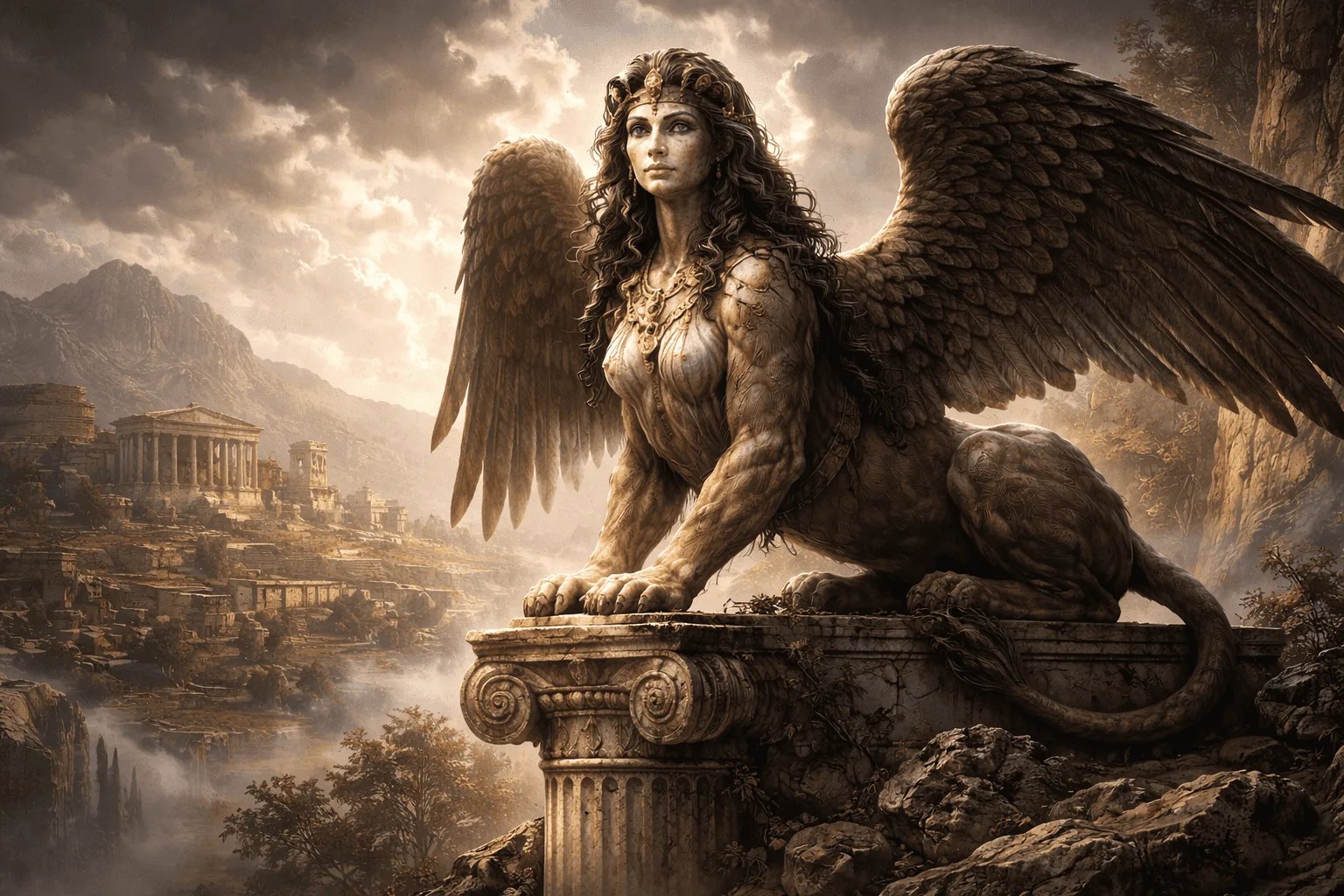
In Greek tradition, the Sphinx is described as a creature with a woman's head and chest, a lion's body, eagle's wings and, in some traditions, a snake's tail. Its form combined human and animal characteristics, highlighting its nature as a hybrid and supernatural being. Her appearance caused fear and awe, as she represented forces beyond the boundaries of the human world.
Most ancient writers say the Sphinx was his daughter Typhon and EchidnaTwo of the most terrible monsters of Greek mythology. From this genealogy come other mythical monsters, such as Cerberus, - Chimera and Lernaean HydraIts origin highlights its role as a creature of chaos and destruction that threatened divine and human order.
According to legend, the Sphinx was sent to Thebes as divine punishment. It settled on a rock near the city and prevented travellers from crossing. To allow them to pass, he set them a riddle. Whoever failed to solve it became her victim. In this way the Sphinx scattered fear and death, while the inhabitants of Thebes were unable to get rid of its threat.
The most famous riddle of the Sphinx was:
«Who is the creature who in the morning walks on four feet, at noon with two and at night with three?»
Many tried to answer, but no one made it. Finally, the Oedipus gave the right solution: man. In infancy she crawls on four, in adulthood she walks on two legs and old age uses bacteria, symbolically obtaining a third «foot».
Oedipus' success had decisive consequences. According to most versions of the myth, once the Sphinx heard the right answer, he realized that he had been defeated. Unable to withstand failure, he fell off the rock or committed suicide in another way. Thus Thebes was freed from the terrible threat that tortured her for years.
The history of the Sphinx and Oedipus has deep symbolism. The monster represents not only violence and death but also the knowledge to be conquered. Its enigma is considered a test of wisdom and self - knowledge, as the answer concerns the very nature of man and the stages of his life. In this sense, Oedipus’ victory was not merely physical but mainly spiritual.
The Sphinx also presents interesting differences in relation to its Egyptian counterpart. In ancient Egypt, the Sphinx was usually a male form with a lion body and king's head, associated with royal authority and protection. Instead, the Greek Sphinx was a female form and was associated with danger, riddles and death.
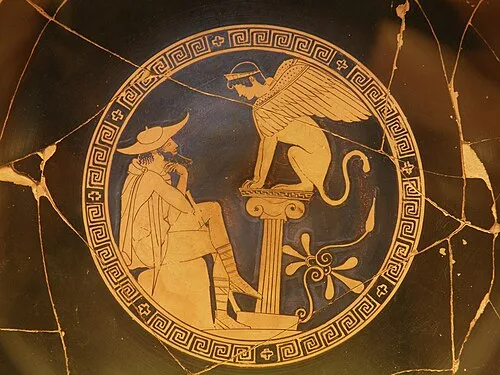
In ancient Greek art, the Sphinx often appears in vases, sculptures, burial monuments and architectural decorative elements. Her performances often served as deterrent symbols, while at the same time recalling the importance of wisdom toward the challenges of life.
The Sphinx remains to this day one of the most recognizable mythological creatures. Her name has become synonymous with mystery, riddles, and difficult questions that require deep thought. Through its myth, the ancient Greeks highlighted the power of knowledge and the importance of human intelligence against the most terrifying challenges.
- Sphinx is one of the most iconic and influential beings of Greek mythology. Unlike other mythical monsters incarnate raw violence or natural destruction, the Sphinx functions as Knowledge guard, tester of the human mind and carrier of moral and philosophical meaning. Her presence culminates in Thebaic cycle, through his myth Oedipus.
Etymology and Name
The word Sphinx/ Sphinx comes from the verb Clamp («I squeeze, I drown, I tighten»), suggesting:
the stifling nature of the riddle
the death of those who fail to answer
Names:
Greek: Sphinx/ Sphinx
Latin: Sphinx
English: Sphinx (Greek Sphinx)
Genealogy and Origin
Ancient sources do not entirely agree on the origin of the Sphinx. The most frequent versions present it as a child:
This origin incorporates the Sphinx into the circle of chthonic and hybrid beings, associated with chaos and the primary forces of nature.
Form and Natural Characteristics
The Greek Sphinx is depicted as a composite being:
body Lion
feathers Eagle
head and chest woman
Unlike the Egyptian sphinx (male and royal), the Greek Sphinx is:
female
aggressive
a fatal knowledge vector
The Myth of Sphinx and Oedipus
The Sphinx was sent (or installed) outside Thebes, punishing the city in the most peculiar way: via Question.
The Enigma
«What is the being who in the morning walks on four feet at noon with two and at night with three?»
Those who were unable to answer:
devoured
led to death
- Oedipus solved the riddle by answering:
«Man»
After the solution:
The Sphinx commits suicide or falls
Release Thebes
The tragic course of Oedipus begins
Role and Function in Myth
The Sphinx is not just an obstacle· acts as:
initiation test
limit between ignorance and knowledge
a prophet of tragic irony
The success of Oedipus does not save him eventually, but leads him to fulfill his destiny.
Symbolism and Philosophical Interpretation
The Sphinx symbolizes:
knowledge that kills when not understood
the power of reason
passing from childhood to maturity
Philosophy:
Incarnates the enigma of human existence
acts as a symbol of self-knowledge
The Sphinx is not killed with guns, but with thought.
Comparative Mythology
Egypt: King protectors' tights
Greece: Sphinx as a vigilante and examiner
Near East: hybrid beings– guards
The Greek Sphinx stands out for mental dimension of the threat.
The Sphinx in Art
Attiki vases (6th–5th century BC)
Grave tomb sculptors
Roman mosaics
Often depicted:
sitting in column
waiting stop
as a border guard (life–death)
Educational Adaptation
Primary
The Sphinx as a creature with a question–trap
The Value of Thought
High school
Analysis of the riddle
Connection with the myth of Oedipus
lyceum
Symbolic and psychological interpretation
Connection with tragedy and fate
Ancient Sources
Sophocles, Oedipus Tyrannus
Apollodorus, Library
Commentators and lexicographers
Conclusion
- Sphinx is a unique example of a mythical being where the knowledge is weapon And the riddle determines fate. It is not just death, it is the limit of human understanding. Her study illuminates the core of ancient Greek thought: the search for meaning through reason.
Bibliography
Ancient Sources
- Hesiod, Theogony.
- Apollodorus, Library.
- Sophocles, Oedipus Tyrannus.
- Pausanias, Greece Tour.
- Young man, Fabulae.
Modern Bibliography
- Grimal, Pierre. The Dictionary of Classical MythologyBlackwell Publishing, 1996.
- Hard, Robin. The Routledge Handbook of Greek MythologyRoutledge, 2004.
- Buxton, Richard. The Complete World of Greek MythologyThames & Hudson, 2004.
- Morford, Mark & Lenardon, Robert. Classical Mythology. Oxford University Press, 2018.
- Kerenyi, Karl. The Heroes of the GreeksThames & Hudson, 1997.
- Gantz, Timothy. Early Greek Myth: A Guide to Literature and Artistic SourcesJohns Hopkins University Press, 1993.