
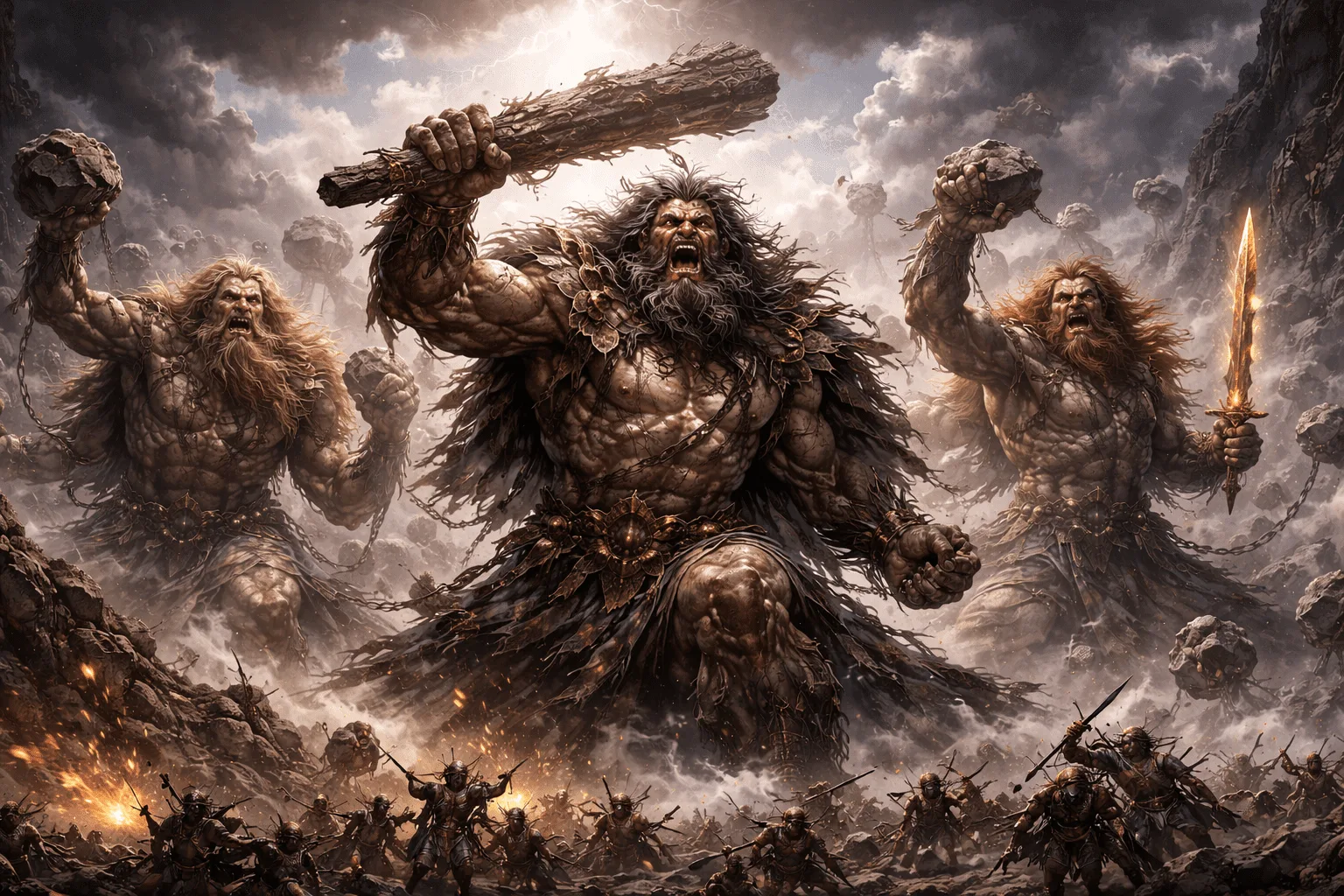
Giants: Her mighty beings Giant combat is one of the most impressive themes of Greek mythology. Giants were not just huge creatures with supernatural power· were forms deeply linked to the Gaia, the primitive earth, and with the great cosmic conflicts that shaped the order of the world.
In the tradition of ancient Greeks, Gigantomachy, i.e. the battle between the Giants and the Olympian gods, was a symbol of the final prevalence of divine order against the uncontrolled forces of chaos. It is a myth with many variations, which appears in literary sources, such as Hesiod and the Apollodorus, but also in works of art, from angiography to the famous altar of Pergamos.
Searching around the subject «Giant Greek mythology» leads to a rich world where cosmogony, religion, art and symbolism coexist. The figures of Alcyone, Porphyrion, Enceladu and other Giants are not merely mythical monsters, but bearers of ideas about nature, violence, resistance and the establishment of divine power.
Who were the Giants?
Their origins from Gaia
Giants were considered her children GaiaThe primal deity who personified the Earth. Gaia is central to Greek cosmogony, as many of the first divine generations were born or came from it: Uranus, the Mountains, the Point, the Titans, the Cyclops and Hecatoncheires.
The birth of the Giants is linked to one of the most violent moments of Theogeny. It is not an ordinary birth of divine beings, but a result of blood, land and vengeance. Giants appear as children of a secular wound, which explains their violent character in later myths.
Gaia, according to several traditions, did not stand neutral against the conflict of her children with the Olympian gods. Rather, it is often presented as a force that motivates resistance against Zeus, especially after the defeat of the Titans and their confinement in Tartara.
Their connection to the blood of Uranus after his castration by Cronus
Hesiod, in Theogonia, relates that Cronus He castrated his father, Uranos, with a scythe given to him by Gaia. From the blood of Heaven that fell on Earth were born the Erinyes, the Melies Nymphs And the Giants. This ancestry places them in the earliest phase of mythical history, before the full prevalence of the Olympian gods.
This detail is important because Giants are not mere mortals or just monsters. They have divine or semi-divine origins, born of the blood of Heaven and Gaia's fertilizing force. In other words, they are creatures of cosmic creation itself.
Their bloody birth presupposes their future conflict with heavenly authority. As they were born of violence between Heaven and Saturn, they themselves will become involved in a new violent confrontation with Zeus and the gods of Olympus.
Their appearance and special characteristics
In earlier written sources, Giants are described primarily as powerful warriors, not necessarily as monstrous beings. Hesiod reports that they were born brilliant in arms, holding long spears. This image presents them as a war generation, ready for conflict.
In art, however, their form evolved. From the archaic and classical period they are often depicted as large men with helmets, shields and spears. Later, especially in Hellenistic art, they acquire more monstrous characteristics, such as snakes instead of legs, wild hair and expressions of rage.
The snake-shaped end of their feet does not always appear in the earliest traditions, but became very popular in art. The snake, associated with the earth and the underworld, emphasized the ethnonic nature of the Giants and their deep relationship with the primary forces of nature.
The nature and powers of Giants
Supernatural force
Giants were famous for their supernatural power. They could hurl rocks, uproot trees and threaten the gods themselves. In Giant Battle they are presented as opponents worthy of the Olympian gods, which shows the size of their power.
Their power was not only physical. They had symbolic weight: they represented the raw violence of nature, the momentum ahead of order and law. Their world is a world of conflict, exaggeration and threat.
- AlcyoneFor example, he was considered one of the strongest Giants. THE Apollodorus says he was immortal while fighting on the earth where he was born. This quality made him almost invincible and explains why he needed his surgery Hercules In a special way.
Relationship with the elements of nature
Giants are closely associated with the elements of nature: earth, fire, earthquakes, mountains and volcanic eruptions. Their very birth from Gaia makes them enthroned beings, that is, forces emanating from the depths of the earth.
Many myths explained natural phenomena through the fate of the Giants. A Giant buried under an island or mountain could, in ancient imagination, cause earthquakes when moving or volcanic activity when breathing fire and smoke.
Enceladus, for example, was strongly associated with earthquakes. Tradition wanted Athena to overwhelm him with Sicily or with another large piece of land. Thus, earthquakes could be interpreted as movements of the defeated Giant under the earth.
Immortality and weaknesses according to myths
The Giants were not immortal in the same way as the Olympian gods. According to Apollodorus, the gods learned that they could not kill them alone· He needed the help of a mortal. This mortal was Hercules, son of Zeus and Alcmene.
Hercules' need to participate is one of the most interesting elements of the Giant Battle. It shows that the victory of the divine order was not self - evident. Even Zeus, the ruler of the gods, had to work with a hero who united divine descent and human mortality.
Some Giants had specific weaknesses. Alcyoneus could not die as long as he remained on his native soil. That is why Hercules, after wounding him, dragged him away from the source of his strength so that he could kill him.
The Gigantomachy
Why did the crash go off?
The Gigantomachy broke out as a result of the deep-seated rivalry between Gaia and Zeus. After the Titanomachy, Zeus had imprisoned the Titans in Tartarus. Gaia, mother of the Titans and the Giants, was enraged by the fate of her children and gave birth to or incited the Giants against the Olympian gods.
This conflict was not just a war for power. It was a cosmic crisis. The Olympian gods represented the new order of the world, with Zeus at the top. The Giants, on the contrary, expressed the Earth's oldest, fierce and unstable force.
According to Apollodorus, the Giants attacked the sky by hurling rocks and flaming oaks. The image is terrible: the earth rises against heaven, and the world is threatened to return to chaos.
The Most Notable Giants
- Alcyone He was one of the most awesome Giants. According to Apollodorus, he was immortal as long as he remained in the land of his birth, usually associated with Pallene or Flerra. Hercules hit him with his arrows and, with Athena's advice, dragged him out of his homeland to kill him.
- Porphyria is often considered the strongest or chief Giant. He attacked Hercules and Hera, while Zeus struck him with lightning and Hercules finished him with his arrows. Porphyrion's form symbolizes the climax of the arrogant challenge against divine authority.
- Enceladus is known for its connection to earthquakes. Athena pursued him and overwhelmed him with a large volume of land. In later traditions, his body under Etna or Sicily explained seismic and volcanic activity.
- Polybot He faced Neptune. The god of the sea, according to tradition, took part of Kos or other piece of land and threw it upon him, creating Nisyros. The myth thus connects the Giant Battle to the Aegean landscape.
- Nightmare appears in certain traditions as a Giant or giant-like rival of the gods. Apollodorus is reported to have been struck in the eyes by Apollo and Hercules. It must, however, be distinguished by the Nightmare of the Aloes, although traditions often overlap.
- EggOr Otto, he is known primarily as one of the Aloes, along with the Nightmare. The Aloeas tried to siege the sky by putting Ossa on Olympus and Pelion on Ossa. Although they do not always belong to the main list of Giants of Giants of Giants, their tradition often treated them as related forms of giant hybrid.
The gods against the Giants
The role of Zeus
- Zeus He was the main leader of the Olympian gods in the Giant Battle. With his lightning, symbol of divine domination and secular order, he beat the Giants and coordinated the defense of Olympus.
Zeus's presence is decisive, but not sufficient in itself. The myth insists that the gods needed a mortal ally, Hercules. Thus, Zeus does not appear merely as an all - powerful monarch, but as a ruler who knows how to use alliances and prophetic knowledge.
Zeus's lightning often opens the way for Hercules' final blow. This seems characteristic in the defeat of Porphyrion, where divine power and heroic intervention work together.
Athena’s participation
- Athena He holds a prominent position in the Giant Battle. As a goddess of wisdom, strategy, and organized warfare, it represents the intelligent force against the anarchous violence of the Giants.
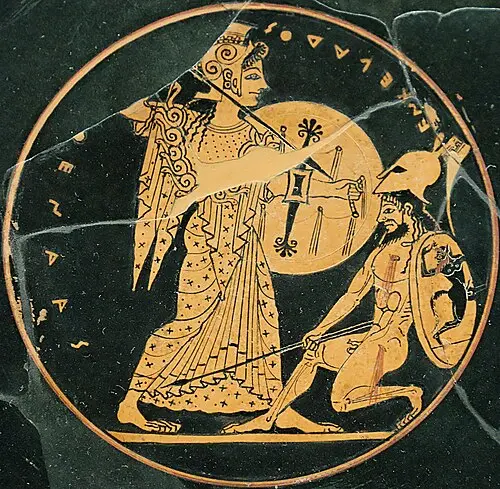
According to Apollodorus, Athena advised Hercules to remove Alkyonea from his birthday land. This detail is characteristic: victory is achieved not only with power but also with knowledge of the limits and weaknesses of the opponent.
Athena is also associated with the defeat of Enceladus and Pallanda. In some traditions, after killing Pallanda, he used his skin as a shield or protective cover. This image highlights its war power and ability to turn enemy power into a class weapon.
Hercules' contribution
Hercules was necessary for the victory of the gods. Though mortal, he was of divine descent as the son of Zeus. His position between the world of men and gods made him a unique ally in the Giant Battle.
Apollodorus says there was an oracle according to which the Giants could not be killed by the gods without the help of a mortal. Hercules fulfilled that condition. With his arrows, often soaked with the poison of Lernaia Hydra, he finished giants already affected by divine weapons.
Hercules' contribution shows the value of the hero in Greek mythology. He is not just an assistant to the gods, but a necessary factor in restoring secular balance.
The remaining Olympian gods
Many Olympian gods participated in the Giant Battle. THE Poseidon He fought Polybotes, using the power of the sea and the earth. THE Apollo He hit Nightmare, while Artemis participated in certain traditions against other Giants.
- Hermes, wearing his hound HadesI mean, the helmet that gave away invisibility killed Hippolytus. THE Hephaestus, with his inflamed weapons, face him Clytium or other opponents; Dionysus appears in visual performances fighting with thyrsus or with help satyr and animals.
The participation of all gods shows that the Giant Fight was a collective case of Olympus. It was not only about Jupiter's personal sovereignty, it was about maintaining the entire divine and secular order.
The Most Important Battles of the Gigantomachy
The most important conflicts of Giant combat They revolve around the great Giants and their divine opponents. The battle of Alkyonea with Hercules is one of the most famous. The hero wounded him with his arrows, but the Giant was regaining his power as he stepped on his land. With Athena's advice, Hercules dragged him out of his territory and killed him.
The battle with Porphyrion was also decisive. Porphyrion attacked with fury, and Zeus, according to the myth, stirred up a desire for Hera within him in order to distract him. He then struck him with a thunderbolt, while Hercules finished him off. This scene combines strategy, divine intervention, and heroic violence.
Enceladus was defeated by Athena, who overwhelmed him with a huge volume of land. This battle remained alive in ancient imagination, because it was associated with earthquakes and volcanoes. Any turbulence of the earth could be considered a sign of the wrath or movement of the buried Giant.
Polybotis was pursued by Poseidon into the sea. God seized a piece of land and hurled it at him. The tradition of Nisyros as an island created by this fact shows how myths explained geological characteristics of the Greek area.
The Nightmare, in one tradition, was struck by two sides: Apollo in one eye and Hercules in the other. The double attack again underlines that divine power and human-heroic involvement had to be united in order to achieve victory.
Other Giants had corresponding squadrons: Mimas was struck by Hephaestus or Mars, Pallas by Athena, Hippolytus by Mercury, Gration by Artemis and Thaon by the Moirs or other divine forces, depending on the variation.
What happened after the Giant Battle?
The defeat of the Giants
After hard fighting, the Giants were defeated. The Giant Battle resulted in the final prevalence of the Olympian gods and the strengthening of Zeus' power. This victory acts as a continuation of Titanic fighting: first Titans and then Giants submit to the new divine order.
The defeat of the Giants did not mean simply extinction. In mythical thought, primal forces are rarely completely lost. Instead, they are limited, buried or transformed into natural phenomena.
Thus, the Giants remained present in people’s imagination as forces trapped under the earth, always capable of reminding themselves of their original power.
Their burial under mountains and islands
Many Giants were thought to be buried under mountains, islands or large rocks. Enceladus under Sicily or Etna, the Polybotes under Nisyros, others under mountain volumes or volcanic areas.
These traditions explained the landscape morphology. An island, a mountain or a volcanic peak could be considered the weight that held a Giant immobilized. The mythology functioned as a way of interpreting the natural world.
Pausanias, traveling in the Greek area, mentions local traditions linking places with giant forms and ancient battles. These accounts show how deep the Giants had taken root in the memory of cities and regions.
The connection with volcanoes and earthquakes in ancient tradition
Ancient Greeks often associated volcanoes and earthquakes with underground divine or monstrous forces. Giants, as Gaia’s children, were ideal figures to explain such phenomena.
Etna, with her fire and smoke, was associated not only with Giants but also with Typhon in other traditions. This coating shows that the ancients did not always have a single mythological system, but many local and poetic versions.
The idea of a huge body moving under the earth gave a mythical form to the earthquake. Enceladus became so characteristic of it that his name is even today used metaphorically for seismic activity.
Giants and Titans: what is the difference?
Giants and Titans are often confused, but in Greek mythology they are different categories of beings. Titans are an older divine generation, children of Gaia and Heaven. Among them are Saturn, Rea, Ocean, Tethys, Themis, Monument, Hyperion, and others.
The Giants, instead, were born of the blood of Heaven that fell into Gaia after its castration by Saturn. They are related to the primal divine powers, but they are not the same generation as the Titans.
Their role also differs. The Titans ruled the world before the Olympian gods and were defeated in Titan fighting. Giants never ruled· appear mainly as a revolutionary force attempting to overthrow Jupiter's power after its establishment.
As for forces, Titans are more secular and divine forms, associated with time, memory, justice, heaven and sea. Giants are more wary, chthonic, and violent forms, associated with the earth, mountains, and natural turmoil.
In cosmogony, then, the Titans belong to a pre-aligned divine order, while the Giants represent a rebellion of the Earth against Olympic domination.
Giants in Ancient Greek Art
Angiogram
Giant combat was a favorite theme of ancient Greek angiography. In black-shaped and red-figure vases, Giants are depicted fighting with gods, holding shields, spears, stones or flaming logs.
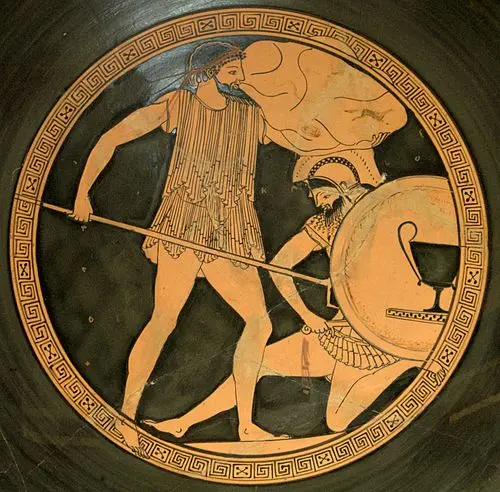
In earlier performances they often resemble gunmen. This choice made the myth more familiar to the city-state public, as the mythical battle was presented with images reminiscent of real war.
Over time, artists highlighted their monstrous nature more. Snake legs, intense movements and expressions of pain became common features, especially in later periods.
Sculpture
In sculpture, Giantfighting offered an ideal theme for depicting tension, movement and heroic conflict. Temples and public monuments used the myth to declare the victory of order, city and culture against disorder.
The choice of the subject was not only aesthetic. On a political and religious level, Giantfighting could act as an allegory of the victory of the Greeks over external enemies or the victory of the law against lawlessness.
The forms of Giants allowed sculptors to experiment with dynamic attitudes, muscle tension and dramatic expressions, elements that culminated in Hellenistic art.
The famous relief of the Giant Battle at the Temple of Pergamum
The most famous artistic ensemble on the subject of Gigant wrestling is the great relief of the Pergamos altar, a work of the Hellenistic period. There, the Olympian gods fight with the Giants in a scene full of intensity, passion and theatricality.
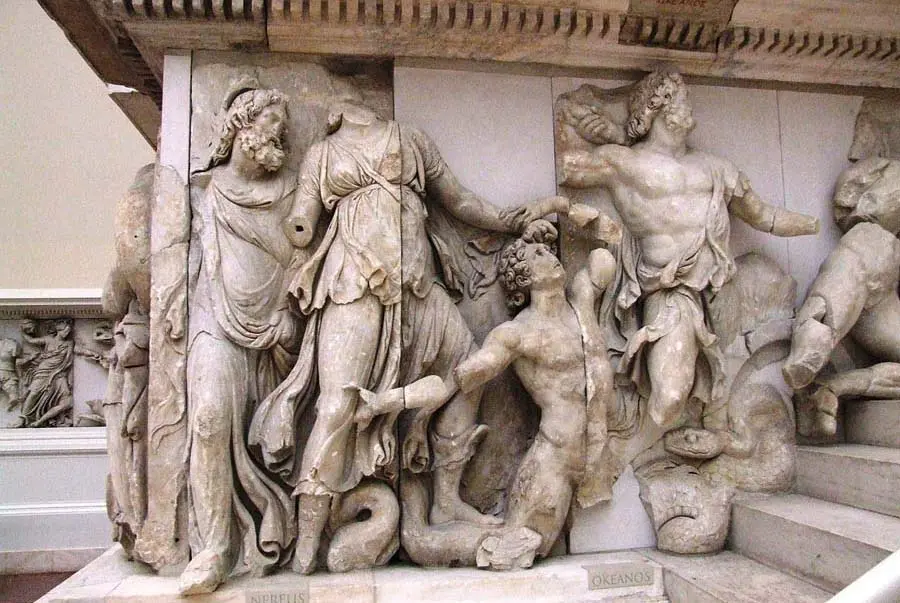
Giants are presented with strong bodies, often with snake legs, in attitudes of desperate resistance. The gods, on the contrary, appear sovereign, although the battle is rendered with great dramatic balance.
The relief is not just decoration. It reflects the ideology of the rulers of Pergamum, who wanted to present their authority as a force of culture and order against threatening forces. The Giant Battle thus became a political and artistic symbol.
Symbolism of Giants
The Giants symbolized for ancient Greeks the raw power, exaggeration and threat of disorderly nature. It is no coincidence that they are born of Gaia, but turn against heaven and the gods that organize the world.
Giant combat expressed the victory of order over chaos. Olympian gods do not win simply because they are stronger· They win because they represent a world with laws, hierarchy, measure and stability.
At the same time, the myth warned about the hybrid. Giants attempt to transcend the boundaries that separate the earth from heaven and lower beings from the gods. Their defeat shows that countless violence and arrogance lead to destruction.
However, Giants are not just «Bad»They are children of the Earth, carriers of a primal force that exists within the world. Their defeat does not eliminate nature, but integrates it into a new cosmic balance.
Giants in modern culture
Giants continue to inspire modern culture. In fictional literature, comic books, cinema, and video games, they often appear as huge creatures with terrifying power, sometimes enemies of heroes and sometimes ancient races with their own wisdom or tragic fate.
The Greek Giant Battle has influenced particularly works that present battles between gods and primal forces. The pattern of divine order threatened by ethnian opponents is extremely durable and appears in many modern accounts.
In video games inspired by Greek mythology, Giants often appear as powerful opponents or ancient beings associated with destructive natural phenomena. Their image draws both from ancient sources and from Hellenistic art, particularly their snake-shaped and monstrous form.
In cinema and popular imagination, Giants are often confused with Titans, Cyclops, or other huge beings. Although this is not mythologically accurate, it shows how powerful the idea of the giant creature that questions the authority of the gods remains.
Conclusion
Giants are one of the most dynamic and symbolically charged groups of beings in Greek mythology. Born from Gaia and the blood of Heaven, they are associated with primal violence, land, mountains, earthquakes and forces that precede the organized order.
Giant combat is not just a spectacular battle. It is a myth for the establishment of secular balance, for the cooperation of gods and heroes, for the boundaries of power and for the confrontation between order and chaos.
Forms such as Alkyoneus, Porphyrion, Enceladus and Polybotes retained their place in literature, art, and memory of humans. From Hesiod and Apollodorus to the altar of Pergamum and modern fictional culture, the Giants remain a living symbol of the awe caused by the raw power of nature.
FAQ
Who were the Giants in Greek mythology?
The Giants were powerful mythical beings, children of Gaia, born of the blood of Heaven when Saturn castrated him. According to Hesiod, they appear as war figures, armed with spears. In later traditions and art they are often presented as huge, terrible creatures, sometimes with snakes instead of legs. Their most important myth is Giant Fight, their great battle against the Olympian gods.
What's the difference between Giants and Titans?
Titans are an older divine generation, children of Gaia and Heaven, and ruled the world before the Olympian gods. The Giants were later born of the blood of Heaven that fell to Earth. The Titans are associated with the pre-alypia secular order and were defeated in Titan fighting, while the Giants are mainly associated with the rebellion against Zeus in the Giantfight. The two groups are related to their ethnonian and primordial origins, but are not identified.
Who beat the Giants?
The Giants were defeated by the Olympian gods led by Zeus, but their victory only became possible thanks to Hercules' participation. According to Apollodorus, there was an oracle that the Giants could not be killed by gods without the help of a mortal. Hercules, as a mortal hero of divine descent, fulfilled this term and finished many Giants with his arrows.
What was Giant Fight?
Giant combat was the great mythical conflict between the Giants and the Olympian gods. It broke out when Gaia, angry at the defeat and imprisonment of the Titans, instigated the Giants against Zeus. The battle symbolized the confrontation between the wild, chthonic forces of nature and the new divine order of Olympus.
Who was the strongest Giant?
Often as a stronger Giant Porphyrion is referred to, who is presented as a chief figure of the uprising and rival of Zeus and Hercules. Also awesome was Alkyoneus, because he was immortal while on the land where he was born. Tradition does not always give a single answer, but these two are considered to be the most dangerous Giants of Giants of Giants.
Why was Hercules necessary for the victory of the gods?
Hercules was necessary because, according to the oracle mentioned by Apollodorus, the Giants could not be killed only by gods. A mortal had to participate. Hercules, although son of Zeus, was mortal by his mother, Alcmene. So he could fulfill the oracle. With his arrows and the help of gods such as Athena and Zeus, he contributed decisively to the final defeat of the Giants.
Sources and Bibliography
Hesiod, Theogonia, especially the lyrics referring to the birth of the Giants from the blood of Heaven.
Apollodoros, Library, 1st 6, 1–2, basic ancient source for the Giants, the most important Giants and the participation of Hercules.
Pausanias, Greece Tour, references to local traditions, sacred works of art and memories associated with Giants and mythical battles.
Pindar, Pythionics and other songs, where hints appear in giant and secular conflicts.
Apollonius Rodius, Argonautian, for traditions linking mythical beings and primordial forces to geographical sites.
Karl Kerényi, The Gods of the Greeks, modern study of the deities and primal forms of Greek mythology.
Walter Burkert, Greek Religion, basic work on religious thought and myths of ancient Greeks.
Timothy Gantz, Early Greek Myth: A Guide to Literary and Artistic Sources, a detailed contemporary study of ancient sources and visual traditions.
Lexicon Iconographicum Mythologiae Classicae (LIMC), articles on Giants, Giants and related iconographic traditions.