
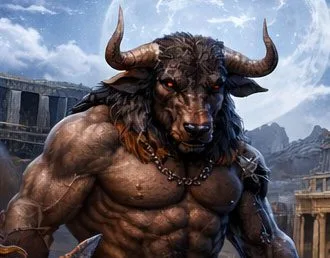
- Minotaur is one of the most iconic monsters of Greek mythology and is inextricably associated with Crete, King Minos and LabyrinthHis form embodies the conflict between the human and the animal element, but also the consequences of the hybrid towards the gods.
Minotaur is one of the most famous and terrifying creatures of Greek mythology. With a human body and a bull's head, this mythical monster was inextricably associated with her Labyrinth KnossosKing Minos and the hero TheseusIts history is one of the most famous myths of antiquity and symbolizes the conflict between culture and barbarity, reason and instinct.
The legend of Minotaur is not just a story about a monster. It reflects religious traditions, political relations between Athens and Crete, as well as deeper symbols that employed philosophers, historians and artists for more than two thousand years.
The birth of Minotaur
The history of Minotaur begins with King Minos of Crete. According to legend, Minos asked God Poseidon send him a sign that would prove his right to rule the island. God responded by sending from the sea a beautiful white bull.
Minos had promised to sacrifice the bull in Poseidon's honor, but he was so impressed by the beauty of the animal that he decided to keep it. The breach of his promise caused the wrath of God.
As punishment, Poseidon made Minos' wife, Pasiphae, madly fall in love with the bull. With the help of the craftsman Daedalus, Pasifae managed to approach the animal and from this strange union was born the Minotaur.
His real name was Stars, but he became known as Minotaur, i.e. «the bull of Minos».
The Labyrinth of Knossos
As the Minotaur grew, he became increasingly dangerous. His power was enormous and his thirst for human flesh caused fear throughout Crete.
To protect his kingdom, Minos commanded him Daedalus to build a huge and complex Labyrinth under the palace of Knossos. There the monster was imprisoned, unable to find the exit.
Labyrinth became one of the most famous symbols of Greek mythology and was associated with mysteries, wandering and searching for truth.
The blood tax of Athens
After the death of his son Minos, Androgeos, relations between Athens and Crete deteriorated. Minos defeated the Athenians and imposed a hard tribute.
Every nine years, Athens had to send seven young people and seven young people to Crete. The unfortunate young men were led to the Labyrinth and became victims of the Minotaur.
This myth probably reflects memories of the power exercised by Minoan culture in the Aegean during the second millennium BC.
Theseus and Ariadne
The fate of Minotaur changed when Theseus, Prince of Athens, decided to volunteer in the mission to Crete.
When he arrived on the island, he met Ariadne, the daughter of Minos. The young princess fell in love with him and decided to help him. He gave him a bundle of thread, known as «Ariadne mitt»So he can find the exit from the Labyrinth after the encounter with the monster.
The Killing of Minotaur
Theseus entered the Labyrinth and faced the Minotaur. Ancient sources differ as to the details of the battle, but all agree that the hero managed to kill the monster with its power and intelligence.
Using the mito of Ariadne, he found the way back and freed the young people of Athens. The death of Minotaur ended the blood tax and Athens was relieved of Cretan rule.
The symbolism of Minotaur
Minotaur is one of the most multi-symbolic creatures of Greek mythology. Half his human and half animal body symbolizes the conflict between reason and primitive instincts.
Labyrinth represents the course of man within the difficulties of life, while Theseus symbolizes the power of knowledge, courage and self-control. The hero's victory over the monster expresses the prevalence of culture and order over chaos.
The legacy of Minotaur
Minotaur's form has inspired countless works of art, literature and cinema. From ancient vessels to modern fantasy worlds, it remains one of the most recognizable mythological creatures.
His myth continues to excite, because it combines adventure, tragedy, heroism and deep symbolism. Minotaur is not just a monster; he is a timeless image of the dark powers that man is called upon to face both in the world and within himself.
Origin & Genealogy
Minotaur was born as a result of divine punishment:
- Poseidon He sent a sacred bull to Minos
Minos did not sacrifice him as he ought
- PasiphaeMinos' wife fell in love with the bull
From this union was born Minotaur
His birth is a direct consequence of Human arrogance.
Format & Show
Human body
Head of bull
Huge physical strength
Wild, uncontrolled behaviour
His form symbolizes the prevalence of instinct over reason.
The Labyrinth
To limit the Minotaur:
The Daedalus He built the famous Labyrinth
an architectural miracle without exit
symbol of confusion, fear and confinement
Labyrinth reflects the human mind when dominated by passions.
Powers & Skills
Superhuman physical force
Pain resistance
Murderous instincts
Terror that paralyzes opponents
The Myth of Theseus
Athens paid a heavy blood tax:
seven young people and seven young people sent to Crete
- Theseus, with the help of Ariadne:
use the thread
He found his way
and killed Minotaur
Victory symbolizes the prevalence of violent logic.
Symbol & Interpretation
The Minotaur symbolizes:
uncontrollable instincts
the dark side of power
the consequences of the hybrid
He's a monster. created by human errorsNot by nature.
Ancient Sources
- Library, 3.1–4.
- Lives Parallel.
- Transfigurations, Book VIII.
- Praise, Book VI.
- Tour of Greece.
Modern Bibliography
- The Greek Myths.
- Early Greek Myth.
- The Complete World of Greek Mythology.
- The Routledge Handbook of Greek Mythology.
- Dictionary of Classical Mythology.