
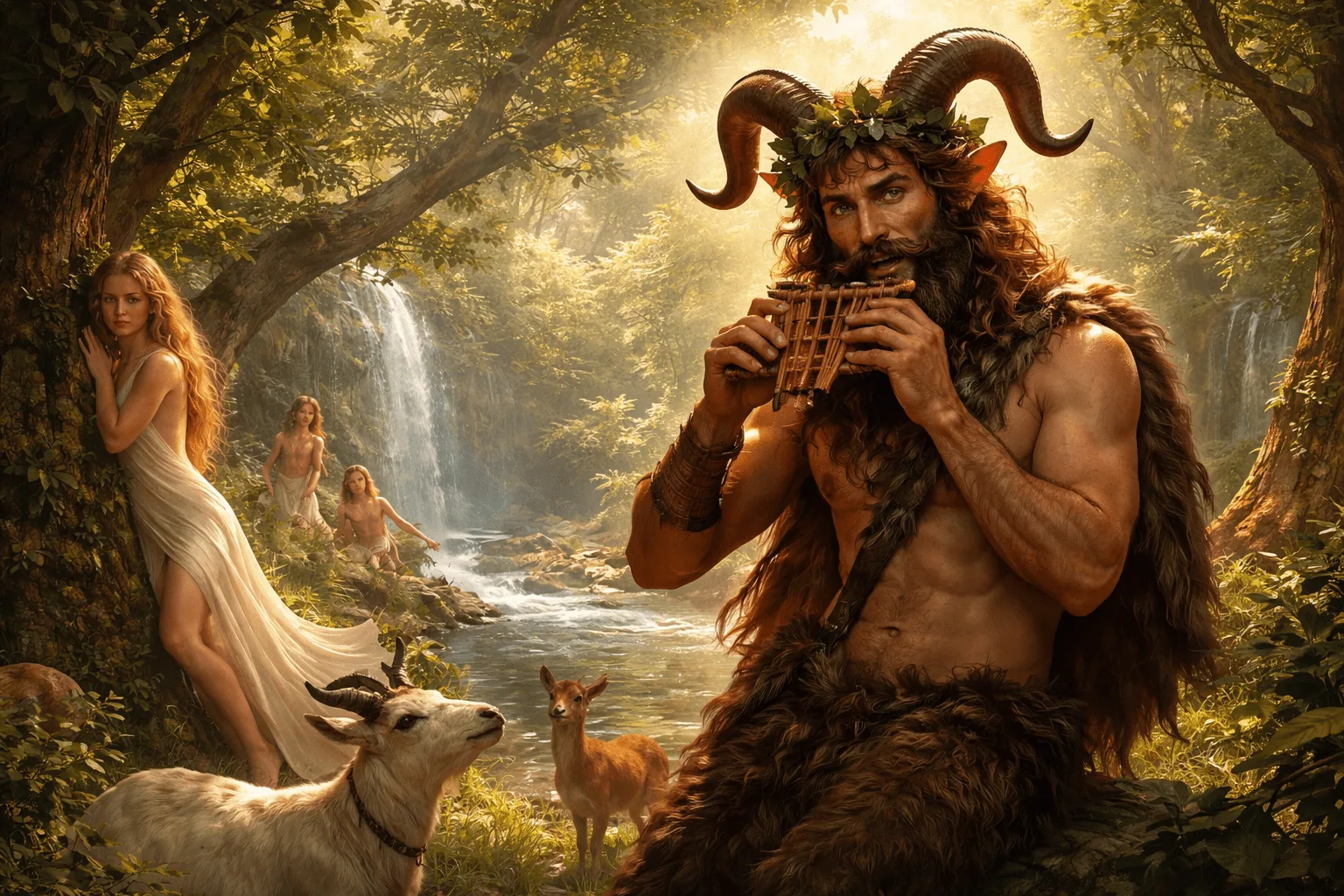
Pan is one of the most special and recognized deities of Greek mythology. God of shepherds, herds, mountains, forests and wildlife, was closely associated with the countryside and life away from cities. His form, half man and half goat, makes him one of the most characteristic deities of the ancient Greek pantheon. Despite his animal appearance, Pan was not a malicious god; instead, he was considered a patron of shepherds and a symbol of fertility, music and natural harmony.
The Origins of Panos
Ancient sources disagree on the origin of the Panos. The prevailing tradition presents him as the son of God Hermes and nymphDruippis. According to legend, when he was born, he had horns, beard, tail, and goat legs. His strange appearance frightened his mother, who abandoned the newborn child. But Mercury took it to Olympus, where the gods entertained so much with his appearance that they named him Pan, because he thanked «panda» The gods.
Other traditions mention different parents, indicating that the worship of Panos had deep and local roots before it was incorporated into the wider Greek religion.
Its form and characteristics
Pan was depicted with human torso but with legs, hooves, tail and goat horns. His appearance reflected his close relationship with the natural world and wild animals. He lived in mountains, forests, caves and isolated valleys, where he wandered freely accompanied by nymphs and satyrs.
Ancient Greeks believed that Pan could cause sudden and inexplicable fear for people traveling alone in deserted areas. From this belief comes the word «panic», which is even used today to describe intense and sudden fear.
Pan and the music
One of the most famous features of God was his love for music. According to legend, Pan fell in love with the bride Syringe. She, wanting to avoid God, transformed into reeds on the banks of a river. When the wind passed through the reeds, a sweet sound was created that moved Pan. He then cut off some of the reeds and built a musical instrument, the syringe or courtyard of the Panos, known today as «Flame of Panos».
The syringe became the foremost symbol of the god and was associated with the music of nature, shepherds and countryside.
Pan and the gods of Olympus
Though not among the twelve Olympian gods, Pan was particularly loved and respected. He often appeared on the side of Dionysus and his noisy sequence, participating in celebrations, dances and music events.
During the Persian Wars, the Athenians believed that Pan helped in the Greek victory causing panic to the Persian troops. As a token of gratitude, they founded a sanctuary dedicated to God in a cave under the Acropolis of Athens.
The worship of Panos
The worship of Panos was particularly widespread in Arcadia, a region of the Peloponnese considered home to God. There were many sanctuaries and caves dedicated to him. Shepherds and hunters offered sacrifices and tributes seeking protection for their flocks and success in hunting.
With the spread of Greek culture, the worship of Panos spread to other areas of the Greek world, and was later adopted by the Romans, who identified him with the god Phaunos.
The Symbolism of Panos
Pan symbolizes wildlife, vital energy, fertility and freedom. It represents a world that is beyond the rules and conventions of organized society. At the same time, his relationship with music and nymphs connects him to the joy of life and harmony of the natural environment.
The influence of Panos exceeded the limits of antiquity. His form inspired medieval and modern art, while elements of his appearance influenced later depictions of mythical creatures of European tradition. Even today, it remains one of the most recognizable symbols of Greek mythology and nature's unbreakable power.
- Pan is a mythological god associated with nature, forests and herds. He is portrayed as half a man half a goat and is famous for his music with the syringe and for the panic it caused travelers and hunters.
Pan – The Ancient God of Nature, Shepherds and Panic
- Pan is one of the most archaic, earthly and enigmatic deities of Greek mythology. God of shepherds, hunters, meadows and forests of mountain areas, embodied the wild, raw power of nature. His presence did not always become visible; he was often invisible, but felt — And it caused terror, confusion and the sudden fear that people named panic.
God’s Origin Pan
Its origin Pan presents many and often conflicting versions, which demonstrates his antiquity and his deeply rooted presence in the popular religiousness of Greece, especially of Arcadia.
The most widespread tradition wants him. son of Hermes and a nymph, usually her Druiope or Penelope. According to Homer's Hymn to Pan, when he was born he already had horns, legs and goat tail, causing horror to his mother, who abandoned him. THE Hermes He wrapped him in animal skins and carried him to Olympus, where the gods laughed and accepted him; from this joy all came, in an etymological interpretation, his name.
Other traditions present him as her native deity Arcadia, older than the Olympians, directly connected to the mountains, herds and wild forces of nature. In some versions he is considered his son Zeus or even a descendant of Cronus, evidence that brings him near pre-lympian cults.
The Master Myths of Pan
The Myth of the Syringe
- Syringx, nymph of rivers, pursued by Panas. To escape, he begged nature's deities to save her and transformed herself into reeds. When the wind blew through the reeds, Pan heard a sad sound and cut the reeds to create the syringe, the musical instrument that became its symbol.
Pittys and the Holy Pine
The nymph Pittys, hunted by Pan (and other versions by Voreas), transformed into pine to be saved. The pine was established as Holy tree of Pan, linking God to the mountain forests.
Echo and Curse
The nymph Echo He rejected Pana. He, angry, caused the fury of the shepherds, who dismembered it. There's nothing left of her body, except the voice Its, which repeats the sounds of the mountains. The myth explains natural phenomena and attributes to Pan a dark and punitive side.
Pan and Panic
Pan was held responsible for sudden, irrational fear occupying people or armies in deserted places. This fear was named panicAnd they believed it came from the invisible presence of God.
Music Games and Conflicts
Pan, like satyr Marsia, connected to musical matches against Apollo. Although he rarely won, these myths contradict the dionysian, wild music Pan with the harmonious and Apollon class.
Pan and Arcadia
Pan's main homeland was Arcadia, a rough, mountainous and isolated area of the Peloponnese, symbol of primitive life in harmony with nature. There God wandered the mountains and forests, playing his syringe and companioning Nymphs, Satyrs and wild animals.
Arcadia was not just a geographical place, but a mythical landscape where Pan dominated as a spirit of nature, freedom and unbridled vital energy.
The Nymphs and the Transformations
Pan was strongly associated with myths Transformation, revealing both his violent and poetic side.
Pittys: To escape God, he transformed himself into a pine tree, which became a sacred tree of Pana.
Syringx: He escaped turning into reeds; of these Pan built the syringe, his foremost musical instrument.
Echo: After rejecting Pana, she cursed to be gradually lost, leaving only her voice repeating the sounds of the mountains.
These stories link Pan to voice of nature, wind, sound and echo of mountain landscapes.
Iconography and Form
Pan is portrayed as hybrid form of man and goat:
horns,
goat legs and tail,
dense beard,
pointed ears and flat nose.
His form caused fear and charm, symbolizing the animal nature of man. He often appears in his escort Dionysus, participating in dionysic scenes of ecstasy, music and dance.
Etymology and Interpretations
During the classical era, the Greeks connected the name Pan by the word pan («all»), giving him a cosmic dimension. However, real etymology comes from Old Arcadian word stating the agricultural, rough and pastoral element.
Relationships and Identifications
Pan connected or identified with other rural and musical deities:
Aristaios – Shepherd god, with titles Farmers and Nomios
Marsia – the satyr piper who challenged Apollo
Egypan – god goat-fish, connected to the constellation Capricorn
In some traditions, Pan appears multiplied in Pans, or as a trinity of gods: Farmers, Law and Forbes.
Symbolism and Heritage
Pan was not a god of cities; he was a god of wilderness, instinct and uncontrolled nature. It represents:
human and nature connection
the fear of the unknown
pleasure, music and physicality
His form survived popular imagination, philosophy and western art as a symbol of the wild that is not tamed.
Frequently Asked Questions About God Pan
1. Who was the god Pan in Greek mythology?
Panas was a god of nature, forests, shepherds and herds. He was particularly associated with wildlife, mountains, and rural music.
2. Who were Pan's parents?
According to the most widespread versions, Panas was the son of Mercury and a nymph, usually Dryope or Penelope.
3. How was God Pan was depicted?
Panas was depicted with a human body at the top and legs, horns and goat tail at the bottom.
4. What was Pan symbolizing?
It symbolized wildlife, fertility, the vital energy of nature and the freedom of mountains and forests.
5. Where was Pan mostly worshipped?
His worship was particularly widespread in Arcadia, a mountainous region of ancient Greece.
6. What's Pan's syringe?
Pana's syringe or flute was a reed musical instrument, known today as «all flutes».
7. How was Pan's syringe created?
According to legend, it was created by the nymph Syringe that transformed into reeds to escape Pana.
8. Why did Pan cause panic?
Pan could suddenly scare people and animals with screams or his presence in the woods. From this comes the word «panic».
9. What was Pan's relationship with the shepherds?
Pan was considered the protector of shepherds, hunters, and flocks.
10. What was Pan's relationship with the Nymphs?
Pan often fell in love with nymphs and wandered the woods chasing them.
11. Who were Pan's comrades?
Pan was associated with the Nymphs, Satyrs, and God Dionysus.
12. Where did Pan live?
He resided mainly in caves, forests and mountain areas.
13. What did Pan have to do with music?
Pan was considered an excellent musician and played his dragga in the mountains and forests.
14. Was there a Pan music competition?
In a myth, Pan competed musically with Apollo and was judged inferior.
15. What was Pan's role in nature?
Pan was considered a spirit of wildlife and deity that embodied natural vitality.
16. What do Pan’s horns symbolize?
Horns symbolize animal nature, fertility, and association with animals.
17. Was Pan Olympian god?
No, Panas did not belong to the twelve Olympian gods.
18. Why is Pan connected to fertility?
His form and relationship with nature and animals made him a symbol of fertility and reproduction.
19. What was Pan's relationship with Dionysus?
Panas was often a companion of Dionysus and participated in the dionysian processions.
20. Are there temples dedicated to Pan?
Yes, there were shrines and caves dedicated to Panas, such as the Acropolis and Arcadia.
21. What was Pan's role in myths?
Panas appears mainly in stories related to nature, music and love.
22. Why is Pan considered a god of the countryside?
Because he lived in forests, mountains, and meadows and was closely associated with the life of shepherds.
23. What is the origin of the name Pan?
Some ancient writers associated his name with the word «M», meaning «all».
24. What were Panic fears in ancient times?
They were sudden and inexplicable fears that they believed the god Panas caused.
25. How did Pan affect modern culture?
His form influenced his art, music and concept «Panic» in modern language.
Discover more Greek deities in our collection.
Ancient Sources
- History, 6.105–106 (Pan and the Battle of Marathon).
- Tour of Greece, 8.30–38 (worship of Panos in Arcadia).
- Library, 1.4.1 (origin of Panos).
- Dialogues of the gods (references to Pan and the nymphs).
- Hostage Hymn to Pan.
Modern Bibliography
- The Greek Myths.
- The Routledge Handbook of Greek Mythology.
- Early Greek Myth.
- Greek Religion.
- The Complete World of Greek Mythology.