
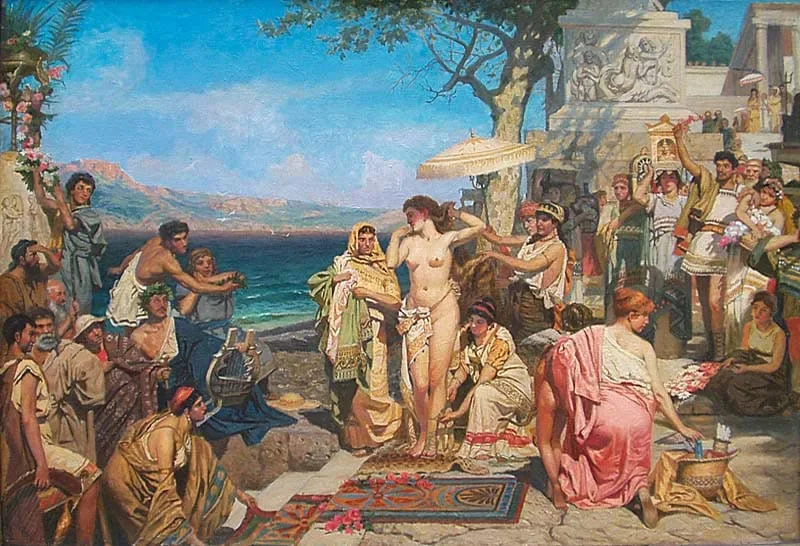
Elefsina was one of the most important sacred places of antiquity thanks to the worship of Demeter and the famous Elefsinian Mysteries. The text presents the myth of the arrival of the goddess, its connection with Persephone, the birth of the Mysteries, the initiation and final decline of the sanctuary with the end of ancient religion.
By studying a modern map of Athens, one can locate its industrial suburb Elefsina. Elefsina is located at the northernmost end of the Saronic Gulf and, in recent decades, has evolved into a main oil and fuel entry gate in Greece.
A current visitor of Athens will hardly include Elefsina on his trip. However, in ancient times, for hundreds of years, visitors from all over the known world flocked to this small settlement, making it one of the most important sacred places in the Greco-Roman world.
The reason for Elefsina's enormous importance was its inextricable connection with the Goddess Demeter, as the fines were held there Eleusinia Mysteries.
Elefsina in Greek Mythology
- Demeter was one of the twelve Olympian deities, although the worship of the pre-existing organized Olympic religion. It was the greatest goddess of agriculture, fertility of land and cultivation, highly honored throughout Greece.
The most famous myth of Dimitra concerns search for her daughter, Persephone, which had been kidnapped by Hades, who wished to make her his wife.
The Arrival of Demeter in Elefsina
Demeter, exhausted by her daughter's constant search, wandered the entire earth and eventually stopped at Elefsina to rest.
Local residents did not recognize the goddess, but saw an elderly woman named Give. Unlike other places, in Elefsina the foreigner was welcomed with hospitality. The King's daughters Celery They even led her to the palace to regain her powers.
To repay hospitality, Demeter decided to make Immortal baby Demophonies, son of Keleos, burning his mortal nature — an act that strongly resembles the myth of Achilles. But Keleos surprised the goddess in the hour of action and, fearing for his child’s life, reacted angryly.
The Apocalypse of the Goddess Demeter
Then Demeter revealed her divine nature and ordered the king to rise temple in honor of. The inhabitants of Elefsina obeyed immediately.
After the temple was completed, Demeter settled there and stated that she would not leave the sacred site until she was informed of the fate of Persephone. As she refused to do her work as a goddess of agriculture, Great famine It spread around the world and humanity began to starve.
The Blessing of Elefsina
Finally Zeus She revealed to Dimitra what had happened to her daughter. Mother and daughter reunited, but only for part of the year. When they were together, the earth was bearing fruit· When separated, nature withered — a myth that explains the rotation of the seasons.
In gratitude to Elefsina, Demeter taught to Triple War, probably son of Keleo, the secrets of agriculture. Triptolemos spread this knowledge throughout Greece, making Elefsina a cradle of culture and cultivation.
The First Temple and the Birth of the Eleusinian Sacraments
Demeter appointed King Keleos as first priest of her temple and taught him sacred rituals promising prosperity and hope for afterlife — as she had reunited with her daughter.
Of these sacred teachings were born Eleusinia Mysteries, one of the most important secret cults of antiquity.
Eleusinian Mysteries
Mysteries gained huge fame when Elefsina was politically incorporated into Athens. The initiation was open to everyone. — men and women, free and slaves.
The Little Mysteries
They were held in the municipality Agrai on the banks of Ilisus, the month Anthestiriona (February–) March). Including purifications and sacrifices to Demeter and Persephone.
The Great Mysteries
They took place six months later, Boedromiona (September–) October), and lasted a week. They included a procession from Athens to Elefsina, fasting, ritual events and final initiation in CeremonyWhere a sacred box was kept.
The contents of the final ceremony remain unknown, as the initiates were bound by a vow of silence under threat of death.
The Decline of Elefsina and the End of Mysteries
Eleusinian Mysteries lasted about 2,000 years. During the Roman period they were incorporated into the religious life of the empire. However, they began to decline when Rome adopted Christianity.
Eleusinian Mysteries continued to be held until the end of the 4th century AD. Their decline is associated with the decrees of Theodosius I against pagan cults after 391 AD, as well as the wider spread of Christianity to the Roman Empire.
Frequently Asked Questions About Eleusinian Mysteries
What were Eleusinian Mysteries?
Eleusinian Mysteries were the most important secret religious ceremonies in ancient Greece. They were held in Elefsina in honor of Demeter and her daughter Persephone and were associated with the cycle of life, death and rebirth.
When did Eleusinian Mysteries begin?
Early references date back to the Mycenaean era, while the ceremonies were systematically organized around the 8th century BC. They continued to take place for more than a thousand years.
Where were Eleusinian Mysteries?
The ceremonies were held in ancient Elefsina, west of Athens. The most important building was the Ceremony, where secret rituals took place.
Who could participate?
In Eleusinian Mysteries could participate men, women and even slaves, as long as they spoke Greek and had not committed serious crimes. That was quite unusual for the time.
Why were they called «Mysteries»?
They were so named because participants took a vow of silence and were not allowed to reveal what they saw or experienced during the ceremonies. The violation of the oath was considered sacrilege.
What was Demeter's relationship with the Mysteries?
Eleusinian Mysteries were based on the myth of Persephone's quest by Demeter, when she was kidnapped by Hades. The myth symbolized the rotation of times and the regeneration of nature.
What happened during the ceremonies?
The exact rituals remain unknown. But it is known that they included processions, purifications, fasting, sacred objects and secret muscular ceremonies within the Ceremony.
What was the cyceon?
The cyceon was a sacred drink consumed during the Mysteries. It was made mainly of water, barley and herbs and had a symbolic character.
What was the meaning of the Eleusinian Mysteries?
The initiates believed they gained a deeper understanding of life after death and secured a better posthumous fate.
What is the difference between Small and Great Mysteries?
The Little Mysteries acted as a preparation and purification of candidates, while the Great Mysteries were the main and most sacred initiation ceremony.
When were Eleusinian Mysteries abolished?
Eleusinian Mysteries ceased in the late 4th century AD, when ancient pagan cults were banned during the spread of Christianity into the Roman Empire.
Are there the ruins of Elefsina today?
Yes, the archaeological site of Elefsina preserves important ruins of the Ceremony, sacred and other buildings related to the Mysteries.
Why is Eleusinian Mysteries so important?
They deeply influenced the religion, philosophy, and culture of ancient Greece. Many ancient writers considered Eleusinian mysterious experience that changed the way man understood life and death.
Ancient sources
Hesiod – Theogenia & Works and Days | Primary Sources
Primary Sources of Greek Mythology | Hesiod, Homer, Orphic Hymns
Perseus Digital Library is a reliable academic database with ancient Greek texts and historical sources, particularly useful for the study of Greek mythology and Elefsinian Mysteries.