
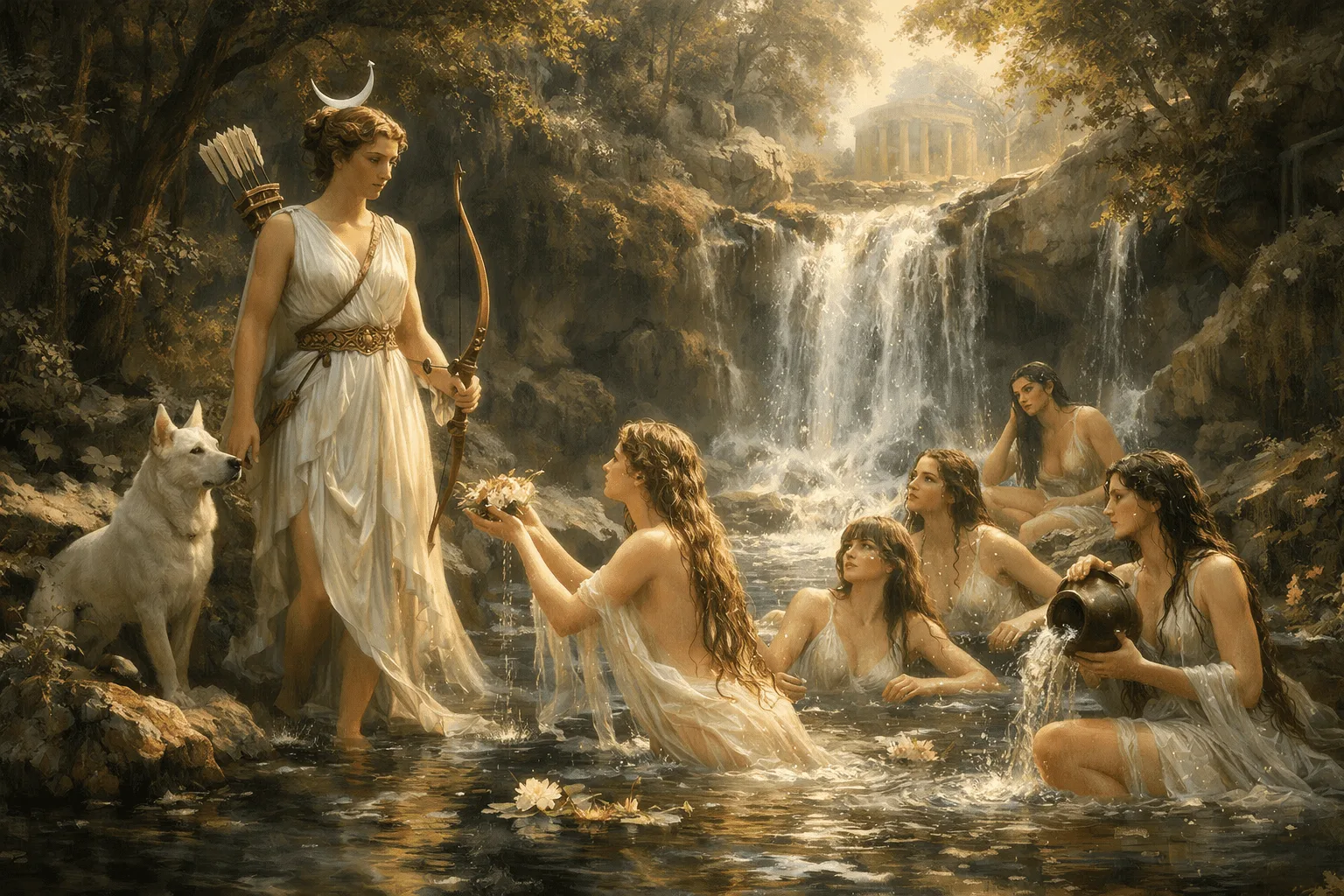
Artemis is one of the most recognizable and at the same time most multidimensional forms of ancient Greek mythology. Wild and unscathed, protector of forests, wild animals and young girls, but also goddess deeply associated with the moon, the night glow and the cycle of nature, Artemis is not just the «goddess of the hunt». It is a symbol of freedom, autonomy and balance between man and the natural environment.
From the mountain trails of Greece to the great sanctuaries of antiquity, Artemis' presence depicts a world where hunting was not only survival but also ritual, the moon was not only a heavenly body, but a regulator of time, and nature was not a setting, but a force alive and sacred. Her story survives to this day, not only through myths, but also through the way we perceive the light of night, female independence and our relationship with the savage and the uncontrolled.
Who was Artemis in mythology?
Artemis was his daughter. Zeus and Leto and his twin sister ApolloBorn, according to legend, on the island of Delos, she came to the world before her brother and from very early on she was associated with protection and skill. Unlike many other deities related to marriage or motherhood, Artemis chose eternal virginity, not as weakness, but as a declaration of independence.
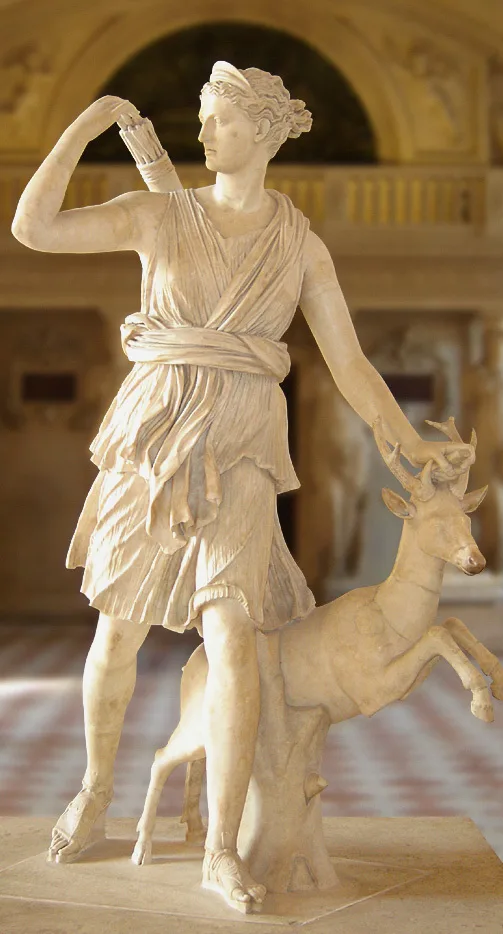
Her image as a young goddess with bow and arrows, accompanied by deer or hunting dogs, captures just this dual nature: she is gentle when she protects, but relentless when her sanctity is violated. In myths he often appears as a goddess who oversees boundaries. Limits between culture and wildlife, between childhood and adulthood, between life and danger.
The twin relationship with Apollo
Her relationship with Apollo is decisive for understanding her position in the Greek pantheon. If Apollo symbolizes sunlight, reason, and harmony, Artemis is associated with nightlight, intensity of nature, and protection of those in a vulnerable phase of life. The two often function as complementary archetypes: sun and moon, day and night, domestication and wild freedom.
Artemis as a goddess of hunting and nature
Artemis' most famous quality is of course that of the goddess of hunting. But hunting in ancient Greece was not just recreation. It was skill exercise, contact with the wild land and at the same time ritual act requiring respect. Artemis does not represent the uncontrolled killing, but the symmetry between the hunter and prey, between need and measure.
The ancients saw her as a patron of animals and also as a deity that could protect or punish them. It is no coincidence that it is often called "goats of beasts", i.e. «animal lady». This phrase bears witness that nature, in the eyes of the ancients, did not belong solely to man. Artemis was the power that reminded the forest had its own laws.
Protector of young girls and transition
Artemis is not only related to hunting, but also to the transition from childhood to adulthood, especially for girls. In several areas of ancient Greece she was worshiped as a protector of youth, purity and preparation for marriage. That doesn't mean it was. «goddess of isolation», but that it embodied the idea of individual integrity before joining social roles.
One of the most typical examples is the ceremonies in Vravron, where young girls participated in acts in honor of Artemis. Her worship had an intense pedagogical dimension: the goddess was not just the object of awe, but also part of a social education around the body, time, nature and position of the woman in the community.
Why is Artemis connected to wild animals?
The link to animals has deep symbolism. Artemis is a wildlife goddess because she cannot be tamed. It does not follow the rules of men's banquets, does not restrict itself to a marriage, does not fall into contractual power relations. She's free like a deer running through the woods and awake like a wolf at night.
This form gave her enormous power to collective imagination. Artemis became the goddess who protected what man desires but can never fully possess: the wild.
Artemis and the moon: from the light of night to the symbolism of time
Artemis' connection to the moon is one of the most known, although historically more complex. In the oldest Greek religious tradition, Artemis was mainly a goddess of nature and hunting. But later, through symbolic thinking and identification with other deities such as the Moon and Hecate, it was closely associated with the moon.
This development is not accidental. The moon, like Artemis, has variability, mystery and a strong relationship with life cycles. The moon grows and declines, as the phases of nature change, animal fertility, time of sowing and harvest. For an ancient world living near the rhythms of the earth, these were not abstract ideas, but everyday reality.
The moon as a natural and cultural phenomenon
From a scientific point of view, the moon affects Earth in ways that ancients observed long before modern astronomy explained to them. The tides, for example, are related to the gravitational attraction of the moon. Moon circles affected time measurement, navigation, and agricultural work. So it is no wonder that the moon gained divine dimension in so many cultures.
In Artemis' case, her lunar connection enhanced the sense of remote and undefiled. The light of night is not blinding like the sun· It's softer, more internal, almost mysterious. That is exactly how Artemis was perceived by tradition: as a goddess not fully revealed, but implied.
From theology to popular imagination
The Artemis and moon connection went deep into popular imagination. In art, literature and later western tradition, the goddess is often depicted with crescent on the head or silver light around her. This picture survived for centuries, for the moon continues to function as a symbol of transformation, secret, and feminine power.
Artemis' most famous myths
Artemis' myths are not just fascinating stories. They reveal the way ancient Greeks understood the honor, transcending the boundaries, nature and punishment of the hybrid. Artemis may appear silent, but her reaction when offended is immediate and often relentless.
The story of Niobe
One of the most famous myths is that of Niobi, who boasted that he had more children than LetoHer arrogance was considered a grave insult. In response, Apollo and Artemis killed the children of Niobish, showing that the hybrid toward the gods has tragic consequences.
This myth is cruel, but revealing. Artemis is not just «good» or «bad». He is a deity who defends sacred order. When human arrogance transcends boundaries, its answer is disastrous.
Actaion and the violation of the sanctuary
Another famous myth is that of Aktaion, who saw Artemis bathe naked. The violation of the goddess's privacy and sacred integrity led to terrible punishment: Aktai was transformed into a deer and devoured by his own dogs.
History doesn't just function as a punishment for curiosity. It highlights the importance of the limit, respect and prohibition. Artemis is a goddess who does not allow abuse of the look. In a world where look can become power, its mythological reaction has special gravity.
Artemis and Iphigenia
One of the most human and emotional complex myths is that of Iphigenia. When the Agamemnon He insulted Artemis, the goddess demanded the sacrifice of his daughter. In the most famous version, at the last minute Artemis replaces the girl with a deer and carries it away.
Here Artemis appears not only as a cruel deity, but also as a lifesaving force. The myth combines sacrifice, mercy, and transition to another place, a place where young Iphigenia acquires a new sacred role. It is a story about the cost of human abuse, but also about the possibility of divine intervention.
The worship of Artemis in ancient Greece
Artemis is not just a mythology. It belongs to the true religious life of the ancient Greeks. Her worship was wide, with sanctuaries in different areas and various local forms. This is important because it shows that there was not only one Artemis, but many versions of the same goddess, depending on the place and the community.
The sanctuary of Bravron
In Attica, Vravron was one of the most important centers of worship in Artemis. There were ceremonies of particular importance to young girls. The sanctuary combined religious reverence with social transition. He wasn't an isolated «temple of the goddess»But a living space where the community negotiated its relationship with youth, reproduction and protection.
Artemis of Ephesus
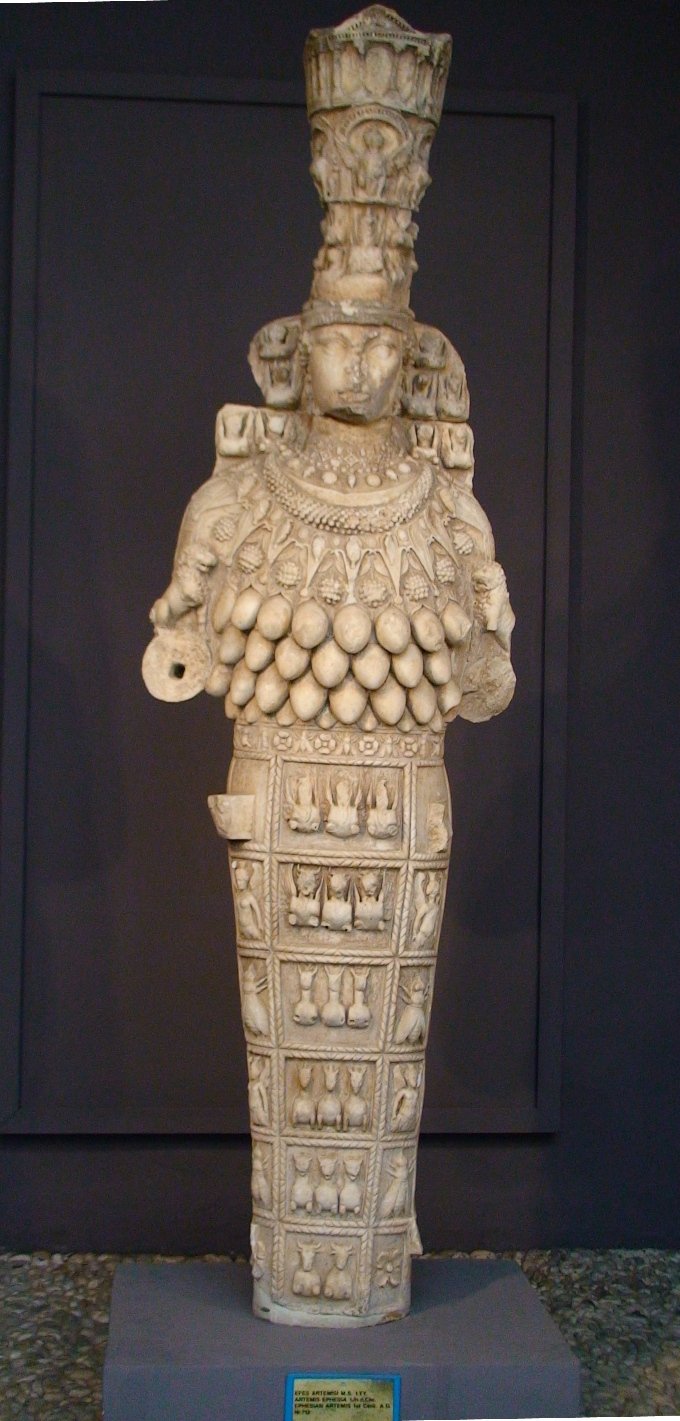
Perhaps her most impressive form Artemis was Artemis of Ephesus in Asia Minor. There the goddess was worshiped with a completely different iconography from the young hunter of Greek tradition. Its famous form full of symbolic elements has been associated with fertility, abundance and city protection.
This version shows how malleable Artemis' religious identity was. He could be a pure virgin and at the same time a strong maternal-protective deity. This diversity explains why her worship lasted so long in time.
Spartan and local dimension
The Sparta, Artemis also had a strong cult presence, associated with cruelty, youth treatment and transition rituals. In each area, the goddess incorporated local needs and values. This makes Artemis extremely interesting: it is not an abstract deity, but a living mirror of society that worshiped it.
Artemis in art, culture and modern times
Artemis' influence does not stop in antiquity. Its form continues to inspire artists, writers, filmmakers and researchers. The idea of a woman who is self-sufficient, oriented to nature and loyal to her own inner compass, remains deeply attractive to modern culture.
In art and literature
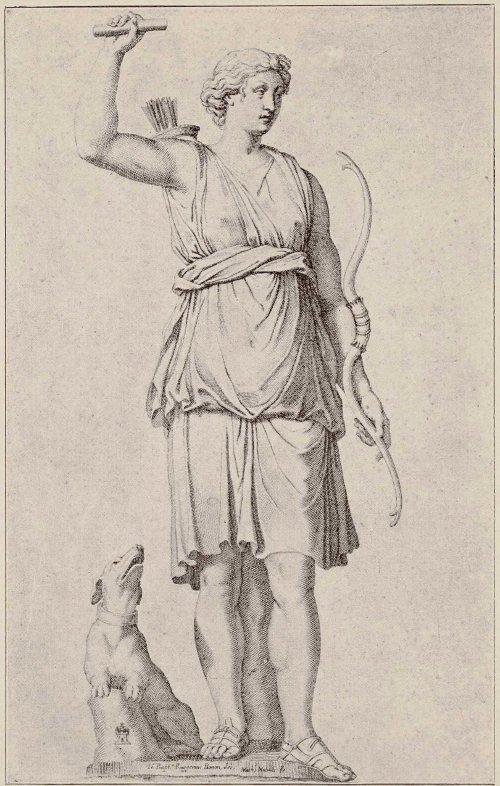
From ancient statues to Renaissance depictions, Artemis is usually presented with a bow, deer or crescent. Her visual language is readily identifiable. In literature, it acts as a model of self-sufficiency, but also as a reminder that freedom always costs.
Artemis is also present in modern readings of mythology as a symbol of environmental consciousness. At a time of ecological crisis, the goddess of forest and wild animals is gaining new news. It reminds us that the natural world is not just a resource, but a living system worthy of respect.
Artemis as a symbol of female autonomy
Many see it today as an archetype of female independence. Artemis is not defined by the wishes of others. She chooses her own way. This symbolism has a particular impact on modern discussions about women's identity, freedom and rights.
Its power lies not in domination over others, but in maintaining its boundaries. This dimension makes Artemis extremely modern, despite its ancient background.
Artemis and the science of heaven
It is interesting to use its name in modern science and technology. The programme Artemis The NASA, for example, borrows the name of the goddess to mark a new lunar era of exploration. This choice is not accidental: Artemis, as a form connected to the moon, acts ideally as a bridge between myth and space science.
Thus, the ancient goddess survives even in the vocabulary of technological progress. From the arrows of mythology to the missile designs of today, its name still symbolizes the march toward something distant, accurate and almost sacred.
Conclusion: why Artemis remains timeless
Artemis, goddess of hunting and moon, is one of the most complex forms of Greek mythology. It unites in one presence the freedom of wildlife, the discipline of hunting, the modesty of youth and the mystery of night. It is both strict and protective, remote and present, human and transcendent.
Her timeless wealth lies right in this composition. She's not just a mythical hunter, not just a lunar deity. It is a symbolic axis around which nature, time, femininity and limit are rotated. That is why Artemis continues to charm: because she reminds modern man that freedom, like the light of the moon, is stronger when she does not try to dominate, but to light up.
Frequently asked questions about goddess Artemis
Who was Artemis in Greek mythology?
Artemis was one of the most important deities of Greek mythology. She was a goddess of hunting, wildlife, moon and patron of animals and young girls.
Who were Artemis' parents?
Artemis was the daughter of Zeus and Litos and his twin sister Apollo.
What was Artemis' role in mythology?
Artemis protected the forests, wild animals and virginity of young women. He is often presented as a dynamic hunter with bow and arrows.
Why is Artemis considered a moon goddess?
In ancient Greek tradition Artemis was later associated with the moon, as the equivalent of Apollo related to the sun.
What were Artemis' symbols?
Artemis' most famous symbols were bow, arrows, deer, and moon.
Where was Artemis adored?
Artemis was worshiped in many areas of ancient Greece, with significant sanctuaries in Ephesus, Vravrona, Attica and Sparta.
What was Artemis' most famous temple?
Her most famous temple was the Temple of Artemis in Ephesus, one of the seven wonders of the ancient world.
What animals were dedicated to Artemis?
Animals such as deer, bear, and hunting dogs were considered sacred to the goddess.
What myths are connected to Artemis?
Artemis appears in many myths, as in the myth of Actaion, Iphigeny and Callistos.
Why was Artemis punishing those who insulted her?
Artemis was a strict deity that punished anyone who violated the sanctity of nature or her personal purity.
OLYMPIAN GODS
ZEUS | HERA | ATHENA | ARES | ARTEMIS | DIONYSUS | HERMES | HADES | Apollo | POSEIDON | HEPHAESTUS | APHRODITE
Ancient sources
Hesiod – Theogenia & Works and Days | Primary Sources
Primary Sources of Greek Mythology | Hesiod, Homer, Orphic Hymns
Primary Sources of Greek Mythology | Ancient Texts
Perseus Digital Library is a reliable academic database with ancient Greek texts and historical sources, particularly useful for the study of Greek mythology and Elefsinian Mysteries.