
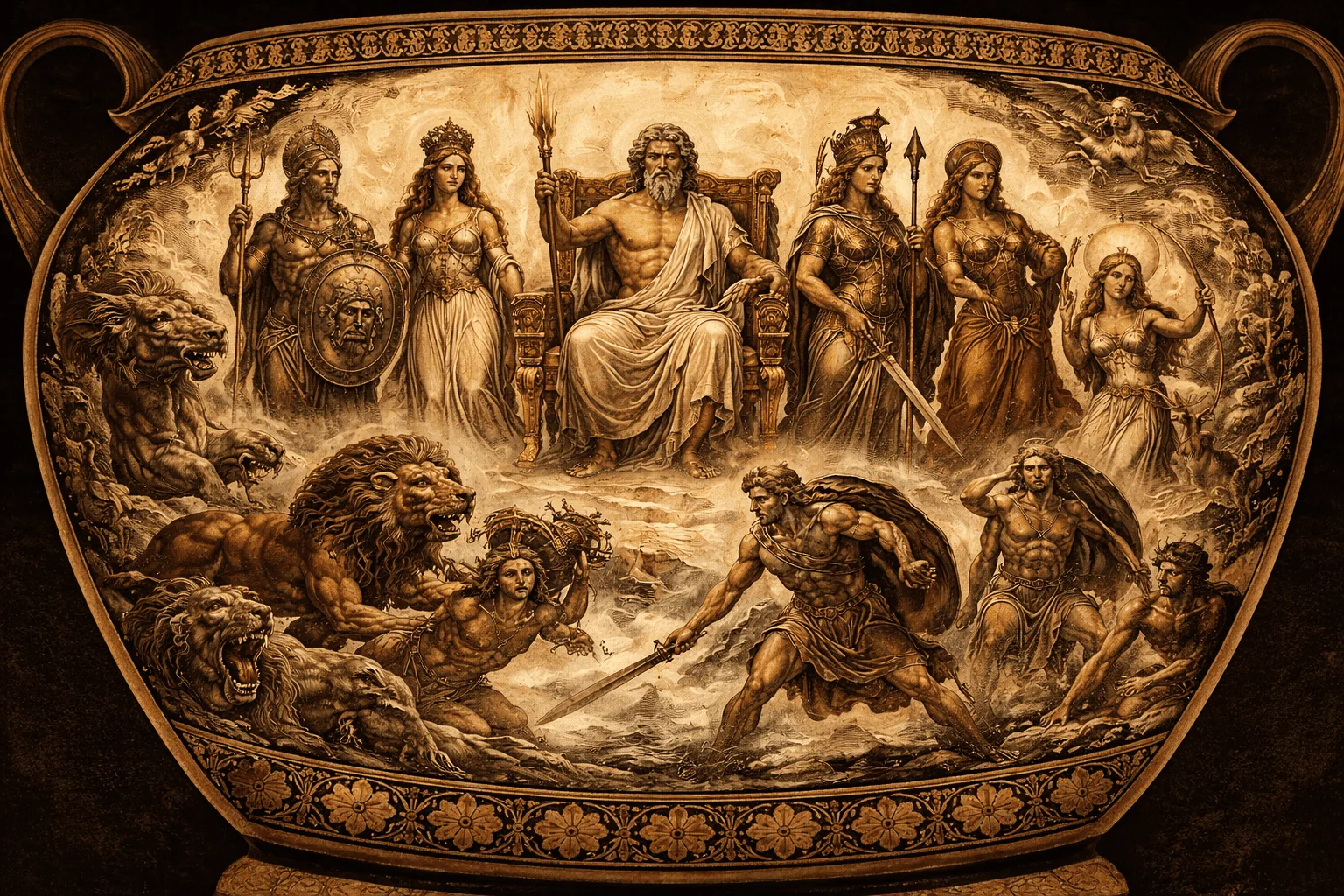
- Greek mythology is not merely a collection of old stories created for entertainment. It is the framework through which an entire civilization sought to answer the great questions of existence: how the world was created, why suffering exists, what virtue means, and where death leads. Born from centuries of oral tradition, it was gradually codified into poetic works, religious practices, and artistic representations that are still regarded today as a foundation of Western civilization.
At the centre of the project are the Gods of Olympus, the Titans The Commission has decided to extend the period of validity of the aid. heroes who bridged the divine and the human, and the monsters that embodied a society's fears of the unknown. No myth exists in isolation; each is interconnected with others through genealogies, conflicts, and alliances, forming a vast web of narratives that encompassed every aspect of ancient Greek life—from agriculture to warfare, from love to death.
The question of why Greek mythology continues to fascinate us thousands of years after its creation has no single answer. Perhaps it is because its gods were not perfect: they felt jealousy, fell in love, became enraged, and made mistakes, which made them profoundly human. Perhaps it is because its heroes did not always triumph, but struggled with dignity against a fate that was often already determined. In this guide, we will explore this entire universe systematically: from the birth of the world out of Chaos, to the great wars, the heroic labors, and the cultural legacy that Greek mythology has left behind.
What is Greek Mythology
As a term, Greek mythology refers to the body of myths, legends, and sacred narratives created and transmitted by the ancient Greeks about their gods, the origin of the cosmos, their heroes, and the relationship between humanity and the divine. It was not, however, a closed or unified system of doctrine. Rather, it was a living, evolving tradition that varied from one city-state to another and continued to develop over the centuries.
Oral Tradition
Before they were printed in written texts, the myths were transmitted orally, from generation to generation, through audils and rhypsoes who sang epics at celebrations and ceremonies. This oral tradition explains why we often find variations of the same myth: each storyteller adapted history to the public and to the occasion, without having one «Official» version.
Religion and worship
The mythology was inextricably linked to the Greek religion. Legends were not simple stories· were the theological basis on which worship practices relied. Temples, altars, feasts such as Panathenes or panthenes Eleusinia Mysteries, sacrifices and prayers immediately echoed the accounts of the gods. The believer didn't have to «Believes» in myth the way a modern man believes in a doctrine· It was enough to honor the gods through the right ritual act.
Relations with culture
Mythology permeated every aspect of ancient Greek life: the political organization of city-states, which often had a patron deity (such as Athena for Athens), as well as art, architecture, and even language. Myths served as a shared cultural code that united the Greeks despite their political fragmentation into hundreds of independent city-states.
The role of Homer
Homer, with his Iliad and OdysseyHomer did not invent the myths, but through the Iliad and the Odyssey he gave them their most influential literary form. His epics preserve the stories of the Trojan War, Achilles, Odysseus, and many other legendary figures, while also presenting a vivid portrait of the Olympian gods, with Zeus reigning over a divine hierarchy whose members constantly intervene in human affairs. Trojan War, Achilles and Odysseus, but also an entire picture of divine hierarchy, with Zeus chairing a world of gods who constantly interfere in human affairs.
The role of Hesiod
If Homer gave mythology its narrative power, Hesiod gave her her systemic structure. The Theogony He recorded the genealogy of the gods from the absolute beginning, Chaos, to the consolidation of the power of Zeus, while in Works and Days He associated mythology with everyday morality and rural life.
Ancient sources
Apart from Homer and Hesiod, valuable sources are Library of Apollodorus, which systematically summarizes the myths, Greece Tour of Pausanias, which connects the myths with certain places of worship, the poems of Pindar and the Argonauts of Apollonio of Rhodes

- Vintage Dog Sketch Framed Wall Art: This wall art comes in two popular sizes, 9×11 inches and 12×16 inches, to suit diff...
- Dog Line Drawing Print: Featuring a charming line art sketch of an adorable puppy playing with a scribbled re...
- Dog Wall Art: No Nails, no Drills, and no wall damage. This framed dark canvas picture comes with convenient hook and lo...
Cosmogogy: World’s Creation
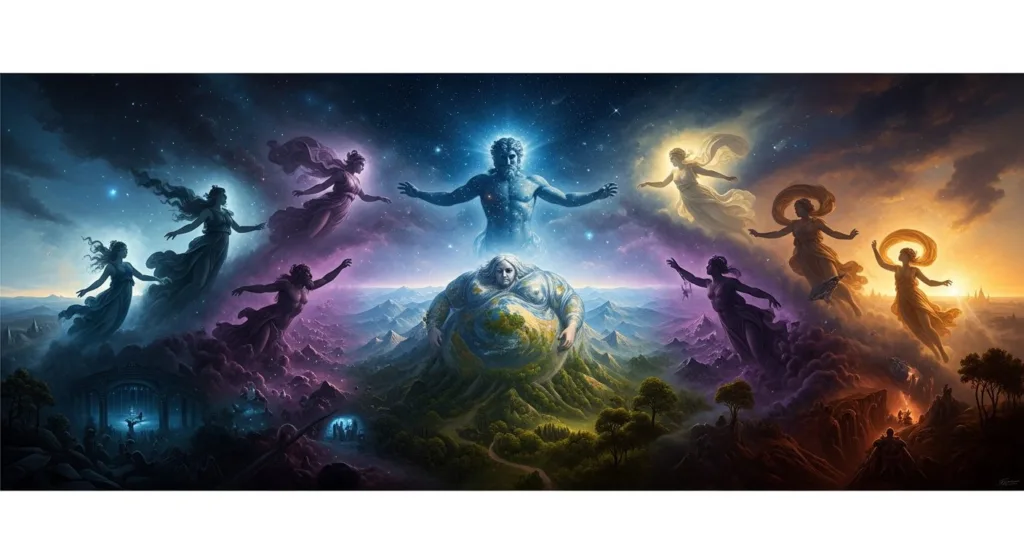
According to Hesiod's Theogeny, cosmogony does not begin with a deity-creator, as in other traditions, but with a condition: Chaos, a vast, shapeless void from which the order of the world will gradually emerge.
From Chaos were born spontaneously the first divine powers. The GaiaThe Earth appeared as the solid base upon which the universe would be built. THE Tartarus He unearthed the deepest, darkest bowels beneath the earth, the place where the defeated gods would later be imprisoned. THE Eros, a primitive force of attraction and creation, appeared to ensure that from this moment on, creation would continue through associations. Chaos also gave birth to Erebus, the darkness of the deep, and the Nyx, from whose union the Ether (the light of the above areas) and Hemera.
Gaia, without a partner, gave birth to Uranos, the starry sky that covered her whole, and the Pontos...the sea. Later, through her union with Uranus, she would give birth to the great race of the Titans. This original structure—Chaos, Gaia, Tartarus, Eros, Erebus, Nyx, Uranus, and Pontus—forms the primordial foundation from which the entire genealogy of the Greek gods unfolds.
This cosmogonic narrative carries profound symbolic meaning. It describes the transition from the formless to the structured, from chaos to cosmic order—a process that reaches its culmination only when Zeus establishes the final cosmic hierarchy following the Titanomachy.
Titans and Titanomachy
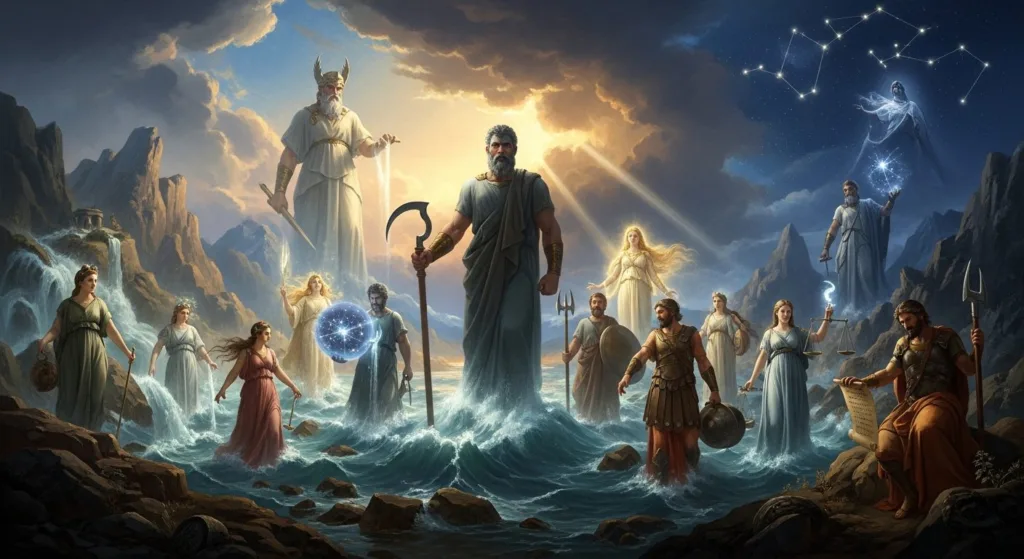
From the union of Gaia with Uranus were born twelve Titans, six males and six females: Cronus, - Rhea, Oceanus, Hyperion, Iapetus, Coeus, Creus, - Mnemosyne, - Themis, - Tethys and PhoebeWith the younger and boldest, Cronus
The Overturning of Uranus
Fearing the power of his children, Uranus imprisoned them deep within Gaia, causing her unbearable pain. Enraged by his cruelty, Gaia persuaded Cronus to rebel. Armed with a sickle that she had fashioned for him, Cronus castrated his father, bringing an end to Uranus's tyranny and ushering in a new era.
The Sovereignty of Cronus
Cronus assumed supreme power and married his sister Rhea, with whom he fathered several children. Yet, haunted by a prophecy that one of his own sons would overthrow him, he swallowed each newborn child immediately after its birth.
The birth of Zeus
When Rhea became pregnant for the sixth time, she resolved to save her child. She secretly gave birth to Zeus in a cave on the island of Crete and gave Cronus a stone wrapped in swaddling clothes, which he swallowed, believing it to be the infant. Zeus was raised in secret, and when he reached adulthood, he returned to free his siblings, whom Cronus had swallowed.
The Titanomachy
This led to the Titanomachy, a ten-year war fought between the Olympian gods, led by Zeus, and the Titans, led by Cronus. Zeus secured powerful allies by freeing the Hecatoncheires and the Cyclopes, who forged for him the mighty thunderbolt that became his signature weapon. The conflict was truly titanic—both figuratively and literally—and shook the very foundations of the cosmos.
The Olympian victory
The Olympians ultimately emerged victorious, and most of the Titans were imprisoned in Tartarus, guarded by the Hecatoncheires. This victory marked the end of an age of chaos and the beginning of the cosmic order established by Zeus, who became the supreme ruler of both gods and mortals.


Olympian Gods and Cosmic Hierarchy
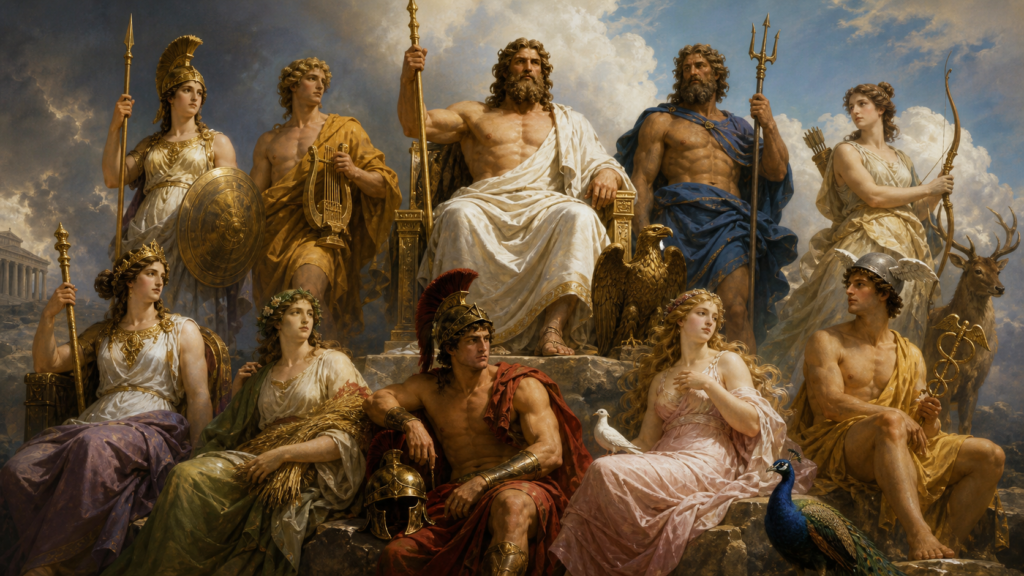
Following their victory in the Titanomachy, the new generation of gods established themselves atop Mount Olympus, forming the Twelve Olympians—the twelve principal deities who came to dominate the religious imagination of ancient Greece.
Zeus, the father of gods and mortals, ruled the heavens and served as the guardian of justice, oaths, and hospitality (xenia). His principal symbols were the thunderbolt, the eagle, the oak tree, and the royal scepter. As the supreme ruler of the cosmos, he maintained universal order by assigning honors and spheres of authority to the other gods.His mythology includes countless love affairs—with Hera, Leto, Europa, Danaë, Semele, and Leda, among others—which resulted in the birth of many of Greek mythology's most important gods and heroes, including Athena, Apollo, Heracles, and Perseus. His great sanctuary at Olympia was the site of the Panhellenic Olympic Games, while the Oracle of Dodona was regarded as one of his oldest and most sacred centers of worship.
Hera, the sister and wife of Zeus, was the goddess of marriage, family, and womanhood. She was renowned for her jealousy toward her husband's lovers and his illegitimate children. She relentlessly persecuted figures such as Heracles, Io, and Semele, not merely out of vengeance, but because she sought to defend the sanctity of the institution of marriage that she embodied. Hera was especially revered at Argos and Samos, where one of the largest and most magnificent sanctuaries of the ancient Greek world was dedicated to her.
Poseidon, his brother Zeus, ruled the seas with his trident, and was considered a god of earthquakes —«Insects»— and patron of horses, which according to legend he created himself. He claimed the protection of Athens against Athena, eventually losing the controversy, while his rage pursued Ulysses throughout his journey, after the hero blinded his son, Cyclops Polyphemos.
Demeter was the goddess of agriculture, grain, and the fertility of the earth. The myth of her daughter, Persephone, explains the changing of the seasons: Demeter's grief during her daughter's absence caused the earth to become barren each winter, while Persephone's return heralded the renewal of life in spring. At Eleusis, Demeter's worship was closely associated with the Eleusinian Mysteries, one of the most important and revered religious rites of the ancient Greek world.
Athena, born fully armed from the head of Zeus, was the goddess of wisdom, strategic warfare, and the arts and crafts. As the patron deity of Athens, she gave the city its name after defeating Poseidon in a divine contest by offering its people the olive tree, a gift symbolizing peace, prosperity, and civilization. Athena guided heroes such as Perseus, Odysseus, and Heracles, embodying reason, strategic intelligence, and thoughtful action in contrast to instinct and chaos.
Apollo, god of light, music, divination and medicine, was worshiped mainly in Delphi, where Pythia passed his oracles. He killed the dragon Python to establish the oracle, while his love stories —With Daphne, Hyacinth— They often ended tragically, emphasising the two-pole class and passion that characterized him.
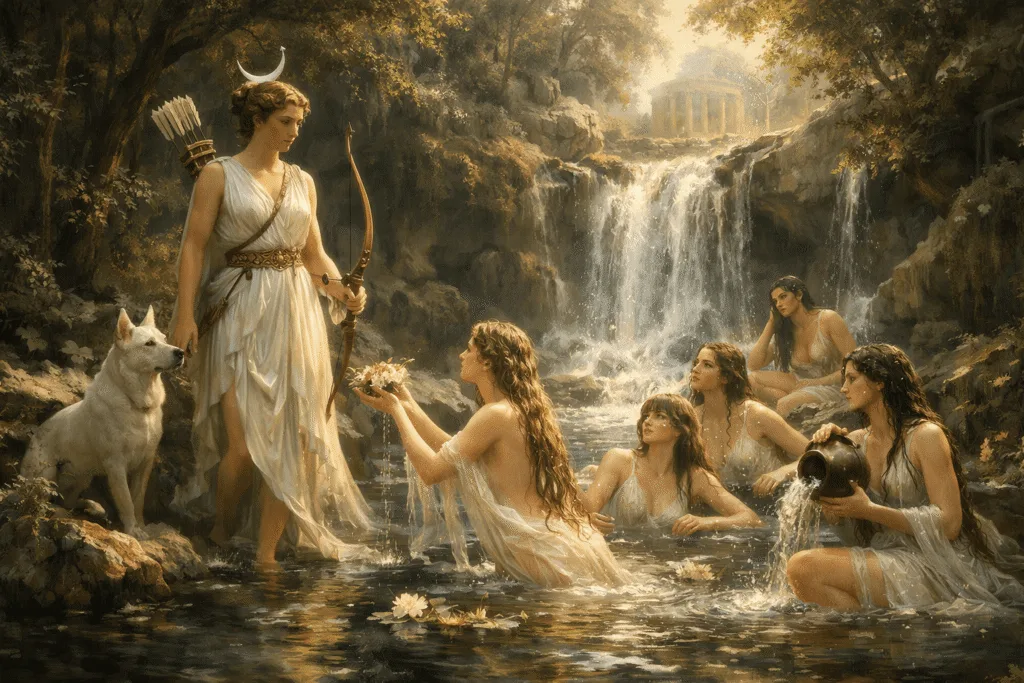
Artemis, the twin sister of Apollo, was the goddess of the hunt, the wilderness, and virginity. She was also the protector of young girls and women in childbirth. Fiercely protective of her sacred domain and chastity, Artemis harshly punished those who violated them, most famously the hunter Actaeon, whom she transformed into a stag after he beheld her bathing.
Ares, god of war in its most brutal and violent form, was not particularly popular among the other gods, unlike Athena who represented war as strategic art. His love affair with Venus was the subject of one of the most famous comedy scandal episodes in the Odyssey.
Aphrodite, goddess of love, beauty and fertility, born from the foam of the sea near Cyprus· Her myth with Mars and her husband Hephaestus, who trapped them both in an invisible net, is one of the most famous scandal episodes in Olympus. The judgment of Paris, where she was declared the most beautiful goddess, indirectly sparked the Trojan War.
Hephaestus, the god of fire, metallurgy, and craftsmanship, was the only Olympian deity traditionally depicted with a physical disability. According to myth, he was cast down from Mount Olympus by his mother Hera because of his deformity, yet he became the greatest divine craftsman, creating extraordinary works—including weapons, thrones, and even mechanical automatons—for gods and heroes.
Hermes, the messenger of the gods, was the deity of commerce, travel, eloquence, and thieves. Renowned for his cleverness from the moment of his birth, he famously stole the cattle of Apollo only a few hours after being born. He also guided the souls of the dead to the Underworld, a role known as Psychopomp.
Hestia, the goddess of the hearth and the home, represented the stability of the family and the sacred public hearth. Every Greek city maintained a communal flame in her honor, symbolizing unity and continuity. In some traditions, Dionysus replaced her among the Twelve Olympians, as Hestia willingly gave up her place to preserve harmony among the gods.
Dionysus, the god of wine, ecstasy, vegetation, and theater, introduced into Greek worship an element of liberation, transformation, and divine frenzy that balanced the order and restraint of the other Olympian gods. The festivals held in his honor, the Dionysia, became the foundation of ancient Greek theater, giving rise to both tragedy and comedy.
Zeus did not rule as a tyrant, but rather as the first among equals, establishing a cosmic order in which each god had a defined sphere of authority. He created a balance of powers that perhaps reflected the political organization of the Greek city-states themselves.
Minor Deities
Beyond the Twelve Olympians, Greek mythology included a multitude of lesser deities who personified and governed every aspect of the natural world and human existence.
The Nymphs They were spirits of nature. —trees, springs, mountains— inhabited in forests and rivers. The Muses, the nine daughters of Zeus and Mnemosyne, inspired poetry, music, and the arts. The The Moirai (Fates) —Clotho, Lachesis, and Atropos—determined the destiny of every mortal, and even the gods themselves, by spinning, measuring, and cutting the thread of life. They represented the inescapable power of fate that governed all existence. Graces They offered grace, beauty and creativity, while Hours They regulated the rotation of the seasons and the natural order.
The Erinyes They were terrible revenge deities pursuing those who committed crimes, especially against the family. The Nemesis He expressed the divine punishment of arrogance. The Iris, the goddess of the rainbow, acted as a messenger, while the Hecate, goddess of magic and crosses, connected to the nightly, mysterious element of worship. THE Pan, half-man half goat, was a god of rural nature and a patron of shepherds.
The water world was dominated by River gods, the Oceanids (Ocean girls) and Nereids, sea nymphs and daughters of Nereus, were among these lesser divine beings. These secondary deities connected the divine world with everyday life: every spring, every forest, and every natural phenomenon possessed its own sacred presence, making the world of the ancient Greeks deeply animated and infused with divine forces.
Heroes of Greek Mythology
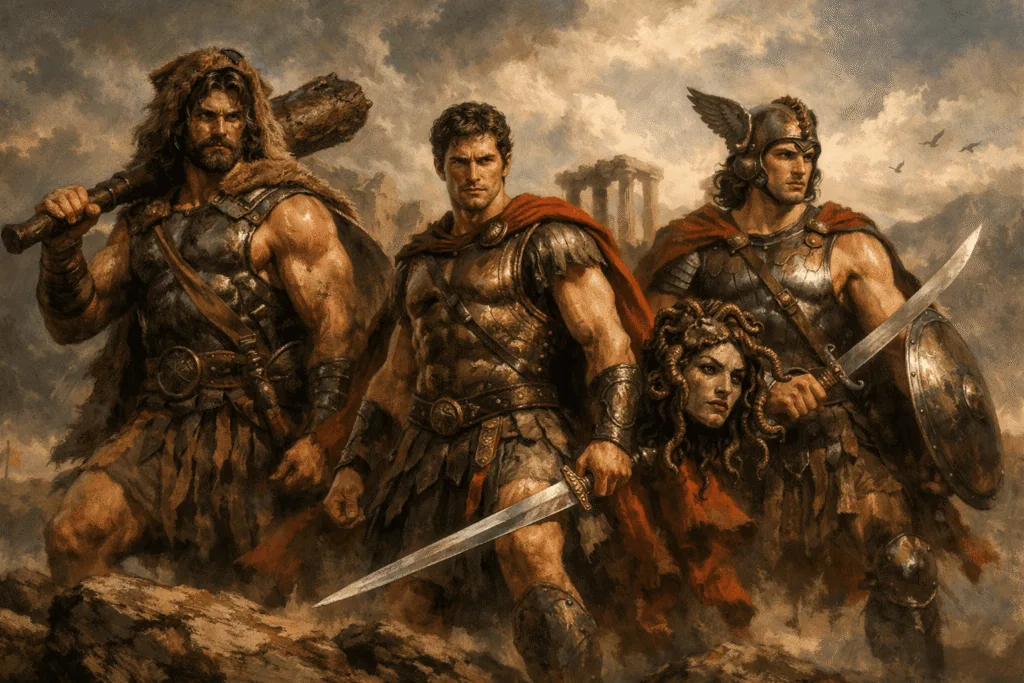
Heroes occupied an intermediate position between mortals and gods, often born from the union of a deity and a human. They were gifted with supernatural abilities but remained subject to mortality.
- Hercules, son of Zeus and Alcmene, is the most famous hero, known for their twelve feats The —from the killing of the lion of Nemea and Lernaia Hydra to the capture of Cerberus and the detachment of the apples of Esperides— a purification process for the murder of his children in a mania crisis imposed by Hera. His symbolism touches the idea of redemption through toil: his power is not enough in itself, but is always accompanied by patience and obedience to divine will. After his death, he was deified and married Evie to Olympus.
- Perseus, son of Zeus and Danaë, beheaded Medusa with the help of Athena and Hermes, using a polished shield as a mirror to avoid her deadly gaze. He later rescued Andromeda from a sea monster and married her. Perseus is considered an ancestor of Heracles and the legendary founder of Mycenae.
- TheseusKing of Athens, killed Minotaur in her maze Knossos with the help of the thread of Ariadne, joining the mythology of Athens with that of Crete and ridding his city of the annual blood tax to King Minos. He later abandoned Ariadne in Naxos, an act that tradition faces with ambivalence.
- Jason Jason led the Argonauts, an elite crew of heroes and demigods, on a perilous quest to retrieve the Golden Fleece from Colchis. With the help of the sorceress Medea, he succeeded in his mission, but later betrayed her—an act that would ultimately lead to one of the darkest tragedies in Greek mythology.
- Odysseus, king of Ithaca, was renowned for his cunning and intelligence both during the Trojan War—where he devised the strategy of the Trojan Horse—and throughout his ten-year journey home, which is immortalized in the Odyssey, where he faced the Cyclopes, the Sirens, the sorceress Circe, and the wrath of Poseidon.
- Achilles, the greatest warrior of the Greeks at Troy, was nearly invulnerable except for his heel—the point where his mother Thetis held him when she dipped him as an infant into the waters of the River Styx—which ultimately became the cause of his death from an arrow shot by Paris. His rage following the death of his friend Patroclus forms the central theme of the Iliad.
- Bellerophon He tamed the winged Pegasus with the help of a gold bridle given to him by Athena and killed Chimera, although his late attempt to climb Olympus on the horse was punished by Zeus by a fall. The Atalanti, a swift huntress devoted to Artemis, refused to marry any man who could not defeat her in a foot race. She was finally overcome by Hippomenes, who won the race with the help of golden apples given to him by Aphrodite. The myth of Atalanta explores themes of independence, competition, and the tension between personal freedom and societal expectations. Cadmus, the founder of Thebes and traditionally credited with introducing the alphabet to the Greeks, slew a dragon and sowed its teeth into the ground. From them sprang armed warriors known as the Spartoi (“the Sown Men”), who became the ancestors of the Theban aristocracy. The myth of Cadmus connects the origins of civilization, writing, and royal lineage with themes of conflict and transformation. Orpheus, whose song and lyre were said to enchant even lifeless objects, descended into the Underworld to bring back his beloved Eurydice. However, he lost his chance at the very last moment when he turned to look at her before they had reached the light, breaking the condition imposed upon him.
Each of these heroes symbolized different virtues —strength, intelligence, courage, loyalty— and their adventures functioned as ethical and cultural standards for ancient Greek society.
Mythical Creatures and Fear Symbolism
The mythical creatures Greek tradition embodied fears, moral lessons and conflict between order and chaos.
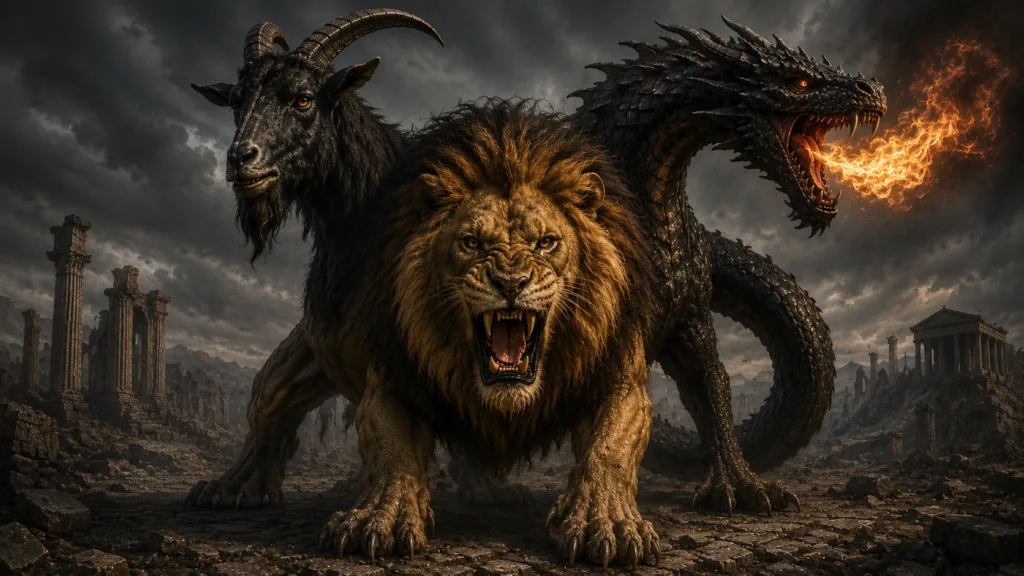
- MedusaMedusa, with snakes instead of hair, turned anyone who looked directly into her eyes to stone—a symbol of the deadly danger hidden behind beauty. Chimera, hybrid monster with lion's head, goat body and snake tail, breathed fire. THE Cerberus, three-headed dog, guarding the gates of Hades, preventing the dead from returning to life. THE MinotaurHalf a bull was held prisoner in the labyrinth of Knossos, feeding on human sacrifices.
- Sphinx, with the body of a lion and the head of a woman, he laid riddles of death on the crossings of Thebes. The Sirens They fascinated the sailors with their song, leading the ships to a wreck. The Lernaean Hydra, a multi-headed snake with reborn heads, was one of Hercules' most difficult feats. The Cyclops, one-eyed giants, were both creators (builders of Jupiter's thunder) and threatening presences, such as Polyphemus in the Odyssey.
The CentaursHalf the people, half the horses, symbolized the conflict between instinct and reason, except for the wise Chiron. The Gryphons, with a lion's body and eagle's head, they guarded treasures, while the Pegasus, the winged horse born of Medusa's blood, represented poetic inspiration and elevation.
Philosophy and Cultural Heritage
The influence of Greek mythology far exceeded the limits of antiquity. The philosophy, thinkers like Plato used mythological accounts to formulate abstract ideas, while tragic poets —Aeschylus, Sophocles, Euripides— They drew from mythology the material for the ancient theatre, exploring issues of fate, justice and human weakness.
The literatureThe effect is uninterrupted, from the Roman era to the present day. The Renaissance turned again to classical myths as a source of inspiration for art, with painters like Botticelli portraying scenes such as Venus' birth. In Modern psychology, Freud and Jung borrowed mythological names and archetypes —like the Oedipal complex— to describe deep human dynamics.
The modern cinema continues to reproduce mythological accounts, from adventure films to superhero stories structured on hero archetypes. Even the science and astronomy They honor mythology, naming planets, constellations and natural phenomena named gods and heroes. The language our is scattered with mythological references — words like «panic» (by God Pana) or «titane» remain in daily use.
Stories of Greek Mythology
Beyond the great circles, there are iconic accounts that capture timeless human dilemmas.
Her myth Pandora, the first woman that the gods formed, explains the entry of evil into the world through the opening of the known pit. Closely connected is his myth Prometheus, who stole the fire from the gods to give it to the people and was eternally punished by Zeus. THE DeucalionWith his wife Pyrra, he survived a devastating flood and recreated mankind.
- Persephone...the daughter of Demeter, was abducted by Hades, and the division of her time between the Underworld and the earth explains the cycle of the seasons. Midas, king with the famous «gold touch», he learned the limits of greed hard. THE Phaethon, son of the Sun, he almost destroyed the world driving his father's chariot uncontrollably. THE Icarus, flying very close to the sun with the wax wings made by Daedalus' father, became the foremost symbol of the hybris.
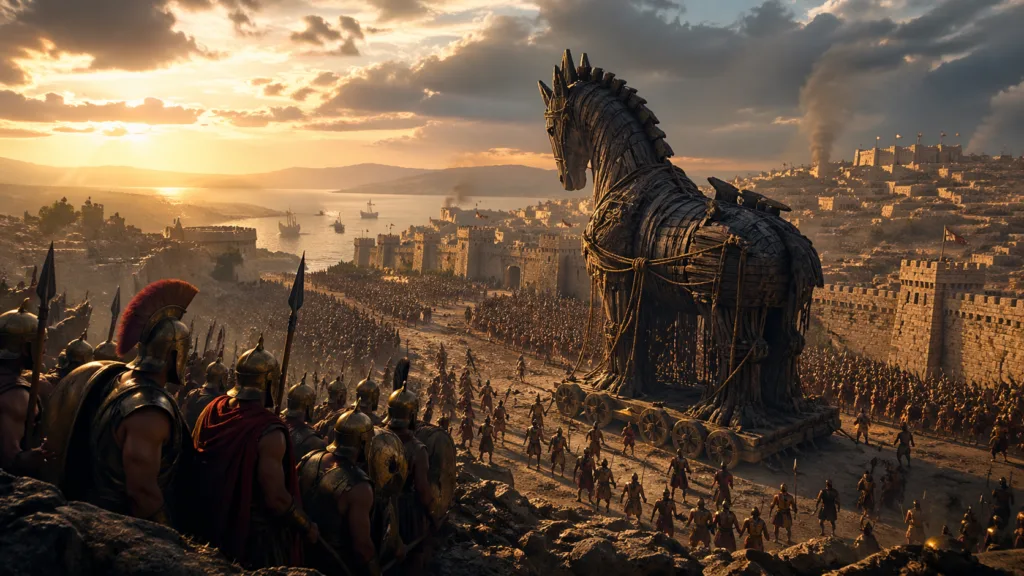
- Europa, a Phoenician princess, was abducted by Zeus, who had transformed himself into a bull, and was carried away to Crete, giving her name to the continent of Europe. The... Argonaut Campaign He relates the journey of Jason and his companions for the Golden Fleece. THE Trojan WarOn the occasion of the kidnapping of Hellen, it was the theme centre of Iliad, the Odyssey It narrates the journey home of Odysseus, filled with trials, challenges, and monsters.
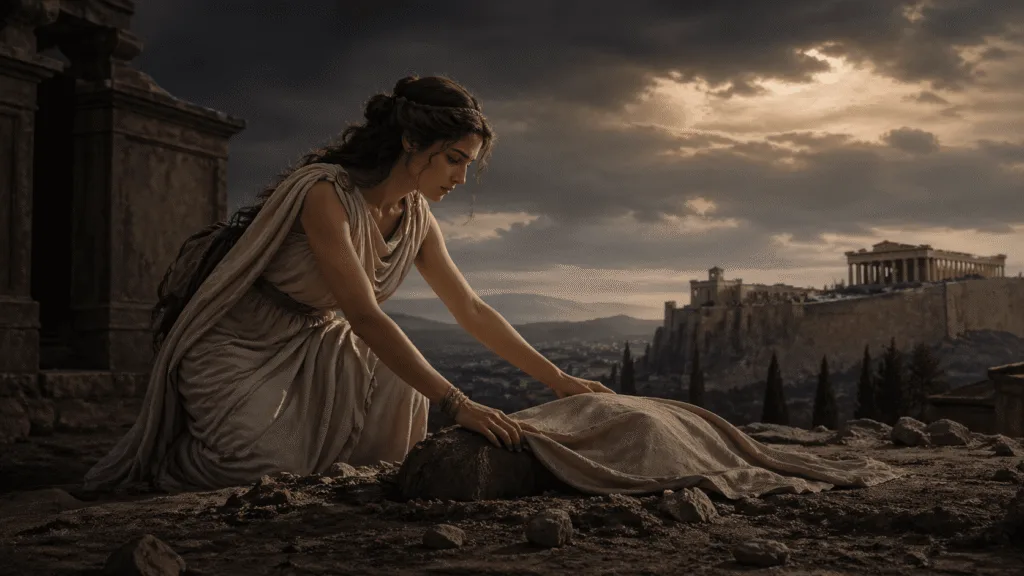
Philosophy and Cultural Heritage
The influence of Greek mythology far exceeded the limits of antiquity. The philosophy, thinkers like Plato used mythological accounts to formulate abstract ideas, while tragic poets —Aeschylus, Sophocles, Euripides— They drew from mythology the material for the ancient theatre, exploring issues of fate, justice and human weakness.
The literatureThe effect is uninterrupted, from the Roman era to the present day. The Renaissance turned again to classical myths as a source of inspiration for art, with painters like Botticelli portraying scenes such as Venus' birth. In Modern psychology, Freud and Jung borrowed mythological names and archetypes —like the Oedipal complex— to describe deep human dynamics.
The modern cinema continues to reproduce mythological accounts, from adventure films to superhero stories structured on hero archetypes. Even the science and astronomy They honor mythology, naming planets, constellations and natural phenomena named gods and heroes. The language our is scattered with mythological references — words like «panic» (by God Pana) or «titane» remain in daily use.
Why Greek Mythology Remains Timeless
The power of Greek mythology lies in the fact that it does not offer simple, one-dimensional answers. Its gods are not flawless, its heroes are not invincible, and its stories do not always have happy endings. This moral complexity makes it deeply connected to the modern human experience. Themes such as hubris, justice, fate, love, and mortality remain just as relevant today as they were thousands of years ago.
Furthermore, its structural flexibility—the ability to be retold, reinterpreted, and adapted to different cultural contexts—allows it to remain alive through every new generation of readers, artists, and creators.
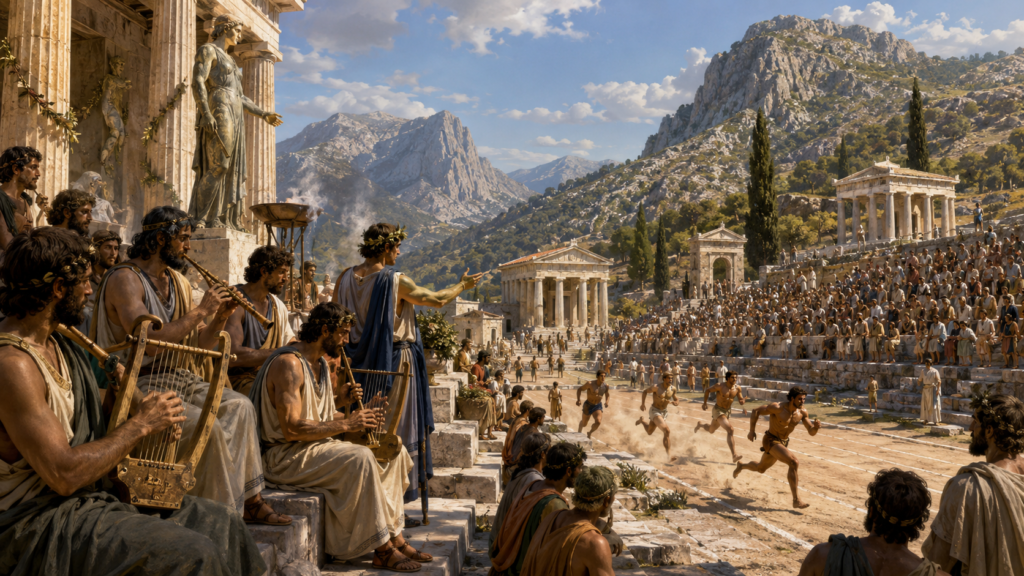
Conclusion
Greek mythology is not a closed chapter of history but a living body of stories that continues to inspire the human imagination. From the primordial Chaos to the established order of Olympus, from the Labors of Heracles to the journey of Odysseus, every myth forms part of a vast mosaic that seeks to understand the human condition. In a world that is constantly changing, the gods, heroes, and monsters of Greek mythology remain enduring points of reference—mirrors in which modern humanity continues to recognize itself.
FAQ
1. What is the difference between myth and religion in ancient Greece? In ancient Greece, there was no strict separation between myth and religion: myth formed the theological foundation of religious practice. Worship, with its sacrifices and festivals, was rooted in stories about the gods, yet it did not require dogmatic belief in every detail of those myths.
2. Who are the twelve gods of Olympus? The classical Twelve Olympians consist of Zeus, Hera, Poseidon, Demeter, Athena, Apollo, Artemis, Ares, Aphrodite, Hephaestus, Hermes, and either Hestia or Dionysus, depending on the tradition.
3. What was Titanomachy? It was the ten-year conflict between the Olympian gods, led by Zeus, and the Titans, led by Saturn, which resulted in the victory of the Olympians and the establishment of the new divine order.
4. Why did Cronus swallow his children? Because a prophecy predicted that he would be overthrown by one of his sons, just as he had done to his father Uranus.
5. Who was the most important hero of Greek mythology? There is no single answer, as each hero embodies different virtues. Heracles symbolizes physical strength and redemption, Odysseus represents intelligence and cunning, Achilles exemplifies martial excellence, and Atalanta stands for courage and independence.
6. What did Medusa symbolize? Medusa is often interpreted as a symbol of the deadly danger behind beauty, but also as an image of power· Her head, Gorgonio, was later used as a deterrent symbol against evil.
7. What is the relationship between Iliad and Odyssey? Both epics are attributed to Homer and relate to the Trojan War: Iliad focuses on the last years of the siege of Troy and the wrath of Achilles, while Odyssey tells of the journey back to Ithaca.
8. Why are the gods of Olympus presented with human flaws? This anthropomorphic approach made the gods more understandable and contemplating, while at the same time explaining physical and moral phenomena through their actions and passions.
9. What were Eleusinian Mysteries? They were mysterious ceremonies dedicated to Demeter and Persephone, closely associated with the myth of Persephone's grab, promising the initiates a more favorable posthumous fate.
10. How did Greek mythology affect Roman religion? The Romans largely adopted the Greek divine system, matching their own gods with the Greeks (e.g. Zeus became Jupiter, Aphrodite became Venus), while maintaining particularly Roman elements.
11. What is the most famous monster of Greek mythology? Although there are many famous monsters, Minotaur and Medusa are considered among the most recognizable internationally, thanks to their long artistic and literary presence.
12. Why are we still studying Greek mythology today? Because it offers timeless standards for understanding human nature, while at the same time it is a foundation stone for literature, art, philosophy and even modern psychology.
13. What is the difference between Titans and Olympian gods? Titans are the previous generation of gods, children of Gaia and Heaven, while Olympians are mainly children of Saturn and Rea (or their descendants) who overturned Titans and took over secular power.
14. Who wrote Theogonia and what does it deal with? Theogonia was written by Hesiod, around the 7th-8th century B.C.E., and deals with the genealogy of the gods from the archegon Chaos until Zeus' power is established.
Ancient Sources
Hesiod, Theogony
Hesiod, Works and Days
Homer, Iliad
Homer, Odyssey
Apollodorus, Library
Pausanias, Greece Tour
Pindar, Wins
Apollonius Rodius, Argonauts
Modern Bibliography
Walter Burkert, Greek Religion
Robert Graves, The Greek Myths
Karl Kerényi, The Gods of the Greeks
Timothy Gantz, Early Greek Myth
Jenny March, Dictionary of Classical Mythology
Richard Buxton, The Complete World of Greek Mythology
Sarah Iles Johnston, Ancient Greek Divination