
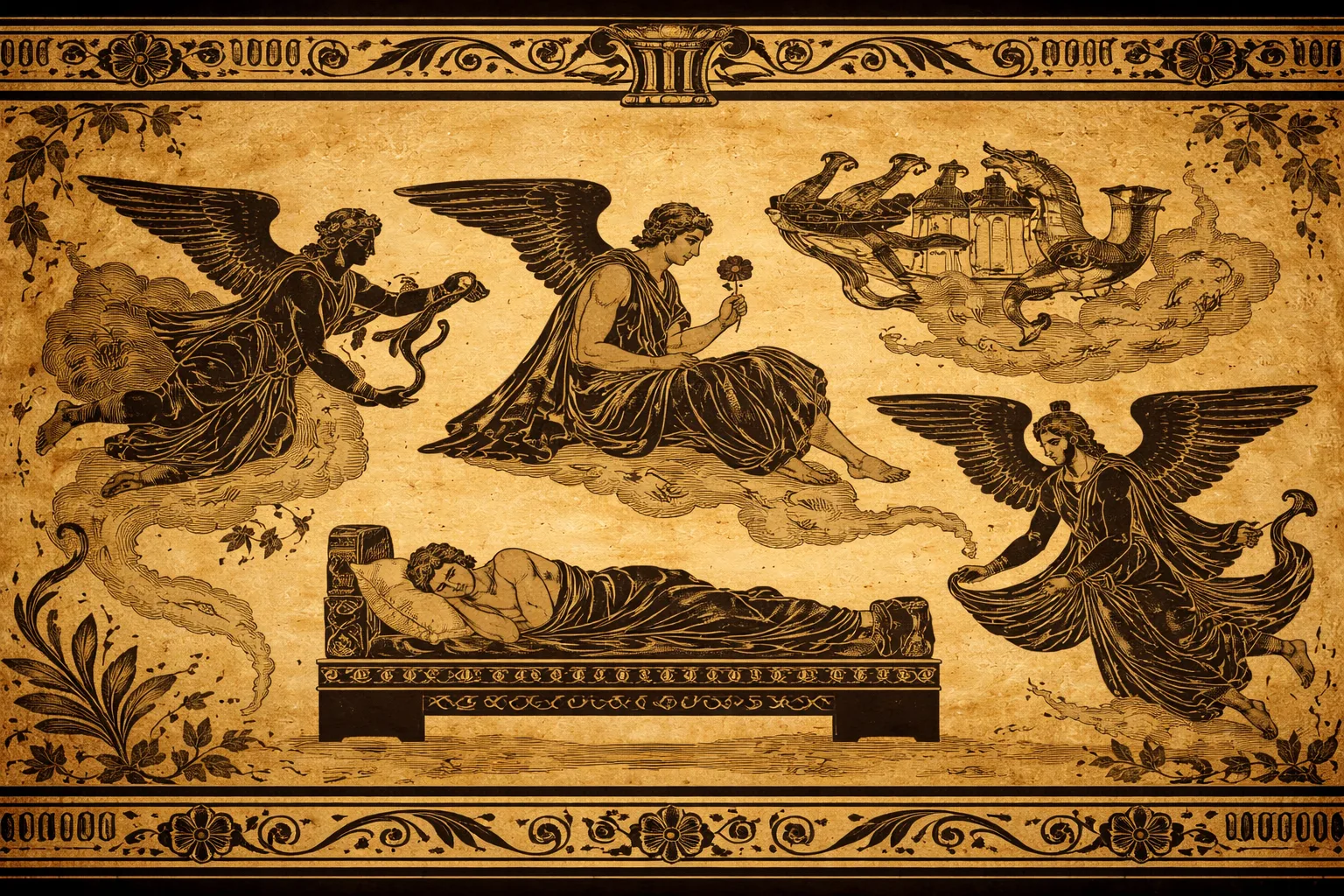
The Dream (Oneiros) He is the personification of dreams in Greek mythology. In ancient texts, the Oneiroi are divine beings who convey to humans the dreams sent by the gods, and they are closely associated with Hypnos and Nyx.
In Greek mythology, Oneiros is not always an individual figure or a strictly defined god of dreams. Ancient tradition most often refers to the Oneiroi or Oneiroi, that is, a group of divine or demonic beings that dwell at the boundaries of sleep, the night, and the invisible world. Before arriving at a simple definition, we need to distinguish between the different ancient versions: in Hesiod, the Oneiroi are the children of Nyx, Homer They act as messengers of divine will, while in Ovid they appear more personified through figures such as the MorpheusThe Fantasus and the Fearer.
Thus, the term Oneiros can mean either the dream experience itself or a divine force that conveys it. In conclusion, when we speak of Oneiros in Greek mythology, we should remember that we are more often referring to the Oneiroi: the numerous, mysterious deities of sleep who connect the world of mortals with the divine, the prophetic, and the depths of the psyche.
Who were Dream's parents?
In Greek mythology, its origin Dream (Oneiros) It is mainly associated with the primary deities of darkness and night. According to the Theogony of Hesiod, Dreams (Oneiroi) are among its children. Night (Nyx), one of the oldest and most powerful cosmogonic deities. Night gave birth on her own to many personifications of abstract concepts, such as Sleep, Death, Moros, the Fates, and Dreams, with no mention of a father’s involvement.
In later ancient traditions, the Nyx presented as his companion Erebus, the personification of utter darkness. Thus, several contemporary scholars note that the Dreams are considered the children of Nyx and Erebus, although this version is not explicitly expressed by Hesiod. For this reason, the prevailing view is that the mother of Dreams was Night, while Erebus only appears in some later genealogical recompositions.
Dreams belonged to the same family as Sleep (Sleep) and Thanatos (Death), two deities symbolizing the subtle transition between alertness, sleep and the end of life. This kinship highlights the close relationship that ancient Greeks perceived between dreams, night, and invisible forces that affect the human mind.
| Person | Relationship with Dream |
|---|---|
| Night (Nyx) | Mother according to the Theogeny of Hesiod |
| Erebus | Father in some later traditions |
| Hypnos | Brother |
| Thanatos | Brother |
| Moros | Brother |
| Keres | Sisters |
Ancient sources
The most important source of Dream origin is Theogony of Hesiod (f. 211–232), where Dreams are listed among Night's children. Later, Homer in Iliad and Odyssey It does not focus on their genealogy, but on their role as divine messengers who convey true or deceptive dreams to humans.
Summary: According to the prevailing tradition, Dreams were her children Nyx, while in some later sources they are considered descendants of Night of Erebus. Their close affinity with Sleep and Death reflects the deep connection of dreams to night, sleep, and mystery of human psychism.
The Oneiroi in Hesiod’s Theogony
To understand the position of the Dreams, we must first see the genealogical framework of Theogenia. Hesiod presents Nyx as a primary force, born of Chaos, which brings to the world a multitude of dark, inevitable and marginal forces: Fates, the Candle, sleep, sleep Thanatos, Nemesis, Friendship in certain interpretive relationships, but also the Dreams. The Nyx is not just a time period· It's a cosmic principle, mother of those that happen beyond man's control.
Within this setting, the Oneiroi do not appear as radiant Olympian gods. They belong more to the realm of chthonic and primordial forces, where silence, darkness, sleep, and ignorance of the future meet. Their kinship with Hypnos and Thanatos is especially important: all three operate in states where human consciousness withdraws. Sleep is a temporary pause, death is a final departure, while the dream is an intermediate experience in which the soul seems to see images beyond everyday reality.
Hesiod’s account does not provide detailed personalities for the Oneiroi. This is crucial, because it corrects a common modern misunderstanding: in Hesiod, there is no single central “god of dreams” with a specific biography. There is a race of Oneiroi, born from Night, related to the powers of sleep and fate. In conclusion, the Oneiroi in the Theogony are a collective divine presence, not necessarily one separate deity with an individual cult.
The Two Gates of Dreams in Homer
To interpret Homeric symbolism, we need to transfer to Odyssey, on the scene where Penelope talks about the two gates of dreams. One is made of horn and the other is made of ivory. Dreams passing through the horn gate are considered true and material, while those passing through the ivory gate are deceptive, charming but false.
This distinction is not accidental. In ancient Greek, horn, keras, is associated through wordplay with krainein, meaning fulfillment or realization, while ivory is connected with elephairesthai, deception. Even if this etymological link does not operate according to modern linguistic analysis, it reveals the way ancient people connected the sound of words with the interpretation of the world.
Penelope uses this distinction because she stands before deep uncertainty: she awaits Odysseus, fears the suitors, and wonders whether her dream contains divine truth or merely human illusion. In conclusion, the two gates of dreams in Homer express a central question in Greek mythology: when is a dream a message from the gods, and when is it only the shadow of desire or fear?
Morpheus and the Other Sons of Hypnos
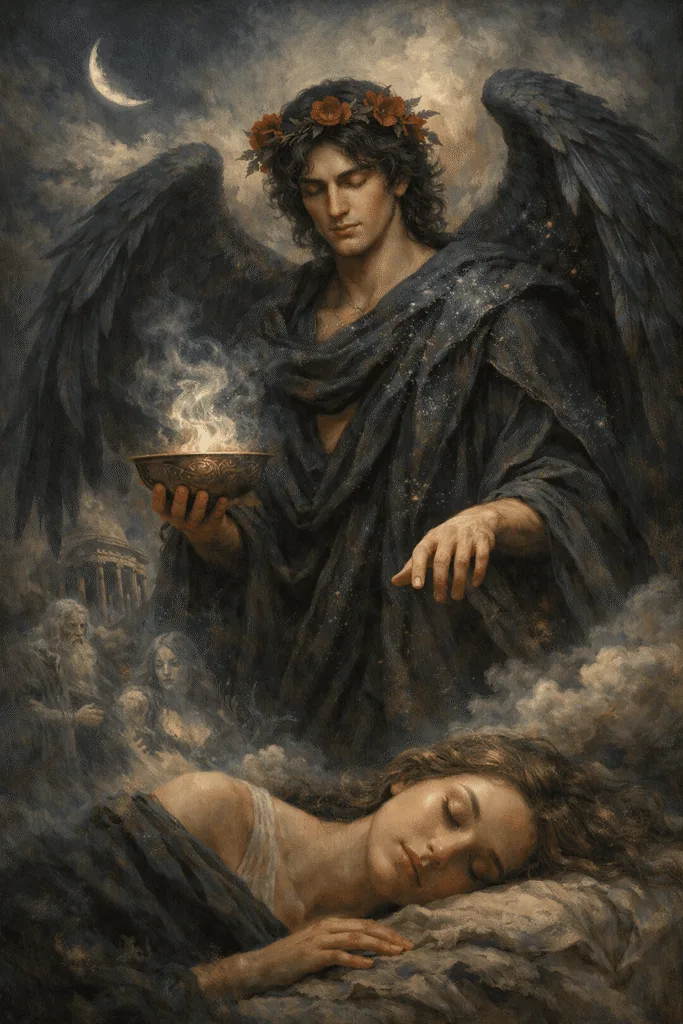
Before we present him Morpheus;, the Fearer and Fantasus, needs an important clarification. These three forms do not belong in the same way to the oldest Greek tradition. Their most known systematic presentation is in Ovid, in Metamorphosis, i.e. in Latin work of the Roman era that uses Greek mythological material. Therefore, it is right to include them in the wider Greco-Roman myth, but with caution not to think that Hesiod or Homer already describe them so thoroughly.
Morpheus
The interpretation of the name Morpheus leads to the word «Form». Morpheus is the one who gives human shape to dreams. In Ovid, he has the ability to imitate faces, movements, voices, and attitudes of people, appearing in sleeping images that look completely convincing. This is why in modern imagination he became the foremost god of dreams.
If we examine his role, we see that he does not simply create random images. He functions like a craftsman of dream-form: he transforms desire, fear, or divine message into human presence. In conclusion, Morpheus is the formative power of the dream, the god who makes the immaterial appear alive.
Phobetor or Icelos
Phobetor, also called Icelos, is connected with animal forms and often with the frightening side of dreams. The name Phobetor recalls fear, while Icelos is related to likeness, meaning the ability to take on an appearance resembling something real. In Ovid, he is the one who shows beasts, birds, snakes, and other non-human creatures in dreams.
This function explains why dreams in ancient Greece could be regarded not only as prophetic but also as disturbing. Animals in a dream could symbolize danger, strength, wildness, or hidden impulses. In conclusion, Phobetor or Icelos expresses the animalistic, threatening, and instinctive aspect of dreams.
Phantasos
Phantasos is associated with inanimate things, landscapes, waters, stones, trees, and the strange images that fill sleep. His name is related to fantasy and phantasm, that is, the appearance of images not present in material reality. His role shows that the ancients understood the dream as a scenic universe, not merely as an encounter with persons.
If Morpheus brings people and Phobetor brings animals, Phantasos creates the space in which all these move. In conclusion, Phantasos is the force of the dream image, of illusion and atmosphere, which makes the dream resemble an autonomous world.
Dreams as Divine Messages
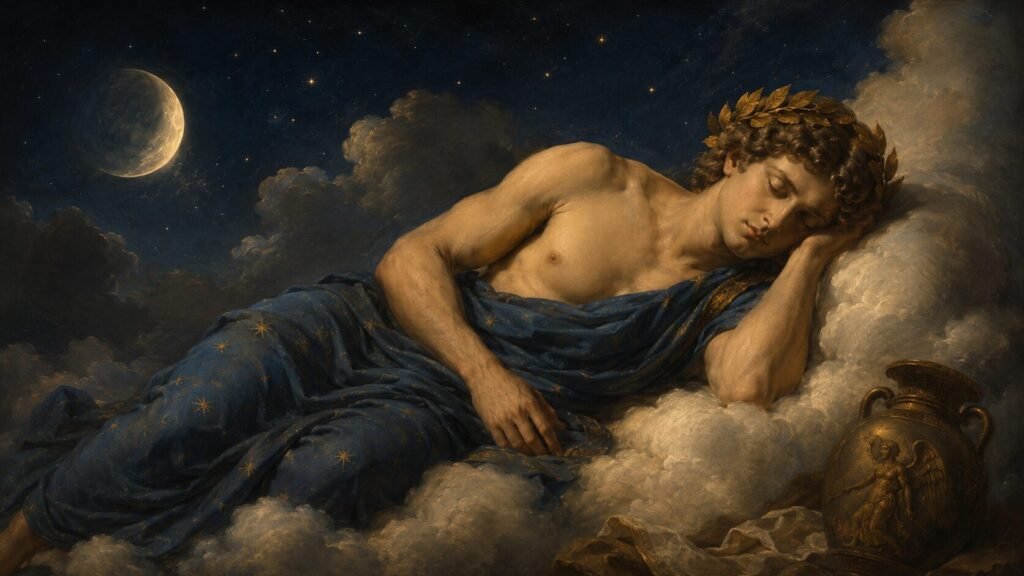
To understand the importance of dreams in ancient Greece, we must remember that the gods did not communicate only through oracles, omens, and sacrifices. They often sent dreams, because sleep was considered a state in which human beings were more receptive to messages beyond waking reason. A dream could be a warning, command, consolation, or trap.
In Iliad, Zeus sends to Agamemnon a deceptive dream, which takes Nestor's form and motivates him to attack the Trojans. The example is decisive, because it shows that a divine dream is not necessarily beneficial. He may serve a wider plan that the mortal does not understand. In Odyssey, dreams are associated with the agony of return, faith, waiting, and doubt.
The ancients knew that dream interpretation was difficult. A dream could be true, false, symbolic, or obscure. In conclusion, dreams as divine messages carried great weight in decision-making, but they required discernment, because divine origin did not always mean easy or safe understanding.
Incubation in the Sanctuaries of Asclepius
Before explaining the abortion, we need to see the role of Asclepius. THE Asclepius (Aesculapius) is not a god of dreams in the same sense that later became the Morpheus; He's a god of healing. However, his sanctuaries, Asclepieia, were deeply associated with the healing power of sleep and dreams.
Incubation was the ritual stay of a patient in a sacred space, usually after purifications, offerings, and prayers. The patient slept in the abaton or in a special area of the sanctuary, waiting to see a dream in which Asclepius would appear, give an instruction, or symbolically perform the healing. In inscriptions from Asclepieia, such as that of Epidaurus, we find accounts of miraculous cures connected with nocturnal visions.
This practice shows that dreams in ancient Greece were not only mythological motifs but also part of religious experience. Body, soul, and divinity met in sleep. In conclusion, incubation reveals a therapeutic dimension of the Oneiroi: the dream could become a place of diagnosis, hope, and contact with divine healing.
Symbolism of Dreams in Greek Mythology
To approach the symbolism, we must avoid anachronism. The ancient Greeks did not speak of the “subconscious” in the modern psychoanalytic sense. Nevertheless, they recognized that dreams reveal fears, hopes, desires, and hidden anxieties. A dream could come from a god, but it could also reflect the inner state of the human being.
The relationship with the soul is particularly interesting. In sleep, man seems to be moving away from normal order of the day. He sees dead, gods, distant places and future events. That’s why the dream acts as a bridge between mortals and gods, but also between life and the world of shadows. The relevance of Dreams to Nyx, Sleep and Death strengthen this limitless nature.
In conclusion, the symbolism of dreams in Greek mythology is twofold: on the one hand, they express divine communication; on the other, they reveal the inner world of the human being. This is why they remain such a powerful mythological theme.
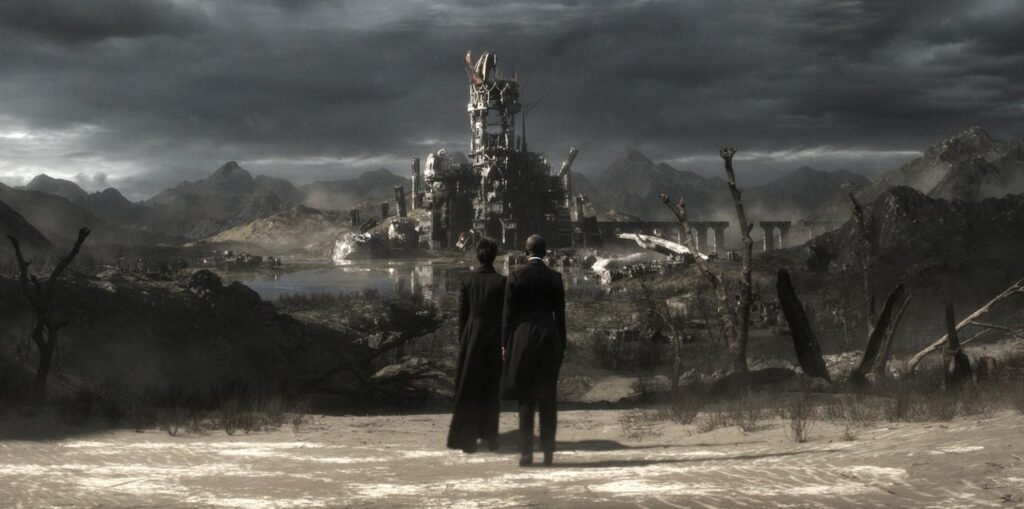
Oneiros in Modern Literature and Pop Culture
To see the modern presence of Dream, we must begin by its great survival Morpheus;. His name is often used as a synonym of sleep and dream experience. In fantasy literature, comic books, cinema and video games, Morpheus sometimes appears as a god, sometimes as a dream lord, sometimes as a dark form that controls illusions and alternative realities.
Pop culture often combines elements from Greek mythology with newer ideas about the unconscious, dimensions, dreams within dreams, and the power of imagination. Thus, the god of dreams is transformed into a character who rules entire worlds, not merely nocturnal images. This development is not ancient in the strict sense, but it creatively continues an ancient question: who controls the images we see when we sleep?
In conclusion, Oneiros survives in modern culture mainly through Morpheus and through the idea that dreams are places of power, revelation, and transformation.
Ancient Sources and Testimonies
To form a reliable picture, we must compare the sources rather than merge them uncritically. Hesiod, in the Theogony, gives us the oldest genealogical position of the Oneiroi: they are children of Night and relatives of Sleep and Death. From this, we learn above all their cosmic and chthonic nature.
Homer, in the Iliad and the Odyssey, shows us the function of dreams within narrative. In the Iliad, a Dream can be a messenger of Zeus; in the Odyssey, the gates of dreams express the distinction between truth and illusion. Ovid, in the Metamorphoses, offers the best-known literary description of Morpheus, Phobetor/Icelos, and Phantasos as sons of Hypnos. Pausanias, in describing sanctuaries, cults, and statues, testifies that Hypnos and related dream powers could also have a place in local religious traditions, especially in contexts connected with healing or nocturnal experience.
In conclusion, no single source exhausts the topic. The Oneiroi are shaped through poetry, cult, narrative, and later mythmaking.
Conclusion
If we follow the ancient testimonies step by step, it becomes clear that Oneiros in Greek mythology is not a simple and fixed deity. In Hesiod, the Oneiroi are a collective race, children of Night, relatives of Sleep and Death, placed in a dark and primordial region of the cosmos. In Homer, the dream gains narrative power: it may be a divine message, a warning, or a deception, while the two gates of dreams underline the uncertainty between truth and illusion. In Ovid, the dream experience becomes more strongly personified through Morpheus, Phobetor, and Phantasos, figures that deeply influenced later imagination.
The importance of dreams in ancient Greece was not limited to mythology. Incubation in the sanctuaries of Asclepius shows that the dream could be considered a therapeutic tool and a direct space of encounter with the divine. At the same time, dreams expressed fears, hopes, desires, and anxieties, functioning as a mirror of the soul long before modern psychology.
Therefore, Oneiros and the Oneiroi constitute one of the most fascinating themes of Greek mythology. They stand between light and darkness, knowledge and deception, life and death. Final conclusion: the Oneiroi are not merely nocturnal images, but mythological powers that reveal how the ancient Greeks understood the mystery of human experience.
FAQ about Oneiros and the Oneiroi
Question: Is Oneiros a specific god of dreams? Analysis: Ancient sources do not always present Oneiros as a single deity. Hesiod refers to the Dreams in the plural, while Homer may personify a dream as a messenger.
Answer: Therefore, the Dream is not always a single god; more often, it refers to the Dreams, collective deities of sleep and nocturnal visions.
Question: Who are the parents of the Dreams in Greek mythology? Analysis: In Hesiod’s *Theogony*, the Dreams are among the children of Nyx. This lineage links them to primordial and dark forces.
Answer: Dreams are considered the children of Night and relatives of Sleep and Death.
Question: Why is Morpheus considered today the most famous god of dreams? Analysis: Morpheus gained a special reputation because Ovid described him as a force taking human form in dreams. This image was easily exploited by literature and pop culture.
Answer: Morpheus became the most famous god of dreams because he clearly personifies the form and image that appears in sleep.
Question: What do the gates made of horn and ivory symbolize? Analysis: In the Odyssey, Penelope distinguishes true dreams from deceptive ones through two symbolic gates. The horn is associated with reality, while the ivory is associated with delusion.
Answer: The horn gate symbolizes true dreams, while the ivory gate represents false and misleading.
Question: What is the difference between Morpheus, Phobitor, and Phantasos? Analysis: This triad organizes different aspects of the dream image. Morpheus is associated with people, Phobitor with animals and terrifying figures, and Phantasos with inanimate objects and landscapes.
Answer: Their difference lies in the kind of images they create within human dreams.
Question: Did ancient Greeks believe all dreams were prophetic? Analysis: Ancient accounts show that dreams could be true, false, God - sent or unclear. The Odyssey itself highlights this distinction with the two gates.
Answer: No, the ancient Greeks did not consider all dreams prophetic· They thought they needed interpretation and attention.
Question: How does Asclepius relate to dreams in ancient Greece? Analysis: In Asclepieia patients were ceremoniously asleep, hoping to receive a therapeutic dream. This experience was called abortion.
Answer: Asclepius is related to dreams as a god who could cure or guide the patient through dream appearance.
Question: Was there a cult of Dreams in ancient times? Analysis: Dreams did not have nationwide worship like Zeus or Athena. However, local testimonies and sacred contexts show that the powers of sleep and dreams were recognized religiously.
Answer: There was no great single worship of Dreams, but there were local and ceremonial connections to sleep, healing and night.
Question: What do dreams mean in Greek mythology on a symbolic level? Analysis: Dreams appear in moments of uncertainty, fear, anticipation or divine intervention. Therefore, they are not mere images but marginal experiences.
Answer: They symbolize the bridge between humans and gods, but also between the soul, desire and unknown truth.
Question: What ancient source is more important for the study of Dreams? Analysis: Each source illuminates different sides: Hesiod the origin, Homer the function, Ovid the personification and Pausanias the cult environment.
Answer: There is not a single most important source· the complete picture is derived from the comparison of Hesiodon, Homer, Ovid and Pausania.
Discover more Greek deities in our collection.
Ancient Sources
Hesiod
- Hesiod.Theogony, f 211–232.
- It describes Night (Nyx) as the mother of Dreams, Sleep, Death and other personifications.
Homer
- Homer.Iliad, 2nd 5–34.
- Zeus sends a deceptive dream to Agamemnon before the battle.
- Homer.Odyssey, 560–569 (Book 19).
- The famous allegory of the two gates of dreams, of horn and ivory.
Ovid
- Ovid.Metamorphoses, Book XI, 592–649.
- He describes the house of Sleep and presents his sons, Morpheus, Ikelo (Fobitore) and Fantaso.
Hygiene
- Hyginus.Fabulae.
- It includes genealogical reports about Sleep and associated deities.
Modern Bibliography
Oxford University Press
Hard, Robin. The Routledge Handbook of Greek MythologyRoutledge, 2004.
Graves, Robert. The Greek MythsPenguin Books, 1955.
West, M. L. Hesiod: TheogonyOxford University Press, 1966.
Gantz, Timothy. Early Greek MythJohns Hopkins University Press, 1993.
Morford, Mark P. O., Lenardon, Robert J., & Sham, Michael. Classical MythologyOxford University Press.
Smith, William (ed.). A Dictionary of Greek and Roman Biography and MythologyLondon: John Murray, 1873.
Grimal, Pierre. The Dictionary of Classical MythologyWiley-Blackwell.
Digital sources
- Perseus Digital Library – Texts of Homer, Hesiod and other ancient writers.
- Theoi Greek Mythology – Gathered ancient sources for Dream, Dreams, Sleep and Morpheus.
- Loeb Classical Library – Bilingual scientific publications of ancient Greek and Latin texts.