
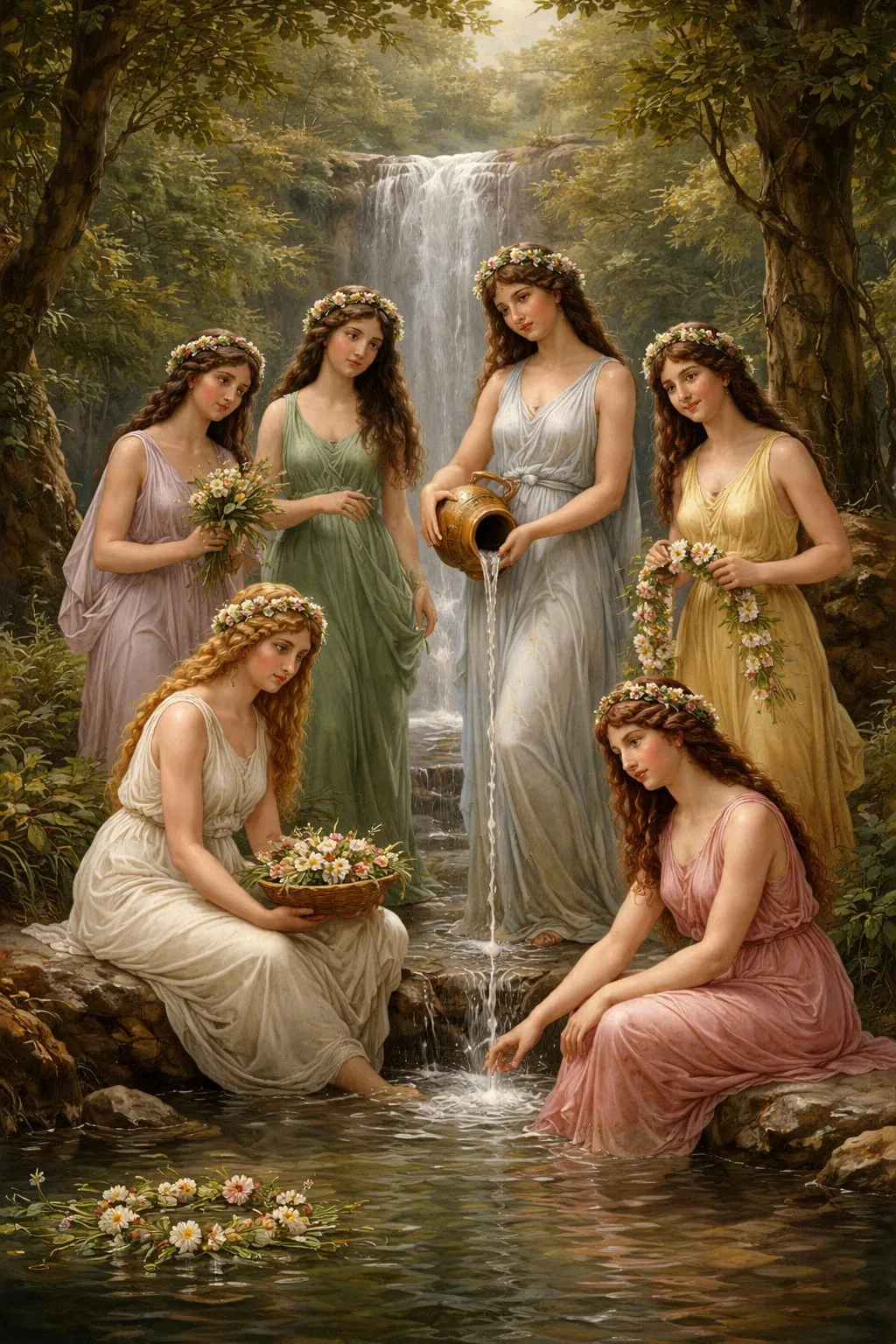
The Nymphs and Spirits of Nature
The Nymphs are female spirits of nature, associated with mountains, forests, springs, rivers, trees and meadows. They are not immortal in the same way as the Olympian godsBut often they have a very long life and divine standing. They are distinguished in various categories, such as Naiads water, Orestiades the mountains, Dryads the trees and Nereids of the sea. Nymphs appear in many sources, from Homer and Hesiod to Homerian hymns and later poetry.
Their appearance is anthropomorphic, usually youthful and beautiful. Unlike many Greek mythological monsters, Nymphs do not cause terror. However, their relationship with humans can be ambivalent. They can help, fall in love with mortals, give birth to heroes, but also cause mania or loss to those who violate their space. The word «nymmol» declares a man possessed by the Nymphs, an element showing the power of their presence in religious imagination.
The Nymphs link mythology to the sanctity of the landscape. Sources, caves and groves could be considered their dwellings and accept worship offerings. In ancient Greek thought nature is not lifeless matter, but full of presences and powers. Nymphs are the most characteristic expression of this perception. In conclusion, while not belonging to monsters and heroes in the conflict sense, they are necessary for understanding the mythological landscape of the Greeks.
Nymphs are among the most beautiful and beloved forms of Greek mythology. They were deities or semi-divine spirits of nature residing in forests, mountains, rivers, sources, lakes and seas. Although they did not belong to the great gods of Olympus, they held an important place in ancient religion and worship, as they were considered patrons of natural places and personifications of nature's life force.
Ancient Greeks believed that every river, source, forest or mountain could host Nymphs. Their presence was linked to the beauty, fertility, development of life and harmony of the natural world. Despite their generally beneficial nature, they could become dangerous when people offended the sacred places they protected.
What was the nature of the Bridesmaids?
Nymphs were considered inferior deities or demonic forces of nature. They were not immortal like the Olympian gods, but lived extremely long periods of time and maintained eternal youth and beauty.
They were usually presented as young women of extraordinary grace, dressed in light garments or wreaths of flowers and leaves. They lived in close connection with their natural environment and their existence was inextricably bound to it. If the place they protected were destroyed, their very existence was often in danger.
The categories of Bridesmaids
The Nymphs were divided into various categories depending on the natural element they protected.
Dryads and Hamadryads
Dryades were Nymphs of trees and especially oaks. Amads were so closely associated with a particular tree that they were born and died with it. For this reason the ancients considered it a sacred act to protect forests.
Naiads
The Naiads were sweet water nymphs. They lived in springs, rivers, lakes, and streams. They believed that the waters they protected had healing or divination properties.
Nereids
The Nireides were sea Nymphs and daughters of Nerea and Doris. They lived in the depths of the sea and helped sailors and heroes. Among them stands Thetida, the mother of Achilles.
Oceanids
Oceanides were daughters of the Ocean and Tethyus. They were connected to rivers, springs, clouds, and every form of water life. They were one of the most populous groups of divine figures in Greek mythology.
Oreads
The Mountains were Nymphs of the mountains and caves. They were associated with wild and isolated landscapes and often followed the goddess Artemis on her hunts.
The Nymphs in myths
Nymphs appear in countless myths of Greek tradition. They often help gods and heroes, raise children of divine origin or participate in important mythological events.
Nysa’s Nymphs, for example, took up his upbringing Dionysus when she was still an infant. Other Nymphs took care of Zeus during his childhood in Crete, protecting him from Cronus.
At the same time, many stories tell love among Nymphs and gods or mortals. These relationships often led to the birth of heroes, royal generations and other important forms of mythology.
The Brides and the gods
The Nymphs were closely associated with many deities. They were frequent followers of Artemis, participating in its hunts and wanderings in the forests and mountains.
They also accompanied Dionysus to the dionysal processions together with Satyrus and MoonsTheir relationship with the god of wine and fertility highlighted their role as life and natural abundance carriers.
Poseidon, on the other hand, was particularly associated with Nereids and other sea nymphs residing in his kingdom.
The Worship of Bridesmaids
Nymphs were worshiped throughout the Greek world. Sources, caves and groves dedicated to them were called Nymphea and were considered sacred places.
The faithful left offerings such as flowers, fruits, milk, honey and small vases. They believed that Nymphs could offer fertility, health, inspiration and protection.
Their worship continued to flourish even during the Roman era, which proves their great popularity.
The Symbolism of Bridesmaids
The Nymphs symbolize the vital power of nature, beauty, fertility, and harmony between man and the natural environment. They represent the divine presence that ancient Greeks believed existed in every river, tree, and mountain.
Their close connection with the environment expresses the perception that nature is alive and sacred. Through the Nymphs, Greeks gave human form to the forces that made the world fertile and beautiful.
The Legacy of Bridesmaids
The Nymphs deeply influenced western art, literature, and folklore. The image of the beautiful women's spirits of nature reappears in Renaissance paintings, poems and contemporary works of imagination.
Even today, Nymphs remain symbols of the natural beauty and spiritual connection of man to the environment. As patrons of nature, they are still one of the most charming and timeless forms of Greek mythology.
In the world of Greek mythology, the Nymphs hold a special place between the gods and humans. They do not belong to the pantheon of Olympian deities, but are neither mortal. These are spirits of nature, inextricably linked to the landscapes that inhabit: forests, rivers, mountains, seas and springs. Their presence reflects the ancient Greek notion that nature is alive, inspired and sacred.
The Nymphs were considered beautiful, eternal young and filled with grace. They often appear in myths as attendants of gods, mistresses of deities or patrons of certain places. Although they were not immortal in the strict sense, they lived extremely long and were associated with the life span of the natural element they represented.
The Nymphs personify the forces of nature. Every Bride is not just a resident of a place, but his very soul. For example, a nymph of a source does not just protect water — is his own vital energy.
In ancient Greek religious thought, the Nymphs were the object of worship. People paid them honors, offering sacrifices in caves, groves, and sacred waters. These places were considered sacred and were often forbidden from desecration.
Nymphs are distinguished in various categories depending on the physical element to which they belong.
Dryads and Hamadryads
Dryades are the Nymphs of trees and forests. A special category is Amads, whose life is inextricably linked to a particular tree. If the tree is cut or dies, the Bride dies. This myth reflects the deep respect of ancient Greeks for nature.
Naiads
Naiades are the nymphs of sweet waters: springs, rivers and lakes. They were often considered therapeutic and associated with the cure of diseases. People visited their sources for cleanness and blessing.
Nereids
Nireides are sea Nymphs, daughters of Nerea. They live in the sea and are associated with the waves and peace of water. They are often presented as friendly to sailors.
Oreads
The Mountains are the Brides of the mountains. They reside in caves and peaks, linking their form to the wild and imposing nature of mountain areas.
Nymphs of meadows and plains
There are also Nymphs related to meadows and fertile plains, linking their presence to earth's fertility.
Nymphs appear in many myths, often in contact with gods and heroes. They are not mere spectators but active persons who influence the evolution of events.
Many Nymphs have been lovers of gods, especially of Zeus and Apollo. From these associations were born heroes and important figures of mythology. In other cases, Nymphs function as food and child protectors, taking care of gods or heroes during their childhood.
However, they are not always favorable to people. In some myths, insulting a Bride or her sacred place leads to punishment, often in the form of madness or destruction.
Nymphs often accompany great deities. They are closely related to the goddess Artemis, which they follow in hunting, and with Dionysus, participating in dionysian dances and ceremonies.
Their presence enhances the connection of gods to nature. Through the Nymphs, the gods are not cut off from the world, but actively present in all its elements.
The worship of the Bridesmaids was widespread throughout the Greek world. Sacred groves, caves and springs were places of worship, known as the bridegroom. There the faithful left offerings such as vases, figurines, and fruit.
The bridegrooms were places of calm and meditation, where man came in contact with the divine through nature. The destruction of such a place was considered sacrilege.
The Nymphs symbolize harmony between man and nature. They express the idea that every natural element has a soul and deserves respect.
At the same time, they represent the female creative power, fertility and renewal of life. Their presence in myths reminds the delicate balance between culture and the natural environment.
Conclusion
Nymphs are one of the most charming and multidimensional institutions of Greek mythology. Through them, the ancient Greeks expressed their respect for nature and belief that the divine is everywhere around them.
They are not merely mythical beings, but symbols of a worldview where the world is alive, sacred and full of presence. Today, the Nymphs continue to inspire literature, art and imagination, keeping alive the legacy of ancient Greek thought.
Discover more Greek deities in our collection.
Ancient Sources
- Theogenia, p. 346–370 and 965–1020.
- Odyssey, various references to Nymphs and Nymphea.
- Hymns, especially the hymns to Mercury and Venus.
- Metamorphosis.
- Tour of Greece.
Modern Bibliography
- The Greek Myths.
- Early Greek Myth.
- The Complete World of Greek Mythology.
- Greek Religion.
- Dictionary of Classical Mythology.