
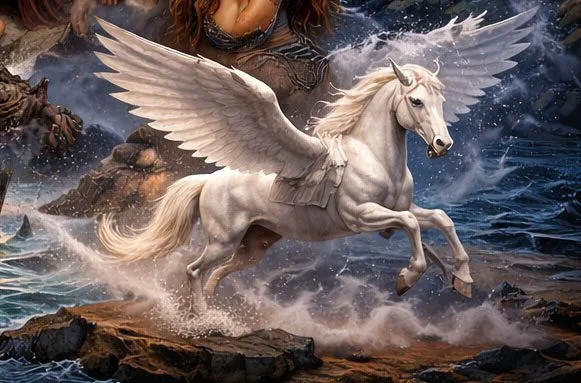
- Pegasus is one of the most iconic mythical creatures of ancient Greek mythology. As feathered horse with divine origin, it is inextricably linked to the birth of inspiration, poetry and transcending human boundaries. Pegasus' form holds a central position in both mythological narrative and ancient art, acting as a symbol of creative power and spiritual elevation.
Pegasus is one of the most famous and recognized creatures in Greek mythology. This winged horse symbolizes freedom, inspiration, power and transcending human boundaries. His form inspired poets, artists and writers from ancient times to the present day, making him one of the most timeless symbols of the ancient Greek world.
The birth of Pegasus
According to Greek mythology, Pegasus was born in a wonderful way. He was the son of the god of the sea, of Neptune, and Mermaid Medusa. When the hero Perseus He decapitated Medusa, from the blood shed were born Pegasus and his brother Chrysaor. His birth was thus associated with one of the most famous mythological episodes of ancient Greece.
From the first moment of its existence, Pegasus stood out from all other horses. His large white wings allowed him to fly to the heavens, cross mountains and seas, and move between the world of gods and men.
Pegasus and the Muses
One of the most important traditions around Pegasus is associated with Muses, the deities of art, poetry and knowledge. According to one myth, the winged horse struck with its hoof Mount Elikona, creating the famous source Hippocrine.
The waters of Hippocrine were considered sacred and believed to give poetic inspiration to those who drank from them. For this reason, Pegasus became a symbol of creativity, spiritual elevation and artistic expression. Even today, his name is often used as a metaphor for imagination and inspiration.
Bellerophon and Pegasus' charge
The most famous story in which Pegasus stars is his relationship with the hero BellerophonThe young hero wished to acquire the winged horse, but no mortal could easily reach it.
With the help of goddess Athena, Bellerophon acquired a gold bridle. Using it, he managed to tame Pegasus and become his rider. Together they carried out many great achievements and became one of the most legendary twins of Greek mythology.
The Battle With Chimera
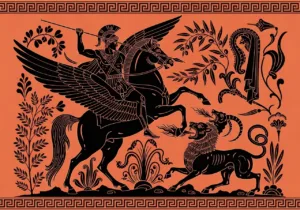
The most important achievement of Bellerophon and Pegasus was their victory over Chimera. This terrible monster had a lion's body, goat's head and snake tail, while flames were emitted from his mouth.
Ride the Pegasus, Bellerophon was able to attack from the air, avoiding the monster's flames and blows. Thanks to the speed and agility of the feathered horse, the hero finally managed to kill Chimera and become famous throughout Greece.
The fall of Bellerophon
But success led the Bellerophon to arrogance. Believing he deserved to live among the gods, he decided to fly with Pegasus to Olympus.
The gods considered the act of the hybrid, or insult to divine order. Zeus sent an insect to bite Pegasus, resulting in Bellerophon losing his balance and falling to earth. The hero survived, but lived the rest of his life isolated and unhappy.
This myth acted as a reminder that humans should not exceed the limits set by the gods.
Pegasus in Olympus
After the fall of Bellerophon, Pegasus continued to fly free until he reached Olympus. There he became a servant of Zeus and undertook to carry the lightnings of the king of the gods.
As a reward for his services, Zeus placed Pegasus among the stars. Thus the constellation Pegasus was created, which is visible even today in the night sky.
The Importance of Pegasus
Pegasus is not just a mythological creature. It symbolizes freedom, the power of imagination, spiritual upliftment and the search for the highest ideal. At the same time, the history of Bellerophon recalls the danger of arrogance and the importance of the measure.
The image of the feathered horse remains alive in literature, art and contemporary culture, proving that the myths of ancient Greece still inspire people around the world. Pegasus still flies into collective imagination as an eternal symbol of freedom and creative inspiration.
Etymology and Name
Name Pegasus is probably spoken by the word «spring», suggesting his close relationship with water and life creation. This connection is reinforced by the myth of the birth of the sacred spring Hippocrine In Elikon, when Pegasus struck the ground with his hoof.
Origin and Birth
According to mythological tradition:
Father: Poseidon
Mother: Medusa
Pegasus was born from the neck of Medusa the moment she was beheaded by Perseus. He was born with him and ChryssaorBrother of Pegasus. This birth suggests the transition from chaos and horror to a new creative and spiritual power.
Morphology and Natural Characteristics
Pegasus is depicted as:
white horse
with large, strong wings
body noble and harmonious
His iconography highlights Purity, the speed and freedom.
Pegasus and Bellerophon
The most famous legend of Pegasus is connected to the hero Bellerophon. With the help of the goddess Athena, Bellerophon managed to tame Pegasus and use him to defeat her ChimeraOne of the scariest hybrid monsters in mythology.
This cooperation shall symbolize:
the combination of human virtue and divine power
overcoming the weak through wisdom
Hubris and Fall
Later, the Bellerophon attempted, on Pegasus, to climb Olympus. This operation was considered to have been the subject of an investigation. hybrid. Zeus sent an insect to bite Pegasus, resulting in the hero falling to earth.
But Pegasus:
He climbed Olympus
became carrier of Jupiter's thunders
converted into immortal symbol
Pegasus and the Muses
Pegasus is directly linked to Muses and Helicon. Source Hippocrine, created by his hoof, was considered a source of poetic inspiration.
So Pegasus became:
a symbol of poetry and art
patron of poets
body of intellectual creation
Symbolism
Pegasus symbolizes:
the freedom of the spirit
the lifting of the soul
the association of earth and uranium
inspiration and creation
Pegasus in Art and Literature
It is illustrated:
in vases of the archaic and classical era
in sculptures and reliefs
in coins and modern symbols
Pegasus deeply influenced western art and literature to this day.
Ancient Sources
Hesiod, Theogony
Pindar
Apollodorus
Pausanias
Corinth Angiography
Educational Adaptation
Suitable for:
Primary & High School students
training programmes
comparative mythology
Conclusion
- Pegasus is not just a mythical creature, but World symbol of inspiration and spiritual transcendence. His timeless presence confirms the importance of Greek mythology as a foundation of culture and creative thinking.
Ancient Sources
1. Theogenia
Hesiod describes the birth of Pegasus from Medusa's blood after her beheading from Perseus.
Reference:
Hesiod, Theogony, p. 280–286.
2. Library
It mentions the birth of Pegasus, his relationship with Bellerophon and the campaign against Chimera.
Reference:
Apollodorus, Library, II 3.1–2.
3. Olympians
Pindar connects Pegasus with Bellerophon and finding the gold rein that Athena gave.
Reference:
Pindar, Olympians 13.
4. Transformations
It presents the birth of Pegasus and various traditions related to the winged horse.
Reference:
Ovid, Transformations, Book IV.
5. Iliad
Although Pegasus does not appear as a central person, reference is made to Bellerophon and his exploits.
Reference:
Homer, Iliad, VII 155–202.