
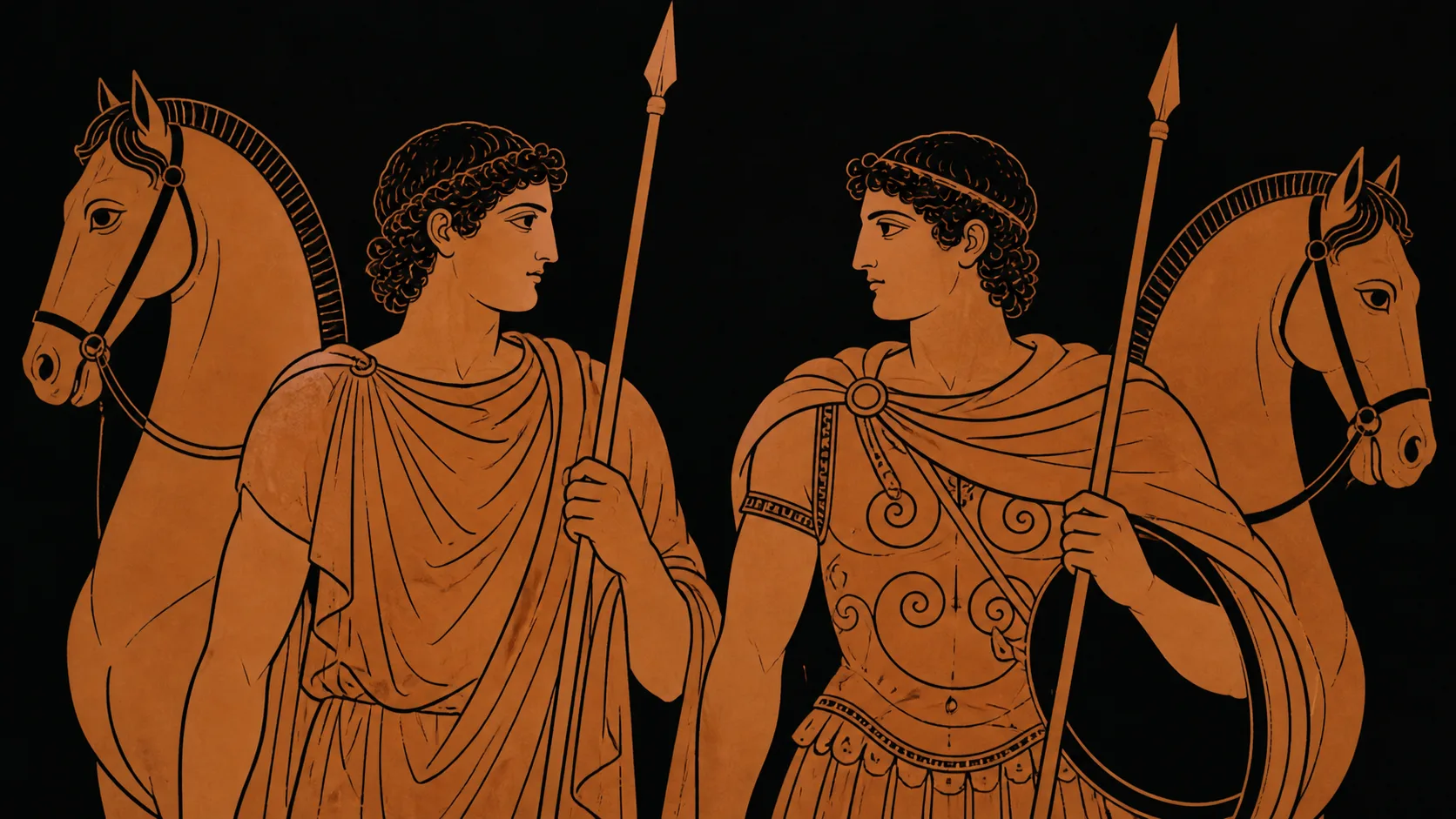
The Dioscuri—sons of Zeus or mere mortals?—are one of the most touching pairs of brothers in Greek mythology. Their love transcended the boundaries of life and death.
Introduction: two brothers, a myth
In the rich world of Greek mythology, few figures embody the bond of brotherhood as powerfully as Castor and Polydeuces. Known collectively as the Dioscuri—meaning “sons of Zeus”— — the two brothers lived together, fought together, and ultimately found a way to remain united even after death. Their story is not merely an adventure—it is a reflection on sacrifice, love, and humanity’s relationship with immortality.
In ancient Greece, the Dioscuri were particularly revered in Sparta, the city from which they originated. Sailors invoked them in times of danger at sea, and the phenomenon of St. Elmo’s fire—the mysterious lights that appeared on ship masts during storms—was considered a protective sign of their presence.
Their origin: human or divine?
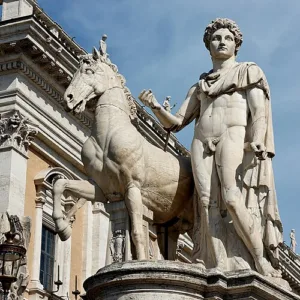
The origin of the Dioscuri is in itself an intriguing story, full of ambiguities and contradictions—something common in mythology, where different cities and traditions shaped the myths according to their own needs.
According to the most widely accepted account, Castor and Polydeuces were the sons of Leda, Queen of Sparta. That same night, their mother was with both the god Zeus—transformed into a swan—and her husband, Tyndareus. As a result of this unique situation, Polydeuces was considered the son of Zeus—and therefore immortal—while Castor was considered the son of Tyndareus—and therefore mortal. This difference in lineage would prove decisive for the course of their story.
However, there are also versions in which both brothers were considered sons of ZeusOr rather, both mortals. This unevenness reflects the way the myth lived and evolved into different communities of the ancient world.
Their abilities: the knight and the boxer
One of the things that makes the Dioscuri unique as a pair is that each of them had his own extraordinary ability—and together they formed a perfect whole.
Castor was an exceptional horseman and horse trainer. His relationship with horses was almost legendary, even in a world full of myths. He was the finest in the art of horsemanship, and his name became synonymous with this virtue in ancient Greece.
Polydectes, on the other hand, was unrivaled in boxing. It was said that no one could defeat him in a fistfight—a talent that was proven time and again throughout their lives.
This combination—the skilled horseman and the undefeated boxer—made them ideal companions on campaigns and in battle. Their complementary roles were both practical and symbolic.
Their adventures: from Argonaut campaign to Calydonia hunting
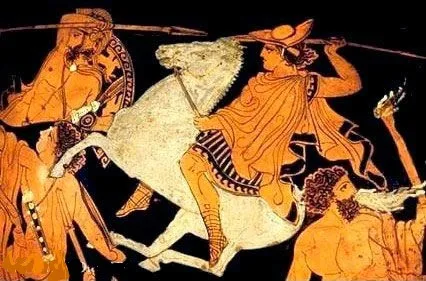
The Dioscuri did not stay idle in Sparta. They participated in some of the greatest adventures that Greek mythology describes.
They were members of the group of Argonauts — that heroic band that followed Jason on his quest for the Golden Fleece. During that expedition, Polydectes faced King Amykos, a giant who forced foreigners to fight him and then killed them. Polydectes defeated him with his exceptional skill in boxing, ridding the region of this threat.
They also took part in the famous Calydonian Hunt—the hunt for the enormous boar that had been sent by Artemis to destroy the Calydon As punishment for the negligence of King Enea. This campaign gathered the most important heroes of the time, and the presence of the Dioscuri among them highlights their high position in the hierarchy of mythological heroes.
Another important act was saving their sister Helen when she was still young. Theseus — the famous king Athens — had the arrogance to kidnap her, considering his worthy companion. The Dioscuri invaded Attica and recovered it, showing that brotherly love was equally true to the female figures of their family.
The clash with the Apharetids and the death of Castor
The most dramatic episode in the life of the Dioscuri — And what determined their fate forever — was their clash with Idas and Lygeas, known as Aphariteides, sons of King Afareas.
The trigger was a dispute over cattle—according to the most widely accepted accounts, the Dioscuri had joined forces with the Apharetids in a cattle raid, but the division of the spoils led to a fierce confrontation. Idas was one of the mightiest mortal heroes, known for his violent nature, and the conflict quickly escalated into open battle.
During the battle, Idas mortally wounded Castor. Polydeuces, inseparable from his brother, confronted Lycaeus and defeated him. However, Idas also attacked Polydeuces—until Zeus intervened by hurling a thunderbolt and killing Idas.
Polydecakis was then found in front of a situation he could not accept: his brother was dead, while he, as the son of Zeus, was immortal. Immortality without Beaver made no sense.
The great sacrifice: shared immortality
What follows is one of the most moving episodes in all of Greek mythology. Polydeuces refused to accept immortality for himself alone and begged his father, Zeus, to share his divine nature with the deceased Castor.
Zeus agreed, but on one condition: the two brothers would share immortality in turn. One day, Polydeuces would be on Mount Olympus, living among the gods, while Castor would be in Hades. The next day, they would switch places. Thus, the two brothers would never be together at the same time—but they would never be completely apart either.
This solution—unique in mythology—reflects a profound understanding of brotherhood: true love does not seek to keep for oneself what one cannot share. Polydeuces chose a world in which he would endure the pain of separation rather than a world in which he would live eternally without Castor.
The Dioscuri as a constellation: Gemini
The story of the Diskurs did not end with their burial or descent to Hades. According to legend, Zeus He honored them by raising them to heaven as constellation — Gemini in Latin astronomy. This is one of the twelve zodiac constellations and still today his two brightest stars bear their names: Castor and Polytechnic.
Their stellar form is of particular importance: the two brothers who could not be together in life or death, found in heaven an eternal proximity — bright, visible, inseparable from the observer's gaze.
The worship of the Dioscuri in antiquity
Dioscuri were not merely mythological characters — They were actively worshiped in much of the ancient world. The SpartaTheir worship was central, and they were attributed to them the role of protectors of the city and its warriors.
Their connection to the sea was particularly important. The sailors of antiquity considered them their protectors and believed that they appeared during storms in the form of the fire of St Elmos — a natural electrical phenomenon that makes the masts of ships shine. This light was interpreted as a sign that the Dioscuri were nearby and would save them.
Their worship spread to Rome, where they knew them as Castor and PolluxThe battle of Lake Regillus (496 BC), in which the Romans defeated the Latins, was largely attributed to the help of the two deities, said to have appeared horsemen on the battlefield. In the Agora of Rome there was a temple dedicated to them, whose three columns are still saved today.
What their myth tells us today
At its core, the myth of the Dioscuri speaks of something very simple and very deep at the same time: the love between two people who refuse to let each other perish alone. Polyduke had in his hands a gift that all mortals yearned for — the immortality — and shared it without hesitation.
The difference in origin — One son of God, the other son of man — never became a cause of separation or superiority. They were equal in their love and equal in their loyalty. This dimension of the myth makes him surprisingly topical: it reminds him that what counts in a relationship is not who has more, but what one is willing to give.
Conclusion
Castor and Polydeuces are not just two more heroes in a world full of heroes. They are a symbol of a bond that withstands everything—even death. Their mythological journey, from the adventures of their youth to their final resting place in the constellation of Gemini, is a story that the ancient world recounted with wonder and understanding—because the human experience of brotherhood and sacrifice remains unchanged through the ages.
Every time we look at the constellation of Twins in the night sky, we actually look at the image of this love. — two lights side by side, inseparable, eternal.