
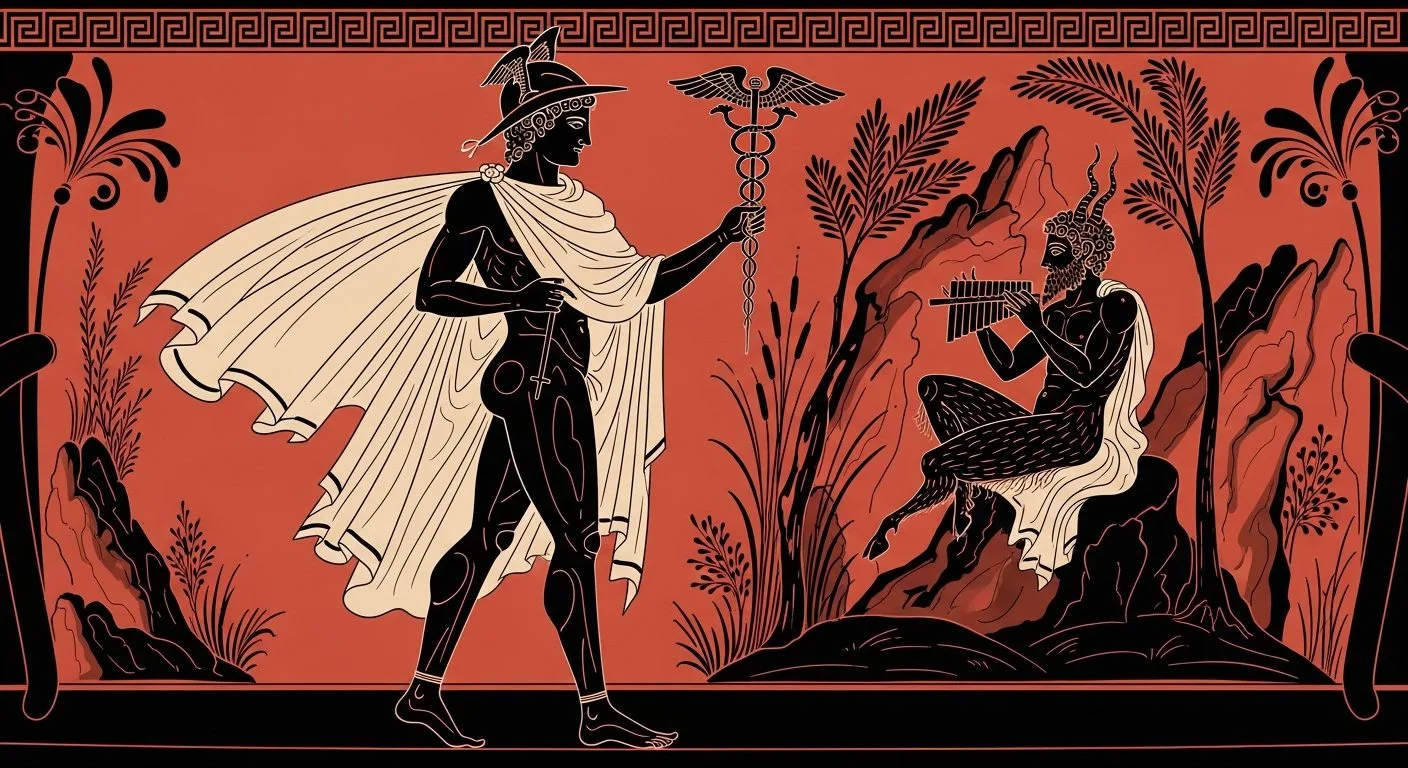
- Greek mythology is one of the most influential spiritual worlds of antiquity. It's not just a collection of fantastic stories with gods, heroes and monsters.· is a complex system of narrative, religious thought, social values and cultural memory. Through the myths of the Greeks the birth of the world, the position of man in the universe, the power of fate, the concept of hubris, the importance of hospitality, the relationship with the divine and the limits of human ambition are explained.
The Greek myths survived through poetic epics, tragedies, historical works, local traditions, cult practices and visual representations. The main sources for their study are Theogony and Works and Days of Hesiod, Iliad and Odyssey attributed to Homer, the tragedies of Aeschylus, Sophocles and Euripides, Library Apollodorus, as well as Pausanias' descriptions. Mythology, therefore, is not uniform «book» with a version, but live tradition network that changed by place, era and poet.
The Beginning of Greek Mythology
- Greek mythology It begins with the need of ancient people to understand the world around them. Before philosophy and science, the myth functioned as a way of interpreting nature, social institutions and unexplained events. The storm could be associated with Zeus' will, the sea with Poseidon's power, love with Venus' influence, death with Hades' kingdom.
In ancient times, the word “myth” did not necessarily mean a lie or a fairy tale. It meant a discourse, a narrative, or a story with profound meaning. Myths could be sacred, didactic, political, or poetic. They were often linked to rituals, cults, and local identities. For example, Athens particularly emphasized its connection to Athena, while Delphi was associated with Apollo and the oracular tradition.
The First Gods and Cosmogonia
According to Hesiod, at first there was the Chaos, a primary situation without order and form. From this, fundamental forces emerged: Gaia as a personification of the land, Tartarus As a dark depth under the world, Eros as a creative principle of attraction and fertility, Nyx and Erebus as dark cosmic powers.
Gaia gave birth to him Uranos, the celestial dome, and with him acquired them Titans, Cyclops and Hecatoncheires. The first major cosmic conflict is the overthrow of Heaven by his son, CronusSaturn, fearing to be overthrown by his children, devoured them as soon as they were born. His wife, the Rhea, save the boy Zeus, giving Saturn a stone wrapped in sparrows. Zeus secretly grew up and later forced Saturn to free his brothers.
The conflict between Olympians and Titans, known as Titanomachy, symbolizes the establishment of a new secular order. Zeus and his allies prevailed, the Titans were punished or restricted, and the world was shared: Zeus received heaven, Neptune the sea and Hades the underworld.
The Twelve Olympian Gods
The Olympian gods They were symbolically inhabited in Olympus, the highest mountain in Greece, and constituted the center of ancient Greek religion. They were not perfect, morally infallible figures. Instead, they featured human characteristics: jealousy, passion, anger, desire, ambition, generosity and vindication. This anthropomorphic dimension made them familiar, but also dangerous.
Zeus: The Father of Gods and Men
- Zeus He was the ruler of Mount Olympus, the god of the sky, lightning, justice, and royal authority. His symbol was the thunderbolt, while the eagle was considered his sacred animal. Although he is often portrayed as fickle in his romantic affairs, Zeus embodied the idea of cosmic order and the keeping of oaths.
In ancient Greek society, the concept of Xenium dionysium He protected hospitality. The abuse of a stranger could be considered a insult to God himself.
Hera: The Goddess of Marriage and Royal Dignity
- Hera, wife of Zeus, is associated with the marriage, fertility and legality of the family. He often appears in myths as jealous and vengeful against Zeus' mistresses or their children, such as Hercules. However, this image does not exhaust its importance. Hera was worshiped in great sanctuaries, such as Argos and Samos, and represented the institutional power of marriage in the city-state.
Poseidon: The Ruler of the Sea
- Poseidon He was a god of the sea, earthquakes and horses. With his trident he could cause storms or tear the earth apart. Its importance was enormous for a maritime culture such as Greek. In Odyssey, Poseidon pursues Ulysses because he blinded his son, Cyclops Polyphemus, showing the power of divine anger and family honor.
Athena: Wisdom, Strategy and Culture
- Athena According to myth, she was born fully armed from the head of Zeus. She is the goddess of wisdom, strategy, craftsmanship, and political organization. Unlike Ares, she does not represent the brutal violence of war, but rather reason, discipline, and victory through strategy.
Her relationship with Athens is central. In her competition with Poseidon to protect the city, she offered the olive tree, symbol of peace, food, oil and economic prosperity. The Parthenon, dedicated to Virgin Athena, is a leading monument to her worship.
Apollo: Light, Music and Magic
- Apole He is one of the most multifaceted gods. He is associated with light, harmony, music, poetry, medicine, and divination. The Oracle of Delphi was one of the most important religious and political centers of the ancient Greek world. The Pythia, a priestess of Apollo, delivered oracles that influenced colonization, wars, and political decisions.
Apollo expresses the idea of measure, purity and self-awareness. The brotherly saying «know him.» It summarizes a deep Greek concept of human boundaries.
Artemis: Wild Nature and Youth Protection
- Artemis, Apollo’s twin sister, is the goddess of hunting, wild animals, virginity, and the transitional stages of life, particularly the transition from childhood to adulthood. Her worship in Brauron was associated with rituals for young girls. Artemis is independent, stern, and often punishes those who cross her boundaries, such as Actaeon, who saw her naked.
Venus: Love, Beauty and Desire
- Aphrodite She is the goddess of beauty, love, and romantic attraction. Her birth from the sea foam, as described in the Hesiodic tradition, emphasizes her connection to fertility and the creative power of desire. However, love in Greek mythology is not always sweet or innocent; it can lead to wars, destruction, and tragedies, as seen in the myth of Helen and Paris.
Ares, Hephaestus, Hermes, Demeter, Hestia, and Dionysus
- Ares personifies raw war violence and conflict. THE Hephaestus, god of fire and metallurgy, symbolizes technical skill and creative work. THE Hermes He is a messenger of gods, protector of travelers, merchants and boundaries, but also a psychotransmitter that leads souls to Hades.
- Demeter, goddess of agriculture, is associated with the cycle of nature and Eleusinian Mysteries. The myth of Persephone's abduction by Hades symbolically explains the rotation of the seasons. The Hestia, goddess of the hearth and home, expresses the stability of the family and community. THE Dionysus, god of wine, ecstasy and theatre, recalls that culture includes the power of irrational, drunken and transcending boundaries.
Heroes of Greek Mythology
Heroes occupy a place between the gods and humans. They often have divine ancestry, but they are mortal and subject to suffering, fate, and death. Their heroic deeds highlight the values and dilemmas of ancient Greek thought.
Hercules: Labors, Atonement, and Human Endurance
- Hercules is perhaps the most famous Greek hero. Son of Zeus and Alcmene, he was pursued by Hera and led to terrible passions. The twelve feats Its, such as the killing of the Nemea lion, the extermination of Lernaia Hydra and the descent to Hades for Cerberus, they are not merely feats of power. They symbolize the struggle with chaos, the monsters of nature and the dark limits of the human soul.
Hercules was worshipped as a hero and god, which shows his only place between mortality and apotheosis.
Theseus: The Hero of Athens
- Theseus It is closely linked to Athenian identity. His victory over him Minotaur in its maze Knossos is one of the most known myths. The maze can be interpreted as a symbol of testing, fear and transition from disorder to civilized order. Ariadne's help, with the famous mitto, also shows the importance of intelligence and cooperation.
Achilles and Ulysses: Two Standards of Heroism
- Achilles, central form of the Iliad, embodies the martial virtue, glory and tragic dilemma between short glorious life and a long unspoiled existence. His anger, the month, moves the plot of the epic and highlights the consequences of insult, honor and loss.
- OdysseusOn the contrary, he stands out for his intelligence, patience and adaptability. Odyssey is not only a return adventure, but also a self - knowledge narrative. Ithaca becomes a symbol of purpose, memory and identity.
The Great Mythological Issues
Hybrid, Nemesis, and Trial
One of the central motifs of Greek mythology is hybrid, i.e. the arrogant transcendence of human boundaries. When a mortal attempts to equate himself with the gods or ignore the laws of the secular order, the following follows: nemesis, the divine retribution, and finally the trial, restoring balance.
The myth of Niobe, who boasted that she was superior to Leto because she had more children, is a prime example. Her punishment at the hands of Apollo and Artemis illustrates the dangers of arrogance.
Fate and Free Will
- Fates in Greek mythology is often stronger even than the gods. The Fates —Cried, Lachesis, and Atro.— They weave, share and cut the thread of life. In tragedy, the question of whether man is free or trapped by destiny appears with particular intensity. THE OedipusFor example, he tries to avoid oracle, but his own actions lead to his fulfillment.
Downstream in the Underworld
The descent to Hades is a recurring mythological pattern. THE Orpheus goes down to bring back the Eurydice, Hercules to capture Cerberus, Ulysses to request oracle from TiresiaThese accounts concern not only death, but also the knowledge, memory and transformation of the hero.
Monsters and Mythical Creatures
The monsters of Greek mythology often express the fear of the unknown, the violence of nature or the boundaries of the civilized world. The Medusa, one of the Mermaids, with the look of anyone who looked at it, is associated with the terrifying power of appearance and forbidden knowledge. THE MinotaurHalf man and half bull are in the center of a labyrinth, between human and animal.
- Sphinx The Thebes, setting riddles to passersby, shows that victory does not always require physical strength, but spiritual clarity. Oedipus defeated her in response to her riddle, but his own intelligence did not protect him from his tragic fate.
Greek Mythology and Ancient Religion
- Greek mythology should not be cut off from the religious life of the ancient Greeks. The gods were worshiped in temples, altars, feasts and games. The Olympic Games were dedicated to Zeus, Panathenaia to Athena, Dionysia to Dionysus.
Legends often explained the origin of a cult or a sacred place. For example, Eleusinia Mysteries, dedicated to Demeter and Persephone, were associated with hope for a more favorable posthumous fate. Although the details of the mysteries remain largely unknown due to their privacy, their importance to the ancient world was enormous.
Historical Sources and Variations of Myths
One of the most important factors in properly understanding Greek mythology is that the myths did not always have a fixed version. The same myth could appear differently in Homer, Hesiod, the tragic poets, or in local traditions.
- Homer presents the gods mainly through their relationship with the heroic world of war and return. THE Hesiod gives systematic cosmogenic and theogenic narrative. The tragic poets They focus on moral conflict, responsibility, passion and destruction. THE Pausanias, a 2nd century AD traveler, records myths associated with shrines, statues and local cults.
The existence of variations does not reduce the value of myths· Instead, it reveals their vitality. Greek mythology was an open narrative system, capable of adapting to different social and political needs.
Greek Mythology in Art and Literature
From antiquity to today, Greek mythology has been an inexhaustible source of inspiration. In ancient angiography we meet scenes from the Trojan War, the feats of Hercules, Perseus and Medusa, Dionysus with the Mainades. Sculpture, architecture and painting used mythological themes to express political, religious and aesthetic values.
In modern Europe, the Renaissance revived ancient mythology as a symbol of beauty, knowledge and classical education. Artists such as Boticelli, Tisian and later Rubens were inspired by Venus, Apollo, Dionysus and the Nymphs. In literature, Greek myths are constantly reinterpreted, from Dante and Shakespeare to modern poetry, novel, cinema and video games.
Greek Mythology in Modern Life
The influence of Greek mythology remains strong in language, psychology, political thought and popular culture. Expressions such as «achille heel», «Seed apple», «odyssey», «Sisypian project» and «Pandora box» are used daily to describe human experiences.
In psychology, mythological forms such as Oedipus, Electra, Narcissus and Prometheus have been used as symbols of internal conflicts, desires and complexes. In philosophy, the myth of Prometheus is associated with technology, knowledge and responsibility. In cultural theory, myths function as archetypes that help understand repeated patterns of human behavior.
How to Study Greek Mythology
The study of Greek mythology becomes more meaningful when the primary sources are combined with modern interpretation. A good way to approach is to start from the basic narratives: the creation of the world, the Olympian gods, the Trojan War, the great heroes and the tragic myths of the royal houses, such as Atreides, Labdakides and Pelopides.
Particular attention is needed to avoid oversimplifications. Legends are not just «stories about children»Nor should they be read only literally. They contain religious background, poetic imagination, social commentary and philosophical depth. Comparing different versions helps the reader better understand the wealth and pluralism of ancient Greek tradition.
Conclusions
- Greek mythology is a fundamental pillar of global civilization. Through its gods, heroes, monsters and tragedies, the ancient Greeks meditated on issues that remain topical: what justice means, what the limits of human power are, how death is treated, what the relationship of man and nature is worth most —glory, wisdom, love or return home.
Its value lies not only in the beauty of narratives, but also in its ability to offer timeless symbols. From Olympus and Hades to Ithaca and Labyrinth, Greek mythology continues to give us language to talk about fear, desire, loss, knowledge and hope.
FAQ
What is Greek mythology?
Greek mythology is the set of myths of ancient Greeks regarding the creation of the world, gods, heroes, monsters, nature, fate and human life. It is closely associated with ancient Greek religion, poetry, art and social organization.
What are the most important sources for Greek mythology?
The main ancient sources are Iliad and Odyssey of Homer, Theogony The tragedies of Aeschylus, Sophocles and Euripides, Library of Apollodorus and the Greece Tour Pausanias.
Who were the Twelve Olympian gods?
The Twelve Olympians usually include Zeus, Hera, Poseidon, Athena, Apollo, Artemis, Aphrodite, Ares, Hephaestus, Hermes, Demeter, and either Hestia or Dionysus, depending on the tradition.
Why are there different versions of the same myths?
The myths were transmitted orally for centuries and adapted to the needs of each city, worship or poet. This is why we find variations in genealogies, events and characters. This diversity is a key feature of Greek mythology.
Who is the most famous Greek hero?
Hercules is considered the most famous Greek hero, mainly because of his twelve feats and widespread worship throughout the Greek world. Other important heroes are Achilles, Ulysses, Theseus, Perseus, Jason, and Orpheus.
What does the myth of Persephone symbolize?
The myth of Persephone, taken by Hades and made queen of the Underworld, is associated with the cycle of times, vegetation, fertility, and the rotation of life and death. Her return to her mother, Demeter, symbolizes the rebirth of nature.
Why are we studying Greek mythology today?
We study Greek mythology because it deeply influenced western literature, art, philosophy, psychology and language. Moreover, its myths continue to illuminate universal issues, such as power, love, loss, arrogance, fate, and the pursuit of meaning.
Sources & References
Greek Mythology: Gods, Heroes, Myths, Creatures
Greek Mythology Stories: The Greatest Myths of Ancient Greece