
| Name | Bellerophon |
|---|---|
| Parents | Glaucus (or Neptune) and Eurynome |
| Residence | Corinth, Lycia |
| Roles and Responsibilities | Hero, Chimera winner, Pegasus domesticator |
| Other Names | Knight of the Pegasus |
| Husbands | Philoni (Antiope in some traditions) |
| Children | Isandros, Ladomea, Deidamia |
| Symbols | Pegasus, spear, wings, sky |
| Roman Name | Bellerophon |
Bellerophon is one of the most exciting figures of Greek mythology: a hero who tames him Pegasus, defeats Chimera And he gets very close to immortality, before he is overtaken by hybris and divine punishment.
Bellerophon is not just another mythical warrior. He is the hero who unites boldness with tragedy, glory with fall, human greatness with the limit that should not be overcome. In the heart of his myth are Pegasus, Chimera and the irresistible ambition that eventually led him from the top to extinction. His story remains timeless, because he not only talks about a hero of antiquity, but about something deeper: about the human desire to overcome our limits and the price that often follows.
If you are looking for a myth that combines adventure, divine intervention, heroism and an intense moral dimension, Bellerophon is one of the most characteristic examples of Greek mythology. His route begins with promises of greatness and ends in a silent, almost poetic fall, which turns him from triumphant to warning.
Who was Bellerophon in Greek mythology
Bellerophon was the son of Glaucus, the king of Corinth, according to one of the prevailing versions of the myth. In some traditions he also refers as his son Poseidon, which gives him an almost semi-divine dimension. His ancestry, as often happens to great mythical heroes, is not entirely single. But this ambiguity does not weaken the myth.· Instead, it makes him richer and figuratively charged.
The name Bellerophon was associated with a hero who acted mainly in Lycia, in the East of the Greek world. There he was invited to face one of the most terrifying fantasy threats of ancient mythology: Chimera. At the same time, his course confronted him with royal intrigues, divine trials and, finally, with his own arrogance.
The origin and identity of the hero
Like many mythical heroes, Bellerophon carries a dual nature. On the one hand he is a man, with weaknesses, fears and need for recognition. On the other hand, he is associated with the divine and supernatural, which explains both his great successes and his final fall. Greek mythology loves these forms that stand at the border: between earth and heaven, victory and destruction.
Pegasus and divine help in the journey of Bellerophon
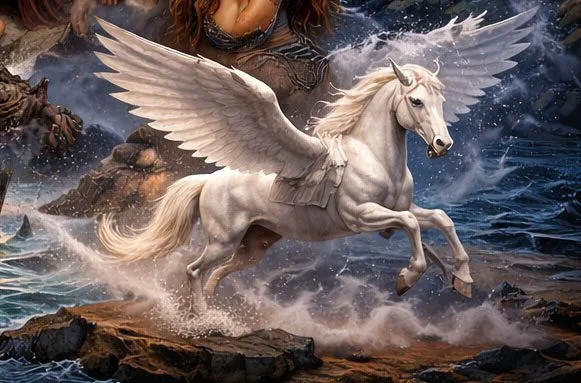
No account of Bellerophon can ignore him Pegasus, the winged horse that became a symbol of freedom, inspiration and transcendence. Their relationship is so strong that many times the hero's myth is almost exclusively identified with this flying form.
Athena helps him tame Pegasus, offering him the gold rein. Thus, the Bellerophon acquires a tool that transcends human boundaries and allows him to approach the impossible.
Why is Pegasus so important?
Pegasus is not just a means of movement, but a symbol of rising, imagination and transcendence. Thanks to him, Bellerophon gains advantage over Chimera and becomes almost invincible.
The extermination of Chimera
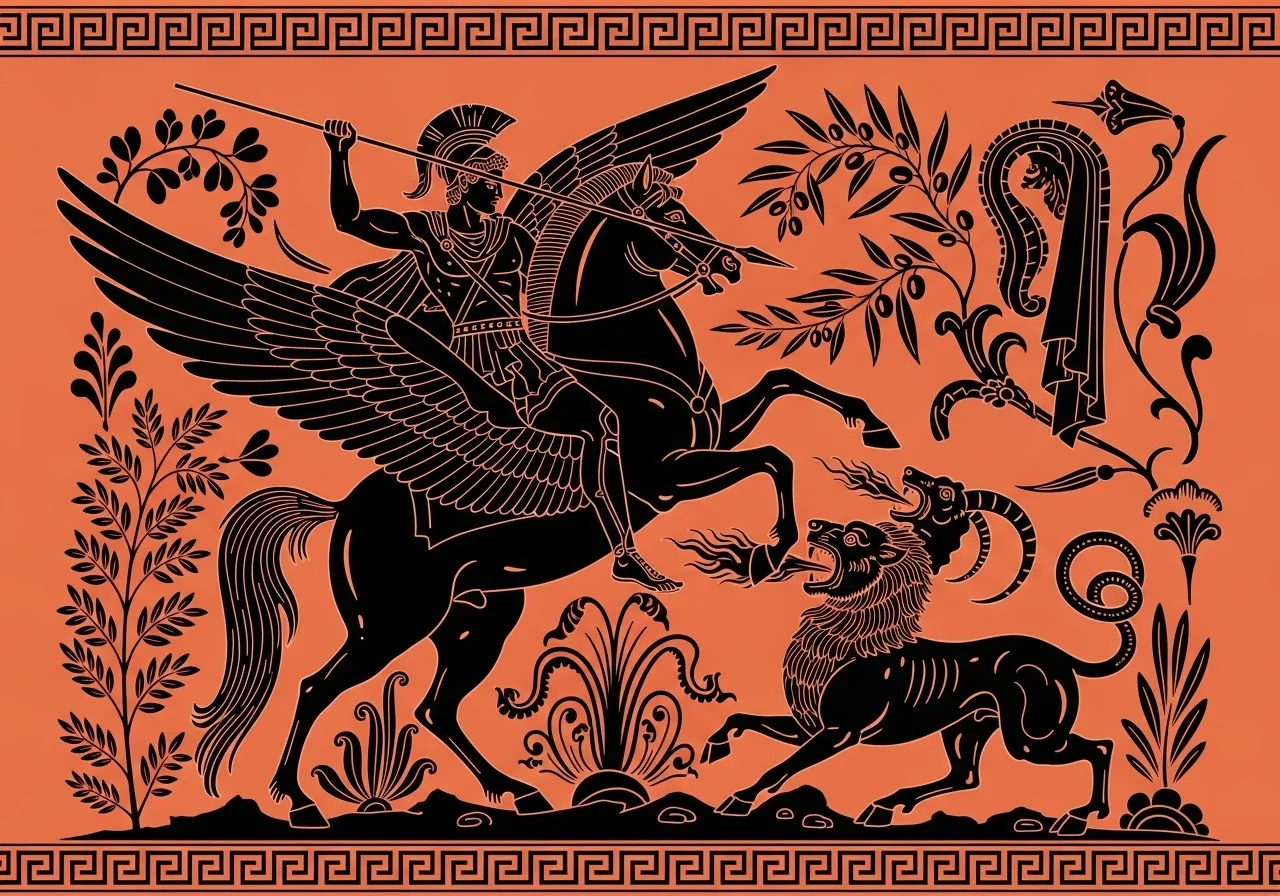
The most famous act of Bellerophon is his victory over Chimera, a monster with a lion, goat, and snake body, that made fires. From the air, on Pegasus, the hero manages to neutralize it, completely changing the rules of battle.
Chimera symbolizes chaos, irrational and uncontrolled. Bellerophon's victory is a triumph of strategy and intelligence against the impossible.
The Trials in Lycia
King Jobatis assigns him dangerous missions in order to eliminate him, but the Bellerophon survives all. Each test enhances its reputation and turns it into almost legendary form.
The role of Jobat
Jobatis acts as a rival power trying to halt the rise of the hero. But eventually, Bellerophon's power turns out to be greater than the court intrigues.
The hybrid and fall of Bellerophon
After his successes, Bellerophon attempts to climb Olympus. This act is a hubris, as it attempts to transcend human boundaries and equalise itself with the gods.
Zeus punishes his arrogance, and Pegasus abandons him. The hero ends up alone, wandering and cut off from the world of mortals and gods.
What the myth symbolizes today
Bellerophon symbolizes ambition, transcendence and the danger of arrogance. His story shows that success without measure can lead to a fall.
It's a timeless myth about the boundary between dream and transcendence.
Conclusion
Bellerophon remains one of the most powerful forms of Greek mythology. He defeats Chimera, rides Pegasus and reaches near uncle, but eventually collapses from his own hubris.
His myth is a reminder that the real power is not only in victory, but also in measure.
Frequently Asked Questions about Bellerophon
Who was Bellerophon?
Bellerophon was one of the most important heroes of Greek mythology, known for his victory over Chimera and his relationship with the winged horse Pegasus.
Where did Bellerophon come from?
According to most traditions, he was the son of Glaucus, King of Corinth. In other versions he is considered the son of Poseidon, which gives him semi-divine origin.
What was Pegasus?
Pegasus was a winged horse of Greek mythology. Bellerophon tamed him with the help of goddess Athena and used him to fly and fight from the air.
What was Chimera?
Chimera was a scary mythical monster with a lion's body, goat's head and snake's tail, which made fires out of the mouth. Bellerophon is the hero who managed to defeat her.
How did Bellerophon defeat Chimera?
Bellerophon used Pegasus to attack from the air, avoiding the monster's flames and managing to neutralize it with strategic advantage.
Why was Bellerophon punished?
He was punished for hubris, as he tried to climb Olympus and equalize himself with the gods. This was considered to exceed human boundaries.
What happened at the end of Bellerophon?
According to legend, Pegasus abandoned him and Bellerophon was left alone, wandering and forgotten, away from the glory of the past.
What does the myth of Bellerophon symbolize?
It symbolizes ambition, transcendence, but also the risk of arrogance when man exceeds the limits of the measure.
Is Bellerophon a god or a hero?
He is a hero of Greek mythology, not a god, although in some traditions he has semi-divine origins.
Why is the myth of Bellerophon important today?
Because it shows the timeless conflict between ambition and measure, and recalls that exaggeration can lead to falling even the most capable people.