
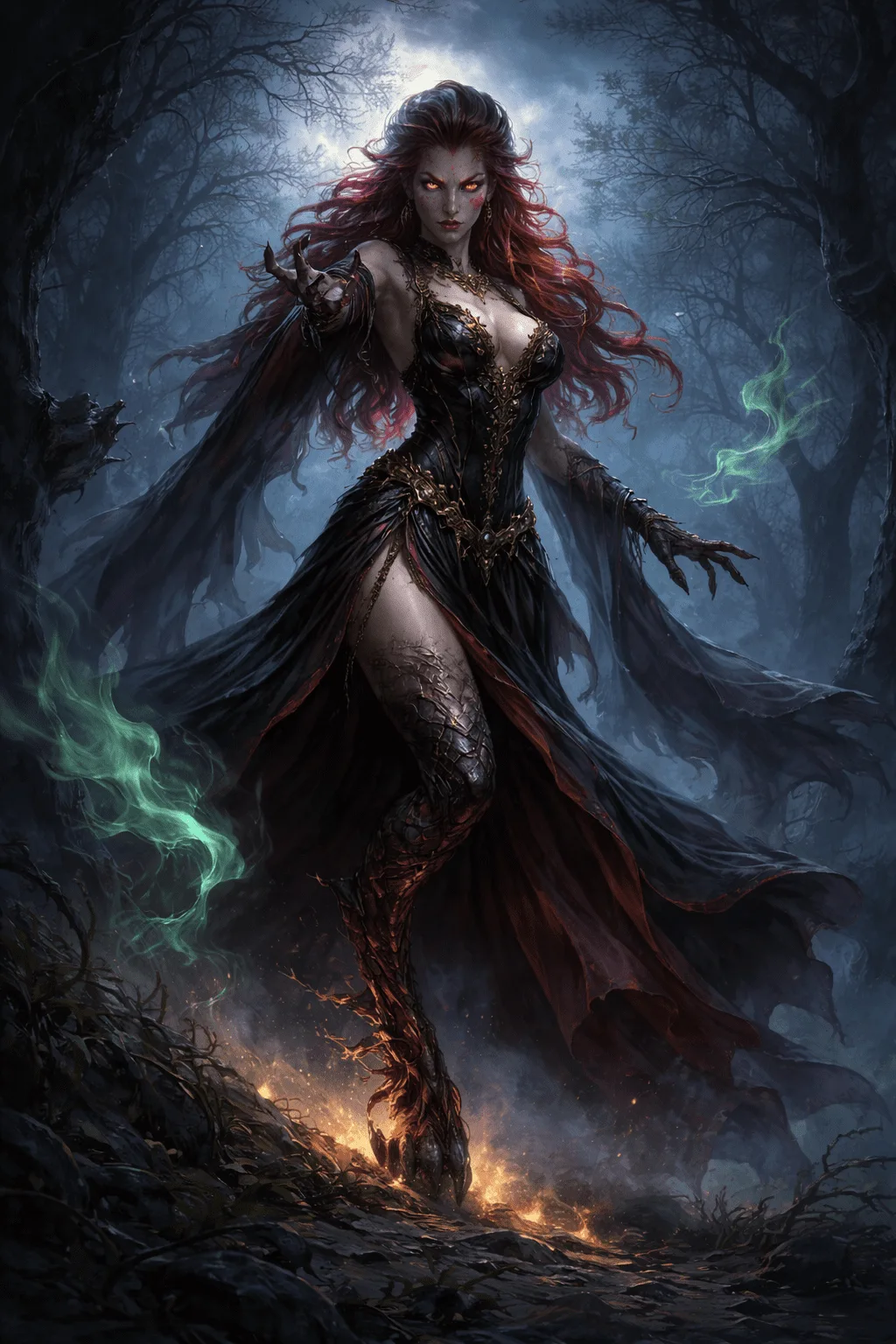
The Empouses belong to the dark world of the chthonic demonic forms of Greek mythology. These are creatures transformative, deceptive and terrifying, associated with night, roads, deception and terror. Their form reflects the fear of the unknown and the threat that lies within the limits of the civilized world.
The Ebuses belong to the darkest and terrifying forms of Greek mythology and folk tradition. They were considered demon creatures wandering at night, terrorizing travelers and dragging unsuspecting people into destruction. Although they are not as well known as the Medusa or Mermaids, The Entesses held an important place in the imagination of ancient Greeks, as they embodied the fears associated with darkness, deception and supernatural.
According to ancient traditions, the Ebuses were closely associated with the goddess Hecate, the deity of magic, crosses, ghosts and night. They were often described as servants or attendants of Hecate, carrying out her orders and appearing on deserted roads, cemeteries, and dark places where people feared to be found alone.
The appearance of Ebuses differed according to tradition, but they were usually presented as creatures that could change form. In some descriptions they had a female body with deformed characteristics, while in others they had a bronze leg and a donkey or ox leg. This bizarre view highlighted their supernatural and demonic nature, making them directly identifiable from those who could distinguish their true form.
One of the most characteristic traits of Ebses was their ability to transform into beautiful women. They thus lured young men, whom they fascinated with their beauty and sweet behavior. When their victims fell into the trap, the Embuses revealed their true nature and, according to certain traditions, drained their vital energy or devoured their flesh. This quality makes them precursors to later legends about vampires and demon seducers.
The most famous reference to Ebuses comes from ancient comedian Aristophanes. In his work Frogs, an Ebusa appears as a terrifying spirit that constantly changes forms to cause fear and confusion. This scene shows that the Embuses were already widely known to the audience of the classical era and were a popular form of the popular fantasy.
In later traditions, the Embuses are often confused with other female demon forms, such as Lamias and Mormons. All these creatures share common features: night action, transformation ability and connection to fear, deception and death. The distinction between them was not always clear, as local traditions often combined elements from different myths.
The Embuses reflect social and psychological fears of antiquity. At a time when journeys were dangerous and night streets full of dangers, stories of demonic creatures acted as warnings about people circulating alone after sundown. At the same time, they symbolized the threat of deception, as external beauty could hide a disastrous reality.
In art and literature, the Embuses are not as often depicted as other mythological monsters, but their influence has been significant. Their stories contributed to the formation of later legends for night demons, vampires, and spirits that seduce their victims. Many of their features reappear in medieval and younger European folklore.
The form of Embusa remains one of the most interesting examples of how ancient Greeks personified their fears. As creatures moving between reality and the supernatural, the Entesses symbolized the invisible dangers lurking in darkness and reminded that appearance may be misleading.
Etymology and Name
The word Empousa (plural: Empouses) probably derived from:
The In + foot («inside the foot»), referring to their malformation
orfrom verbs stating appearance and sudden presence
In the Latin Secretariat they reply as Empusae.
Origin and Mythological Identity
The Empouses are directly linked to:
the goddess Hecate
the world of the dead
night ranges
They are considered as:
maids or attendants of Hecate
demonic entities of the crossroads and night
Morphology and Metamorphosis
The Empouses are characterized by:
metamorphosis ability
unstable and deformed form
Often described as:
women with:
a bronze or onus foot
a human leg
with face sometimes beautiful and sometimes repugnant
morphological instability symbolizes:
fraud
the illusion
the nightmare
Role and Function
The Empouses:
terrorize lonely travelers
They're misleading people.
cause fear and mental confusion
They do not act as punishment gods with a moral purpose, but as terror spirits.
You Entered Literature
In particular:
THE Aristophane (Frogs), where they appear as horror ghosts
in later folk traditions
Their presence often has:
preventative
pedagogical character
Symbolism
The Inners symbolize:
the fear of the night
the risk of limits
illusion and deception
the horror of loneliness
They are models:
demonic creatures of popular imagination
later forms of terror (ghosts, demons)
Inputs and Folklore
The Embuses are considered precursors:
Their influence reaches:
Byzantine demonology
newer popular beliefs
Ancient Sources
Aristophanes, Frogs
Souda
Ancient Grammar Comments
Folklore traditions
Educational Adaptation
Suitable for:
teaching mythological fear
comparative study of chthonic creatures
analysis of popular psychology and symbolism
Conclusion
The Empouses They are characteristic figures of the dark side of Greek mythology. They do not incarnate divine justice but the primary fear of man against the unknown, acting as psychological and cultural symbols.
Ancient Sources
- Aristophane, Frogs.
- Philostratus, The SS Tyaneas Apollonion.
- Souda, article «Input».
- Quiet Alexander, Dictionary.
- Athens, Dinnosophists.
Modern Bibliography
- Ogden, Daniel. Magic, Witchcraft and Ghosts in the Greek and Roman WorldsOxford University Press, 2002.
- Johnston, Sarah Iles. Restless Dead: Encounters Between the Living and the Dead in Ancient Greece. University of California Press, 1999.
- Ogden, Daniel. Drakōn: Dragon Myth and Serpent Cult in the Greek and Roman Worlds. Oxford University Press, 2013.
- Buxton, Richard. The Complete World of Greek MythologyThames & Hudson, 2004.
- Grimal, Pierre. The Dictionary of Classical MythologyBlackwell Publishing, 1996.
- Bremmer, Jan N. Greek Religion and Culture, the Bible and the Ancient Near East. Brill, 2008.