
The 12 Labors of Hercules – History, Meaning, and Symbolism
The Twelve Labors of Hercules are among the most iconic stories in Greek mythology. More than a series of heroic feats, they tell a powerful story of atonement, trial, and inner transformation.
Hercules, son of Zeus and Alcmene, was born with divine power but a human fate. Hera, jealous of Zeus’s infidelity, persecuted him from the moment of his birth. The climax of her divine wrath came when she drove him mad, leading him to kill his wife and children.
Devastated, he sought solace at the Oracle of Delphi. There he was instructed to serve King Eurystheus of Mycenae for twelve years. Thus began the 12 Labors of Hercules—tasks that seemed impossible, but which, on a deeper level, symbolized the transcendence of human suffering.
Why Was Hercules Forced to Perform the 12 Labors?
Hercules’ 12 labors were not heroic adventures he chose to undertake. They were both a punishment and a redemption.
- Hera It drove him mad. The murder of his family filled him with shame and despair. The Oracle of Delphi ordered him to serve Eurystheus, who, out of fear and jealousy, assigned him increasingly humiliating tasks.
The number twelve is no coincidence. It symbolizes completeness and the cycle of fulfillment—just like the 12 months and the 12 zodiac signs.
The 12 Labors of Hercules – Summary List
The Nemea Lion
The Lernaean Hydra
The Ceryneian Hind
The Erymanthian Boar
The Augean Stables
The Stymphalian Birds
The Bull of Crete
The Horses of Diomedes
The Belt of Hippolyta
The Oxen of Geryon
The Apples of Esperides
Cerberus
Below is a detailed presentation of Hercules' 12 feats.
Detailed Presentation of the 12 Labors of Hercules
1. The Nemea Lion
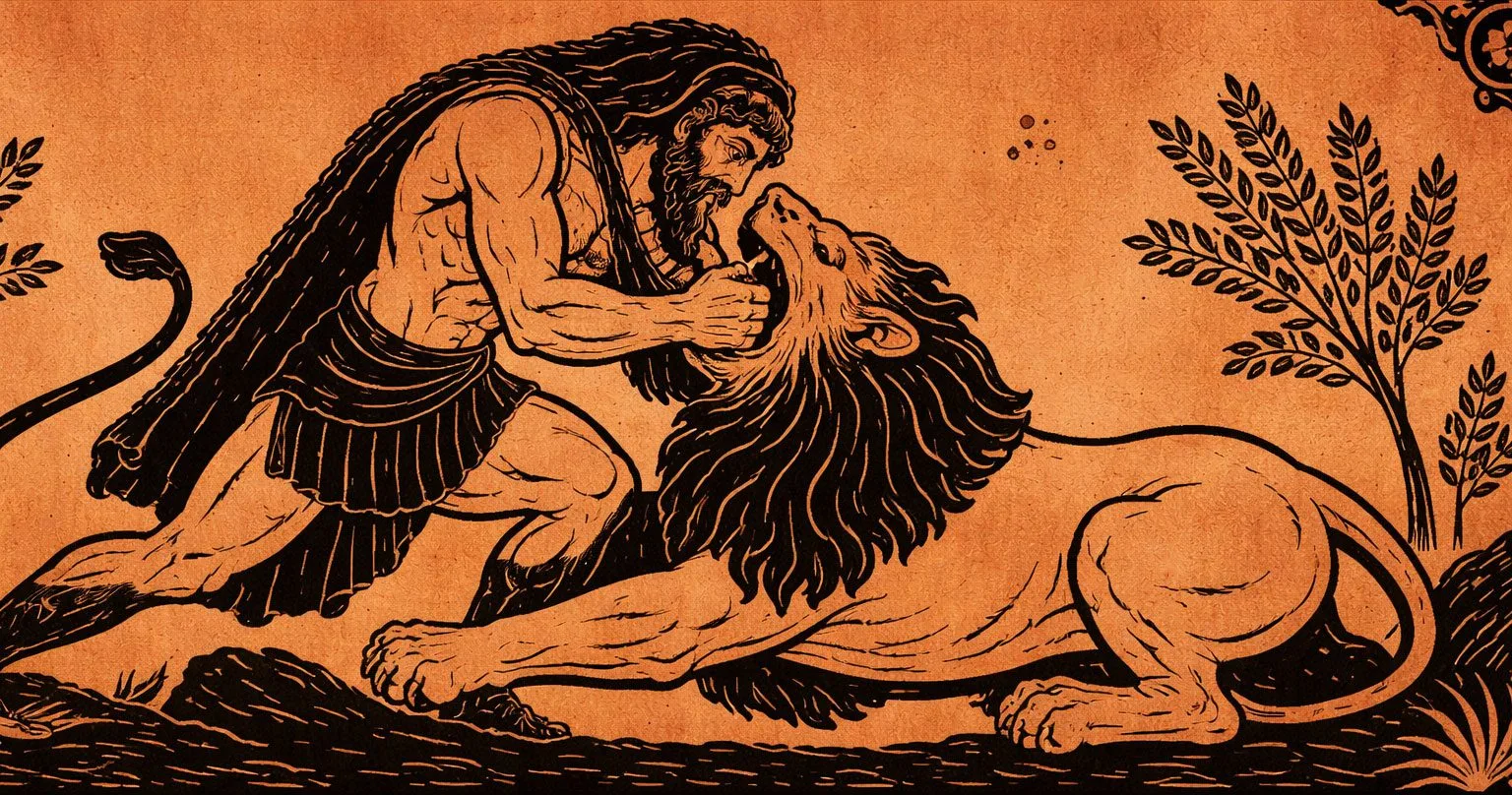
The first of Hercules' 12 labors was to slay the invincible Nemean lion. Its hide was impenetrable; no weapon could pierce it.
Hercules faced it bare-handed. He strangled it with his own hands and wore its skin as armor.
Symbolism: Victory over primary fear.
2. The Lernaean Hydra
- Lernaean Hydra had many heads; for every one that was cut off, two more grew back. With the help of Iolaus, Hercules cauterized the wounds to stop them from regrowing.
Symbolism: Problems that multiply when they are not treated properly.
3. The Deer of Kerynitis
Her holy animal Artemis, with golden horns and bronze legs. Hercules hunted her for a whole year without killing her.
Symbolism: Patience and self-control.
4. Erymanthian Boar
Wild beast terrorizing villages. Hercules captured him alive.
Symbolism: The restraint of violence.
5. The Stables of Augeas
The stables had not been cleaned for decades. Hercules diverts rivers to clear them in one day.
Symbolism: Purification by intelligence, not just power.
6. The Stymphalian Birds
Metal birds with deadly wings. Hercules drove them away using Athena’s rattles.
Symbolism: Face threats from a distance.
7. The Bull of Crete
Wild and indestructible animal. Hercules tamed it and delivered it alive.
Symbolism: Instinct control.
8. The Horses of Diomedes
They fed on human flesh. Hercules tamed them.
Symbolism: The conversion of ferocity into discipline.
9. The Belt of Hippolyta
The Amazon queen was willing to give it to him, but Hera caused a conflict.
Symbolism: The interference of jealousy in peace.
10. The Cattle of Geryon
The three-headed Geryon lived at the ends of the world. Hercules killed him and brought the oxen.
Symbolism: The journey beyond the bounds of the known.
11. The Apples of Esperides
Golden apples of immortality. Hercules asked for help from Atlas.
Symbolism: The wisdom of cooperation.
12. Cerberus
The last of Hercules' 12 feats was the descent to Hades to bring him Cerberus unarmed.
Hercules returned alive from the Underworld.
Symbolism: Victory over death.
What Do Hercules ’ 12 Labors Symbolize?
Hercules' 12 feats are not just adventures. It is allegory of human evolution:
Facing Fear
Fight against chaos
Clear guilt
Spiritual maturation
Each feat represents a stage of self-knowledge.
How Are They Described in Ancient Sources?
Hercules' 12 feats are reported:
To Apollodorus
In Diodoros Siciliotis
In Euripides
Ancient sources are differentiated into details, but maintain the core: the test leads to divination.
Is Hercules God?
After his death in the flames of Mount Oeta, Zeus raised him to Olympus. His deification completed the cycle that began with the Twelve Labors of Hercules.
From a man tortured, he became an immortal hero.
FAQ
How long did Hercules' 12 feats last?
Twelve years.
Were all the feats successful at first?
Nope. Some were not initially identified by Eurysthea.
Why are they so important?
Because they symbolize human transcendence.
Conclusion
The 12 Labors of Hercules are more than just heroic tales. They are a timeless model of inner struggle, responsibility, and transformation.
Hercules wasn't just the strongest hero in Greek mythology. He was the man who fell into darkness and managed to return to the light.
JTNDcCUZRSUwQSVDRSU5MSVDRSVDRSVCQSVDRSVCQSVDRSVCQiVDRiU4RCVDRIU4OCVDRIU4NCVDRSVCNSU4MCVDRSVCNSVDRIU4MSVDRSVCOSVDRIU4MyVDRiU4MyVDRiU4QyVDRIU4NCVDRSVCNSVDRIU4MSVDRSVCNSVDRIU4MiUyMCUzQ2ElMjBocmVmJTNEJTTEYJTJTJTJGA XN0b3JpZXMtbXl0aG9sb2dpYXMmlKYlM0UlQ0UlQjklQ0YlodMlQlQlQlQlQlQlQlQUlQUlQUlQUlQUlQUlQUlQUlQUlQUlQUlQUlQUlQUlQlQlQl0UlQlKYlQlQlQUlQUlQlQlQlQlQlQUlQlQlQUlQlQlQUlQUlQUlQUlQUlQUlQUlQUlQUlQUlQUlQUlQUlQULQULQULQULQULQULQULQULQULQULQULQULQULQULQULQULQULQULQULQULQULQ