
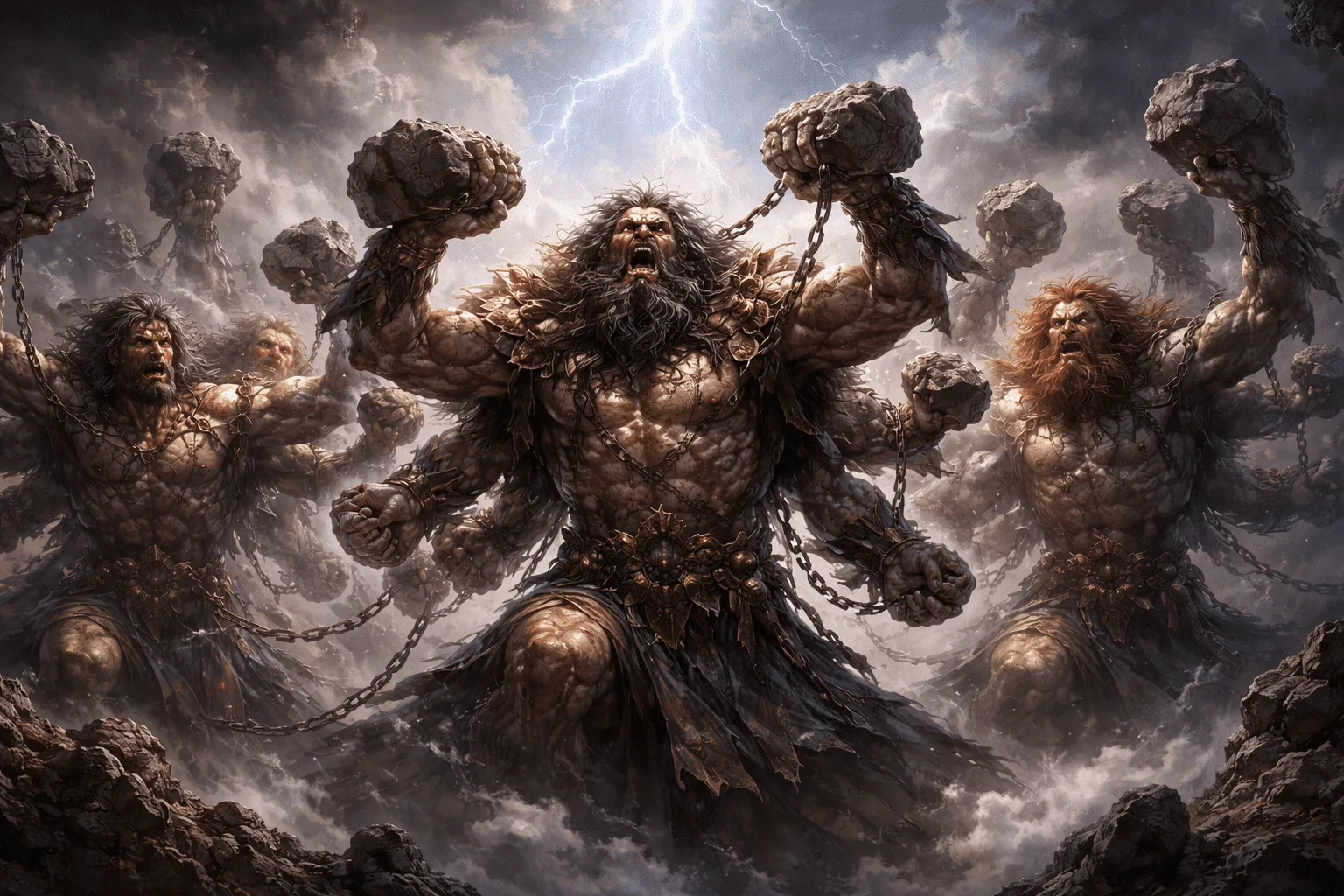
The Hecatoncheires are among the most impressive and powerful beings of Greek mythology. Although they are not as well known as Olympian gods or Titans, they played a decisive role in shaping the world and in the prevalence of Zeus during the great conflict between the gods and the Titans. With a hundred hands and fifty heads each, the Hundred-Handed embodied an almost irresistible force, capable of changing the course of secular history.
In ancient Greek tradition, the Hundred Hands symbolize the power that protects order against chaos. Although initially they were victims of fear and oppression, they later became Jupiter's strongest allies and Tartar guards.
Who were the Hundred Hands?
The Hundred-Handed belonged to the first generation of divine beings born after the creation of the world. They were the children of Heaven, the god of heaven, and Gaia, the goddess of Earth.
Their name means «those with a hundred hands», which reflects their most impressive feature. According to mythology, each Centurion had a hundred powerful hands and fifty heads, which made them unique among all creatures in the mythological world.
The three Hundred Hands were:
- Briareus (or AEGEAN),
- Kottos,
- Gyges.
All three are described as giants of inconceivable power, capable of unleashing countless rocks against their enemies.
Prison from Heaven
- Uranus He feared the power of his children. He felt that the Hundred-Handed were so powerful and terrifying that they could threaten his authority.
That is why he decided to imprison them deep inside the Earth’s bowels. This act caused Gaia's pain and wrath, which sought a way to avenge her husband.
Finally, her youngest son, CronusHe overturned Heaven and seized power. However, he did not release the Hundred Hands either. Instead, he kept them imprisoned in Tartara, fearing their power.
The release from Jupiter
When Titan fighting broke out, the great conflict between the Olympian gods and Titans, Zeus sought allies who could overturn the balance of battle.
At Gaia’s advice, he freed the Hundred and Cyclops from Tartara. This decision proved decisive.
The Hundred-Handed, grateful for their freedom, joined Zeus and fought alongside him against the Titans.
Their role in Titanic combat
The contribution of the Hundred Hands to the war was enormous. According to legend, each of them could hurl a hundred huge rocks at once.
Their ceaseless attack destroyed the Titan defenses and permanently raised the balance in favor of the Olympians. With their help, Zeus managed to defeat his opponents and become the master of the universe.
This victory marked the end of the rule of the Titans and the beginning of the era of the Olympian gods.
The Tartar Guards
After the end of the Titanic battle, Zeus assigned the Hundreds an extremely important role. He appointed them guardians of the Tartars, the deepest and darkest part of the Underworld.
There they imprisoned the defeated Titans and made sure no one could escape. This mission required enormous power and total devotion, features that the Hundred-Handed had more than any other being.
Thus, from prisoners they were converted into guardians of the new secular order.
Briareos and the later myths
Among the three Hundred-Handed, Briareos gained a special reputation. In later traditions he appears as an ally of the Olympian gods and patron of Zeus.
In a well-known myth, when Hera, Athena, and Poseidon tried to challenge Zeus' authority, Briareus rushed to help him, preventing any attempt to overthrow him.
His presence shows that the Hundred-Handed continued to play an important role even after the creation of the Olympic order.
The Symbolism of the Hundred Hands
The centennials symbolize the invincible power put in the service of justice and order. They represent the idea that even the most terrifying forces can become beneficial when used to maintain balance.
Their history also reflects the issue of injustice and its restoration. From prisoners who suffered because of the fear of the powerful, they evolved into saviors of the new world and guardians of divine authority.
The legacy of the Hundred Hands
Although less often they appear than other mythological forms, the Hundred-Handed remain among the most impressive creatures in Greek mythology. The image of giants with the hundred hands continues to inspire literary works, illustrations, and modern fantasy accounts.
Their contribution to Titanic combat and their mission as guardians of the Tartars secured them a special place in the mythological universe of ancient Greeks. As defenders of the secular order, the Hundred-Handed are symbols of power, devotion and stability against chaos.
The Hecatoncheires (Hecatoncheires, «persons with a hundred hands») are among the oldest and most powerful cosmogenic entities in Greek mythology. Incarnate the primary, uncontrolled force of nature and play a key role in the transition from Titanic to the divine order of the world.
Nomenclature and Identity
The three Hundred-Handed are:
Briareos (or Aegean)
Kotos
Gyges
They are characterised by:
100 Hands
fifty heads (at Hesiod)
supernatural physical strength
Genealogy and Cosmological Position
According to the Theogony of Hesiod, Hundred-Handed are children:
They belong to the first generation of divine beings, earlier than Titans, and constitute cosmogenic formsNot just monsters.
Heaven, fearing their power, imprisoned them in the depths of the Earth — an act that inaugurates the succession of divine conflicts.
Prison and Liberation
The Hundred-Handed:
originally imprisoned by Heaven
They are temporarily released by Saturn
re-incarcerated in Tartarus
Their permanent release is carried out by Zeus, who recognizes their cosmogenic value and joins them in the fight against Titans.
Role in Titanic Fighting
In the Titanomachy, the Hundred-Handed act as:
Cosmic weapons
catalysts of divine victory
Executors of the overthrow of the old order
They throw hundreds of rocks at once, causing:
geological changes
seismic vibrations
metaphysical destruction
Their participation marks the transition from chaos to order.
After Titanic Fight
After the Olympian victory:
Hundred-Handeds become his guards Tartarus
overseeing the captured Titans
ensure the stability of the new secular regime
Briareus is also associated with sea power and earthquake, especially in later tradition.
Symbolism and Philosophical Interpretation
The Hundred Hands symbolize:
primary physical energy
the chaotic power of matter
the necessity of controlling power by mind
Philosophyly, they express the idea that:
«Order does not abolish chaos — It tames it.».
Comparative Mythology
Similar forms appear:
in Indo-European myths
correspondent in Mesopotamia
correspondent in Nordic cosmogonia
The existence of multiple deities suggests common mythological root associated with natural large-scale phenomena.
Ancient Sources
Hesiod, Theogony (f. 147–153, 617–735)
Apollodorus, Library
Commentators of ancient texts
Educational Value
Centuries are offered for:
teaching cosmogony
philosophical interpretation of myths
design of symbols
comparison of ancient cultures
Ancient Sources
- Theogenia, p. 147–153, 617–735.
- Iliad, I 399–406 (reference to Briareo).
- Library, 1.1.1–2.
- Tour of Greece.
- Transfigurations (indirect references to Giantfighting and primitive giants).
Modern Bibliography
- The Greek Myths.
- Early Greek Myth.
- The Complete World of Greek Mythology.
- Greek Religion.
- Dictionary of Classical Mythology.