
Nemesis: The Goddess of Divine Justice and Retribution
Nemesis is one of the most important and strict deities of ancient Greek mythology, as it embodies the concept of divine justice, balance, and punishment of the hybrid. Unlike the deities that offer protection, inspiration, or benevolence, Nemesis acts as a power to restore the secular order, punishing those who go beyond the limits set by gods and fate.
Her name comes from the verb «I do», meaning «Share» or «awarding the law», suggesting that Nemesis is the one that attributes to everyone what is his. Its concept is closely linked to the idea of hubris, that is, excessive arrogance and violation of divine and moral boundaries. When a mortal or even a god exceeds its limits, Nemesis intervenes to restore balance.
According to the mythological tradition, Nemesis is presented with different genealogies. In some sources he is considered daughter of the Night (Nyx), which connects it to the primitive and dark powers of the universe. In other traditions he appears as his daughter Oceanus Or even Jupiter's. This variety of origins suggests its deep and multilevel significance as a force that penetrates the entire secular class.
Nemesis does not operate in a blind or chaotic way, but in absolute balance. It doesn't just punish, it restores harmony. For this reason, it is often associated with concepts such as justice and fate, although it differs from the Fates as its action is more immediate and punitive. While the Fates determine destiny, Nemesis intervenes when this destiny is violated by human hubris.
One of the most famous myths indirectly related to Nemesis is that of Beautiful Helen. According to some traditions, Helen’s excessive beauty was seen as a result of divine imbalance, and Nemesis played a role in restoring balance through the events that led to Trojan War. Although this connection differs according to sources, it shows the function of Nemesis as a force that interferes with human affairs.
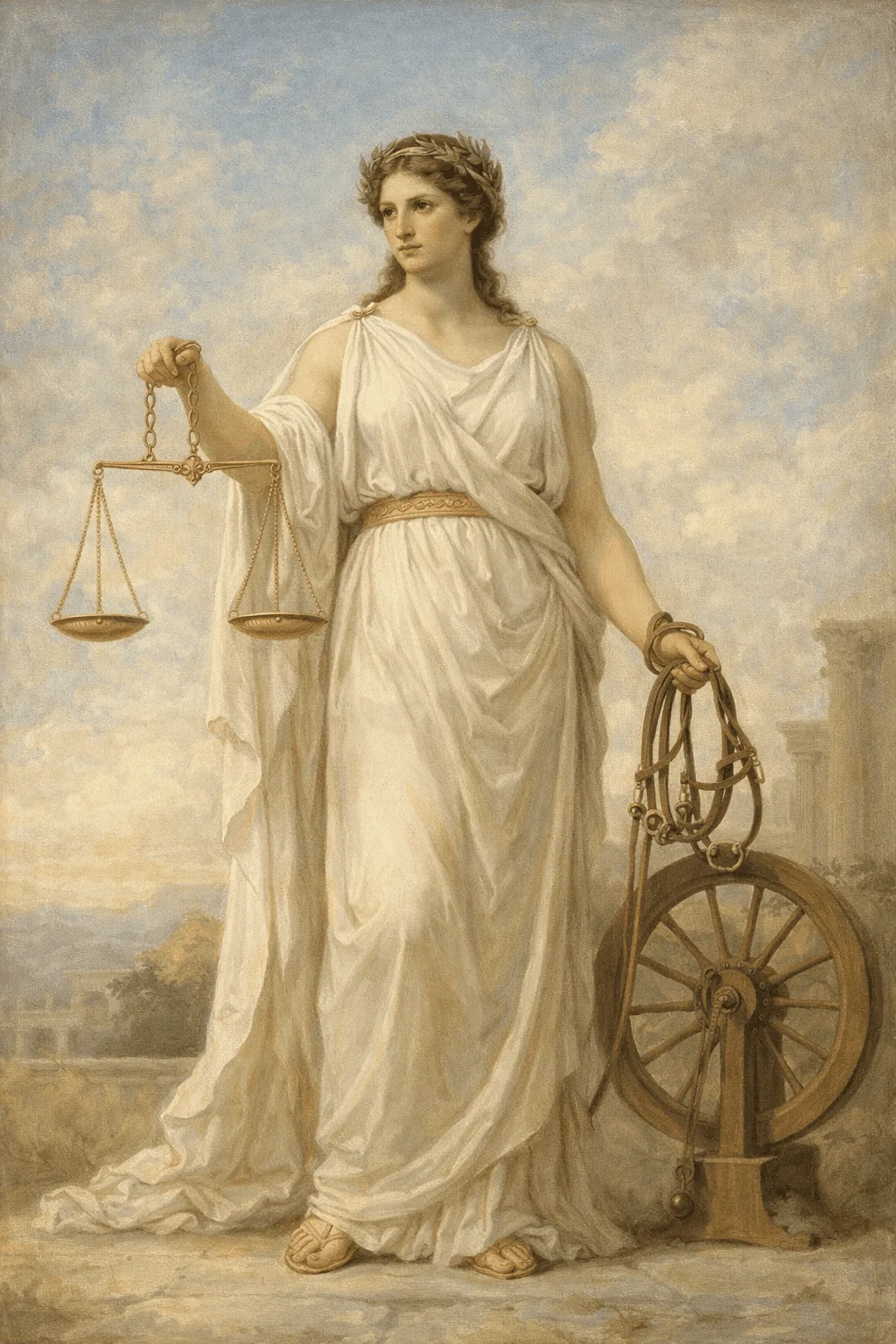
In the iconography of antiquity, Nemesis is often depicted as a strict and imposing female form, holding scales, bridles, or measure. These symbols indicate balance, control and justice. In some performances it carries wings, suggesting the speed at which divine justice can reach those who outlaw.
Special worship to Nemesis was developed in Ramnuda, Attica, where there was an important shrine dedicated to it. There he was worshiped as a goddess who renders justice and punishes arrogance, especially of people who display excessive happiness or luck. Her sanctuary in Ramnuda is one of the most important cult centers of Attica land.
Nemesis also held an important position in the philosophical thought of ancient Greeks. For tragic poets, hybridism and nemesis were a basic pattern of human fate. Crossing boundaries inevitably leads to punishment, restoring secular balance. This idea is the foundation of the ancient Greek tragedy.
Symbolically, Nemesis represents the moral order of the universe and the need for measure in all human acts. It recalls that no exaggeration remains unpunished and that justice, even late, is always restored.
Today, Nemesis remains a strong symbol of justice and moral balance, often used in literature, philosophy, and culture to express the idea of the inevitable consistency of acts.
Nemesis in Greek Mythology, one of the most enigmatic forms of Greek mythology, embodies the concept of divine justice. He's not just a vigilante.· is the power that restores balance when the hubris of men or gods disrupts secular order. Her presence is not always visible, but is felt when arrogance transcends boundaries.
According to ancient tradition, Nemesis is considered her daughter Nyx, the personification of the night. From this dark and ancient genealogy he inherited the power to move unseen and impose order without warning.
Other traditions link it to Oceanus or ZeusBut the most widespread version wants it to be born of Night, as do other abstract but powerful concepts – Squadron, Eris, Fraud.
Nemesis does not accidentally punish. It occurs when someone exceeds the limits set. Hybridity – excessive pride or arrogance toward the gods – is what calls it.

Unlike other gods acting impulsively, Nemesis works accurately. He pays everyone what he deserves. Her justice is not vindictive but balanced. It is the invisible force that ensures that no one can escape the consequences of his actions.
In ancient thought, its presence was a reminder that happiness without measure leads to a fall. Anyone who is too favored by luck will eventually face Nemesis.
Nemesis and Narcissus
One of the most famous stories associated with Nemesis is that of NarcissusThe young man, known for his incomparable beauty, despised those who loved him.
Nemesis, seeing his arrogance, led him to a lake where he saw his own idol. Enchanted by his image, he fell in love with himself and eventually lost, unable to get away. His punishment was not violent· It was perfectly adapted to his hybrid.
Nemesis and the birth of Beautiful Helen
In another myth, Nemesis was chased by Zeus, who had been transformed to approach her. To escape him, she changed forms herself, until she eventually turned into a goose.
Zeus transformed into a swan and joined her. From this union was born an egg, from which came the Beautiful Helen, the woman who would later become the cause of Trojan War. In some versions, Helen surrenders to Leda to raise her.
The most famous descendant of Nemesis is Beautiful Helen. However, ancient sources differ and do not always attribute clear genealogy to the goddess.
The very nature of Nemesis – abstract and symbolic – makes her presence more important than her family. She is not a goddess defined by her descendants, but by the act of justice.
Nemesis was a timeless symbol of balance. In ancient Greece, he was worshiped as a force that ensures that order is not disturbed.
Her idea survives to this day. The word «nemesis» is used to describe the inevitable punishment that comes when someone crosses the line.
Conclusion
Nemesis is not just a deity of punishment. It is the reminder that every act has consequences and that the balance of the world, however disturbed, is finally restored.
Her presence in the myths is not only frightening· He teaches. And perhaps that is why it remains one of the most timeless and meaningful forms of Greek mythology.
Frequently Asked Questions About Nemesis
Discover more Greek deities in our collection.
Sources and Bibliography for Nemesis
Ancient Sources
- Theogony
- It includes references to Nemesis as the Night's daughter in certain traditions.
- Hostile Hymns
- References to divine justice and the concept of retribution.
- Library
- It gathers mythological traditions related to Nemesis and divine order.
- Transformations
- It contains references to divine punishment and the concept of hubris.
- Iliad
- It indirectly presents the concept of divine retribution and justice.
Modern Bibliography
- Greek Religion
- The Greek Myths
- Early Greek Myth
- The Routledge Handbook of Greek Mythology
- Greek Mythology
- Mythology: Timeless Tales of Gods and Heroes
- Theoi Project: Nemesis
Indicative References
Primary sources: Hesiod, Theogony· Homer, Iliad· Apollodorus, Library· Ovid, Transformations.