
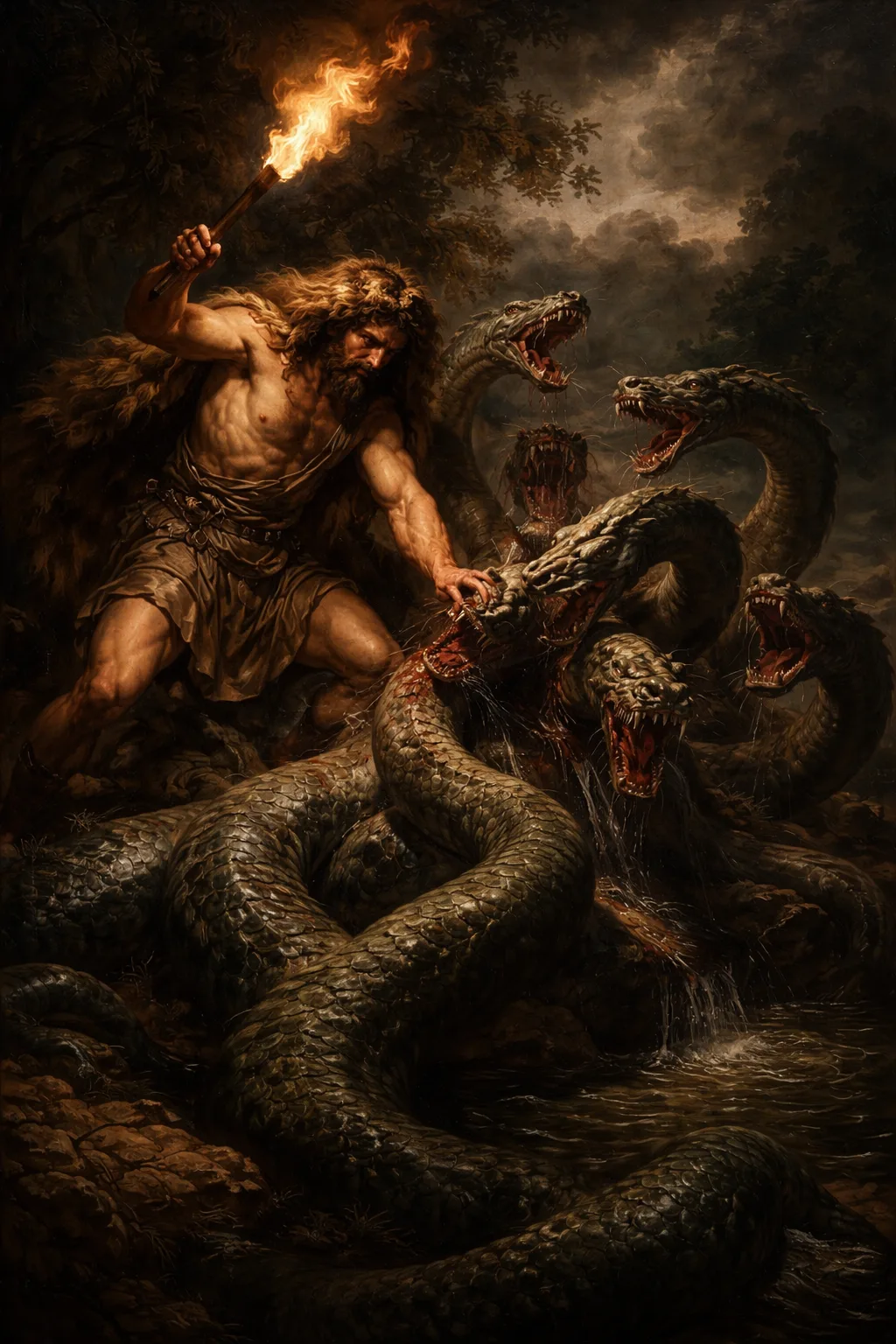
- Lernaean Hydra is one of the most famous and awesome monsters of Greek mythology. Known for her many heads and her terrifying ability to regenerate what she was losing, Hydra became famous as the second of his twelve feats HerculesIts history is one of the most important myths of ancient Greece and symbolizes the constant battle of man against problems that seem impossible to defeat.
The form of Lernaia Hydra combines elements of snake, dragon and sea monster. Her presence in the mythological world was so strong that her name passed into the language as a symbol of a danger multiplied every time one attempts to confront him.
The Origins of Hydra
According to Greek mythology, Lernaia Hydra was the daughter of two of the most terrifying monsters ever born by the mythological world: Typhon and Echidna. From the same generation also came the Cerberus, - Chimera, Orthos and other terrible creatures.
- Hera, the wife of Zeus and his constant opponent Hercules, took care of Hydra and installed her in the marshes of Lerna in Argolida. There the monster grew and became fear and terror for the inhabitants of the region.
The Lerna marsh monster
- Lernaea was an area full of springs, swamps and groundwater. Ancient Greeks considered that there was one of the entrances to the Underworld. Within this dark and mysterious landscape was inhabited by Hydra.
Ancient sources differ in number of heads. Some report five or six, another nine, while later traditions even speak of a hundred heads. But they all agree on one feature: every time someone cut off a head, two new ones grew in place.
Furthermore, one of her heads was immortal and could not be destroyed by conventional means. Her breathing was poisonous and her blood was so toxic that she could cause instant death.
Hercules' second feat
After completing the first feat, during which he killed the lion of Nemea, Hercules received from King Eurysthea the order to annihilate Lernaia Hydra.
The hero traveled to the marshes of Lerna accompanied by his nephew, Iolaus. When he spotted the monster, he forced it out of his nest using burning arrows.
A tough fight ensued. Hercules cut the heads of Hydra with his sword or bat, but every time two new ones appeared in place. The monster seemed impossible to defeat.
Iolaus’ help
Seeing that the usual force was not enough, Iolaus proposed a different solution. Every time Hercules cut off a head, he burned the wound with a burning torch.
This prevented the regeneration of new heads. Thanks to their cooperation they gradually managed to neutralize all mortal heads of the monster.
Finally, Hercules cut off Hydra's immortal head and buried it deep under a huge rock, so that he could never come back.
The Poison of Hydra
After his victory, Hercules used one of Hydra's most dangerous features: her poisonous blood. He dipped his arrow spikes into the poison, turning them into powerful weapons.
These arrows appear in many later myths and played a decisive role in several adventures of the hero. However, Hydra's poison was finally linked to his own death, when it was used in the poisoned garment sent to him by Deianeira.
The Hydra Lernaia in Art
The battle of Hercules with Lernaia Hydra was a favorite subject of ancient Greek art. It occurs in vases, reliefs, sculptures and temples from the Archaic to Roman period.
Artists usually portrayed the hero struggling with the multi-headed snake, while Iolaus held the lit torch that proved decisive for victory.
The symbolism of Lernaia Hydra
Lernaia Hydra is considered a symbol of problems that multiply when treated incorrectly. Her ability to regenerate her heads represents difficulties that constantly reappear and require intelligence, persistence and strategy to overcome.
The myth also shows that raw power alone is not always enough. Hercules needed Iolaus' help and a new approach to defeat the monster. Thus, the history of Hydra highlights the importance of cooperation and resourcefulness.
The Legacy of Hydra
Lernaia Hydra remains one of the most recognizable monsters in world mythology. The image of the multi-headed snake has influenced literature, painting, cinema, and modern fiction works.
Even today, the expression «You cut off one head and two grow» it is used metaphorically to describe complex problems that seem to become bigger as one tries to solve them. This proves that the legend of Lernaia Hydra remains alive and timely thousands of years after its creation.
- Lernaean Hydra often misreported as «Greek goddess»But that's not right. In Greek mythology, Hydra was a terrible multi-headed monster and not a deity. It is mainly known from its battle with Hercules In Twelve Labors of.
No. No. — Hydra She wasn't a goddess..
Despite many people searching for “Hydra Greek goddess,” the Hydra was actually a monstrous creature. This confusion likely comes from its powerful, almost divine abilities, such as regenerating heads and its connection to ancient mythological beings.
The Hydra was a gigantic water serpent that lived in the swamps of Lerna in ancient Greece. It had multiple heads, and for every head that was cut off, two more would grow back in its place.
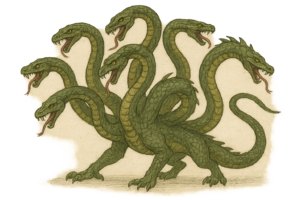
Key characteristics:
- Multi-headed monster
- Head regeneration capability
- Poisonous breathing and blood
- Lived in the marshes of Lernaea
The Hydra was the offspring of two of the most fearsome creatures in Greek mythology:
- Typhon – giant monster connected to disasters
- Echidna – half woman, half snake, known as «Mother of monsters»
This lineage explains its strength and reputation.

The most famous history of Hydra is its conflict in Lernaea with Hercules.
The test:
Hercules had to kill Hydra. But every time he cut off a head, two new ones appeared.
The solution:
With Iolaus' help, he burned the wounds so that no more heads would grow.
The end:
Hydra's immortal head was buried under a huge rock.
Symbolism of the Hydra
Hydra wasn't just a monster — had deep symbolism:
- Problems that multiply
- Chaos and uncontrolled forces
- Need for strategic thinking
Why do they confuse her with a goddess?
The confusion arises from:
- False searches online
- Her supernatural powers
- it appears in stories involving gods and heroes
However, in all ancient sources, Hydra is clearly a monster.
Hydra in modern culture
Hydra appears to date in:
- Films and series
- Video games
- Imagination books
Often used as a symbol of problems that «They're coming back louder.».
FAQ
Was Hydra a goddess?
No, he was a mythological monster.
Who killed Hydra?
- Hercules.
Where did Hydra live?
To the marshes of Lerna.
What were her powers?
Rebirth of heads and poisonous blood.
Summary
- Lernaean Hydra He was a multi-headed monster of Greek mythology with a rebirth ability. Despite confusion in some searches, he was never a goddess but one of his most dangerous opponents Hercules.
Ancient Sources
- Theogenia, p. 313-118.
- Library, 2.5.2.
- Hercules Ape.
- Metamorphosis.
- Tour of Greece, Book 2 (Argalis).
Modern Bibliography
- The Greek Myths.
- Early Greek Myth.
- The Complete World of Greek Mythology.
- The Routledge Handbook of Greek Mythology.
- Dictionary of Classical Mythology.