
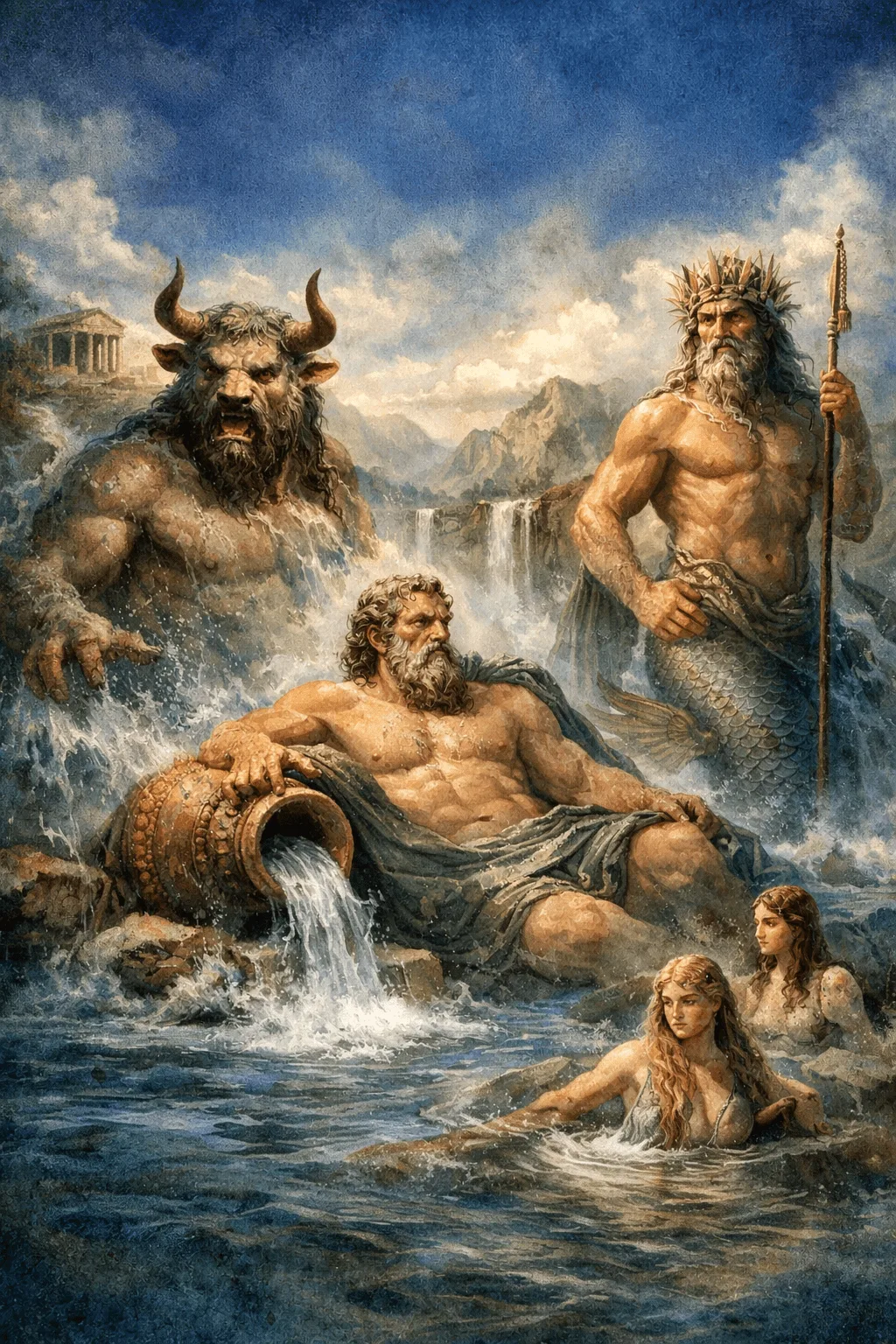
River Deities in Greek Mythology
River deities hold a special place in ancient Greek mythology, as they represent the close relationship of ancient Greeks with the natural environment and especially with rivers that ensured life, fertility and prosperity. At a time when people depended directly on the waters for survival, agriculture, and trade, rivers were not simply considered physical features of the landscape, but living divine entities with power, will, and personality. Ancient Greeks believed that each important river had its own god, who protected its waters and influenced the lives of the people who lived on its banks.
River gods usually belonged to the so-called Rivers, a category of deities descended from Oceanus and TethysTwo of the oldest deities in the world. According to Hesiod's Theogenia, the Rivers were numerous and represented all the great rivers of the known world. Each river had its own divine standing and was often depicted as a mature man with a rich beard, symbol of wisdom, power and fertility. In other cases he appeared as a hybrid creature with human and animal characteristics, highlighting his connection to the primitive forces of nature.
Among the most famous river deities of Greek mythology stands Acheloos, the greatest and strongest of all river gods. Achelos was worshiped as the personification of the river of western Greece and was considered a symbol of abundance and fertility. His reputation was strengthened by the famous myth of his clash with Hercules over the hand of Deianeira, a story revealing the great power attributed to the river gods.
River deities were closely associated with the Nymphs. They are often presented as fathers of the Naiads, the brides of sweet waters, which inhabited rivers, springs, and lakes. Through these family relations, ancient Greeks created a complex mythological network that connected all the water elements of nature. Rivers, springs, and lakes were not independent of each other, but were parts of a divine world full of spirits and deities.
The importance of river gods was not limited to mythology. In many regions of Greece local cults were developed dedicated to certain rivers. Residents offered sacrifices and tributes calling for fertile crops, flood protection, and water adequacy. In some cases, before major campaigns or travels, heroes and kings invoked the favor of river deities, recognizing their power to influence people's fate.
River gods often appear in the myths of heroes. Many royal families and important figures of mythology were considered descendants of river gods, which conferred prestige and divine descent. Through these myths, rivers were transformed from natural borders and sources of life into active participants in the history of humans and gods.
Beyond their religious dimension, river deities reflect the deep ecological consciousness of ancient Greeks. Rivers were considered vital forces to be respected and protected. Their personification in deities was a way of expressing this respect for nature and the forces that sustain life.
Today, the river gods remain a fascinating part of Greek mythology. Their stories reveal how ancient Greeks understood the natural environment not as something special to man, but as a living and sacred part of the world. Through the forms of Acheloos and the other river deities, the memory of an era where each river had its own soul, its own history and its own divine presence is kept alive.
The River deities (Potamoi) are one of the oldest and most substantial divine categories of Greek mythology. They were not merely personifications of rivers, but living, divine forces directly associated with earth’s fertility, human survival, and the physical balance of the world. For the ancient Greeks, every great river had soul, will and divine standing.
River deities were considered life and destruction carriers: they could bless an area with rich waters or wipe it out with floods. So they were worshiped with respect, sacrifice and local rituals.
Origin and Nature of River Deities
According to the prevailing mythological tradition, the River Gods were sons of Oceanus and Tethys, of the two primates Titans personifying the global water element. The Ocean, the earth - surrounded river, was considered the source of all water.
In some traditions, river gods are simply referred to as sons of Oceanus, and in others it is also linked to ZeusAs a god of rain and heavenly waters. This dual origin places them between heaven and earth, strengthening their role as mediators among the physical elements.
The Family of River Gods
Parents
- Oceanos & Tythis (Hesiod, Theogony· Austria· Diodoros Siciliotis)
- Oceanus (Homer, Iliad)
Sisters: The Oceanides
The Oceanids were nymphs of water, springs, clouds and rain. They often functioned as spectator escorts or as patrons of natural places.
Daughters: The Naiads
The Naiads They were the daughters of the river gods. Nymphs of springs, fountains and sweet waters, were closely associated with human life and often occur in myths of love, grab or protect heroes.
Illustration and Representation
River gods were depicted in three key ways:
- As a bull with a human head, a symbol of strength, fertility and indomitable nature.
- As a man with bull horns and a tail of reptile-shaped fish, combining human, animal and aquatic elements.
- As a recovering bearded man, based on a water or vessel from which water flows — form particularly common in sculpture and coins.
This iconography highlights their dual character: calm and beneficial, but also dangerous when angry.
List of Important River Gods
Acheloos
River god of Aetolia and the strongest of all. He fought Hercules for Deianeira, transformed into a snake and bull, but was eventually defeated.
Acheron
River god of Hades and Thesprotia. It connects to the world of the dead and groundwater.
Alphae
River god of Arcadia and Ilia. He fell in love with Arethousa and pursued her to Sicily, under the sea.
Asopos
River god of Boeotia and Argos. Father of twenty Templars. Zeus struck him with lightning when he tried to avenge the capture of Aegina.
Skamandros
River god of Troada. He fought Achilles in the Trojan War and almost drowned him.
Styx
River goddess of Hades. Her waters were sacred and sworn to the gods.
Nile
River god of Egypt, symbol of fertility and culture.
Great River Gods of the World
Euphrates, Tiger, Danube (Istro), Indian, Ganges — personifications of the largest rivers in Asia and Europe.
The River Gods in the Ancient Secretariat
In the ancient Greek secretariat, the river gods are presented as:
- sons of Oceanus and Tethys,
- Fathers of Naiad,
- Protectors of youth together with Apollo,
- Subjects of Poseidon,
- active members of the divine assemblies.
They participated in major mythical conflicts, such as the Trojan War and the Giant Battle, and were often transformed into rivers or other water forms.
Myths of River Gods
First Kings of Earth
Some river gods, such as Inochus, Ashos and Eurotas, were considered the first kings and lawmakers of a region.
Transformations
Mortals such as Akish, Ebenus and Selemnos were transformed into rivers, symbolizing the transition from human to natural immortality.
Loves
Famous myths include:
- Hercules and Acheloos
- Alfios and Arethousa
- Enipeas and Tyro
- Crimisos and Aegesti
Battles
Symbolism and Meaning
The River Gods incarnate life-giving power of water, fertility, continuous flow of time and human and nature connection. In Greek mythology, the river is not just a natural phenomenon, but a divine presence requiring respect.
Their myths reveal the ancient Greek way of thinking: nature as an inanimate, sacred and unbroken part of the secular order.
Conclusion
The Potamian Gods hold a central place in Greek mythology, bridging the natural and divine element. Through myths, cults and art, the deep respect of ancient Greeks towards water is reflected — the very source of life.
Discover more Greek deities in our collection.
Sources and Bibliography for River Deities in Greek Mythology
Ancient Sources
- Theogony
- The most important source for the origins of the Rivers as children of the Ocean and Tethyos. Hesiod lists dozens of river deities of the Greek world.
- Iliad
- It includes references to river gods, especially the River Xanthos (Scamandro), which actively interferes with the Trojan War.
- Odyssey
- References to rivers, sources and water deities associated with Ulysses' journey.
- Library
- It gathers myths concerning Acheloos, Inaho, Asop and other river gods.
- Transformations
- It presents numerous stories associated with river deities and their families.
- Argonauts
- It contains references to rivers and water deities encountered by Argonauts during their journey.
- Tour of Greece
- A valuable source for local cults of river gods and their sanctuaries in various regions of Greece.
- Geographical
- It describes rivers and traditions associated with their deities.
Modern Bibliography
- Greek Religion
- It analyzes the worship of natural deities and the religious importance of rivers in ancient Greece.
- The Greek Myths
- It gathers and interprets the most important myths related to Acheloos and other river gods.
- Early Greek Myth
- Academic analysis of ancient sources and variations of myths for river deities.
- The Routledge Handbook of Greek Mythology
- It includes detailed articles on Rivers, Naiades, and water deities.
- Greek Mythology
- It examines the symbolism of water and river gods in the Greek mythological system.
- Mythology: Timeless Tales of Gods and Heroes
- Affordable presentation of the most important myths related to river deities.
- Theoi Project: River Gods
- Collection of primary fragments from ancient sources, ancient visual representations and genealogical elements.