
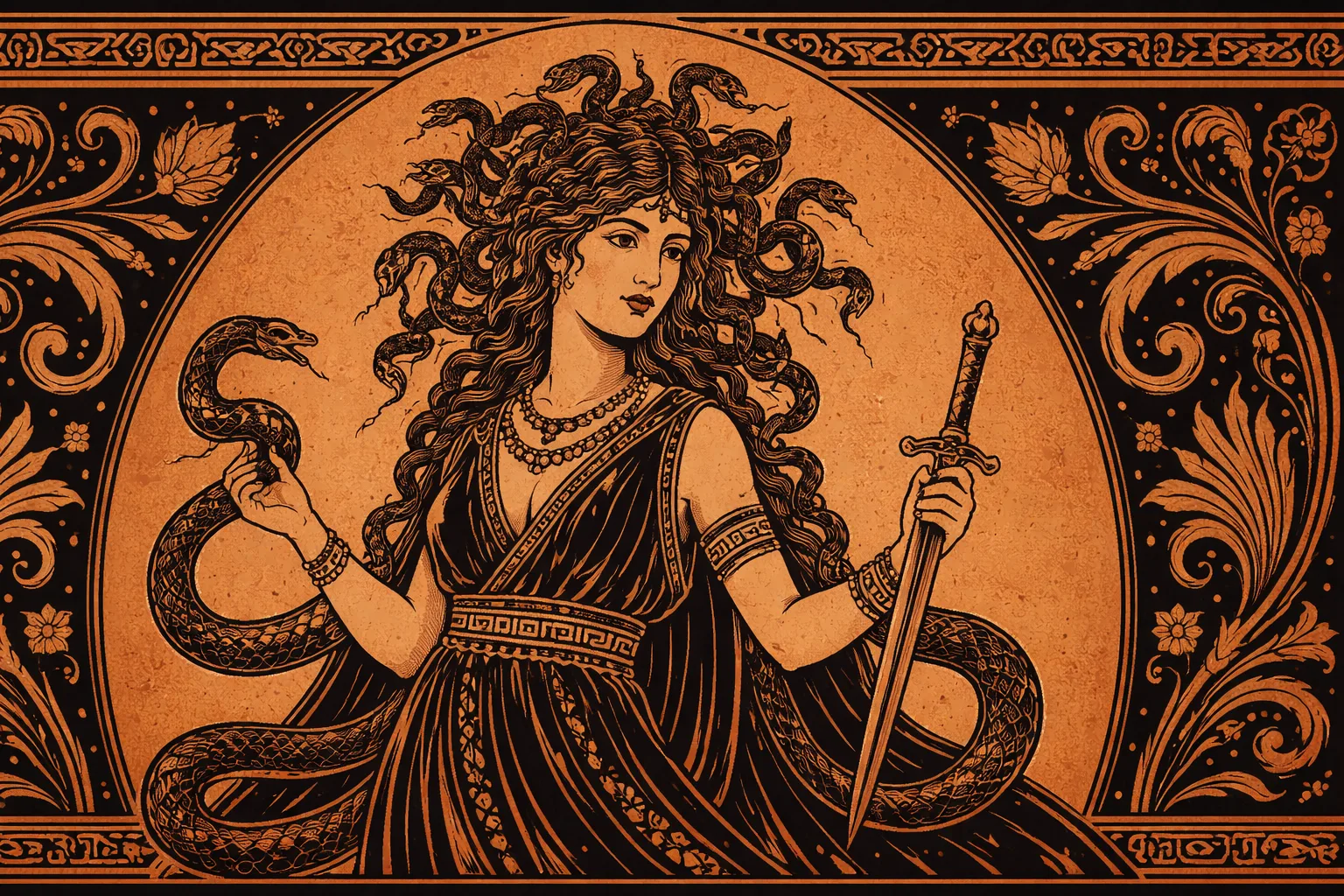
The History of Medusa: From Beautiful Priestess to Legendary Beast
The history of Medusa is one of the most famous and tragic accounts of Greek mythology. Although most remember her as the terrible monster with snakes instead of hair and the look that petrifies anyone who sees her, ancient myths reveal a much more complex form. The Medusa no monster born· In many traditions there was initially a beautiful woman whose fate changed dramatically because of the wrath of the gods.
Medusa was one of three. Gorgons, daughters of the marine deities Forky and Cetus. Her sisters, Steno and Euryal, were immortal, while Medusa was the only mortal. This particularity would later define its role in one of the most famous heroic feats of Greek mythology.
According to a later and highly widespread version of the myth, Medusa was originally an extremely beautiful young woman and priestess of Athena. Her beauty was so impressive that she attracted Poseidon's interest. When the god of the sea joined her in a temple dedicated to Athena, the goddess was enraged by the desecration of her sacred space. Instead of punishing Poseidon, Athena turned against Medusa, transforming her into a terrifying creature.
Her bright hair became poisonous snakes that whistled constantly around her head. Her face acquired repulsive features and her look gained a terrible power: whoever looked her directly into the eyes immediately turned into a stone. From a symbol of beauty, Medusa became a symbol of terror and isolation.
After her transformation, Medusa resided in a remote area to the ends of the world, where few dared to approach. Her name spread as a legend, and people feared her as one of the most dangerous creatures that existed.
Her fate was finally linked to the hero Perseus. King Polycepter commissioned Perseus a seemingly impossible mission: to bring Medusa's head. With the help of the gods, the hero acquired magical objects, including a shiny shield from Athena, feathered sandals by Hermes And his chase Hades which made him invisible.
Using the shield as a mirror to avoid her deadly look, Perseus approached Medusa while sleeping and decapitated her with a blow. From her blood were born two wonderful beings: the winged horse Pegasus and Chrysaor, a mighty warrior. According to legend, both were children of Poseidon, which were released at the time of her death.
Although dead, Medusa maintained her power. Her head was still petrifying anyone who looked at it. Perseus used it in many adventures, turning enemies into stone. She later handed it over to Athena, who placed it in her patronage, her sacred shield, as a symbol of protection and divine power.
The form of Medusa gained particular importance in ancient Greek art. Her head, known as Gorgonium, was often used in shields, temples, coins and buildings as a deterrent symbol against evil. Ancient Greeks believed that its terrifying image could protect people and sacred places from evil forces.
In modern times, Medusa has acquired new interpretations. Many scholars see in her history a symbol of injustice, transformation, and female power. From a monster of mythology it was transformed into a cultural symbol that still inspires literature, art, cinema and modern readings of ancient myths.
The history of Medusa remains one of the most exciting narratives of Greek mythology, because it combines tragedy, supernatural power, heroism and transformation. Behind the scary face of the Mermaid lies a myth that continues to provoke discussions and charm people around the world.
- Medusa is one of the most iconic forms of Greek mythology. It belongs to Gorgons, three sisters-monsters with snakes instead of hair and look capable of turning into stone whoever faced it. Unlike her immortal sisters, Medusa was mortal. — and its history is revealed much more tragic than it seems at first glance.
«I transformed Medusa», continue the Athena, «so she could have protection from everyone who would try to hurt her.».
«That's bullshit. You didn't give her a choice, did you?», Loret answered. «And now the story remembers her as a villain who deserved to die».
«Nope. So she is portrayed by men, through art, through myths.»Athena said. «They imagined her horrible because they were afraid to meet a woman's true look, to witness the powerful storm that lives in her, waiting. He wasn't defeated by my uncle's attack. He was just reborn as a being who could look the world in the eyes, without fear. Isn't that what your generation has done for centuries, looking behind her mask?»
— Alexandra Bracken, Lore
Who Was Medusa?
According to ancient sources, Medusa was not born a monster. She was originally a beautiful woman and priestess of goddess Athena.
Her beauty was so intense that she drew the attention of gods and mortals, which in many versions of the myth led to tragic consequences.
The transformation into a Mermaid

The most famous version of the myth states that god Poseidon He desired Medusa and approached her within the temple of Athena.
In some traditions, this act is presented as a violent violation of the sacred space.
Instead of punishing Poseidon, Athena turned to Medusa and transformed her into a monster:
- Her hair became snakes
- Her look gained the power to petrify anyone who looks at her.
So was born the form of the Mermaid as we know it.
Her tragic fate
The history of Medusa has been interpreted in many ways. In a more modern and anthropocentric reading, it is not just presented as a monster, but as a victim of divine injustice.
Her transformation isolated her from the world and made her a scare for everyone.
Perseus and the Beheading
The hero Perseus Take the mission to kill Medusa.
With the help of the gods, he managed to approach her without looking directly at her, using the reflection of his shield.
Finally decapitated her in her sleep.
From her body were born two important forms of mythology:
- The Pegasus
- Chrysaor
Even after her death, her head retained the power to petrify whoever faced it.
The Symbolism of Medusa
Medusa has been interpreted in many ways over the centuries:
1. Justice and injustice
Her story is often read as an example of unjust punishment of an innocent person.
2. Power and fear
Her look symbolizes absolute authority and terror towards the unknown.
3. Protective symbol
In ancient Greece, her head (gorgone) was used as a talisman to prevent evil.
Medusa in the Modern World
In modern culture, Medusa has been reinterpreted many times:
- as a symbol of female power
- as a tragic figure of injustice
- as an archetype of transformation and survival
Her image continues to inspire art, literature and cinema.
Conclusion
Medusa's story is not just a myth of horror.
It is a multi-level narrative of power, punishment, transformation and human interpretation of power.
Perhaps that is why he remains so alive to this day.
FAQ – Frequently Asked Questions
Was Medusa always a monster?
Nope. In most versions of the myth she was originally a beautiful woman and priestess of Athena.
Why was Medusa punished?
In some versions, he was punished after the desecration of Athena's temple by Poseidon.
Who killed Medusa?
The hero Perseus, with the help of the gods and the mirror shield.
What does Medusa symbolize today?
It symbolizes injustice, power, transformation and protection.
Keywords: Medusa, Greek mythology, Perseus, Gorgons, Athena, Poseidon, myths
Bibliography
Ancient Sources
- Hesiod, Theogony.
- Apollodorus, Library.
- Ovid, Transformations.
- Pindar, Pythionic.
- Pausanias, Greece Tour.
Modern Bibliography
- Grimal, Pierre. The Dictionary of Classical MythologyBlackwell Publishing, 1996.
- Hard, Robin. The Routledge Handbook of Greek MythologyRoutledge, 2004.
- Morford, Mark & Lenardon, Robert. Classical Mythology. Oxford University Press, 2018.
- Kerenyi, Karl. The Heroes of the GreeksThames & Hudson, 1997.
- Ogden, Daniel. Perseus. Routledge, 2008.
- Buxton, Richard. The Complete World of Greek MythologyThames & Hudson, 2004.
Online Sources
- Encyclopedia Britannica – Medusa
- Theoi Greek Mythology – Gorgons and Medusa
- World History Encyclopedia – Medusa
- Perseus Digital Library – Classical Sources on Medusa