
Introduction
Among the most shocking myths of Greek mythology, the myth of Phaethon stands out for its tragic intensity and its timeless significance. This is the story of a young man who, wanting to prove his divine origin, asked to lead the chariot of the Sun —And he paid for that desire with his life.
The myth of Phaethon is not merely a captivating tale about the passions of a youthful soul. It is, first and foremost, a profoundly instructive allegory about hubris, the limits of human ambition, and the consequences that arise when someone takes on responsibilities that exceed their capabilities. The story has been preserved primarily through Ovid’s *Metamorphoses*, although its roots lie deep in ancient Greek tradition, from Hesiod to Euripides.
In this article we will examine in detail the origins of Phaethon, his adventurous course towards the palace of the Sun, his destructive route to heaven, Zeus' intervention, as well as the symbolism, the artistic and literary appeal of the myth until today.
Who was Phaethon?
Its origin
Phaethon was, according to the prevailing version, the son of the sun god and the Ocean Clement. His name, which means «the lamp» or «The bright», directly refers to the brilliance of his father, the god who daily crossed the sky with his burning chariot.
The Sun (or Apollo in later traditions)
In the archaic Greek religion, the Sun was a special deity, the son of Titan Hyperion and Divine. Over the centuries, especially in the Roman era, there is a gradual identification or confusion of the Sun with Apollo, which was associated quite later with light and sun. Ovid, writing in Latin, mainly uses the term Sol (Sun) for his father Faethon, thus maintaining the original Greek tradition.
Klymenis's mother
Klymena, wife of King Meropa of Ethiopia in one version, was the one who revealed to her son his true origin. It was that certainty. —No proof, but mother's reason— that prompted the young man to seek confirmation from his own divine father.
The different ancient traditions
Although the most famous version of the myth comes from Ovid, older Greek sources, such as Hesiod, refer to Faethon in a different way, sometimes linking him to Lucifer or rendering him a different genealogy. This diversity of traditions is characteristic of Greek mythology, where a myth often evolves and transforms depending on the era and the author.
The question of divine origin
Because his peers made fun of him.
According to Ovid's account, Epaphus, the son of Zeus and Ios, publicly questioned Faethon's claims that he was the son of a god. This mockery deeply struck the young man, who felt that his honor and identity were being questioned.
The decision to seek out his father
Wounded and determined to prove the truth, Phaethon turned to his mother. She, seeing his anguish, assured him of his divine origin and urged him to travel eastward, where the palace of the Sun was located.
The journey to the palace of the Sun
The young man began a long and painful journey to Ethiopia and India, at the border where, in ancient conception, the sun rose. This journey acts symbolically as a course of self-awareness: Faethon seeks not only a father, but confirmation of his own existence.
The Palace of the Sun
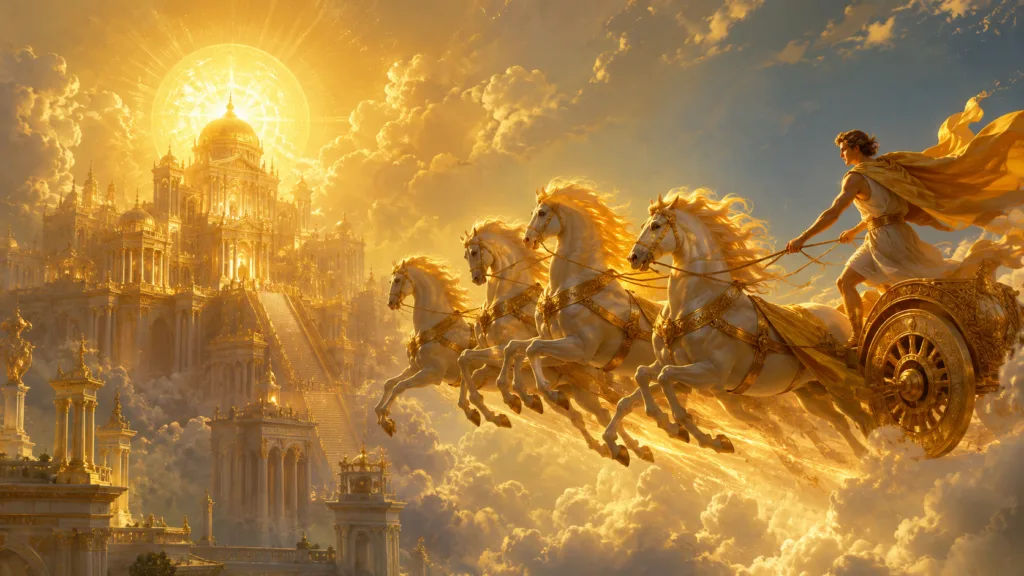
The Ovid, on «Transformations», describes the palace of the Sun with impressive detail and splendor, creating one of the most iconographic scenes of ancient literature.
- The golden throne: The palace was based on tall columns, gleaming with gold and precious amber, with gates of silver bearing embossed representations of the earth, the sea and the sky.
- The Hours: In the palace stood, as guards, the Hours, deities symbolizing the days of the day and regulating the entrance and exit of the solar chariot.
- The Seasons: Around the throne were personified Spring, Summer, Autumn and Winter, each with its own distinctive traits.
- Day and Time: Next to them stood the personifications of Day, Month, Year and Ages, highlighting the timeless and secular dimension of the power of the Sun.
- The splendor of the palace: The whole description aims to render the awe that Faethon felt in front of the transcendental greatness of his father —a greatness that, as it will prove, he was unable to manage.
The Sun's oath
The Promise to the Styx
When Phaethon presented himself before his father and asked for proof of his origin, the Sun happily embraced him and, wanting to dispel any doubt, he swore in the holy waters of Styx —an oath that neither the gods themselves could break— That she would give him anything he asked for.
Because the oath was irrevocable
The oath at Styx was considered the most sacred and binding oath in mythology, even for the gods themselves. As soon as it was pronounced, there was no way back, no matter what request it would follow.
Phaethon's desire to lead the solar chariot
Without a second thought, the young man asked for the most dangerous gift he could imagine: driving the chariot of the Sun himself, even for one day. His father, terrified, tried to prevent him, explaining the dangers, but the oath had already been given.
The chariot of the Sun
The four horses
The chariot was dragged by four fiery horses, known in tradition with names such as Pyros, Eos, Athon and Flames —names referring to fire and shine.
The path to the sky
The course of the chariot followed a specific, defined trajectory: it gradually ascended in the morning, crossed the height of the sky at noon and went down gently to the west.
The difficulties of the march
The Sun explained to his son that the route was full of dangerous points: the zodiac circle with monsters, such as Taurus, Leo, and Scorpio, lurked at every turn.
Because even the Sun itself had difficulty driving it
Even God himself, with the experience of centuries, stated that he had difficulty holding back the horses. This admission prepared the reader —and warned Fathoda— for the inevitable end.
The destructive route
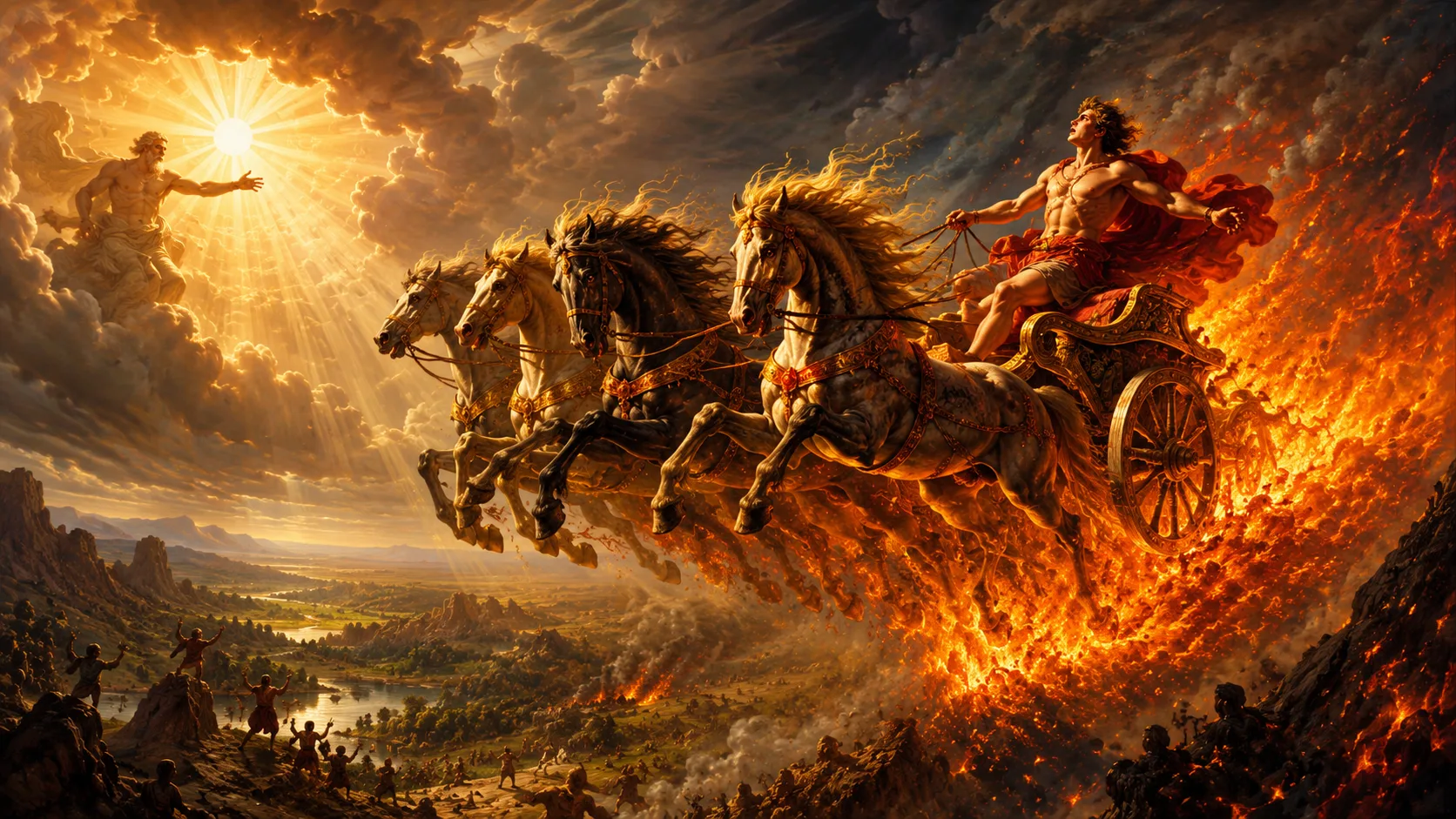
Despite warnings, Faethon ascended to the chariot. Since the horses felt that the weight and hand that held the reins was not their usual master, chaos began.
- The horses are flailing.: Feeling the young rider's weakness and hesitation, the horses escaped his control altogether.
- The chariot goes too high: In a moment, the chariot was launched so high that the sky froze and the stars were in danger of burning.
- It's going too low.: The next moment, losing control in the opposite direction, the chariot descended so close to the earth that the fire began to destroy everything.
- Fired forests: Whole forests were delivered to flames, mountains such as Parnassus and Athos became stagnation.
- Rivers dry up: Great rivers, such as the Nile, were dried up or hid under the earth by the terror of excessive heat.
- The deserts are created: According to the mythological explanation, this burning is responsible for the creation of the deserts of Libya and North Africa.
- Ethiopia burns: The myth symbolically explains the dark color of the skin of the inhabitants of Ethiopia, giving it to the excessive proximity of the chariot fire.
- Mythological explanations of natural phenomena appear: Faethon's myth works, thus, as a caetological myth, explaining natural phenomena through divine action.
Zeus's intervention
Gaia’s Prayers
As destruction spread, the Earth itself, sore and desperate, raised a voice to Zeus, asking him to stop chaos before the world was completely destroyed.
Zeus’s decision
The father of the gods, seeing that the danger now concerned the entire universe, was forced to intervene, despite the tragic cost that his act would have.
The lightning
Zeus launched his lightning against Faethon, hitting the chariot and finally stopping the destructive course.
The Fall of Phaethon into the River Eridanus
The body of the young man, burning, fell into the waters of the river Herodan —a river that ancient tradition often identified with Padus of Italy. There he found his tragic ending, sealing one of the most dramatic moments of Greek mythology.
The Suns
The mourning of his brothers
Faethon's sisters, known as Iliads, inconsolably lamented his death on the banks of Herod, refusing to leave the spot where he fell.
The transformation into poplars
Sad gods transformed the Suns into poplars, trees that remained forever rooted on the banks of the river, symbol of a mourning that does not fade.
The tears that became amber
Their tears, according to legend, hardened upon the logs and turned into an amber, thus symbolically explaining the origin of this precious material.
The Kycknus
His friendship with Phaethon
Swan, King of the Lighs and a close friend of Phaethon, lamented so deeply the loss of his friend that he sought unstoppably his body in the waters of the river.
Its transformation into the constellation Swan
Apollo, moved by this devotion, transformed Swan into a bird —the swan— and later in the constellation of the same name, thus immortalizing in heaven the memory of an unselfish friendship.
Symbolism of the Myth
The Faethon myth carries multiple symbolic levels that explain its timeless impact:
- The hybrid: Phaethon embodies the classical theme of the hybrid, the transcendence of human boundaries, which in ancient Greek thought always causes divine punishment.
- Human ambition: The young man's desire to prove his value reflects a universal tendency to ambition which, when not accompanied by maturity, leads to destruction.
- The need for self - awareness: The myth highlights the importance of self-awareness —knowledge of our limits and capabilities— as a prerequisite for any successful action.
- The responsibility of power: The chariot of the Sun symbolizes the power which, when found in infinite hands, becomes destructive not only for its own carrier but also for those surrounding it.
- The boundaries between man and God: The myth recalls the fundamental distinction between mortal nature and divine nature, a distinction that is not allowed to be punished unpunished.
- The importance of soundness of mind: Finally, the myth highlights soundness as the virtue that could have saved Phaethon, if he had accepted his father's advice.
Phaethon in ancient art
The myth was a source of inspiration for artists of various times:

- Angiograms: Scenes from the fall of Phaethon appear in ancient Greek vases, where the moment of lightning is often reflected.
- Roman mosaics: In Roman villas mosaics have been found depicting the chariot of the Sun in full motion, testifying the popularity of the myth in the Roman Empire.
- Reliefs: Relief performances in sarcophagus depicted the dramatic fall, often as an allegory of human fate and vanity.
- Renaissance paintingsDuring the Renaissance, painters returned to the subject, mainly inspired by Ovid, rendering the dramatic greatness of the scene.
- Works by Rubens: Peter Paul Rubens created impressive paintings on the fall of Faethon, full of dynamism and intense movement.
- Works by Tintoretto: The Venetian painter also portrayed the scene, emphasising light and shadow.
- Works by Guercino: The Italian baroque painter added his own interpretation to the subject, stressing divine justice.
Phaethon in literature
The myth runs through ancient and later literature with various references:
- Hesiod: «Theogenia» Early reports are made that link the Faethon with brilliance and light, but without the full account of his tragedy.
- Pindar: The great lyric poet refers indirectly to elements of the myth within his work, joining them in the general theme of divine punishment.
- Euripides (lost project) «Fathos»): The tragic poet wrote a whole drama dedicated to myth, from which only excerpts are saved today, but enough to understand the dramatic intensity of the work.
- OvidOn «Transformations» is the fullest and most famous version of the myth, with a detailed description of all stages of history.
- Follow-up European references: From the Middle Ages to Modernity, poets and writers invoked Faethon as a symbol of reckless ambition, joining him in Western literary tradition.
Influence on modern times
The myth of Phaethon still maintains a living presence in many areas of modern thought:
- In psychology: It is used as an allegory for father-son relationship, search for identity and the risks of oversolicitedness without sufficient mental maturity.
- In Philosophy: It is a classic example of hubris and nemesis, concepts central to moral philosophy from antiquity to today.
- In political thinking: It is used as a metaphor for leaders taking power without the required experience or maturity, with devastating results for the whole.
- In science: Name «Fathos» has been given to asteroids and hypothetical planets of astronomy, and is also used as a metaphor for the risk of climate change.
- In art: It continues to inspire contemporary artists who reinterpret the subject of fall and punishment.
- In literature: It remains a reference symbol for stories of youthful ambition leading to a tragic end.
Interesting elements
- Name «Eating» means «the lamp» or «the one radiating».
- The myth is considered by the first explanatory myths that explain natural phenomena, such as deserts and skin color.
- Euripides' lost drama «Fathos» only saved in excerpts.
- The Heridan River is often identified with the Padus of Northern Italy.
- The amber is called in ancient Greek «amber», word from which the modern word comes «electricity».
- The constellation of Swan is directly associated with the myth through the transformation of his friend Faethon.
- The myth experienced special popularity in Roman art, mainly through Ovid.
- Earth's asteroid bears today the name «Fathos» (3200 Phaethon).
- The myth was a source of inspiration for great baroque painters, such as Rubens.
- History is considered by the first «warning myths» against recklessness and excessive ambition.
- In ancient Greek religion, the oath at Styx was so sacred that even Zeus could not break it.
Conclusion
The Faethon myth remains, centuries after its first record, one of the most powerful symbols of human ambition and its boundaries. The tragic fall of the young son of the Sun recalls that power without maturity, desire without self-awareness inevitably leads to destruction —Not just the person himself, but the world around him. At the same time, through the mourning of the Suns and the transformation of the Swan, the myth highlights the power of love and friendship towards death, giving it a dimension deep human, beyond divine punishment.
FAQ
Who was Fathos? He was the mortal son of the sun god and the ocean Clement, known for his tragic attempt to lead the solar chariot.
Was he the son of the Sun or Apollo? In the original and most widespread tradition he was the son of the Sun, although in later times the Sun was often identified with Apollo.
Why did Zeus kill him? Zeus was forced to lightning him to stop the destruction caused by the uncontrolled chariot, thus saving the earth from total destruction.
Where did Fathos fall? His body fell into the waters of the river Iridanos, which tradition often identifies with Padus of Italy.
What is the moral lesson of myth? The myth teaches the dangers of hubris, recklessness and taking responsibility without sufficient maturity and self-awareness.
Who were the Suns? They were the sisters of Faethon, who, mourning his death, were transformed into leeks on the banks of the Herod.
What's a Herod? It is the river in which Faethon's body fell, often identifying with the current Padus River.
How is it connected to amber? The tears of the Suns, according to legend, hardened upon the logs of the whites and turned into amber (electro).
Who wrote the most famous Faethon myth? The fullest and most well known narrative is due to the Roman poet Ovid, in «Transformations» of.
What does Faethon symbolize today? It symbolizes youthful ambition without maturity, as well as the risks of assuming power or responsibility without adequate preparation.
Ancient Sources
- Apollodorus. LibraryTranslation and comments in modern Greek publications.
- Euripides. Phaethon (excerpts). In: Tragicorum Graecorum Fragmenta.
- Hesiod. TheogonyTranslation: A. S. Athanasakis or corresponding scientific publication.
- Hesiod. List of Women (excerpts).
- Ovid. Transformations, Book I (1,747–2,400), where the fullest surviving version of the myth is described.
- Pausanias. Greece Tour.
- Pindar. Olympians And other excerpts with references to Faethon.
- Hyginus. FabulaeA Faethon myth.