
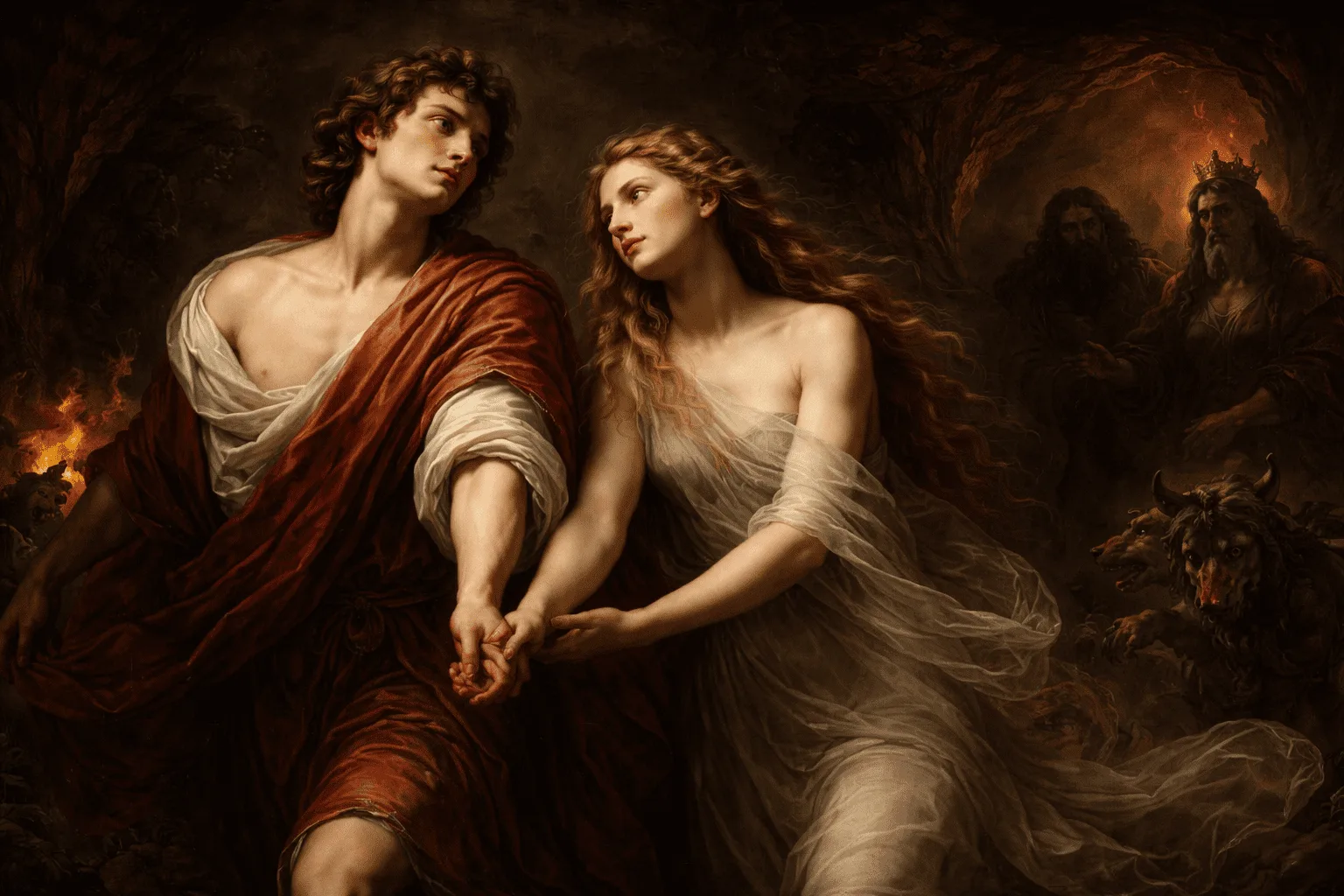
Orpheus story. Orpheus was a mythical musician, poet and mystic of ancient Greek tradition, known for the divine power of his music. Son of Apollo (in one version) and mousse Calliope, could with his lyre bewitching people, animals and nature.
- Orpheus is one of the most important and complex forms of ancient Greek mythology. His personality extends beyond the limits of a simple mythical hero, touching the fields of religion, philosophy, music and metaphysics. Orpheus' myth is not limited to a narrative, but is a multi-level cultural phenomenon, which deeply influenced ancient Greek thought and shaped religious currents such as Orphism.
Origin and Identity
Orpheus story. Orpheus is considered his son Apollo or, in other traditions, of Thracian king Oiagros, and of the muse CalliopeHis origins from Thrace, an area with an intense mystic and dionysian character, are directly linked to his role as a mystic and religious teacher.
His dual nature —as a poet and mystic— It places it between the world of men and the world of uncle.
Orpheus as a Musician and Poet
Orpheus was the foremost musician of antiquity. With his lyre, Apollo’s gift, he could tame wild beasts, move trees and enchant even inanimate objects. His music was considered divine and transcendent.
His power of art reflects a deep Greek perception: that harmony and music are fundamental elements of the secular order. In this context, Orpheus is not just an artist, but a secular mediator.
The Argonaut Campaign
Orpheus participated in the campaign of Argonauts Under his leadership JasonHis role was decisive:
With his music he covered their song Sirens
Maintaining the crew's mental cohesion
It boosted morale at dangerous times
His presence highlights the importance of spiritual power in relation to physical strength.
The most famous account relates to his love for Eurydice. After her premature death by snake bite, Orpheus descends to Hades to restore her.
In the underworld, it thrills him Hades and Persephone With his music. He is allowed to take Eurydice back, on one condition: not to look back until they reach the upper world.
However, Orpheus succumbs to doubt and turns to look at it — Losing her forever.
Interpretive Approaches
This myth is interpreted in a variety of ways:
As an allegory of human weakness
As a conflict between faith and doubt
As philosophical meditation on the nature of death
Orpheus’ Death
After the loss of Eurydice, Orpheus retires from society and devotes himself to the worship of Apollo. According to legend, he is killed by Pineapples, probably because of the rejection of dionysian worship.
His head, according to tradition, continued to sing even after his death — symbol of the immortality of art.
Orphism: Religious and Philosophical Current
Orpheus is directly connected to Orphism, a mystical belief system developed in ancient Greece.
Basic Principles
The soul is immortal
The body is a prison of the soul
Reincarnation is a clearance cycle
Redemption is achieved through knowledge and purity
Orphic hymns and holy texts are attributed to Orpheus himself, although they were later written.
Orpheus and Philosophy
Orpheus' influence extends to philosophy:
In Pythagoras, through the concept of soul and harmony
In PlatoThrough the idea of immortality of the soul
In Neoplatonicism, as a model mystic
Orpheus acts as a bridge between myth and philosophy.
Symbolism and Cultural Meaning
Orpheus symbolizes:
The power of art
The search for truth
Human tragedy
The transition between life and death
His form influenced literature, music and art from antiquity to modern times.
Conclusion
Orpheus is not just a mythical musician, but a fundamental

form of Greek intellectual tradition. Through his myth, basic questions arise about human existence, the nature of the soul and the power of art.
The History of Orpheus reveals a world where myth, religion and philosophy coexist, offering one of the most profound and timeless symbols of Greek culture.
Frequently Asked Questions about Orpheus and Orphism
Who was Orpheus?
Orpheus was one of the most mysterious and important heroes of ancient Greek tradition. He was considered a legendary musician, poet and mystic, with the power to charm people, animals and even nature through his music.
Where did Orpheus come from?
According to tradition, Orpheus came from Thrace. His father is usually considered King Oiagros or the god Apollo, while his mother was Musa Calliope.
What is Orpheus' most famous story?
The most famous myth is his descent to Hades to bring back Eurydice's beloved. With his music he moved Hades and Persephone, but lost Eurydice when he turned to look at her before they went out into the upper world.
What does the myth of Orpheus and Eurydice symbolize?
The myth symbolizes love, loss, human weakness and the quest for the immortality of the soul. It is also considered an allegory for the journey of the soul and the relationship of life and death.
What is Orphism?
Orphism was a mystical and religious stream of ancient Greece associated with the teachings of Orpheus. It focused on cleansing the soul, reincarnation and spiritual redemption.
What were Orphism's basic ideas?
Orphics believed that the soul was of divine origin but trapped in the body. Through clean, moral life and mysterious ceremonies, the soul could be liberated from the circle of continuous rebirths.
Did the Orphs believe in reincarnation?
Yeah. Reincarnation was one of the basic beliefs of Orphism. The soul was considered immortal and passed through successive lives until it was fully purified.
Who were Orphic Mysteries?
Orphic Mysteries were secret religious ceremonies aimed at spiritual cleansing and the salvation of the soul. Many of their elements remain unknown, as the initiated did not easily reveal their practices.
Were there sacred texts of Orphism?
Yeah. Orphics used hymns and sacred poems attributed to Orpheus. The most famous today are Orphic Hymns, a collection of religious hymns dedicated to deities.
What did Orphism have to do with Dionysus?
Orphism was closely associated with the worship of Dionysus. In several orphic traditions, Dionysus Zagris plays a central role in the creation and fate of the human soul.
Did Orphism affect philosophy?
Yeah. Many scholars consider that Orphism affected philosophers such as Pythagoras and Plato, especially in ideas about the immortality of the soul and the afterlife.
How did Orpheus die?
According to legend, Orpheus was killed by the Mainades, the ecstatic following of Dionysus. After his death, his head and lyre continued to sing, symbolizing the power of art and soul.
Why does Orpheus remain important today?
Orpheus still inspires literature, music, philosophy and art. His myth is considered a timeless symbol of the power of love, music and human search for truth and immortality.
Bibliography – Orpheus & Orphism
The following bibliography includes basic ancient sources and modern scientific studies on Orpheus and Orphic tradition.
🏺 Primary ancient sources
- Virgil, Agricultural (Georgica, Book 4)
- Ovid, Transformations (Books 10–11)
- Plato, Symposium, State, Laws
- Apollodorus, Library
- Pindar, Pythionic
- Orphic Hymns
- Orphic Fragments
📚 Modern scientific literature
- Walter Burkert – Greek Religion
- Walter Burkert – Ancient Mystery Cults
- M. L. West – The Orpic Poems
- Radcliffe G. Edmonds – Redefining Ancient Orphism
- Alberto Bernabé – Orphicorum et Orphicorum Simium Testimonia et Fragmenta
- Fritz Graf & Sarah Iles Johnston – Ritual Texts for the Afterlife
🌐 Online Sources
- Mythopedia – Orpheus: https://mythopedia.com/topics/orpheus
- Routledge Encyclopedia of Philosophy – Orphism: https://www.rep.routledge.com/articles/thematic/orphism/v-1
* These sources are widely used in academic studies on Greek mythology and Orphism.