
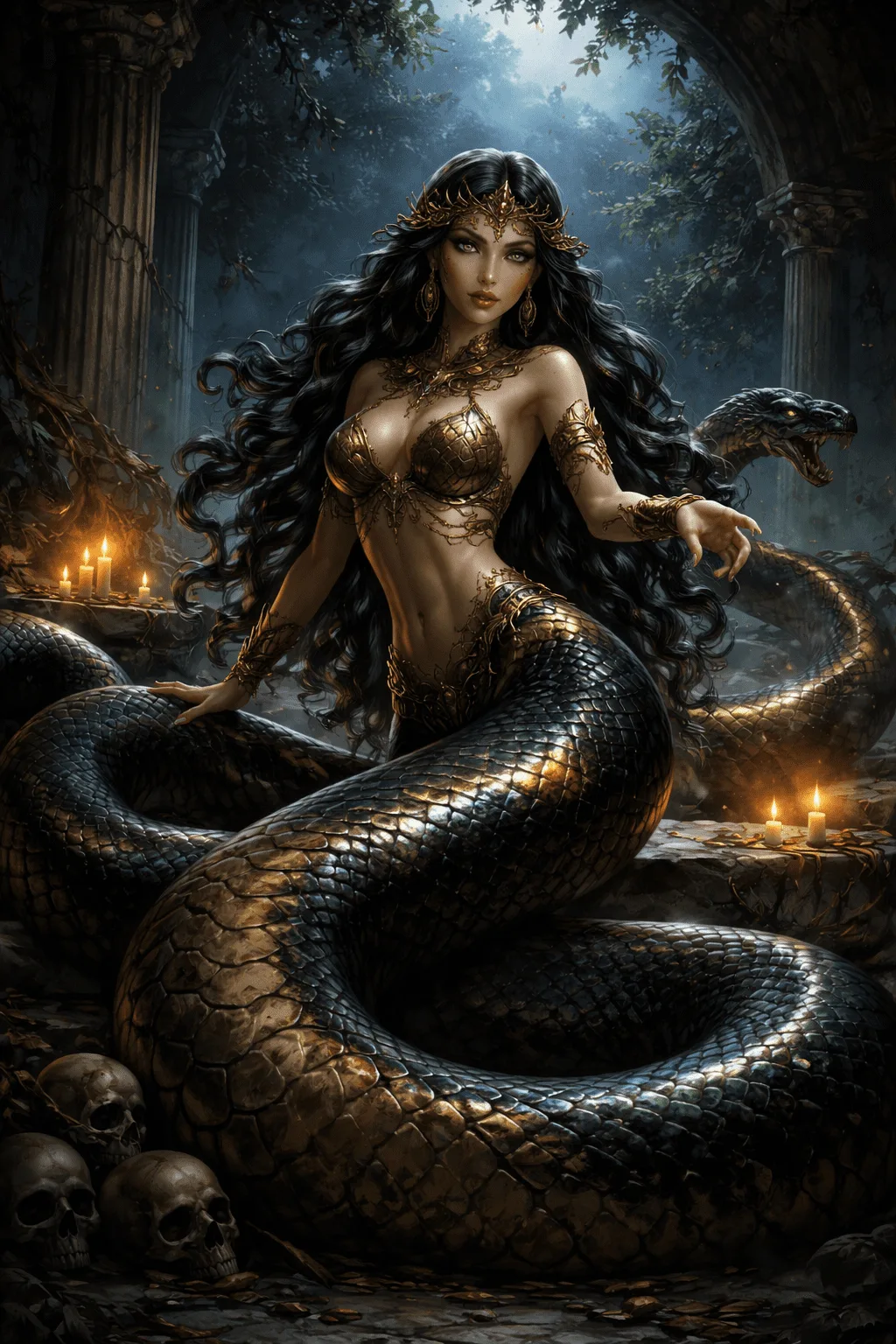
- Lamia is one of the darkest and most terrifying forms of Greek mythology. Unlike other mythological monsters born from the beginning as creatures of chaos, Lamia was originally a beautiful woman or queen who transformed herself into a monster because of her divine anger and personal tragedy. Her myth is associated with jealousy, revenge, maternal loss and fear of the unknown, which made her one of the most timeless forms of Greek folk and mythological tradition.
Who was Lamia?
According to ancient traditions, Lamia was the daughter of God Poseidon and ruled Libya as queen of extraordinary beauty. Her beauty caught his attention Zeus, who fell in love with her and had children with her.
When Hera discovered their relationship, she was overwhelmed by jealousy. To avenge Lamia, she killed or made her children disappear. This loss led the queen to despair and madness. According to some versions of the myth, Hera herself transformed her into a monster, while others report that transformation was a result of her unbearable pain.
- Lamia belongs to the darkest and most important figures of Greek mythology. It combines elements of tragedy, punishment and fear, while its history reflects deeper human concerns about motherhood, loss and revenge. From a queen and mistress of a god, Lamia turns into a demonic existence that haunts people's imagination, especially as a threat to children.
The origin and original form of Lamia
According to tradition, Lamia was originally a beautiful Libyan queen. Her beauty and charm attracted Zeus, with whom she had children. However, this relationship did not go unpunished.
Hera, Zeus' wife and known for her jealousy, avenged Lamia in the cruelest way: she killed or caused her children to perish. In some versions, the Hera She cursed her never to be able to close her eyes so that she could live eternally with the pain of loss.
This tragic moment is the turning point that transforms Lamia from human form to something much darker.
The Transformation into a Monster
After the loss of her children, Lamia plunges into madness and despair. Her pain turns into hatred towards the children of other mothers. Thus, according to mythology, he begins to grab and devour children.
Her image gradually changes: from a beautiful woman she becomes a terrifying creature, often with a snake or monster body. In some traditions it maintains the upper part human and lower reptilian, which enhances its dual nature — between human and demonic.
After her tragedy, Lamia abandoned her human form. Ancient writers describe it in various ways. In some traditions he had a female face and snake body from the waist down, while elsewhere he is presented as a deformed monster with sharp teeth and a piercing look.
The best-known version of the myth states that Lamia, mad at grief for her lost children, began to grab and devour other people's children. So it turned into a symbol of fear associated with loss and death.
- Zeus, according to some accounts, gave her the ability to remove and reposition her eyes so that she could rest from the horror of her memories. This detail adds an almost supernatural element to its form.
The curse of insomnia
A well-known tradition states that Hera condemned Lamia never to be able to close her eyes and find no rest. Constant pain and insomnia led to paranoia.
Zeus, sorry for her fate, gave her a strange ability: he could temporarily remove her eyes and reposition them when he wished. This detail is one of the strangest elements of the myth and is mentioned by several ancient writers.
Lamia as a child-eating demon
During the Hellenistic and Roman times, the form of Lamia evolved even further. From a tragic queen he was converted into a demonic entity lurking at night to grab children or seduce young men.
In many areas of ancient Greece parents used its name to scare children and prevent them from dangerous behavior. In this way Lamia passed from mythology to folk tradition as a form similar to the bogeyman of younger fairy tales.
Ancient Greek parents often invoked Lamia to prevent children from bad behavior, something similar to modernists «Bamboo». Thus, her form passed from mythology to folk tradition, retaining her role as a fear bearer.
Lamia in later tradition
The image of Lamia was not limited to antiquity. In Byzantine and modern Greek legends he appears as a female monster residing in caves, mountains or desert areas and threatens travelers and children.
In many folk traditions of Greece the word «laria» was used to describe any fearsome or supernatural female creature. Thus, its form survived for more than two thousand years, moving from classical mythology to popular imagination.
The symbolism of Lamia
Lamia is one of the most complex forms of Greek mythology. It symbolizes the transformation caused by the loss, the pain of the mother who loses her children and the devastating consequences of revenge.
At the same time, it represents the ancient fears of the night, the unknown and threats lurking outside community security. Her evolution from beautiful queen to monstrous demon makes her one of the most tragic faces of Greek mythology.
The Legacy of Lamia
Lamia's form influenced literature, folklore, and fictional literature of many times. Similar creatures appear in medieval legends, Balkan traditions, and modern fiction works.
Her story reminds her that mythological monsters were not always born evil. Often they were forms that resulted from tragedies, divine punishments, and human passions. That is why Lamia remains one of the most touching and terrifying forms of the ancient Greek mythological world.
Symbolism and interpretations
The story of Lamia is not just a scary fairy tale. It hides deeper symbols:
- Motherhood loss and madness: Her transformation reflects the extreme mental pain that can lead to alienation from human nature.
- The divine punishment: Hera’s intervention shows how the gods could impose cruel and often unjust punishments.
- The fear of «Other»: Lamia represents the unknown and dangerous, especially in relation to childhood and vulnerability.
Over time, its form was also associated with other mythological figures, such as shrews and nightly demonic presences.
Lamia in later tradition
The influence of Lamia was not limited to ancient Greece. Her name passed into the folk tradition of many areas, while appearing in later literature.
In some European traditions, Lamia is identified with witches or vampires, while her image as a woman who seduces and destroys remains strong. Its dual nature — attractive and scary — makes it one of the most interesting forms of mythological imagination.
Conclusion
Lamia is a form that transcends the simple mythological narrative. It's a story about the loss, punishment and transformation of human pain into something dark and dangerous.
Despite her terrifying character, her story also causes a sense of compassion. Behind the monster lies a tragic figure — A mother who lost everything. This duality is what makes Lamia stay alive in collective memory, as one of the most powerful and human symbols of Greek mythology.
Frequently Asked Questions About Lamia
Who was Lamia in Greek mythology?
Lamia was a terrifying creature of Greek mythology associated with child abduction and consumption. According to legends, she was originally a beautiful Libyan queen, but transformed into a monster after tragic events.
What was Lamia's relationship with Zeus?
Lamia was said to be his mistress. Zeus. This relationship caused the goddess' jealousy Hera.
Why did Hera punish Lamia?
Hera, angry at Lamia's relationship with Zeus, punished Lamia by killing or condemning her children. According to some traditions, the grief and madness that followed transformed her into a monster who hunted other people's children.
How is Lamia portrayed?
In mythology and later tradition, Lamia is often described as a monster with a female body and elements of snake or dragon. In some traditions he also had scary appearances and large teeth.
Why is Lamia connected to child abduction?
After the loss of her own children, Lamia according to the myth began to envy other mothers and kidnap or devour their children.
In what ancient texts does Lamia refer?
The form of Lamia appears in works of ancient writers such as Diodorus Siciliotis and Aristophanes, while later referring to various Hellenistic and Latin texts.
Was Lamia a deity or a monster?
Lamia was not considered a deity. He was a demonic creature of mythology symbolizing fear, loss, and vengeance.
How was the myth of Lamia used in ancient times?
Ancient Greeks used Lamia's name to scare children to behave properly, as is the case in many folk traditions in terrifying forms.
Is Lamia in the folk tradition of Greece?
Yeah. In the modern Greek folk tradition Lamia often appears as an evil witch or monster residing in caves, mountains or desert places.
Ancient Sources
- Library (references to Lamia and her genealogy).
- Wonderful Sounds.
- Apollonios Tyaneus (Lamias as demonic beings).
- About Properties Animals.
- Suda (article «Kales»).
Modern Bibliography
- The Greek Myths.
- Early Greek Myth.
- The Routledge Handbook of Greek Mythology.
- Dictionary of Classical Mythology.
- Monsters in Greek Mythology.